Last Updated on July 5, 2026
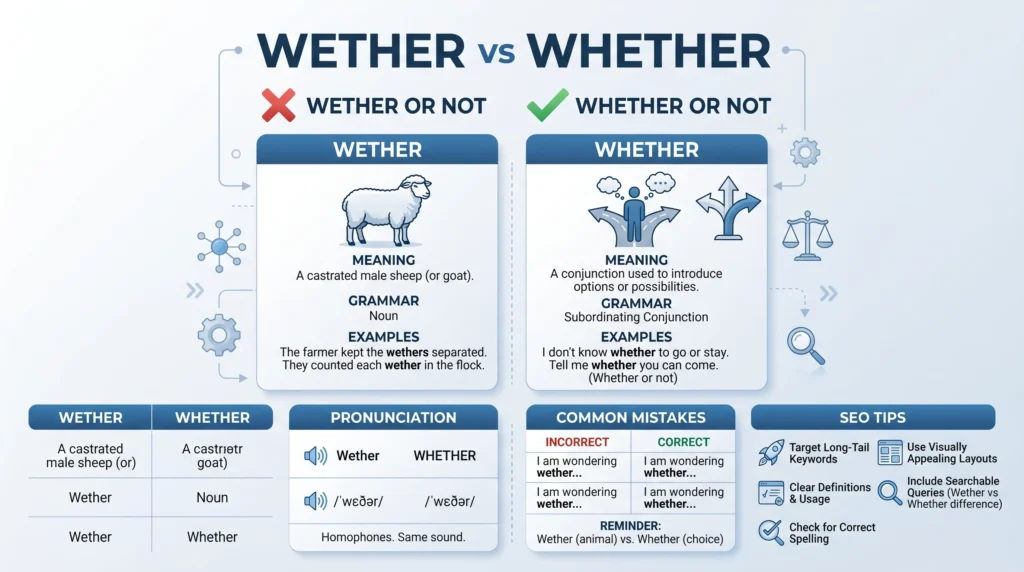
The phrase whether or not is a common English expression used to show that something will happen regardless of a particular condition. Many people mistakenly write wether or not, but wether is not the correct word in this context. A wether is actually a castrated male sheep. For everyday writing, grammar, business communication, and SEO content, whether or not is the correct phrase.
English contains many words that sound similar but have completely different meanings. One of the most common examples is the confusion between wether or not and whether or not.
Because the words sound nearly identical when spoken, many writers accidentally use the wrong spelling. This mistake frequently appears in:
- Emails
- School assignments
- Blog posts
- Social media updates
- Online searches
The confusion becomes even greater because wether is actually a real English word. However, it has nothing to do with decisions, choices, or conditions.
If you’re trying to express uncertainty, alternatives, or possibilities, the word you need is whether, not wether.
This guide explains:
- The meaning of whether
- The meaning of wether
- Common mistakes
- Grammar rules
- Real-world examples
- SEO recommendations
- Frequently asked questions
Quick Answer
| Word | Correct in “___ or not”? | Meaning |
|---|---|---|
| Whether | Yes | Expresses choice or possibility |
| Wether | No | A castrated male sheep |
Simple Summary
The correct phrase is whether or not. The phrase wether or not is a spelling mistake.
What Does Whether Mean?
Definition
Whether is a conjunction used to introduce alternatives, choices, or possibilities.
Common Uses
Whether often appears when discussing:
- Decisions
- Uncertainty
- Possibilities
- Conditions
Examples
- I don’t know whether she will come.
- We must decide whether to proceed.
- Tell me whether you agree.
What Does Wether Mean?
Definition
A wether is a castrated male sheep.
Agricultural Usage
The word is mainly used in farming and livestock management.
Modern Usage
Outside agriculture, the word is rarely used.
Example
- The farmer separated the wether from the flock.
Main Difference Between Wether or Not and Whether or Not
Meaning
Whether
Refers to choice, possibility, or uncertainty.
Wether
Refers to a sheep.
Grammar
Whether
Functions as a conjunction.
Wether
Functions as a noun.
Everyday Usage
Whether
Extremely common.
Wether
Rare.
Comparison Table
| Feature | Whether | Wether |
|---|---|---|
| Real English Word | Yes | Yes |
| Used in Grammar | Yes | No |
| Refers to Choice | Yes | No |
| Refers to Sheep | No | Yes |
| Common in Writing | Very Common | Rare |
| Correct in “Whether or Not” | Yes | No |
What Does “Whether or Not” Mean?
Definition
The phrase means:
- Regardless of the outcome
- No matter what happens
- Independent of a condition
Examples
- We are going whether or not it rains.
- The event will continue whether or not attendance is high.
- She will succeed whether or not others support her.
Why It Is Popular
The phrase creates clarity when discussing possibilities.
Examples of Whether in Sentences
Decision Making
- We must determine whether the plan is practical.
Questions
- I wonder whether he called.
Business Communication
- Management will decide whether to expand operations.
Academic Writing
- Researchers examined whether the treatment was effective.
Examples of Whether or Not
Everyday Conversation
- I’m going whether or not you join me.
Workplace Communication
- The project continues whether or not funding increases.
Personal Decisions
- She plans to travel whether or not her friends participate.
Why People Write Wether Instead of Whether
Similar Pronunciation
The words sound nearly identical.
Typing Mistakes
Fast typing often causes spelling errors.
Autocorrect Issues
Some devices may fail to recognize the intended word.
Lack of Familiarity
Many people have never encountered the agricultural meaning of wether.
Grammar Rules for Whether
Introducing Alternatives
Example:
- Decide whether to stay or leave.
Expressing Uncertainty
Example:
- I don’t know whether he agrees.
Using Whether or Not
Example:
- We’ll continue whether or not conditions improve.
Formal Writing
Whether is preferred over some informal alternatives.
Common Mistakes People Make
Writing Wether or Not
Incorrect:
- Wether or not we attend, the meeting will happen.
Correct:
- Whether or not we attend, the meeting will happen.
Confusing Whether and Weather
Incorrect:
- Weather you like it or not.
Correct:
- Whether you like it or not.
Omitting Necessary Context
Whether often works best when alternatives are clear.
Assuming Wether Means the Same Thing
The meanings are completely different.
Whether vs Weather vs Wether
Whether
Choice or uncertainty.
Example:
- I don’t know whether to go.
Weather
Atmospheric conditions.
Example:
- The weather is sunny.
Wether
A castrated male sheep.
Example:
- The wether grazed in the field.
SEO Recommendation for 2026
Focus on Whether or Not
Searches commonly include:
- Whether or not meaning
- Whether or not grammar
- Whether or not examples
- Whether vs weather
- Whether vs wether
Include Common Misspellings
Users frequently search for wether or not when seeking spelling clarification.
Match User Intent
Most searchers want the correct spelling and usage.
Real World Examples
Education
Students often confuse whether with weather and wether.
Business
Professional documents frequently use whether in decision-making contexts.
Legal Writing
Contracts often include whether clauses.
Everyday Communication
Whether is one of the most commonly used conjunctions in English.
Related Word Comparisons
Whether or Weather
One concerns choices; the other concerns climate.
Whether or If
Both can introduce conditions, though whether is often more precise.
Wether or Weather
These words have entirely different meanings.
Exercises With Answers
Exercise 1
Which phrase is correct?
Answer: Whether or not
Exercise 2
What does wether mean?
Answer: A castrated male sheep.
Exercise 3
Complete the sentence:
I don’t know _____ she will attend.
Answer: Whether
Exercise 4
Which word refers to climate?
Answer: Weather
Exercise 5
Is wether commonly used in everyday writing?
Answer: No.
FAQs
Is it wether or not or whether or not?
The correct phrase is whether or not.
What does whether mean?
Whether introduces alternatives, uncertainty, or choices.
What does wether mean?
A wether is a castrated male sheep.
Is wether a real word?
Yes, but it has a completely different meaning from whether.
Why do people write wether instead of whether?
Mostly because the words sound alike when spoken.
Can whether be used in formal writing?
Yes. It is common in academic, legal, and professional documents.
Is whether or not grammatically correct?
Yes. It is a standard English phrase.
What’s the difference between whether and weather?
Whether relates to choices, while weather refers to atmospheric conditions.
Which spelling is better for SEO?
Whether is the correct keyword and receives much higher search volume.
Should students use whether or not?
Yes, when discussing possibilities or alternatives.
Conclusion
The difference between wether or not and whether or not is simple once you understand the meanings.
Whether is the correct word when discussing:
- Choices
- Possibilities
- Uncertainty
- Conditions
Wether is a farming term that refers to a castrated male sheep and has no connection to the phrase.
Key takeaways include:
- Whether or not is correct.
- Wether or not is a spelling mistake.
- Whether is one of the most common English conjunctions.
- Wether is a specialized agricultural noun.
- Professional writing should always use whether when expressing alternatives.
For modern communication, education, SEO content, and business writing in 2026, whether or not is the phrase you should use.

Kevin Brooks is a grammar specialist at GramBrix.com, dedicated to helping readers understand language rules with clarity and confidence. He simplifies complex grammar concepts through practical examples and easy explanations.