
Last Updated on July 7, 2026
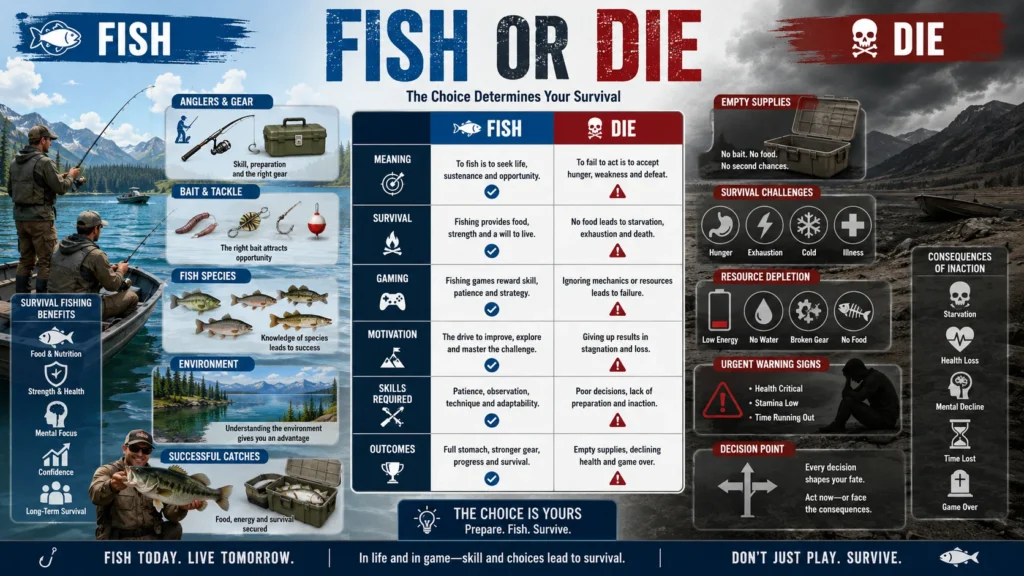
Fish or Die is a phrase used in different contexts, including fishing games, survival challenges, outdoor adventures, and motivational language. It generally means that success depends on catching fish or mastering fishing skills, making it a symbol of survival, persistence, and resourcefulness.
The phrase fish or die sounds dramatic. It creates a strong image of survival and determination. In many situations, it means a person must fish successfully to survive or achieve a goal.
Today, the term appears in fishing games, outdoor survival content, recreational fishing communities, and motivational discussions. Some people encounter it as the title of a game. Others hear it in conversations about survival, hard work, or persistence.
Because the phrase can have several meanings, many readers wonder what it really means. Is it literal? Is it symbolic? Is it related to fishing culture or gaming?
This guide explains everything you need to know about fish or die. You will learn its meaning, origins, practical uses, advantages and disadvantages, real world examples, common mistakes, and related concepts. Whether you are a beginner interested in fishing culture or someone researching the phrase online, this article provides a complete and easy-to-understand explanation.
Quick Answer
Fish or die generally means that fishing is necessary for survival, success, or progress.
Depending on the context, it may refer to:
| Context | Meaning |
|---|---|
| Survival | Catch fish to stay alive |
| Fishing Games | Complete objectives by fishing |
| Outdoor Adventure | Depend on fishing for food |
| Motivation | Take action or fail |
| Recreational Fishing | Dedication to fishing as a lifestyle |
The exact meaning depends on where and how the phrase is used.
What Does Fish or Die Mean?
At its simplest, fish or die means there are no alternatives.
The phrase suggests that a person must fish successfully or face negative consequences.
In a survival situation, this can be literal.
For example:
A stranded traveler near a lake may need to catch fish to obtain food.
In motivational language, the phrase becomes symbolic.
For example:
An entrepreneur may say “fish or die” to mean that consistent effort is required for success.
The phrase communicates urgency, determination, and necessity.
Definition of Fish or Die
A practical definition is:
Fish or die is an expression that emphasizes fishing as an essential activity for survival, achievement, or progression within a specific context.
Key elements include:
- Necessity
- Persistence
- Resourcefulness
- Action
- Survival
The phrase often carries a strong emotional impact because it presents only two outcomes.
Origins and Background
The exact origin of the phrase is difficult to trace because similar expressions have existed for centuries.
Fishing has long been associated with survival.
Ancient communities relied on:
- Rivers
- Lakes
- Oceans
- Coastal regions
Fish provided:
- Protein
- Nutrition
- Trade goods
- Economic value
Because fishing was often necessary for life, expressions linking fishing and survival naturally emerged.
Modern usage expanded through:
- Outdoor survival culture
- Fishing competitions
- Social media communities
- Video games
- Adventure television programs
Today, the phrase is recognized by both anglers and gamers.
Fish or Die in Survival Situations
One of the most literal uses of the phrase occurs in survival scenarios.
Imagine being stranded near a body of water with limited food.
Fishing becomes a valuable skill because fish can provide:
- Calories
- Protein
- Fat
- Essential nutrients
Why Fishing Matters in Survival
Fishing offers several advantages over hunting:
| Fishing | Hunting |
|---|---|
| Often requires less movement | Requires tracking animals |
| Can provide multiple catches | Usually one animal at a time |
| Works day and night | Often limited by visibility |
| Conserves energy | May require significant effort |
Survival experts frequently teach fishing techniques because they increase the chances of obtaining food.
In these situations, the phrase fish or die can be very close to reality.
Fish or Die in Gaming
The phrase is also associated with fishing-themed games.
In gaming environments, fishing often becomes the main mechanic for progression.
Players may need to:
- Catch fish
- Earn money
- Upgrade equipment
- Unlock locations
- Complete missions
The idea behind the title or phrase is simple:
Success depends on your ability to fish effectively.
This creates a challenging and engaging gameplay loop.
Common Features in Fishing Games
Many fishing games include:
- Fishing rods
- Bait systems
- Weather effects
- Rare fish species
- Skill progression
- Competitive tournaments
The phrase fits naturally into these game designs.
Fish or Die as a Motivational Expression
Outside fishing, the phrase can serve as a motivational slogan.
It symbolizes commitment.
For example:
Business
A startup founder might use the phrase to emphasize effort and persistence.
Education
A student preparing for exams may interpret it as:
Work hard or fail.
Sports
Athletes often embrace all-or-nothing mindsets.
In this context, fish or die means:
- Focus completely
- Keep improving
- Do not quit
The phrase becomes a metaphor for determination.
Advantages of the Fish or Die Mindset
The concept offers several benefits when applied correctly.
Encourages Action
People often delay important tasks.
A fish or die mindset encourages immediate action.
Builds Resilience
Challenges become opportunities for growth.
Improves Focus
When options are limited, focus increases.
Promotes Problem Solving
Fishing requires strategy and adaptation.
These skills transfer to other areas of life.
Develops Patience
Fishing rewards persistence and observation.
Disadvantages of the Fish or Die Mindset
While useful, the philosophy also has drawbacks.
Can Create Stress
Constant pressure may increase anxiety.
May Encourage Extremes
Not every situation requires an all-or-nothing approach.
Risk of Burnout
Excessive commitment can lead to exhaustion.
Oversimplifies Complex Problems
Many challenges require multiple solutions.
Ignores Balance
Life often benefits from flexibility.
Advantages and Disadvantages Table
| Advantages | Disadvantages |
|---|---|
| Motivates action | Can increase stress |
| Builds discipline | May cause burnout |
| Encourages persistence | Can become too rigid |
| Develops focus | May overlook alternatives |
| Strengthens resilience | Can create pressure |
Real World Examples of Fish or Die
Example 1: Remote Fishing Community
A coastal village depends heavily on fishing.
Poor catches directly affect income and food supplies.
In this case, fish or die reflects economic reality.
Example 2: Survival Training
Outdoor instructors teach fishing techniques.
Students learn:
- Knot tying
- Bait selection
- Fish identification
The goal is survival preparedness.
Example 3: Competitive Angler
Tournament anglers rely on successful catches.
Without results, they may lose rankings and sponsorship opportunities.
Example 4: Video Game Player
A player must catch increasingly valuable fish to unlock new equipment.
Progress depends entirely on fishing success.
Example 5: Business Metaphor
A salesperson must continually find new customers.
The phrase becomes a metaphor for consistent effort.
Fish or Die in Fishing Culture
Fishing culture values dedication.
Many anglers spend years mastering:
- Casting techniques
- Water reading
- Seasonal patterns
- Fish behavior
The phrase reflects this commitment.
Among passionate anglers, fishing is often more than a hobby.
It becomes:
- A lifestyle
- A tradition
- A family activity
- A personal challenge
Regional Usage Around the World
Fishing plays a major role in many regions.
North America
Popular among:
- Recreational anglers
- Bass fishing enthusiasts
- Outdoor survival communities
Europe
Often connected to traditional fishing practices and sport fishing.
Asia
Fishing remains important for food production and local economies.
Africa
Many communities rely on freshwater and coastal fishing.
Oceania
Fishing contributes significantly to culture and recreation.
Because fishing is universal, the concept behind fish or die is understood globally.
Related Fishing Terms
Understanding related terms helps place fish or die into context.
| Term | Meaning |
|---|---|
| Angling | Fishing with a hook and line |
| Catch and Release | Returning fish to the water |
| Tackle | Fishing equipment |
| Bait | Material used to attract fish |
| Lure | Artificial fish attractor |
| Casting | Throwing a fishing line |
| Trophy Fish | Exceptionally large fish |
| Sport Fishing | Fishing for recreation |
Fish or Die Compared with Similar Expressions
Fish or Die vs Sink or Swim
| Fish or Die | Sink or Swim |
|---|---|
| Focuses on fishing success | Focuses on survival generally |
| Often tied to outdoor contexts | Used broadly |
| Can be literal or symbolic | Usually metaphorical |
Fish or Die vs Adapt or Perish
| Fish or Die | Adapt or Perish |
|---|---|
| Specific action focus | General adaptability |
| Fishing centered | Applies everywhere |
| Often outdoor themed | Universal expression |
Fish or Die vs Do or Die
| Fish or Die | Do or Die |
|---|---|
| Fishing oriented | General challenge |
| Niche phrase | Common phrase |
| Outdoor associations | Universal usage |
Common Mistakes When Using Fish or Die
Assuming It Is Always Literal
The phrase is often metaphorical.
Ignoring Context
Meaning changes based on the situation.
Using It for Minor Tasks
The expression implies urgency.
Using it for trivial activities may sound exaggerated.
Confusing It with Do or Die
Although similar, fish or die specifically references fishing.
Overusing the Phrase
Repeated use can reduce its impact.
Practical Lessons from Fish or Die
Several valuable lessons emerge from the phrase.
Preparation Matters
Successful anglers prepare equipment and strategies.
Patience Produces Results
Fishing often rewards persistence.
Adaptability Is Essential
Conditions change constantly.
Skill Beats Luck
Knowledge improves outcomes.
Consistency Wins
Regular effort typically leads to success.
These principles apply far beyond fishing.
Beginner’s Guide to Fishing Skills
For people inspired by the phrase, learning fishing basics can be valuable.
Essential Equipment
- Fishing rod
- Reel
- Fishing line
- Hooks
- Bait
- Tackle box
Basic Steps
- Choose a location.
- Prepare equipment.
- Attach bait.
- Cast the line.
- Wait patiently.
- Set the hook.
- Reel in the fish.
These simple steps form the foundation of fishing success.
How Fish or Die Relates to Personal Growth
Many people connect the phrase with self improvement.
Fishing teaches:
- Observation
- Discipline
- Patience
- Planning
- Adaptation
These traits are valuable in:
- Careers
- Education
- Sports
- Leadership
- Entrepreneurship
The phrase reminds people that consistent effort often determines outcomes.
Exercises with Answers
Exercise 1
What does fish or die usually imply?
A. Relaxation
B. Urgency and necessity
C. Entertainment only
Answer: B. Urgency and necessity
Exercise 2
Is fish or die always about actual fishing?
Answer: No. It can also be used metaphorically.
Exercise 3
Which phrase is closest in meaning?
A. Do or Die
B. Sleep or Rest
C. Wait and See
Answer: A. Do or Die
Exercise 4
True or False:
Fish or die can be used in survival situations.
Answer: True.
Exercise 5
Complete the sentence:
“The entrepreneur adopted a fish or die attitude and worked every day to grow the company.”
Answer: Correct usage.
Exercise 6
Which skill is commonly associated with fishing?
A. Patience
B. Carelessness
C. Laziness
Answer: A. Patience
Exercise 7
What is a major advantage of the fish or die mindset?
Answer: Increased focus and determination.
Exercise 8
What is a major disadvantage?
Answer: It may create excessive pressure or stress.
Advanced Interpretation of Fish or Die
At a deeper level, fish or die represents resource management.
Successful fishing involves:
- Understanding environments
- Managing time
- Conserving energy
- Making strategic decisions
These same principles appear in:
- Economics
- Leadership
- Business planning
- Project management
Viewed this way, the phrase becomes a lesson about effective decision making.
FAQs
What does fish or die mean?
It means fishing is necessary for survival, success, or progress within a specific situation.
Is fish or die a real survival concept?
Yes. In wilderness situations, fishing may provide a critical food source.
Is fish or die a metaphor?
Often yes. It can symbolize determination, effort, and persistence.
Why do gamers search for fish or die?
Many players encounter the phrase through fishing themed games where catching fish drives progression.
Can fish or die be used in business?
Yes. It can describe a situation where consistent action is necessary for success.
What is the difference between fish or die and do or die?
Fish or die specifically references fishing, while do or die applies to almost any challenge.
Is fish or die a positive phrase?
Usually yes. It promotes persistence and problem solving, though it can sometimes imply pressure.
How is fish or die used in fishing culture?
It reflects dedication, commitment, and the importance of fishing skills.
Can beginners understand the fish or die mindset?
Absolutely. The concept simply emphasizes effort, learning, and persistence.
What lessons can people learn from fish or die?
People can learn patience, preparation, adaptability, resilience, and focus.
Conclusion
The phrase fish or die is simple, powerful, and versatile. At its most literal level, it describes situations where fishing is necessary for survival. In modern culture, it has expanded into gaming, outdoor recreation, competitive angling, and motivational language.
The core message remains the same. Success requires action. Whether someone is fishing in a remote wilderness area, competing in a tournament, progressing through a game, or pursuing personal goals, the phrase emphasizes commitment and persistence.
Like many strong expressions, fish or die works best when understood in context. It can inspire determination and focus, but it should not encourage unhealthy pressure or extreme thinking. The most effective approach combines persistence with flexibility and good judgment.
If you encounter the phrase in fishing communities, survival discussions, or gaming environments, remember its central lesson: prepare well, stay patient, adapt to challenges, and keep moving forward. Those principles apply not only to fishing but also to many areas of life and personal growth.

Victoria Lane is a grammar-focused writer at GramBrix.com, passionate about helping readers master the rules of language. She provides clear explanations and practical examples that make writing more accurate, polished and confident.