Last Updated on July 6, 2026
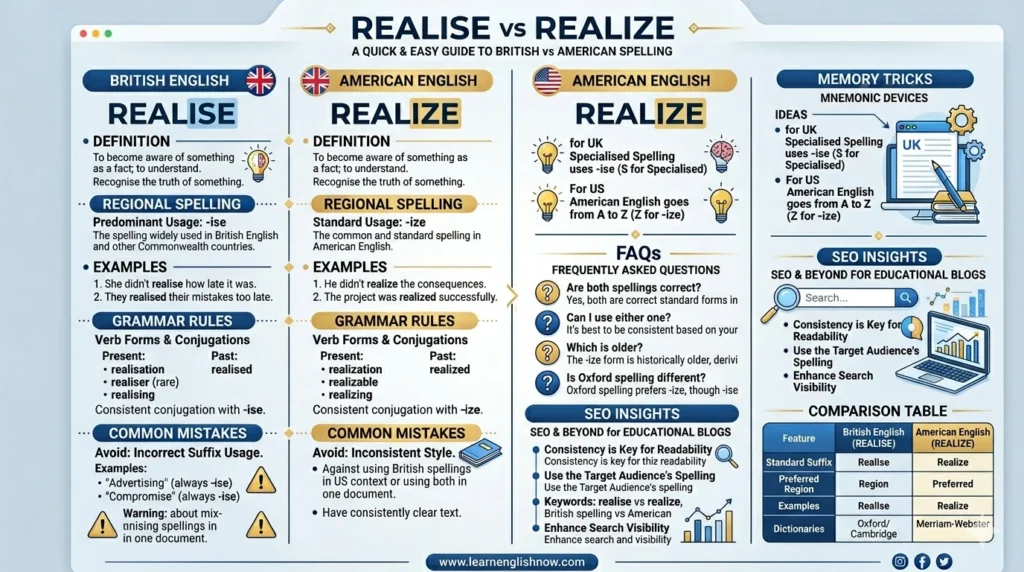
Both realise and realize are correct spellings of the same verb, but their usage depends on regional English conventions. Realize is the preferred spelling in American English and is also accepted by many British publishers. Realise is more common in British English, Australian English, and other Commonwealth countries. Both words have identical meanings and are pronounced the same way.
The question of realise or realize is a common spelling debate among English learners, writers, students, and professionals.
At first glance, the difference seems simple: one ends with -ise while the other ends with -ize. However, many people are surprised to learn that both spellings are correct.
Consider these examples:
- I didn’t realize the meeting was today.
- I didn’t realise the meeting was today.
Both sentences are grammatically correct.
The difference comes down to regional spelling preferences and style guides rather than grammar.
This guide explains:
- The difference between realise and realize
- British vs American English usage
- Grammar rules
- Examples
- Common mistakes
- SEO recommendations
- FAQs
Quick Answer
| Word | Correct? | Common Region |
|---|---|---|
| Realize | Yes | American English |
| Realise | Yes | British English |
| Both | Yes | Standard English |
Simple Summary
- Realize = Preferred in American English
- Realise = Preferred in British English
- Both have exactly the same meaning
What Does Realize Mean?
Definition
The verb realize means:
- To become aware of something
- To understand something clearly
- To achieve or fulfill something
Examples
- I realize my mistake.
- She realized the answer immediately.
- They realized their dream of owning a business.
Common Usage
Realize is frequently used in:
- Education
- Business writing
- Academic content
- Everyday communication
American English Preference
Most American dictionaries list realize as the standard spelling.
What Does Realise Mean?
Definition
Realise has the exact same meaning as realize.
Examples
- I realise my mistake.
- She realised the answer quickly.
- They realised their goal after years of work.
British English Preference
Many British writers prefer realise.
Commonwealth Usage
Realise is commonly used in:
- United Kingdom
- Australia
- New Zealand
- South Africa
Main Difference Between Realise or Realize
Meaning
There is no difference in meaning.
Pronunciation
Both words are pronounced identically.
Grammar
Both function as verbs.
Regional Preference
Realize
Preferred in American English.
Realise
Preferred in British English.
Comparison Table
| Feature | Realize | Realise |
|---|---|---|
| Correct Spelling | Yes | Yes |
| Meaning | Same | Same |
| American English | Preferred | Rare |
| British English | Accepted | Preferred |
| Pronunciation | Same | Same |
| Grammar Function | Same | Same |
Why Are There Two Spellings?
Historical Development
The verb comes from Greek and Latin word formations that historically supported both spellings.
British English Tradition
Many British publications adopted the -ise ending.
Examples:
- Realise
- Organise
- Recognise
American English Standardization
American English generally adopted -ize endings.
Examples:
- Realize
- Organize
- Recognize
Modern Acceptance
Today, both spellings are recognized by major dictionaries.
Realize in American English
Standard U.S. Usage
American writers almost always use realize.
Examples
- I realize what happened.
- She realized her error.
- They realize the importance of education.
Academic Writing
American universities typically require realize.
Business Communication
Most U.S. businesses use realize.
Realise in British English
Common British Usage
British writers often choose realise.
Examples
- I realise what happened.
- She realised her mistake.
- They realise the benefits of teamwork.
Publishing Standards
Many British newspapers prefer realise.
Educational Usage
British students frequently encounter realise in textbooks.
Is Realize Accepted in British English?
The Surprising Answer
Yes.
Oxford Style
The Oxford University Press traditionally prefers realize rather than realise.
Modern Publishing
Some British publishers use realize, while others use realise.
Practical Impact
Both spellings are accepted in the UK.
Common Examples of Realize
Awareness
- I realize the importance of sleep.
Understanding
- She realized the truth.
Achievement
- They realized their ambitions.
Professional Communication
- We realize the challenges involved.
Common Examples of Realise
Awareness
- I realise the importance of patience.
Understanding
- He realised the answer later.
Achievement
- They realised their goals.
Formal Writing
- We realise the significance of the project.
Common Mistakes People Make
Assuming One Version Is Wrong
Both spellings are correct.
Mixing Spellings
Avoid switching between realize and realise in the same document.
Ignoring Audience
Choose the spelling your readers expect.
Following the Wrong Style Guide
Always check organizational writing standards.
Realise vs Realize in Academic Writing
American Universities
Generally require realize.
British Universities
May accept both forms.
Research Journals
Follow the publication’s style guide.
Student Assignments
Use the spelling expected by your institution.
Realise vs Realize in SEO
Search Trends
Realize typically receives higher search volume globally.
American Traffic
The majority of English-language searches come from regions where realize is preferred.
International Reach
Using both spellings naturally can improve visibility.
SEO Recommendation
Target realise or realize as the primary keyword while explaining regional differences.
Related Word Comparisons
Organise or Organize
Similar British vs American variation.
Recognise or Recognize
Another common spelling difference.
Analyse or Analyze
Frequently confused international spellings.
Realise or Realize
One of the most searched spelling comparisons.
Which Spelling Is More Common?
Online Usage
Realize appears more frequently on the internet.
American Influence
American websites contribute significantly to global content volume.
British Publishing
Realise remains widely used throughout the UK.
Overall Trend
Realize generally has greater worldwide visibility.
How to Remember the Difference
Think Geography
United States → Realize
United Kingdom → Realise
The Z Rule
American English often prefers -ize endings.
The S Rule
British English often prefers -ise endings.
Easy Formula
US = Realize
UK = Realise
Exercises With Answers
Exercise 1
Which spelling is preferred in American English?
Answer: Realize
Exercise 2
Which spelling is more common in British English?
Answer: Realise
Exercise 3
Do realize and realise have different meanings?
Answer: No
Exercise 4
Which spelling uses the letter Z?
Answer: Realize
Exercise 5
Are both spellings accepted by dictionaries?
Answer: Yes
FAQs
Is it realise or realize?
Both are correct. Realize is preferred in American English, while realise is more common in British English.
Which spelling is correct in the United States?
Realize.
Which spelling is correct in the United Kingdom?
Both are accepted, but realise is generally more common.
Do realize and realise mean the same thing?
Yes. They are identical in meaning.
Is realize wrong in British English?
No. Many British publications accept realize.
Is realise wrong in American English?
It’s not technically wrong, but it is uncommon in American writing.
Which spelling should I use for international audiences?
Either works, but realize often has broader global recognition.
Can I use both spellings in one article?
It’s best to choose one version and stay consistent.
Which spelling is better for SEO?
Realize generally has higher search visibility, but both spellings should be mentioned naturally.
Will readers understand both forms?
Yes. Both are widely recognized across English-speaking countries.
Conclusion
The answer to realise or realize is simple: both spellings are correct.
The difference is primarily regional:
- Realize is preferred in American English.
- Realise is preferred in British English.
- Both have identical meanings and pronunciation.
Key takeaways include:
- Neither spelling is wrong.
- Audience location should guide your choice.
- Consistency matters more than the specific spelling.
- Realize tends to dominate global search traffic.
- Both versions are accepted by major dictionaries.
For blogging, academic writing, business communication, and SEO in 2026, understanding the distinction between realise and realize helps ensure clarity and professionalism.

Victoria Lane is a grammar-focused writer at GramBrix.com, passionate about helping readers master the rules of language. She provides clear explanations and practical examples that make writing more accurate, polished and confident.