Last Updated on June 24, 2026
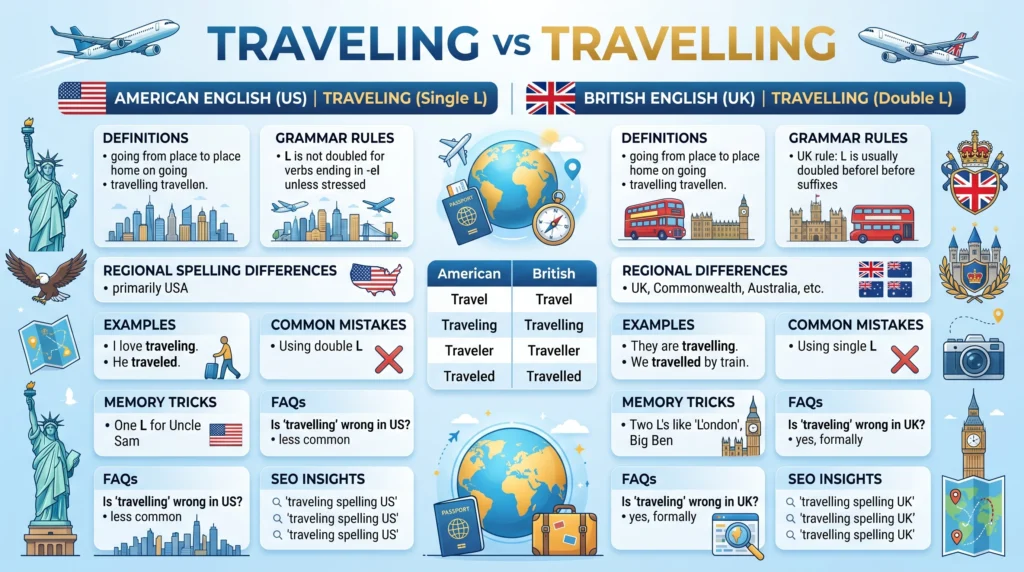
Both traveling and travelling are correct spellings, but the preferred version depends on the type of English you use. Traveling with one “L” is the standard spelling in American English, while travelling with two “L’s” is preferred in British English, Australian English, and many other Commonwealth countries. The meaning is exactly the same in both cases.
The debate over traveling or travelling is one of the most common spelling questions in English.
Many writers notice that some books, websites, and newspapers use traveling, while others use travelling. This often leads people to wonder which spelling is correct.
The good news is that both spellings are accepted. The choice depends largely on regional spelling conventions.
Consider these examples:
- I love traveling around Europe.
- I love travelling around Europe.
Both sentences are grammatically correct.
The only difference is whether you’re following American English or British English spelling rules.
This guide explains:
- The difference between traveling and travelling
- American vs British spelling rules
- Grammar usage
- Examples
- Common mistakes
- SEO recommendations
- FAQs
Quick Answer
| Word | Correct? | Common Region |
|---|---|---|
| Traveling | Yes | American English |
| Travelling | Yes | British English |
| Both | Yes | Standard English |
Simple Summary
- Traveling = American English
- Travelling = British English
- Both mean exactly the same thing
What Does Traveling Mean?
Definition
Traveling is the American English present participle and gerund form of the verb travel.
Examples
- She enjoys traveling abroad.
- We are traveling this summer.
- Traveling teaches valuable life lessons.
American English Usage
Most American dictionaries prefer traveling.
Professional Writing
Traveling is standard in U.S. publications, businesses, and educational institutions.
What Does Travelling Mean?
Definition
Travelling is the British English present participle and gerund form of the verb travel.
Examples
- She enjoys travelling abroad.
- We are travelling this summer.
- Travelling can broaden your perspective.
British English Usage
Most British dictionaries prefer travelling.
International Usage
Travelling is common in the United Kingdom, Australia, New Zealand, and other Commonwealth nations.
Main Difference Between Traveling or Travelling
Meaning
There is no difference in meaning.
Spelling Convention
Traveling
Preferred in American English.
Travelling
Preferred in British English.
Pronunciation
Both words are pronounced identically.
Grammar Function
Both function as present participles and gerunds.
Comparison Table
| Feature | Traveling | Travelling |
|---|---|---|
| Correct Spelling | Yes | Yes |
| Meaning | Same | Same |
| American English | Preferred | Less Common |
| British English | Less Common | Preferred |
| Pronunciation | Same | Same |
| Grammar Function | Same | Same |
Why Are There Two Spellings?
Regional English Differences
American and British English often use different spelling conventions.
American Simplification
American English tends to simplify spellings by removing doubled consonants.
British Doubling Rule
British English often doubles the final consonant before adding suffixes.
Historical Development
The two forms evolved as English spelling standards developed separately.
American English Rule
Single Consonant Preference
American English usually uses one “L” when adding -ing.
Examples
- Traveling
- Canceling
- Modeling
Publishing Standards
Most U.S. newspapers and publishers use traveling.
Business Communication
Traveling is the standard choice for American audiences.
British English Rule
Double Consonant Preference
British English often doubles the final consonant.
Examples
- Travelling
- Cancelling
- Modelling
Educational Usage
British schools generally teach travelling.
Media Usage
Most U.K. publications prefer travelling.
Traveling vs Travelling in Everyday English
Casual Conversation
Both forms are understood worldwide.
Social Media
Users often choose the spelling based on their country.
Travel Blogs
American bloggers usually write traveling.
British bloggers often write travelling.
Global Communication
Either spelling is acceptable if used consistently.
Common Examples of Traveling
Vacation Planning
- We are traveling to Italy next month.
Business Trips
- She is traveling for work.
Tourism
- Traveling helps people experience new cultures.
Education
- Traveling can be an educational experience.
Common Examples of Travelling
Holiday Planning
- We are travelling to Spain next month.
Business Journeys
- He is travelling for meetings.
Adventure Tourism
- Travelling creates lasting memories.
Cultural Experiences
- Travelling introduces people to new traditions.
Common Mistakes People Make
Thinking One Spelling Is Wrong
Both spellings are correct.
Mixing Styles
Avoid using traveling and travelling in the same article.
Ignoring Audience Location
Choose the spelling your readers expect.
Inconsistent Brand Voice
Businesses should maintain a single spelling style.
Traveling vs Travelling in Academic Writing
American Universities
Generally prefer traveling.
British Universities
Generally prefer travelling.
Research Publications
Both forms are accepted depending on style guidelines.
Student Writing
Follow your institution’s preferred style.
Traveling vs Travelling in SEO
Search Volume
Traveling usually receives more global searches because of American internet traffic.
International Reach
Both keywords have substantial search demand.
Content Strategy
Including both spellings naturally can improve visibility.
SEO Recommendation
Target traveling or travelling as the primary keyword while explaining the regional distinction.
Related Word Forms
Traveled or Travelled
Past tense comparison.
Traveler or Traveller
Noun form comparison.
Traveling or Travelling
Present participle comparison.
Travel
Base verb form.
Which Spelling Is More Common?
Global Internet Usage
Traveling generally appears more frequently online.
American Influence
American websites contribute heavily to search volume.
British Publishing
Travelling remains dominant in British media.
Overall Trend
Traveling tends to have higher worldwide search visibility.
How to Remember the Difference
Think Geography
United States → Traveling
United Kingdom → Travelling
Single vs Double L
US = One L
UK = Two Ls
Easy Formula
American English = Traveling
British English = Travelling
Consistency Rule
Choose one version and use it throughout your content.
Related Word Comparisons
Canceled or Cancelled
Another American vs British spelling difference.
Modeled or Modelled
Common regional variation.
Counseling or Counselling
Similar spelling pattern.
Traveling or Travelling
One of the most searched English spelling questions.
Exercises With Answers
Exercise 1
Which spelling is preferred in American English?
Answer: Traveling
Exercise 2
Which spelling is preferred in British English?
Answer: Travelling
Exercise 3
Do traveling and travelling have different meanings?
Answer: No
Exercise 4
Which version contains two Ls?
Answer: Travelling
Exercise 5
Are both spellings grammatically correct?
Answer: Yes
FAQs
Is it traveling or travelling?
Both are correct. Traveling is American English, while travelling is British English.
Which spelling is used in the United States?
Traveling is the standard American spelling.
Which spelling is used in the United Kingdom?
Travelling is the preferred British spelling.
Do traveling and travelling mean the same thing?
Yes. There is no difference in meaning.
Is travelling incorrect?
No. It is the standard British English spelling.
Is traveling incorrect?
No. It is the standard American English spelling.
Which spelling should I use for international audiences?
Either works, but many writers choose traveling because of its broader global visibility.
Can I use both spellings in one article?
It’s best to remain consistent and use only one style.
Which version is better for SEO?
Traveling generally has higher search volume, but including both spellings naturally can improve coverage.
Will readers understand both forms?
Yes. Both spellings are widely recognized worldwide.
Conclusion
The answer to traveling or travelling is simple: both spellings are correct.
The key difference is regional preference:
- Traveling is the standard American English spelling.
- Travelling is the standard British English spelling.
Key takeaways include:
- Both words have identical meanings.
- Both are grammatically correct.
- Neither spelling is superior.
- Audience location should guide your choice.
- Consistency is more important than the specific version you choose.
For SEO, blogging, business writing, and professional communication in 2026, understanding both spellings helps you reach a broader audience while maintaining language accuracy.

Kevin Brooks is a grammar specialist at GramBrix.com, dedicated to helping readers understand language rules with clarity and confidence. He simplifies complex grammar concepts through practical examples and easy explanations.