
Last Updated on July 14, 2026
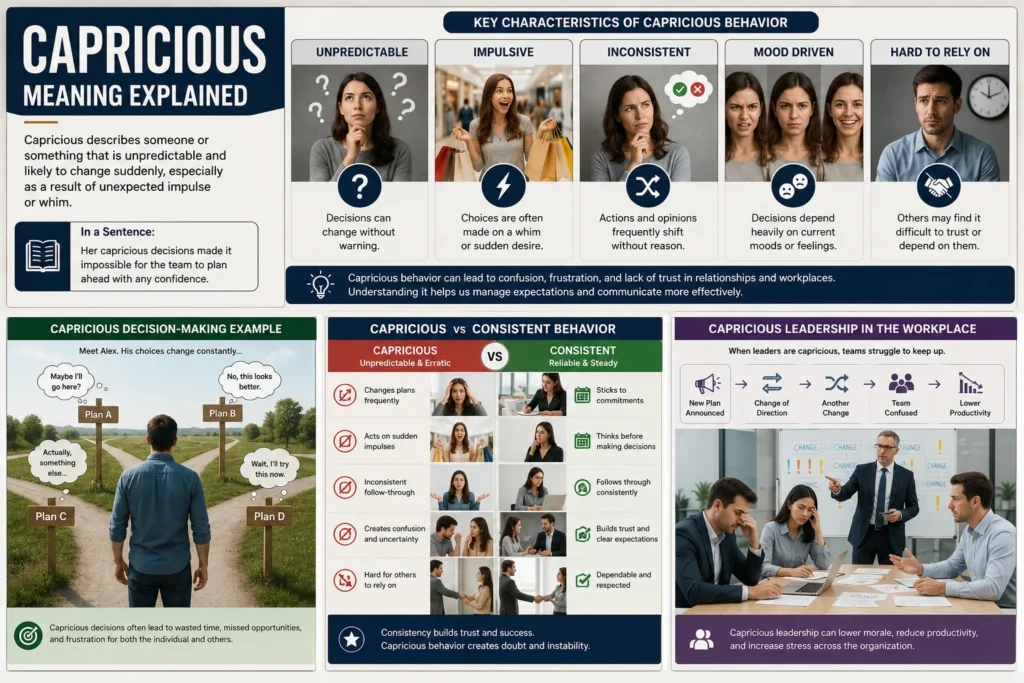
Capricious means changing suddenly and unpredictably without a clear reason. People use the word to describe someone’s behavior, decisions, moods, preferences, or actions when they seem impulsive, inconsistent, or difficult to predict.
Have you ever met someone who changes their mind every few minutes? Maybe they want pizza for dinner, then suddenly choose sushi, and later decide they are not hungry at all. In situations like these, many English speakers use the word capricious.
The capricious meaning centers on unpredictability. It describes people, decisions, behaviors, moods, or circumstances that change suddenly without warning or logical explanation. Because of this, the word often appears in conversations about personality, leadership, relationships, literature, business, and everyday life.
Moreover, capricious is a useful vocabulary word for anyone who wants to express the idea of inconsistency or impulsiveness more precisely than words like “random” or “unpredictable.”
In this comprehensive guide, you’ll learn what capricious means, where it comes from, how native speakers use it, real-world examples, platform-specific usage, common mistakes, related terms, and much more.
Quick Answer Box
| Category | Explanation |
|---|---|
| Meaning | Acting or changing unexpectedly without a clear reason |
| Context | Personality, decisions, moods, leadership, relationships |
| Usage | Describing unpredictable behavior or choices |
| Tone | Usually negative or critical |
| Common Platforms | Social media, workplace discussions, literature |
| Example | “The manager’s capricious decisions frustrated the team.” |
| Synonyms | Unpredictable, impulsive, erratic, fickle |
| Opposites | Consistent, reliable, stable, predictable |
What Does It Mean?
The word capricious describes someone or something that changes suddenly, unexpectedly, and without an obvious reason.
People often use it when discussing:
- Behavior
- Emotions
- Decisions
- Preferences
- Leadership styles
- Rules
- Circumstances
Simple Definition
Capricious = unpredictable + impulsive + inconsistent
For example:
- A capricious friend constantly changes plans.
- A capricious boss creates new rules every day.
- A capricious customer changes preferences repeatedly.
- A capricious weather pattern shifts unexpectedly.
In most situations, the word carries a negative tone because unpredictable behavior can create confusion or frustration.
Full Definition
A person, action, decision, or situation is capricious when it changes according to sudden impulses rather than careful thought or consistent reasoning.
Unlike ordinary unpredictability, capriciousness often suggests that changes happen without a logical explanation.
Key Characteristics of Capricious Behavior
Capricious actions are often:
- Sudden
- Unpredictable
- Impulsive
- Inconsistent
- Erratic
- Changeable
- Difficult to anticipate
For instance, imagine a manager who approves a project one day and rejects it the next without any new information. Many employees would describe that behavior as capricious.
Origin and History of the Word
Understanding the history of a word often makes its meaning easier to remember.
The word capricious comes from the Italian word capriccio, which referred to a sudden whim or impulse. Over time, English adopted the term to describe actions guided by unpredictable desires rather than logic.
Today, the word appears in:
- Business communication
- Academic writing
- Literature
- News articles
- Everyday conversations
Although it sounds formal, many native speakers use it regularly.
Context and Usage
The meaning of capricious can vary slightly depending on context. However, the core idea of unpredictability remains the same.
In Personal Relationships
People sometimes describe friends, family members, or partners as capricious when their behavior changes frequently.
Example:
“Her capricious attitude made it difficult to plan anything.”
In Business
Organizations often criticize capricious leadership because employees value consistency.
Example:
“The company’s capricious policies created uncertainty among workers.”
In Politics
Journalists occasionally describe political decisions as capricious when leaders change direction unexpectedly.
Example:
“Critics argued that the proposal reflected capricious decision-making.”
In Education
Teachers may discuss capricious grading standards if rules appear inconsistent.
Example:
“Students struggled with the professor’s capricious expectations.”
In Daily Life
People often use the word casually.
Example:
“My capricious cravings change every hour.”
Emotional Meaning of Capricious
Beyond its dictionary definition, capricious often carries emotional implications.
Frustration
Many people associate capricious behavior with frustration.
When someone changes plans repeatedly, others may feel annoyed.
Example:
“His capricious behavior exhausted everyone.”
Uncertainty
Capricious actions create unpredictability.
Consequently, people may feel anxious when dealing with someone who behaves this way.
Lack of Trust
Reliability builds trust. Therefore, repeated capricious behavior can damage relationships.
Example:
“The team stopped trusting the manager because of her capricious decisions.”
Occasional Positivity
In rare situations, capricious behavior may seem spontaneous or adventurous.
Example:
“Her capricious travel plans led to unexpected discoveries.”
Even then, the word often implies a lack of planning.
Real-Life Examples
Real-world examples help clarify the capricious meaning.
Example 1: Restaurant Choice
Jake changes his dinner choice four times before ordering.
“His capricious decision-making delayed the entire group.”
Example 2: Workplace Leadership
A supervisor changes project priorities every morning.
“Employees struggled to follow the capricious instructions.”
Example 3: Shopping Habits
A customer repeatedly switches between products.
“The salesperson found the customer’s capricious preferences difficult to understand.”
Example 4: Vacation Planning
A traveler books three different destinations in one week.
“Her capricious planning style confused her friends.”
Example 5: Classroom Rules
A teacher enforces different standards each day.
“Students viewed the grading policy as capricious.”
Conversation Examples
These realistic dialogues show how native speakers use the word naturally.
Conversation Example 1
Person A: Why did the meeting get canceled?
Person B: The manager made another capricious decision.
Conversation Example 2
Person A: Is your roommate easy to live with?
Person B: Not really. He’s pretty capricious and changes plans constantly.
Conversation Example 3
Person A: Why are employees leaving?
Person B: Many are tired of the CEO’s capricious leadership style.
Conversation Example 4
Person A: Did you enjoy planning the trip?
Person B: It was difficult because my friend is so capricious.
Conversation Example 5
Person A: Why didn’t you buy the laptop?
Person B: I kept making capricious changes to my decision.
Platform-Specific Meaning
The word maintains the same definition across platforms. However, people use it differently depending on the environment.
Capricious on Social Media
Users often describe unpredictable trends, opinions, or behaviors as capricious.
Example:
“Social media algorithms can seem capricious at times.”
Capricious on TikTok
Creators may use the word when discussing changing trends.
Example:
“The internet is capricious. One trend is huge today and forgotten tomorrow.”
Capricious on Instagram
Users often describe rapidly changing preferences or aesthetics.
Example:
“Fashion trends can be incredibly capricious.”
Capricious on X
People frequently use the term when discussing public figures, business decisions, or news events.
Example:
“Investors dislike capricious policy changes.”
Capricious in Online Communities
Forum members often use the word when discussing inconsistent moderation or changing rules.
Example:
“Some users criticized the capricious enforcement of guidelines.”
Alternative Meanings
Although the primary meaning remains consistent, capricious can apply to different subjects.
Capricious People
Someone who changes moods, opinions, or decisions unexpectedly.
Example:
“She can be capricious when making plans.”
Capricious Decisions
Choices made without consistency.
Example:
“The committee made several capricious rulings.”
Capricious Weather
Weather that changes suddenly.
Example:
“Mountain weather is often capricious.”
Capricious Markets
Economic conditions that fluctuate unpredictably.
Example:
“Investors prepared for capricious market behavior.”
Related Terms and NLP Variations
Search engines and AI systems connect capricious with several related concepts.
Common Synonyms
- Unpredictable
- Impulsive
- Erratic
- Fickle
- Inconsistent
- Volatile
- Changeable
- Whimsical
- Arbitrary
- Mercurial
Near Synonyms
- Spontaneous
- Unstable
- Irregular
- Variable
- Temperamental
Opposites
- Reliable
- Stable
- Consistent
- Dependable
- Predictable
- Steady
- Rational
- Methodical
Related Concepts
- Sudden impulses
- Mood swings
- Inconsistent behavior
- Uncertain outcomes
- Unpredictable decisions
- Erratic leadership
Capricious vs Similar Words
Many English learners confuse capricious with other vocabulary terms.
Capricious vs Impulsive
Impulsive means acting without thinking.
Capricious means changing unexpectedly and inconsistently.
Someone may act impulsively once. A capricious person behaves unpredictably over time.
Capricious vs Fickle
These words are very similar.
However, fickle often refers specifically to changing preferences or loyalties.
Capricious has a broader meaning.
Capricious vs Erratic
Erratic emphasizes irregular behavior.
Capricious emphasizes unpredictable changes driven by whim.
Capricious vs Whimsical
Whimsical often sounds playful or imaginative.
Capricious usually sounds more critical.
Example:
A whimsical artist may be charming.
A capricious manager may frustrate employees.
How to Respond When Someone Uses the Word Capricious
Your response depends on the context.
When Discussing a Person
Possible replies:
- “That sounds difficult to deal with.”
- “Consistency would probably help.”
- “I can understand the frustration.”
When Discussing Leadership
Possible replies:
- “Employees usually prefer predictable expectations.”
- “Clear policies often improve morale.”
When Discussing Life Events
Possible replies:
- “Unexpected changes can be challenging.”
- “Flexibility becomes important in situations like that.”
When Used Humorously
Possible replies:
- “At least life isn’t boring.”
- “That definitely keeps things interesting.”
Edge Cases and Special Situations
Understanding unusual situations helps deepen your understanding.
Can Capricious Be Positive?
Sometimes.
A spontaneous artist may appear capricious in a creative sense.
However, most uses remain mildly negative.
Can Weather Be Capricious?
Yes.
Many people describe rapidly changing weather as capricious.
Can Technology Be Capricious?
Yes.
Users sometimes describe software or algorithms this way when outcomes seem inconsistent.
Can Rules Be Capricious?
Absolutely.
People often criticize organizations for capricious enforcement of policies.
Common Misinterpretations
Several misunderstandings surround this word.
Mistake 1: Assuming It Means Crazy
Capricious does not mean mentally unstable.
It simply refers to unpredictability.
Mistake 2: Thinking It Means Random
Random and capricious overlap.
However, capricious usually suggests behavior driven by changing personal desires.
Mistake 3: Using It for Every Change
Not all change is capricious.
Planned and logical changes do not qualify.
Mistake 4: Confusing It With Creative
Creative people may appear capricious.
However, creativity and unpredictability are different concepts.
When NOT to Use It
Avoid using capricious in situations involving logical and well-supported decisions.
Incorrect Usage Examples
- A carefully researched scientific conclusion
- A strategic business plan
- A predictable process
- A structured routine
- A consistent leader
These examples do not fit the meaning of capricious.
Better Alternatives
Depending on context, use:
- Strategic
- Rational
- Deliberate
- Consistent
- Thoughtful
- Methodical
Usage Tips
Using capricious correctly makes your English sound more advanced and precise.
Tip 1: Use It for Unpredictability
Good example:
“The capricious customer changed her order three times.”
Tip 2: Consider Tone
The word often sounds critical.
Therefore, avoid using it casually when discussing sensitive topics.
Tip 3: Use It in Professional Writing
Business professionals frequently use the word.
Example:
“Investors prefer stable policies over capricious decision-making.”
Tip 4: Avoid Overuse
Mix in related terms such as:
- Erratic
- Unpredictable
- Fickle
- Inconsistent
Tip 5: Match the Context
The word works best when behavior lacks consistency or logic.
Why Understanding Capricious Matters
The word appears frequently in advanced English communication.
Moreover, understanding it helps you:
- Improve vocabulary
- Read literature more effectively
- Understand business discussions
- Interpret news articles
- Express complex ideas clearly
Because many professional and academic texts use this word, learning it provides practical value beyond casual conversation.
Capricious in Literature and Popular Culture
Writers often use capricious characters to create conflict.
In Novels
Authors frequently portray villains or complicated protagonists as capricious.
Their unpredictable actions increase tension.
In Movies
Screenwriters use capricious behavior to surprise audiences.
As a result, viewers remain engaged.
In Television
Many dramatic characters display capricious traits.
These sudden changes often drive the story forward.
In Historical Writing
Historians sometimes describe rulers as capricious when they governed through unpredictable decisions.
This usage remains common in biographies and political analysis.
FAQs
What is the exact meaning of capricious?
Capricious means changing suddenly and unpredictably without a clear reason.
Is capricious a positive or negative word?
It is usually negative because it suggests inconsistency and unpredictability.
Can a person be capricious?
Yes. A person can be capricious if they frequently change moods, opinions, or decisions.
What is a simple synonym for capricious?
Unpredictable is one of the simplest and most common synonyms.
What is the opposite of capricious?
Reliable, stable, consistent, and predictable are common opposites.
Does capricious mean impulsive?
The meanings overlap. However, capricious emphasizes repeated unpredictability, while impulsive focuses on acting without thinking.
Can weather be described as capricious?
Yes. Rapidly changing weather often earns that description.
Is capricious formal English?
Yes. However, educated speakers also use it in everyday conversation.
How do you use capricious in a sentence?
Example: “The manager’s capricious decisions frustrated the entire team.”
Why do writers use the word capricious?
Writers use it because it conveys unpredictability, inconsistency, and sudden change more precisely than many simpler words.
Conclusion
The capricious meaning revolves around unpredictability, inconsistency, and sudden changes driven by impulse rather than logic. Whether describing a person, decision, mood, policy, trend, or situation, the word highlights behavior that is difficult to anticipate.
Moreover, capricious often carries a mildly negative tone because unpredictable actions can create confusion, frustration, and uncertainty. Nevertheless, in certain creative or adventurous contexts, the word may suggest spontaneity and excitement.
By understanding the meaning, synonyms, usage patterns, comparisons, examples, and common mistakes associated with capricious, you can use this advanced vocabulary word with confidence in conversations, professional writing, academic work, and everyday communication.

Kevin Brooks is a grammar specialist at GramBrix.com, dedicated to helping readers understand language rules with clarity and confidence. He simplifies complex grammar concepts through practical examples and easy explanations.