Last Updated on June 16, 2026
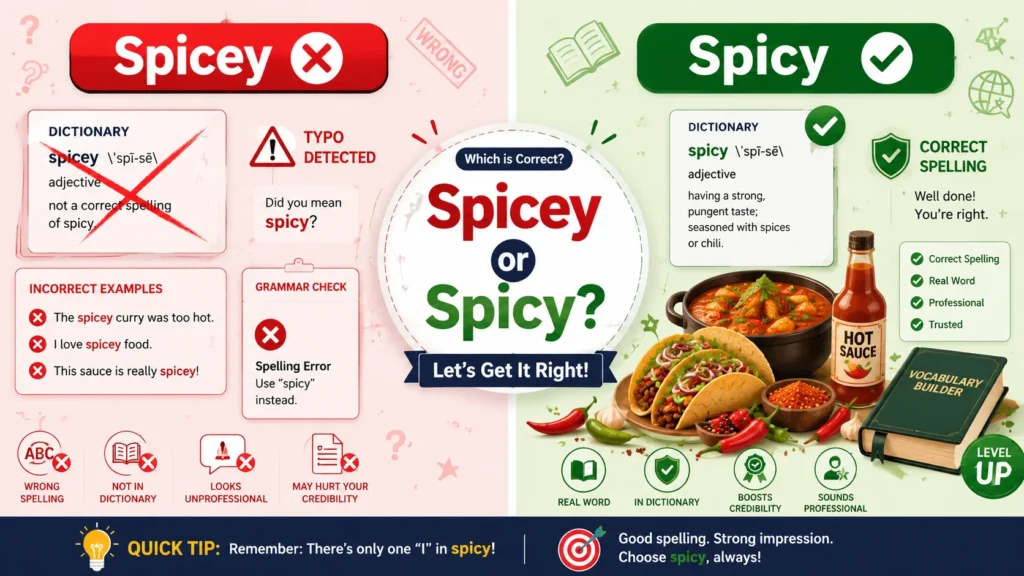
Spicy is the correct spelling in standard English when describing food with a strong, hot flavor or anything exciting and bold. Spicey is generally considered a misspelling and should be avoided in formal, academic, and professional writing.
Many English words can be confusing, especially when two versions look almost the same. One common spelling question is spicey or spicy. People often see both forms online and wonder which one is correct.
The confusion happens because the word comes from spice, so it seems logical that adding a “y” would create spicey. However, English spelling rules do not always work that way. As a result, many writers, students, bloggers, and even business owners accidentally use the wrong spelling.
Understanding the difference between spicey or spicy is important for clear communication. Whether you are writing a restaurant menu, a food review, a social media post, an article, or a school assignment, using the correct spelling helps your writing appear professional and trustworthy.
This guide explains everything you need to know about spicey or spicy, including definitions, examples, common mistakes, grammar rules, regional usage, exercises, and practical tips. By the end, you will know exactly which spelling to use and why.
Quick Answer
| Word | Correct? | Meaning |
|---|---|---|
| Spicy | ✅ Yes | Having spice, heat, or strong flavor |
| Spicey | ❌ No | Common misspelling of spicy |
The correct spelling is “spicy.”
Example:
✅ This curry is very spicy.
❌ This curry is very spicey.
In modern English, dictionaries, style guides, and professional writers use spicy.
What Does Spicy Mean?
The adjective spicy describes something that contains spices or produces a hot, pungent sensation.
It is most commonly used for food, but it can also describe conversations, stories, jokes, opinions, or situations that are exciting or provocative.
Simple Definition
Spicy means:
- Full of spices
- Hot or pungent in taste
- Exciting or interesting
- Bold or provocative
Examples
- The tacos were spicy and delicious.
- I love spicy noodles.
- The debate became spicy after the new announcement.
- She shared some spicy gossip.
In each example, spicy is the correct spelling.
Why Do People Write Spicey?
The mistake happens because many people assume the word should keep the entire root word spice.
Consider these words:
- Ice → Icy
- Juice → Juicy
- Price → Pricy
Many writers think:
- Spice → Spicey
However, English spelling follows a different pattern.
The correct transformation is:
- Spice → Spicy
The silent “e” is dropped before adding “y.”
Similar Examples
| Base Word | Correct Adjective |
|---|---|
| Ice | Icy |
| Juice | Juicy |
| Noise | Noisy |
| Spice | Spicy |
| Lace | Lacy |
This spelling pattern explains why spicy is correct and spicey is not.
The Origin of the Word Spicy
The word spice comes from historical trade and cooking traditions involving aromatic plant substances used to flavor food.
Over time, English speakers developed the adjective spicy to describe foods containing spices.
The word gradually expanded beyond cooking and gained additional meanings.
Today, spicy can describe:
- Food
- Drinks
- Conversations
- Entertainment
- News
- Opinions
- Relationships
The spelling has consistently been spicy in standard English usage.
Spicey or Spicy in Dictionaries
Major dictionaries recognize spicy as the standard spelling.
Examples include:
- Merriam Webster
- Cambridge Dictionary
- Oxford English Dictionary
- Collins Dictionary
- Dictionary.com
These dictionaries define spicy as containing spices or having a strong flavor.
The spelling spicey is generally treated as an incorrect variation or misspelling.
Dictionary Verdict
| Spelling | Dictionary Accepted |
|---|---|
| Spicy | Yes |
| Spicey | No |
Spicy in Everyday Language
The word appears frequently in daily communication.
Food Reviews
- This chicken is spicy.
- The salsa is too spicy for me.
Restaurant Menus
- Spicy buffalo wings
- Spicy shrimp pasta
- Spicy ramen
Social Media
- That interview got spicy.
- The comments section became spicy.
Entertainment
- The movie contains spicy dialogue.
- The show became more spicy in season two.
In all these examples, spicy remains the correct spelling.
Spicey or Spicy in Different Contexts
Food Context
The most common use refers to food.
Examples:
- Spicy curry
- Spicy soup
- Spicy chicken
- Spicy chips
Figurative Context
The word can also describe exciting situations.
Examples:
- A spicy discussion
- A spicy rumor
- A spicy opinion
- A spicy headline
Romantic Context
Sometimes people use spicy to suggest romance or passion.
Examples:
- A spicy novel
- A spicy scene
- A spicy storyline
Regardless of context, the correct spelling is always spicy.
Comparison Table: Spicey vs Spicy
| Feature | Spicey | Spicy |
|---|---|---|
| Correct English spelling | No | Yes |
| Found in major dictionaries | No | Yes |
| Accepted in academic writing | No | Yes |
| Used in professional content | No | Yes |
| Common online typo | Yes | No |
| Recommended usage | Never | Always |
Advantages of Using the Correct Spelling
Using spicy correctly provides several benefits.
Professional Appearance
Correct spelling makes writing look polished and credible.
Better Communication
Readers immediately understand your meaning.
Improved SEO
Search engines recognize correct spellings more effectively.
Academic Accuracy
Teachers and editors expect standard English spelling.
Brand Trust
Restaurants, food blogs, and businesses appear more professional.
Disadvantages of Using Spicey
Using spicey can create problems.
Looks Unprofessional
Readers may assume the writer made a mistake.
Reduces Credibility
Incorrect spelling can weaken trust.
Editing Issues
Editors often mark it as an error.
Search Performance Problems
Content may appear less polished to users.
Confuses Learners
Students may learn the wrong spelling.
Real World Examples
Example 1: Restaurant Menu
Correct:
- Spicy Chicken Burger
Incorrect:
- Spicey Chicken Burger
Example 2: Food Blog
Correct:
- This spicy Thai soup is easy to make.
Incorrect:
- This spicey Thai soup is easy to make.
Example 3: Product Packaging
Correct:
- Extra Spicy Sauce
Incorrect:
- Extra Spicey Sauce
Example 4: Social Media Post
Correct:
- Try our new spicy wings today.
Incorrect:
- Try our new spicey wings today.
Regional and Global Usage
One interesting fact about spicey or spicy is that regional differences do not apply.
Unlike words such as:
| British English | American English |
|---|---|
| Favourite | Favorite |
| Colour | Color |
| Centre | Center |
There is no accepted regional variation.
Around the World
Countries using English generally write:
- United States: Spicy
- United Kingdom: Spicy
- Canada: Spicy
- Australia: Spicy
- New Zealand: Spicy
- India: Spicy
- Pakistan: Spicy
The spelling remains the same everywhere.
Common Mistakes and Corrections
Mistake 1
❌ The curry was spicey.
✅ The curry was spicy.
Mistake 2
❌ I enjoy spicey food.
✅ I enjoy spicy food.
Mistake 3
❌ These chips are very spicey.
✅ These chips are very spicy.
Mistake 4
❌ She ordered a spicey taco.
✅ She ordered a spicy taco.
Mistake 5
❌ The restaurant serves spicey noodles.
✅ The restaurant serves spicy noodles.
Easy Memory Trick
A simple way to remember the correct spelling is:
Spice loses the “e” before becoming spicy.
Think of:
- Juice → Juicy
- Noise → Noisy
- Spice → Spicy
No extra “e” remains.
Memory Formula
Spice + y = Spicy
Not:
Spice + ey = Spicey
Related Words and Their Spellings
Understanding related words can reinforce the correct spelling.
| Word | Correct Form |
|---|---|
| Spice | Yes |
| Spices | Yes |
| Spiced | Yes |
| Spicy | Yes |
| Spicey | No |
Example Sentences
- The recipe uses many spices.
- The chicken was spiced perfectly.
- The sauce tasted spicy.
Spicy in Marketing and Branding
Businesses often use the word spicy to attract customers.
Food Industry Examples
- Spicy chicken sandwich
- Spicy wings
- Spicy ramen
- Spicy salsa
Advertising Examples
- Try our new spicy flavor.
- Experience a spicy kick.
- Bold and spicy taste.
Correct spelling matters because it reflects professionalism.
Spicy in Popular Culture
The meaning of spicy has expanded over time.
Today it may refer to:
Exciting News
- That’s a spicy story.
Strong Opinions
- She made a spicy comment.
Entertainment
- The show became spicy.
Fashion
- That’s a spicy outfit.
Social Media
- Things got spicy online.
Even when the meaning changes, the spelling stays the same.
Related Comparisons
Many English learners confuse similar spelling pairs.
Spicy vs Spiced
| Word | Meaning |
|---|---|
| Spicy | Having a hot or strong flavor |
| Spiced | Flavored with spices |
Examples:
- The curry is spicy.
- The tea is spiced.
Spicy vs Hot
| Word | Meaning |
|---|---|
| Spicy | Contains spices |
| Hot | High temperature or spicy flavor |
Examples:
- The soup is hot.
- The soup is spicy.
A dish can be hot in temperature, spicy in flavor, or both.
Exercises with Answers
Exercise 1
Choose the correct spelling.
- I love _____ food.
- The salsa is very _____.
- We ordered _____ chicken wings.
- The noodles were extremely _____.
Answers:
- Spicy
- Spicy
- Spicy
- Spicy
Exercise 2
Correct the sentence.
- The curry was spicey.
- She likes spicey chips.
- We bought a spicey sauce.
Answers:
- The curry was spicy.
- She likes spicy chips.
- We bought a spicy sauce.
Exercise 3
Fill in the blanks.
- This pizza is very _____.
- I enjoy _____ snacks.
- The chef created a _____ recipe.
Answers:
- spicy
- spicy
- spicy
Advanced Understanding of Spicy
As language evolves, words often gain broader meanings.
The adjective spicy now functions in several ways:
Literal Meaning
Refers to taste.
Example:
- The chili is spicy.
Emotional Meaning
Refers to excitement.
Example:
- The conversation became spicy.
Cultural Meaning
Refers to something bold or provocative.
Example:
- The article contains spicy opinions.
This flexibility helps explain why the word appears so often online and in media.
FAQs
Is spicy the correct spelling?
Yes. Spicy is the correct and accepted English spelling.
Is spicey a real word?
No. Spicey is generally considered a misspelling of spicy.
Why do people write spicey instead of spicy?
People often assume the root word spice should keep its final “e,” but standard spelling rules create the form spicy.
Do dictionaries accept spicey?
Major dictionaries recognize spicy, not spicey, as the standard spelling.
Which is correct: spicey food or spicy food?
Spicy food is correct in all forms of English writing.
Is spicey used in British English?
No. British English uses spicy, just like American English.
Is spicey accepted in American English?
No. American English also uses spicy as the correct spelling.
How can I remember spicy or spicey?
Remember that the silent “e” is dropped, creating spicy.
Can spicy describe things other than food?
Yes. It can describe conversations, news, opinions, stories, and other exciting situations.
Should businesses use spicy or spicey in marketing?
Businesses should always use spicy because it is the professional and correct spelling.
Conclusion
The debate over spicey or spicy has a clear answer. Spicy is the correct spelling, while spicey is a common misspelling that should be avoided in professional, academic, and everyday writing.
The confusion often arises because the word comes from spice, leading some people to believe the final “e” should remain. However, English spelling rules remove the silent “e” before adding the “y,” resulting in the correct form spicy. This pattern is similar to words such as juicy, icy, and noisy.
Whether you are writing a restaurant menu, food blog, recipe, social media caption, academic paper, or business advertisement, using spicy helps maintain credibility and clarity. Remember the simple rule: spice becomes spicy, not spicey.
For the best results, proofread your writing, use spell check tools, and consistently choose spicy whenever describing flavorful, hot, exciting, or bold experiences. Doing so will ensure your writing remains accurate, professional, and easy to understand.

Victoria Lane is a grammar-focused writer at GramBrix.com, passionate about helping readers master the rules of language. She provides clear explanations and practical examples that make writing more accurate, polished and confident.