
Last Updated on June 18, 2026
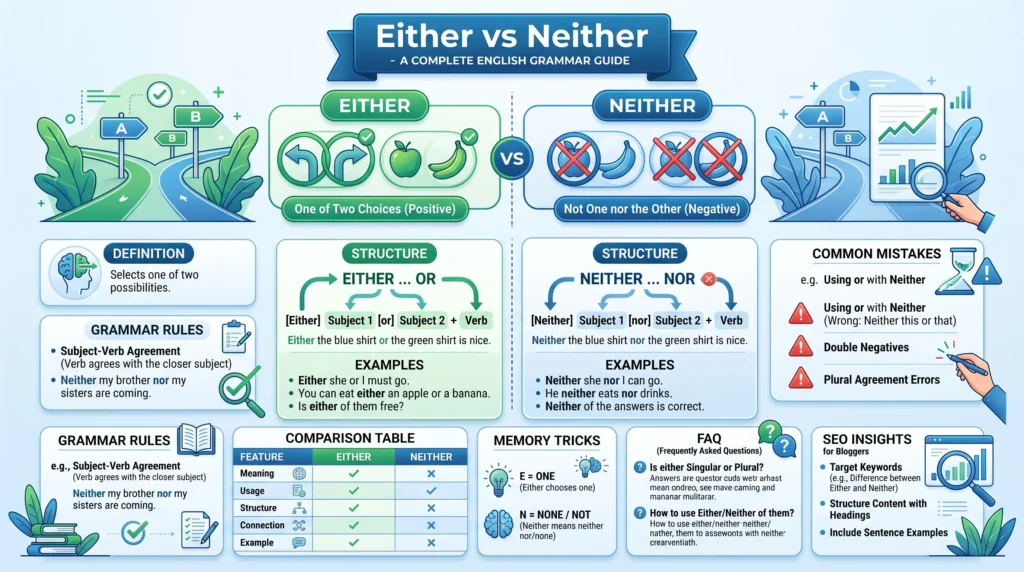
Either and neither are commonly confused English words because both refer to two choices. However, they have opposite meanings. Either means one or the other of two options, while neither means not one and not the other. Understanding the difference between either or neither helps improve grammar, writing clarity, and everyday communication.
The question of either or neither is one of the most searched grammar topics in English.
Both words deal with two options, people, places, or things. Because they often appear in similar sentence structures, many writers use them incorrectly.
Consider these examples:
- Either answer is acceptable.
- Neither answer is correct.
In the first sentence, one of the options works.
In the second sentence, neither option works.
Learning the difference helps you communicate more clearly in both casual and professional writing.
This guide explains:
- Definitions
- Grammar rules
- Sentence structures
- Examples
- Common mistakes
- SEO recommendations
- FAQs
Quick Answer
| Word | Meaning | Usage |
|---|---|---|
| Either | One of two choices | Positive |
| Neither | Not one and not the other | Negative |
Simple Summary
Use either when at least one option is acceptable.
Use neither when both options are rejected.
What Does Either Mean?
Definition
Either means one or the other of two people, things, choices, or possibilities.
Basic Meaning
It indicates that one option can be chosen from two available choices.
Examples
- Either book is fine.
- You can choose either route.
- Either candidate could win.
Common Usage
Either is often used when discussing alternatives.
What Does Neither Mean?
Definition
Neither means not one and not the other.
Basic Meaning
It indicates that both options are rejected or unavailable.
Examples
- Neither book is available.
- Neither route is safe.
- Neither candidate qualified.
Common Usage
Neither is used to express a negative idea involving two choices.
Main Difference Between Either or Neither
Meaning
Either
One option works.
Neither
No option works.
Sentence Function
Either
Creates a positive or neutral meaning.
Neither
Creates a negative meaning.
Decision Making
Either
Allows selection.
Neither
Rejects all available options.
Comparison Table
| Feature | Either | Neither |
|---|---|---|
| Refers to Two Choices | Yes | Yes |
| Positive Meaning | Yes | No |
| Negative Meaning | No | Yes |
| Allows Choice | Yes | No |
| Rejects Both Options | No | Yes |
| Common in English | Yes | Yes |
How to Use Either Correctly
Choosing Between Two Options
Either allows one choice from two possibilities.
Examples:
- Either restaurant is acceptable.
- Either answer earns full credit.
With “Or”
A common structure is:
Either + A + Or + B
Examples:
- Either coffee or tea is available.
- Either Sarah or John will attend.
In Questions
Examples:
- Do you like either option?
- Is either solution acceptable?
Everyday Conversations
Either appears frequently in spoken English.
How to Use Neither Correctly
Rejecting Both Options
Neither means that both choices are unacceptable.
Examples:
- Neither restaurant is open.
- Neither answer is correct.
With “Nor”
A common structure is:
Neither + A + Nor + B
Examples:
- Neither Sarah nor John attended.
- Neither rain nor snow stopped us.
Formal Writing
Neither is common in academic and professional writing.
Negative Statements
Neither naturally creates a negative meaning.
Either vs Neither in Sentences
Example 1
Either:
- Either car will get us there.
Meaning: Both are acceptable choices.
Neither:
- Neither car works.
Meaning: Both cars are unusable.
Example 2
Either:
- Either hotel is fine.
Neither:
- Neither hotel has availability.
Example 3
Either:
- Either solution could work.
Neither:
- Neither solution solves the problem.
Grammar Rules for Either
Singular Verb Agreement
Either usually takes a singular verb.
Examples:
- Either answer is correct.
- Either candidate is qualified.
Pronoun Usage
Examples:
- Either of them can help.
- Either one works.
Formal Grammar
Either is grammatically correct in both formal and informal writing.
Grammar Rules for Neither
Singular Verb Agreement
Neither generally takes a singular verb.
Examples:
- Neither option is available.
- Neither student was present.
Pronoun Usage
Examples:
- Neither of them agreed.
- Neither one succeeded.
Formal English
Neither is commonly used in professional communication.
Common Examples of Either
Education
- Either answer receives credit.
Travel
- Either flight is acceptable.
Shopping
- Either shirt looks great.
Business
- Either manager can approve the request.
Common Examples of Neither
Education
- Neither answer is correct.
Travel
- Neither flight is available.
Shopping
- Neither shirt fits properly.
Business
- Neither proposal was accepted.
Common Mistakes People Make
Using Either Instead of Neither
Incorrect:
- Either option works for me.
(when both options are bad)
Correct:
- Neither option works for me.
Double Negatives
Incorrect:
- I don’t want neither choice.
Correct:
- I want neither choice.
Mixing Neither with Or
Incorrect:
- Neither Sarah or John attended.
Correct:
- Neither Sarah nor John attended.
Mixing Either with Nor
Incorrect:
- Either Sarah nor John attended.
Correct:
- Either Sarah or John attended.
Either or Neither in Conversation
Positive Responses
Examples:
- Either choice is fine.
- Either day works for me.
Negative Responses
Examples:
- Neither option interests me.
- Neither one is available.
Casual English
Both words appear frequently in daily speech.
Professional English
Both are commonly used in workplace communication.
Which Word Is More Common?
Search Trends
Either tends to appear more often because it is used in positive and neutral contexts.
Writing Frequency
Both are extremely common.
Educational Content
Grammar websites frequently compare the two words.
SEO Importance
The keyword either or neither has strong search demand because learners often confuse them.
Which Version Is Better for SEO?
Search Intent
Users typically want grammar clarification.
Content Strategy
Target both words together.
Keyword Opportunity
Grammar comparison articles perform well in search results.
SEO Recommendation
Use either or neither as the primary keyword and explain the distinction clearly.
How to Remember the Difference
Either = One Works
Think:
“Either option works.”
Neither = None Works
Think:
“Neither option works.”
Easy Memory Trick
Either = Choose one.
Neither = Choose none.
Visual Rule
Two options available → Either
Two options rejected → Neither
Related Word Comparisons
Neither Nor vs Either Or
The most common pairing.
Then vs Than
Another common grammar confusion.
Affect vs Effect
Frequently searched word comparison.
Either or Neither
One of the most important English grammar distinctions.
Exercises With Answers
Exercise 1
Which word means one of two choices?
Answer: Either
Exercise 2
Which word means not one and not the other?
Answer: Neither
Exercise 3
Complete the sentence:
_____ answer is acceptable.
Answer: Either
Exercise 4
Complete the sentence:
_____ answer is correct.
(when both are wrong)
Answer: Neither
Exercise 5
Which pairing is correct?
Answer: Neither…nor
FAQs
What is the difference between either and neither?
Either means one of two choices. Neither means not one and not the other.
Can either mean both?
No. Either refers to one option out of two.
Does neither mean none?
Yes. When discussing two choices, neither means none of them.
Should I use either or neither?
Use either when at least one option is acceptable. Use neither when both options are rejected.
What comes after either?
Either is commonly paired with or.
What comes after neither?
Neither is commonly paired with nor.
Is “me neither” grammatically correct?
Yes. It is widely accepted in conversation.
Do either and neither take singular verbs?
Generally, yes.
Which word is more common?
Either appears slightly more often, but both are extremely common.
Is neither a negative word?
Yes. Neither creates a negative meaning.
Conclusion
The difference between either or neither is simple once you understand their meanings.
Key takeaways include:
- Either means one of two options.
- Neither means not one and not the other.
- Either is commonly paired with or.
- Neither is commonly paired with nor.
- Both usually take singular verbs.
- Choosing the correct word improves grammar and communication.
The easiest rule to remember is:
Either = One option works
Neither = No option works
Mastering this distinction will make your writing clearer, more professional, and grammatically correct.

Kevin Brooks is a grammar specialist at GramBrix.com, dedicated to helping readers understand language rules with clarity and confidence. He simplifies complex grammar concepts through practical examples and easy explanations.