
Last Updated on July 6, 2026
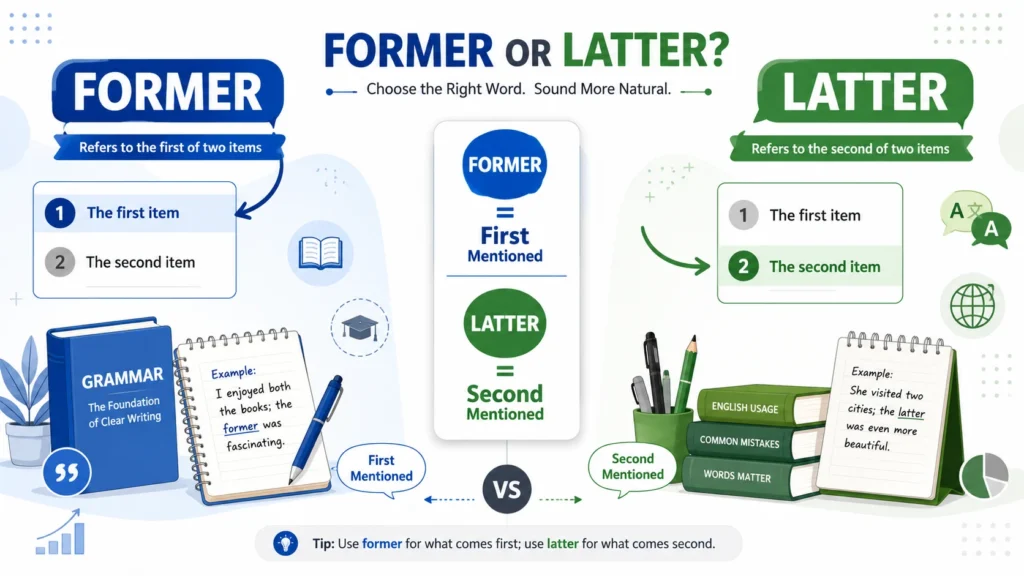
Former and latter are words used to refer back to two things already mentioned. Former means the first item mentioned, while latter means the second item mentioned. Understanding the difference helps make writing clearer, more professional, and easier to read.
Many English learners and even native speakers sometimes get confused about former or latter. These two words appear often in books, articles, academic writing, business communication, and everyday conversations. While they seem simple, using them incorrectly can confuse readers.
Imagine you mention two options, such as tea and coffee. Instead of repeating the names again, you can use former and latter. This makes your writing shorter and smoother.
The challenge is remembering which word refers to which item. Many people mix them up because they sound formal and are not used in casual speech every day.
Learning the difference between former and latter is useful for students, professionals, writers, and anyone who wants to improve their English. Once you understand the basic rule, these terms become easy to use.
This guide explains everything from beginner to advanced level. You will learn definitions, examples, comparisons, common mistakes, exercises, FAQs, and practical tips to master the use of former and latter.
Quick Answer
The rule is simple:
| Term | Meaning |
|---|---|
| Former | The first of two items mentioned |
| Latter | The second of two items mentioned |
Example
Sarah likes cats and dogs.
- The former refers to cats.
- The latter refers to dogs.
In this sentence:
Sarah likes cats and dogs, but the latter requires more attention.
Latter” means dogs because dogs were mentioned second.
What Does Former Mean?
The word former refers to the first item in a list of two things.
It helps avoid repeating the original noun.
Example
John can choose a laptop or a tablet. He prefers the former.
The former = laptop.
Another Example
We visited Paris and Rome. The former impressed us with its museums.
The former = Paris.
Simple Formula
First item = Former
Think:
Former = First
Both words begin with the letter F.
This memory trick helps many learners remember the meaning.
What Does Latter Mean?
The word latter refers to the second item in a list of two things.
Example
John can choose a laptop or a tablet. He prefers the latter.
The latter = tablet.
Another Example
We visited Paris and Rome. The latter impressed us with its food.
The latter = Rome.
Simple Formula
Second item = Latter
Think of the latter as the item that comes later.
This makes it easier to remember.
Former vs Latter Comparison Table
| Feature | Former | Latter |
|---|---|---|
| Refers to | First item mentioned | Second item mentioned |
| Position | Earlier | Later |
| Usage | Avoid repetition | Avoid repetition |
| Formality | Formal | Formal |
| Common in | Academic writing, reports | Academic writing, reports |
| Example | Tea or coffee? Former = tea | Tea or coffee? Latter = coffee |
Why Do Writers Use Former and Latter?
These words make writing more efficient.
Instead of repeating long phrases, writers can use a single word.
Without Former and Latter
The company can invest in renewable energy or traditional energy. Renewable energy offers long term environmental benefits.
With Former and Latter
The company can invest in renewable energy or traditional energy. The former offers long term environmental benefits.
The second sentence is shorter and cleaner.
Real World Examples of Former and Latter
In Business Writing
The company considered hiring interns or full time employees. The latter option was more expensive.
Latter = full time employees.
In Academic Writing
Researchers studied online learning and classroom learning. The former showed greater flexibility.
Former = online learning.
In News Articles
The government discussed tax cuts and infrastructure spending. The former received more public support.
Former = tax cuts.
In Technology
Users can store files on a hard drive or cloud storage. The latter offers easier remote access.
Latter = cloud storage.
In Sports
The team focused on defense and offense. The former improved significantly during the season.
Former = defense.
How Former and Latter Improve Writing
Good writing avoids unnecessary repetition.
Compare these examples.
Repetitive Writing
Emma bought a bicycle and a scooter. The bicycle was cheaper than the scooter.
Improved Writing
Emma bought a bicycle and a scooter. The former was cheaper than the latter.
The second version sounds more polished.
Advantages and Disadvantages of Using Former and Latter
Advantages
Reduces Repetition
You do not need to repeat nouns.
Makes Writing More Professional
These words are common in formal writing.
Saves Space
A single word can replace a long phrase.
Improves Flow
Readers can move through the text more smoothly.
Disadvantages
Can Confuse Readers
Some readers may not remember which item was mentioned first.
Not Ideal for Long Lists
Former and latter work best with two items.
Sounds Formal
In casual conversation, repeating the noun may sound more natural.
Can Cause Ambiguity
If many sentences separate the reference from the original items, readers may forget what former and latter refer to.
Former and Latter in Formal Writing
These terms are widely used in:
- Academic papers
- Legal documents
- Business reports
- Research articles
- Professional emails
- News reports
Example
The study compared traditional advertising and digital advertising. The latter generated higher engagement rates.
This sentence sounds concise and professional.
Former and Latter in Everyday Conversation
People rarely use these words in casual speech.
Formal
I can buy a sedan or an SUV. I prefer the latter.
Informal
I can buy a sedan or an SUV. I prefer the SUV.
The second version sounds more natural in everyday conversation.
Regional and Global Usage
American English
American English uses former and latter regularly in formal contexts.
Examples include:
- Business reports
- Academic writing
- News publications
British English
British English also uses these terms frequently.
They are especially common in:
- Newspapers
- Government documents
- Academic research
International English
Writers around the world use former and latter because the meanings are clear and standardized.
Whether you are writing in Canada, Australia, India, Pakistan, or South Africa, the usage remains the same.
Former and Latter in Academic Writing
Academic writing values precision and conciseness.
Example
The experiment compared organic fertilizers and chemical fertilizers. The former improved soil quality, while the latter increased short term crop yields.
This sentence efficiently compares both options.
Former and Latter in Legal Writing
Legal professionals often use these terms.
Example
The agreement distinguishes between the buyer and the seller. The former is responsible for payment, while the latter is responsible for delivery.
This avoids repeating long legal terms.
Related Concepts and Comparisons
Former vs Previous
Many people think these words are identical.
They are not.
| Word | Meaning |
|---|---|
| Former | First of two mentioned items |
| Previous | Something that came before another event |
Example
My previous job was in marketing.
This does not involve two choices.
Latter vs Later
These words are often confused.
| Word | Meaning |
|---|---|
| Latter | Second item mentioned |
| Later | Happening afterward in time |
Example
I will call you later.
This relates to time, not comparison.
Former vs Ex
Former can also mean previous.
Example
She met her former manager.
Here, former means previous, not first in a list.
Context determines the meaning.
Common Mistakes When Using Former and Latter
Mistake 1: Reversing the Meanings
Incorrect:
Tea and coffee are available. The former is coffee.
Correct:
Tea and coffee are available. The former is tea.
Mistake 2: Using Them for More Than Two Items
Incorrect:
Apples, bananas, and oranges were available. The latter refers to bananas.
This creates confusion.
Correct:
Use the specific fruit name instead.
Mistake 3: Referring Back After a Long Gap
Incorrect:
Mention two items in one paragraph and use former five paragraphs later.
Readers may forget the reference.
Mistake 4: Using Latter Instead of Later
Incorrect:
I will see you latter.
Correct:
I will see you later.
Mistake 5: Using Former When Meaning Previous
Be careful with context.
Example
My former teacher lives nearby.
Here, former means previous.
It does not refer to the first of two items.
Memory Tricks for Former and Latter
Many learners use simple tricks.
Trick One
Former = First
Both begin with F.
Trick Two
Latter = Later Position
The latter item comes later in the list.
Trick Three
Imagine a Line
First item → Former
Second item → Latter
This visual method helps many students remember the rule.
Real World Sentences with Former and Latter
Education
Students could choose online classes or campus classes. The former offered greater flexibility.
Healthcare
Doctors recommended medication or surgery. The latter carried greater risks.
Travel
We considered Spain and Portugal. The former had cheaper flights.
Finance
Investors can choose stocks or bonds. The latter are generally less volatile.
Technology
Users can install software locally or use a cloud solution. The latter requires internet access.
When Not to Use Former and Latter
Avoid them when:
- More than two items are involved.
- Readers may become confused.
- Casual conversation is preferred.
- The original items were mentioned long ago.
Sometimes repeating the noun is clearer.
Better Example
The meeting covered marketing, sales, and finance. Finance received the most attention.
This is clearer than forcing a former or latter reference.
Exercises with Answers
Exercise 1
Choose the correct word.
I can choose a bicycle or a motorcycle. I prefer the _____.
Answer: latter
Exercise 2
Choose the correct word.
We visited London and Manchester. The _____ was larger.
Answer: former
Exercise 3
Identify the reference.
Emma bought a phone and a laptop. The latter was expensive.
Answer: Laptop
Exercise 4
Identify the reference.
The report discussed inflation and unemployment. The former was rising.
Answer: Inflation
Exercise 5
Fill in the blank.
We compared diesel engines and electric motors. The _____ produced fewer emissions.
Answer: latter
Exercise 6
Fill in the blank.
The article examined books and movies. The _____ received better reviews.
Answer: former
Exercise 7
I will call you latter.
Answer:
I will call you later.
Exercise 8
Correct the mistake.
Apples and oranges are healthy. The former refers to oranges.
Answer:
The former refers to apples.
Advanced Usage of Former and Latter
In advanced writing, these terms often appear together.
Example
The company evaluated remote work and office work. The former improved employee satisfaction, while the latter improved direct collaboration.
This structure allows writers to compare two concepts efficiently.
It is common in:
- Research papers
- Corporate reports
- Legal contracts
- Academic essays
Style Tips for Better Writing
Use Only for Two Items
This keeps meaning clear.
Keep References Close
Mention former and latter shortly after introducing the two items.
Consider Your Audience
Use simpler wording for general audiences.
Prioritize Clarity
If repeating a noun improves understanding, repeat it.
FAQs
What does former mean?
Former refers to the first of two items previously mentioned.
What does latter mean?
Latter refers to the second of two items previously mentioned.
How do I remember former or latter?
Remember that former = first because both start with the letter F.
Can former and latter be used for three items?
No. They work best when only two items are being compared.
Is latter the same as later?
No. Latter refers to the second item in a pair, while later refers to time.
Can former mean previous?
Yes. In some contexts, former means previous, such as “former employee” or “former president.”
Are former and latter formal words?
Yes. They are more common in professional, academic, and formal writing than in casual speech.
Should I use former and latter in business writing?
Yes. They can make reports and professional documents more concise when comparing two items.
Is it okay to avoid former and latter?
Absolutely. If repeating the original nouns makes the sentence clearer, that is often the better choice.
What is the difference between former or latter in grammar?
Former points to the first mentioned item, while latter points to the second mentioned item. They are reference words that help avoid repetition.
Conclusion
Understanding former or latter is an important step toward clearer and more professional English writing. The rule is straightforward: former refers to the first item mentioned, and latter refers to the second item mentioned. These words help reduce repetition, improve sentence flow, and make comparisons easier to read.
They are especially useful in academic papers, business reports, legal documents, and formal communication. However, they should generally be limited to situations involving only two items. When too many items are involved, or when the reference appears far from the original nouns, repeating the noun may be the clearer choice.
A helpful memory trick is to remember that former and first both start with F. Once that association becomes automatic, using former and latter correctly becomes much easier.
For the best results, use these words when they improve clarity, keep references close to the original items, and always consider your audience. Mastering this small grammar concept can significantly improve the quality and professionalism of your writing.

Justin Powell is a writer at GramBrix.com who focuses on grammar, clarity and effective communication, helping readers strengthen their language skills.