Last Updated on August 8, 2026
Winston AI is a comprehensive content verification platform that detects AI-generated text and images with industry-leading accuracy. Unlike basic detectors, this tool combines machine learning classifiers with proprietary linguistic analysis to achieve 99.98% accuracy across major AI models including ChatGPT, Claude, Gemini, and Grok. The platform offers text detection, AI image forensics, plagiarism checking, and writing feedback in one unified system. Users can scan content directly through browser extensions for Chrome and Edge, or upload documents through the web dashboard. Winston AI serves educators, publishers, marketing teams, and enterprises needing content authenticity verification with HUMN certification for websites.
What Is Winston AI and Why Should You Care
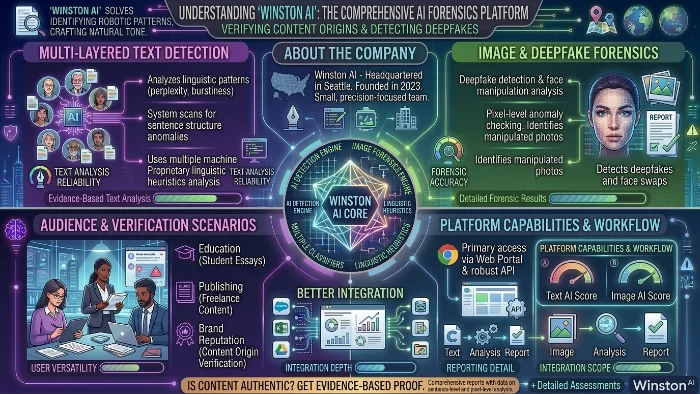
The internet is drowning in AI-generated content. Some estimates suggest over 60% of online text now comes from language models. That creates a problem. How do you know what’s real and what’s machine-made?
Winston AI answers that question. This platform doesn’t just guess. It analyzes text and images with forensic precision. The system processes content through multiple detection layers, examining everything from sentence structure to pixel-level anomalies.
What makes Winston AI different from other detectors? The platform combines several approaches. It uses multiple machine learning classifiers. It applies proprietary linguistic heuristics. And it offers something rare in this space: actual image forensics. Most detectors only handle text. Winston AI analyzes images too, including deepfake detection and manipulated photos.
Think of it like a security system for content. Whether you’re a teacher checking student essays, a publisher verifying freelance work, or a brand protecting your reputation, Winston AI gives you evidence-based answers about content origins.
How Winston AI’s Detection Technology Actually Works
The Text Detection Engine
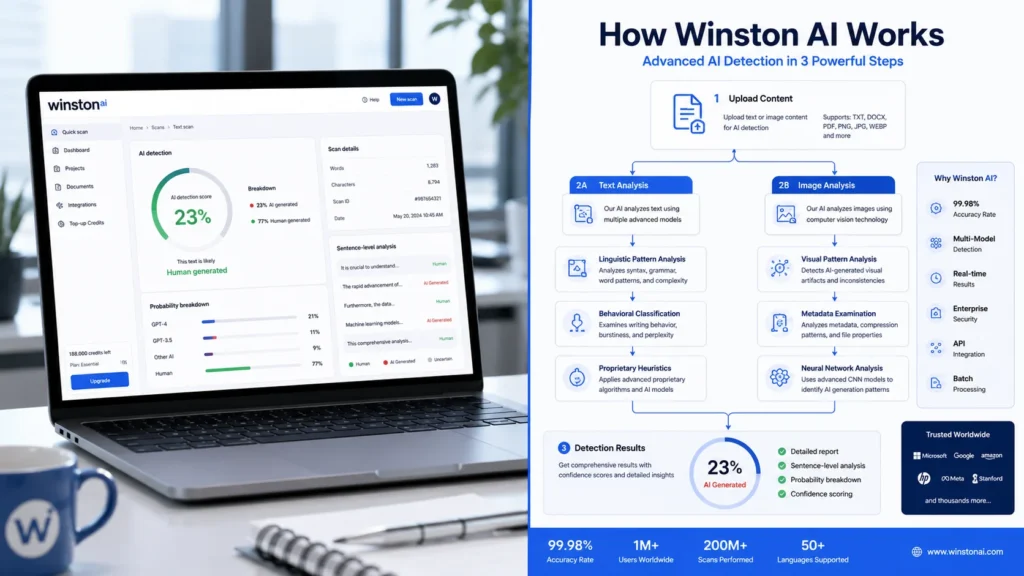
Winston AI processes text through a multi-stage analysis pipeline. Each stage examines different aspects of the content.
First Stage: Linguistic Pattern Analysis
The system evaluates word choice, sentence structure, and writing patterns. AI-generated text exhibits distinctive statistical properties. Human writing shows more variation in sentence length and complexity. The platform measures these differences with mathematical precision.
Second Stage: Behavioral Classification
Multiple machine learning models analyze the text independently. Each model looks for different signals. One examines perplexity patterns. Another checks burstiness scores. A third evaluates semantic coherence. The platform combines these results for a final probability score.
Third Stage: Proprietary Heuristic Layer
This is where Winston AI differs from basic detectors. The platform applies specialized linguistic rules developed through extensive testing. These heuristics catch subtle patterns that standard machine learning models might miss.
Image Detection and Forensics
Most AI detectors ignore images entirely. Winston AI treats them with equal seriousness. The platform offers two scan levels:
| Scan Type | Credit Cost | Features Included |
|---|---|---|
| Basic | 200 credits | AI probability score, metadata extraction (EXIF, IPTC, C2PA) |
| Advanced | 500 credits | Everything in Basic plus Error Level Analysis, Residual Noise Maps, Edge Anomaly Heat Map, CFA Pattern Analysis |
The Advanced scan is particularly powerful. Error Level Analysis reveals pixel-level inconsistencies that indicate manipulation. Residual Noise Maps show whether an image lacks natural camera sensor patterns. Edge Anomaly Heat Maps flag unnatural boundary artifacts common in AI-generated images.
These tools help distinguish between AI-generated images and authentic photographs. The system also reads C2PA watermarks and Content Credentials metadata from tools like Adobe Firefly and ChatGPT.
OCR and Handwriting Recognition
Here’s a feature few competitors match. Winston AI can scan documents with optical character recognition. It processes scanned text and even handwriting samples. This is particularly valuable in academic settings where students submit physical assignments.
Winston AI Accuracy: What the Numbers Really Mean
Winston AI claims 99.98% accuracy based on benchmark testing across major AI models. That sounds impressive. But let’s be realistic about what that means.
The 99.98% figure comes from controlled testing environments. Real-world conditions vary. Independent research confirms Winston AI performs well. An IEEE study evaluating multiple detectors found Winston AI among the top performers.
However, no detector is perfect. Accuracy depends on three critical factors:
Text Length matters enormously. The platform requires a minimum of 500 characters for reliable analysis. Shorter text produces wider confidence intervals. The more words you scan, the more accurate the result.
Document Type affects detection reliability. Natural prose like essays, articles, and emails is easiest to classify. Lists, code, and legal boilerplate are harder because they lack the linguistic variation detectors rely on.
Human Editing can fool detectors. Heavy rewrites or AI humanizer tools raise the Human Score because the text starts resembling human cadence. This is an arms race. As AI gets better, detection must improve too.
Winston AI provides transparent guidance on interpretation. When you see borderline results between 40-60%, the platform recommends scanning more text or looking for external context before making decisions. No single score should be treated as a guilty verdict.
Winston AI Pricing: Credit System Explained
Winston AI uses a credit-based pricing model. This is important to understand because costs can add up quickly.
| Action | Credit Cost |
|---|---|
| Text scan | 1 credit per word |
| Basic Image Scan | 200 credits |
| Advanced Image Scan | 500 credits |
| Plagiarism Check | 2 credits per word |
The free trial gives you 2,000 credits for 14 days. That’s enough to test thoroughly without committing money. No credit card required.
Essential Plan: $18 monthly or $144 annually. Provides 80,000 credits per month. Includes AI text detection, basic image scanning, OCR, writing feedback, and API access. Best for individuals and small teams focused on AI detection only.
Advanced Plan: $29 monthly or $228 annually. Provides 200,000 credits per month. Adds plagiarism checking, advanced image forensics, HUMN-1 certification badge, and up to five team members. Best for teams needing both AI detection and plagiarism checking.
Elite Plan: $49 monthly or $384 annually. Provides 500,000 credits per month. Adds HUMN-1+ website certification, unlimited team members, and priority support. Best for enterprises with high volume needs.
Annual billing saves roughly 40-45% versus monthly rates.
What Is HUMN Certification?
HUMN certification is Winston AI’s website verification feature. It signals to visitors that your site’s content has been verified for human authorship. This builds trust with readers and search engines. HUMN-1 is for individual websites. HUMN-1+ is available on Elite plans.
Who Uses Winston AI and Why
Winston AI serves several distinct user groups:
Educators and Academic Institutions
Teachers verify student essays, capstones, and discussion posts. The platform integrates with Google Classroom and other learning management systems. Academic integrity teams use it to investigate potential misconduct.
Publishers and SEO Agencies
Content teams verify that freelance articles are genuinely human-written. The platform catches AI-generated content that might harm search rankings or brand reputation. Plagiarism checking ensures submitted work is original.
Marketing and Communications Teams
Brands audit campaign copy, product descriptions, and press releases before publication. Maintaining authentic human voice is increasingly important for brand trust. Winston AI provides evidence of content origins.
Legal and Compliance Departments
Policy documents, contracts, and regulated communications need verification of authorship. Legal teams use Winston AI to confirm documents meet human authorship requirements.
Enterprises Building AI Governance Programs
Organizations developing AI usage policies combine detection, plagiarism checks, and HUMN certification to enforce internal guidelines. This creates a defensible content verification process.
Winston AI vs Competitors: How It Stacks Up
The AI detection market has several players. Each has strengths and weaknesses.
| Tool | Best For | Starting Price | Key Differentiator |
|---|---|---|---|
| Winston AI | Comprehensive verification (text + images) | $18/month | Image forensics, OCR, HUMN certification |
| Originality.ai | SEO and publishing teams | $14.95/month | Bundled plagiarism + AI detection |
| GPTZero | Education and quick checks | Free tier available | Widest brand recognition in education |
| Copyleaks | Enterprise deployment | Custom pricing | LMS integrations, institutional scale |
| Sapling | Detection + writing assistance | Free tier available | Integrated productivity stack |
Winston AI vs Originality.ai
Originality.ai focuses heavily on content operations. It’s built for SEO agencies and publishers who need bulk scanning. The dashboard is modern but can feel complex for beginners.
Winston AI markets more broadly. Education is a major focus. The platform also offers image detection, which Originality.ai doesn’t match. Choose Originality.ai for dedicated publishing workflows. Choose Winston AI for broader content verification needs.
Winston AI vs GPTZero
GPTZero has the strongest brand recognition in education. Its free tier makes it accessible for casual checks. Sentence-level highlighting is intuitive for classroom use.
Winston AI offers more comprehensive features. Image detection, OCR, and plagiarism checking go beyond what GPTZero provides. The paid tiers offer higher volume capacity. Choose GPTZero for quick academic checks. Choose Winston AI for professional verification across multiple content types.
Winston AI vs Copyleaks
Copyleaks excels at enterprise scale. LMS integrations and institutional deployment are strengths. The plagiarism engine has deep historical reach.
Winston AI is more lightweight and accessible. The interface is simpler for individual users. Image detection gives Winston AI an advantage in visual content verification.
How to Use Winston AI: Step-by-Step
Step One: Create a Free Account
Visit app.gowinston.ai and register. No credit card required. You receive 2,000 credits for a 14-day trial.
Step Two: Install Browser Extension
Winston AI offers extensions for Chrome, Edge, and Firefox. The extension lets you scan content directly on any webpage. Highlight text, right-click, and select “scan for AI content.”
Step Three: Scan Text
The platform requires a minimum of 500 characters for reliable analysis. Upload text directly or paste it into the web dashboard. Each word costs one credit.
Step Four: Scan Images
Upload images through the dashboard. Basic scans cost 200 credits. Advanced scans cost 500 credits and provide full forensic analysis. Results include probability scores and detailed forensics reports.
Step Five: Interpret Results
Results show the AI-generated probability percentage. A Human Score above 50% suggests human authorship. Scores in the 40-60% range are borderline and require additional context. Sentence-level heat maps show which sections appear AI-generated.
Step Six: Download Reports
Share results as PDF reports. This is valuable for documenting findings in academic or professional contexts.
The Limitations You Should Know
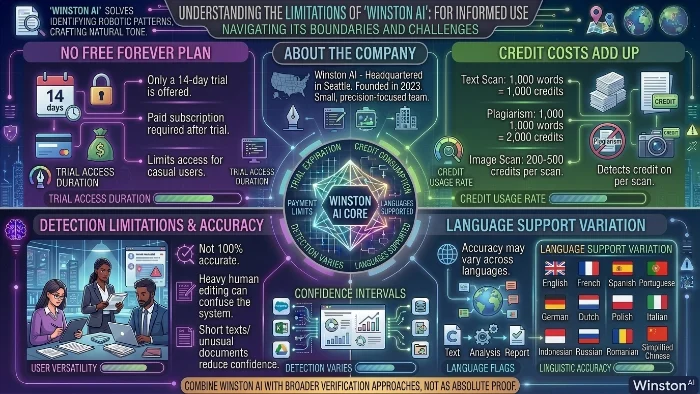
Winston AI is powerful but not perfect. Understanding its limits helps you use it effectively.
No Free Forever Plan
Unlike GPTZero’s ongoing free tier, Winston AI only offers a 14-day trial. After that, you need a paid subscription. Casual users may find this limiting.
Credit Costs Add Up
One thousand words cost 1,000 credits. Plagiarism checks cost 2,000 credits for the same text. Image scans are 200-500 credits each. Heavy users can burn through credits quickly.
Detection Limitations
No detector is 100% accurate. Heavy human editing can confuse the system. Short text or unusual document types produce wider confidence intervals. The platform recommends using detection as part of a broader verification approach, not as absolute proof.
Language Support
Winston AI supports detection in multiple languages including English, French, Spanish, Portuguese, German, Dutch, Polish, Italian, Indonesian, Russian, Romanian, and Simplified Chinese. However, accuracy may vary across languages.
Winston AI vs ChatGPT Detection Capabilities
Many users specifically want to know if Winston AI detects ChatGPT content. The answer is yes. Winston AI detects content from all major language models including:
| AI Model | Detection Status |
|---|---|
| ChatGPT (GPT-3.5) | Fully supported |
| GPT-4 | Fully supported |
| GPT-4o | Fully supported |
| Claude (Anthropic) | Fully supported |
| Google Gemini | Fully supported |
| Microsoft Copilot | Fully supported |
| Grok (xAI) | Supported |
The platform maintains detection capabilities across model versions. As AI models improve, Winston AI updates its detection algorithms accordingly.
FAQs
Is Winston AI completely free to use?
No. Winston AI offers a 14-day free trial with 2,000 credits. After the trial, you need a paid subscription starting at $18 monthly. There is no ongoing free plan available.
How accurate is Winston AI compared to other detectors?
Winston AI claims 99.98% accuracy based on benchmark testing across major AI models. Independent research from IEEE shows Winston AI among the top-performing detectors available. However, accuracy varies based on text length, document type, and the amount of human editing applied.
Can Winston AI detect AI-generated images too?
Yes. Winston AI offers both Basic and Advanced image scanning. The Advanced scan includes forensic tools like Error Level Analysis, Residual Noise Maps, Edge Anomaly Heat Maps, and CFA Pattern Analysis. The platform also reads metadata and C2PA watermarks.
How does Winston AI’s credit system work?
Plagiarism checks cost two credits per word. Plans range from 80,000 to 500,000 credits monthly.
Is Winston AI suitable for checking student assignments?
Yes. Winston AI is widely used in education for verifying student essays and assignments. The platform integrates with Google Classroom and other learning management systems. OCR functionality even handles scanned documents and handwriting.
What plagiarism features does Winston AI offer?
The Advanced and Elite plans include plagiarism checking that compares content against billions of web pages. The system supports cross-language plagiarism detection and source attribution. This combines with AI detection for comprehensive content verification.
Can I integrate Winston AI with my existing tools?
Yes. Winston AI offers API access on all paid plans. Browser extensions work with Chrome, Edge, and Firefox. Integrations include Google Classroom and WordPress. The platform supports team collaboration features on Advanced and Elite plans.
Conclusion
Winston AI stands out for comprehensiveness. It doesn’t just detect AI text. It verifies images, checks plagiarism, provides writing feedback, and offers website certification. Few competitors match this breadth.
The credit system is the biggest downside. Heavy users face significant costs. But for professional applications where accuracy matters, the investment makes sense. Publishers, educators, and enterprises need reliable verification.
The free trial gives you room to evaluate thoroughly. Try it with your actual content. Test borderline cases. See how it performs on your specific document types. That’s the real test of whether Winston AI fits your needs.
For teams serious about content authenticity, Winston AI delivers. The forensic depth, image analysis, and HUMN certification provide capabilities beyond basic detectors. It’s not the cheapest option. But it might be the most complete one.

Victoria Lane is a grammar-focused writer at GramBrix.com, passionate about helping readers master the rules of language. She provides clear explanations and practical examples that make writing more accurate, polished and confident.