Last Updated on August 18, 2026
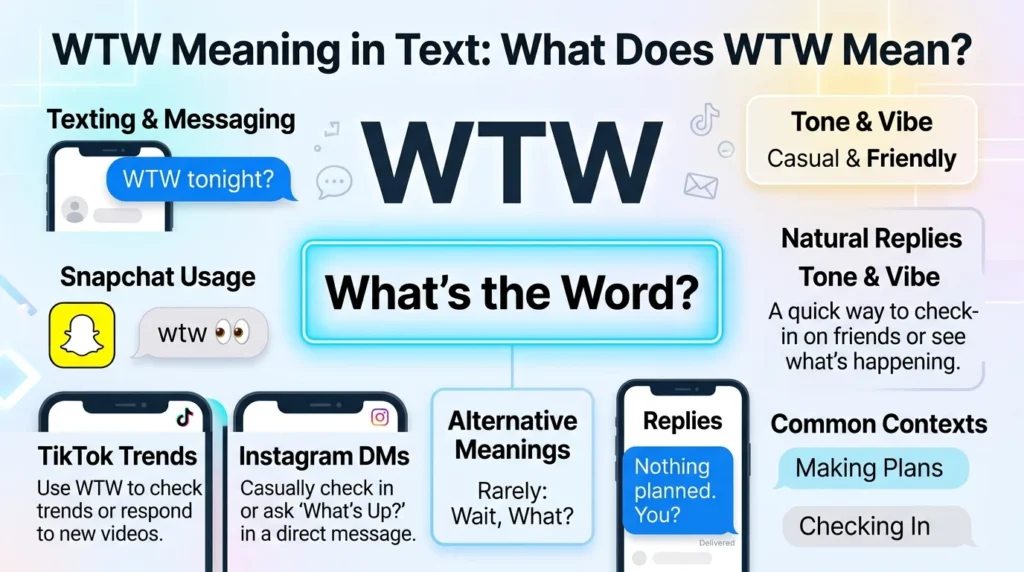
WTW usually means “What’s the word?” in texting and social media. People use it to ask what is happening, what someone is doing, or whether they have plans. Depending on context, it can also mean “What’s up?” or “What’s the word?”
wtw meaning in text is usually “What’s the word?” It is a casual way to ask someone what is happening, what they are doing, or whether they have plans.
For example, a friend might text, “WTW tonight?” They are probably asking about your plans. Similarly, “WTW?” can work as a relaxed conversation starter.
However, the exact meaning depends on context. Slang often changes between friend groups, platforms, and conversations. Therefore, you should read the surrounding messages before deciding what someone means.
The abbreviation appears most often in informal digital communication. You may see it in texts, Snapchat messages, Instagram DMs, TikTok comments, and other social spaces.
Importantly, WTW does not normally sound formal. It feels quick, friendly, and conversational. In some situations, it can also show interest in meeting up or joining an activity.
This guide explains the phrase in detail. You will learn how people use it, what it means across major platforms, how to respond, and when another interpretation may make more sense.
Quick Answer Box
| Meaning | Context | Primary Platforms | Example | Tone |
|---|---|---|---|---|
| What’s the word? | Asking what is happening or planned | Texting, Snapchat, Instagram | “WTW tonight?” | Casual |
| What’s up? | Checking in with someone | Texting, social media | “WTW bro?” | Friendly |
| What are you on? | Asking about someone’s current activity or situation | Informal chats | “WTW rn?” | Casual |
| What’s the word? about plans | Starting a conversation about going out | Snapchat, texting | “WTW this weekend?” | Social |
What Does wtw meaning in text Mean?
The most common wtw meaning in text is “What’s the word?”
Here, “the word” does not literally refer to a word. Instead, it means information, news, plans, or the current situation.
For example:
Person A: “WTW?”
Person B: “Not much. You?”
Person A is essentially asking, “What’s happening?” or “What’s going on?”
The abbreviation can also function like “What’s up?” This interpretation becomes especially likely when there is no specific event or plan in the conversation.
What Does “What’s the Word?” Mean?
“What’s the word?” is an informal expression that can mean:
| Expression | Practical meaning |
|---|---|
| What’s the word? | What’s happening? |
| What’s the word? | What are the plans? |
| What’s the word? | What’s new? |
| What’s the word? | What are you doing? |
| What’s the word? | Do you have any information? |
Therefore, WTW is flexible. The surrounding conversation usually determines the intended meaning.
Why Do People Use WTW Instead of a Full Sentence?
Digital communication rewards speed. People often shorten familiar phrases because their friends already understand them.
WTW is especially convenient because three letters can replace a longer question.
Instead of writing:
“What are you doing tonight, and do you have any plans?”
Someone might write:
“WTW tonight?”
The shorter version feels natural in casual messaging.
Furthermore, abbreviations help create an informal social tone. They can make a message feel relaxed rather than carefully composed.
Is WTW Always “What’s the Word?”
No. Context matters.
In most casual conversations, “What’s the word?” is the strongest interpretation. However, some people use WTW differently.
For example, someone might use it to mean “What’s up?” Another person may use it as a broad question about current plans.
Consequently, you should not interpret the abbreviation in isolation.
If someone writes “WTW at 8?” they are likely asking about plans around 8 o’clock. If they simply write “WTW?” they may be checking in.
Where Did the Expression Come From?
“What’s the word?” is older than internet slang. People have used the expression conversationally to ask for news, information, or updates.
Social media did not create the phrase. Instead, digital communication shortened it into WTW.
That transformation follows a common pattern in online language. Long expressions become abbreviations when users repeat them frequently.
Similar examples include:
| Abbreviation | Common expansion |
|---|---|
| WYD | What are you doing? |
| WYA | Where you at? |
| WBU | What about you? |
| WSG | What’s good? |
| WTW | What’s the word? |
These expressions often overlap. Therefore, the best interpretation depends on the conversation.
Contextual Dynamics & Nuances of the Term
Understanding wtw meaning in text requires more than memorizing one definition. Tone, punctuation, timing, and previous messages can change the meaning.
WTW as a Conversation Starter
A simple “WTW?” can start a conversation without sounding overly formal.
For example:
“WTW?”
This could mean:
“What are you up to?”
“What’s going on?”
“What are the plans?”
“What’s new?”
The sender may simply want to reconnect.
WTW When Making Plans
The phrase becomes more specific when paired with a time or event.
For example:
“WTW tonight?”
This probably means, “What are the plans tonight?”
Similarly:
“WTW Friday?”
The sender may want to know whether you are free or whether something is happening.
Therefore, adding a time reference can narrow the meaning.
WTW as an Invitation Signal
Sometimes WTW indirectly tests whether someone wants to hang out.
Consider:
“WTW later?”
The sender may not be asking for information alone. They could be checking whether you are available.
If you answer:
“Nothing planned. What’s up?”
you give them an opening to suggest an activity.
Tone Can Change the Message
Capitalization usually does not change the meaning.
“WTW?”
“wtw?”
“Wtw?”
All can communicate the same basic idea.
However, punctuation can affect the feeling.
| Message | Possible tone |
|---|---|
| WTW? | Direct and casual |
| wtw | Very relaxed |
| WTW tonight? | Planning focused |
| WTW 😭 | Playful or dramatic |
| WTW 👀 | Curious or interested |
| WTW lol | Lighthearted |
Emojis can add emotional context. Still, they do not create a fixed definition.
Relationship Matters
A close friend may send:
“wtw bro”
That sounds highly casual.
A new acquaintance might write:
“WTW this weekend?”
That could feel more like a social invitation.
Meanwhile, a coworker may avoid WTW entirely because the abbreviation is informal.
Thus, the relationship between the people affects whether the expression feels natural.
Real Life Conversation Examples Using wtw meaning in text
The best way to understand wtw meaning in text is to see how people use it in realistic conversations.
Example 1: Asking About Tonight
Alex: “WTW tonight?”
Jordan: “Nothing planned yet. You?”
Alex: “A few of us might grab food.”
Here, WTW means something close to “What are the plans tonight?”
Example 2: Checking In
Maya: “wtw?”
Chris: “Just chilling at home.”
Maya: “Same 😂”
In this case, the message works more like “What’s up?” or “What are you doing?”
Example 3: Looking for Weekend Plans
Sam: “WTW this weekend?”
Taylor: “Probably going downtown Saturday.”
Sam: “Bet. I might come through.”
The sender is asking about weekend plans.
Example 4: Showing Interest
Nina: “WTW later 👀”
Jay: “Not sure yet.”
Nina: “Lmk if you wanna do something.”
The emoji adds a hint of curiosity or interest. The abbreviation itself remains casual.
Example 5: Asking for Information
Chris: “WTW with the game?”
Drew: “They postponed it.”
Here, WTW is asking for an update. The phrase means something like “What’s the latest information?”
These examples demonstrate why context matters. The abbreviation does not always translate into exactly the same sentence.
Platform Specific Breakdown
Online platforms share slang, but users may apply the same abbreviation differently depending on the environment.
How It Is Used on Snapchat
Snapchat strongly favors short, conversational messages. Therefore, WTW fits naturally into the platform.
Someone might send:
“WTW?”
Or:
“WTW tonight?”
Or:
“WTW 👀”
Snapchat users often communicate through quick messages, photos, videos, and informal replies. As a result, abbreviations can feel especially natural.
The phrase can also appear when someone wants to make plans.
For example:
“WTW after work?”
The sender may be asking what everyone is doing later.
However, Snapchat context can be highly personal. A message between close friends may carry a different tone from one between acquaintances.
The Role of wtw meaning in text on TikTok
TikTok uses slang heavily in comments, captions, direct messages, and community conversations.
On TikTok, WTW can appear when users discuss plans, reactions, or current situations.
For example:
“WTW this weekend?”
could be a casual question about upcoming plans.
Meanwhile:
“WTW with this trend?”
could ask what is happening with a trend or why people are discussing it.
TikTok language also changes quickly. Therefore, users should avoid assuming that every abbreviation has one permanent meaning.
Context remains the strongest clue.
Instagram and Texting Dynamics
Instagram DMs often resemble ordinary texting. Therefore, WTW can work naturally in private conversations.
A friend might send:
“WTW later?”
Someone might reply:
“I’m free after 7.”
The abbreviation can also appear in group chats.
For example:
“WTW Friday?”
A group may then discuss restaurants, parties, movies, or other activities.
Text messaging follows a similar pattern. Because SMS and messaging apps encourage fast communication, familiar abbreviations save time.
Still, WTW usually belongs in informal conversations.
Alternative Meanings & NLP Variations of the Phrase
The strongest interpretation is “What’s the word?” However, online language is not perfectly standardized.
Common Interpretations
| Possible interpretation | When it makes sense |
|---|---|
| What’s the word? | Asking about news or plans |
| What’s up? | General check in |
| What’s going on? | Asking about a situation |
| What are the plans? | Discussing an upcoming activity |
| What’s happening? | Requesting an update |
The surrounding words usually provide the necessary clue.
WTW and “What’s Up?”
WTW and “What’s up?” can overlap heavily.
For instance:
“WTW bro?”
could easily mean:
“What’s up, bro?”
However, the phrase may have a stronger planning meaning when paired with a time.
“WTW tonight?”
sounds more like:
“What are we doing tonight?”
WTW and “What Are You Doing?”
WYD is more directly associated with “What are you doing?”
Still, people can use WTW for a similar purpose.
Compare these examples:
“WYD?”
This directly asks about someone’s current activity.
“WTW?”
This is broader. It may ask about activity, plans, news, or the general situation.
Therefore, the two abbreviations should not automatically be treated as identical.
Linguistic Variation Across Friend Groups
Slang is socially negotiated.
One friend group may use WTW primarily for plans. Another may use it as a general greeting.
Consequently, dictionaries cannot capture every private usage.
When the meaning seems unclear, the surrounding conversation provides the best evidence.
Misinterpretations: When NOT to Use wtw meaning in text
Knowing wtw meaning in text also means knowing when the abbreviation does not fit.
Avoid It in Formal Communication
WTW usually does not belong in:
Professional emails
Job applications
Academic papers
Business proposals
Formal customer communication
Official documents
For example, writing “WTW about the meeting?” to a manager may sound overly casual.
Instead, write:
“Do you have an update about the meeting?”
Avoid Assuming It Means One Thing
Do not automatically translate every WTW message as “What’s the word?”
For example:
“WTW with your car?”
could mean:
“What’s going on with your car?”
It may not relate to social plans at all.
Do Not Force the Slang
Using slang can feel unnatural if it does not match your normal communication style.
If you rarely use abbreviations, writing WTW may feel artificial.
Natural communication matters more than using trending slang.
Be Careful With Professional Audiences
Some readers may not recognize WTW.
Older audiences, international readers, customers, or formal contacts may interpret it incorrectly.
Therefore, standard language is safer when clarity matters.
How to Respond in Chat Comfortably
Once you understand wtw meaning in text, responding becomes simple.
Your answer should match the apparent purpose of the message.
If They Ask About Your Plans
You can answer directly.
“Nothing yet. What did you have in mind?”
Or:
“I’m free tonight. You?”
If They Are Checking In
Try:
“Not much. Just relaxing. What’s up?”
Or:
“I’m good. What are you doing?”
If You Are Interested in Hanging Out
You can keep your answer open.
“I’m down. What’s the plan?”
Or:
“Nothing planned yet. Want to do something?”
If You Are Busy
A short response works.
“I’m busy tonight, maybe tomorrow?”
This keeps the conversation friendly without overexplaining.
If You Do Not Understand the Context
Ask for clarification.
“What do you mean?”
Or:
“WTW about what?”
There is nothing wrong with asking. Slang varies between communities.
Common Response Styles
| Situation | Natural response |
|---|---|
| You are free | “Nothing planned. What’s up?” |
| You want details | “What did you have in mind?” |
| You are interested | “I’m down. What’s the plan?” |
| You are busy | “Can’t tonight. Maybe tomorrow?” |
| You need clarification | “WTW about what?” |
| You are casually chatting | “Not much, you?” |
FAQs
What does wtw meaning in text usually refer to?
The most common interpretation is “What’s the word?” In practice, that means “What’s happening?”, “What’s new?”, or “What are the plans?” Context determines the precise meaning.
What does WTW mean on Snapchat?
On Snapchat, WTW commonly asks what someone is doing or what plans are happening. It can also work as a casual conversation starter between friends.
Is WTW the same as WYD?
Not exactly. WYD directly means “What are you doing?” WTW is broader and can ask about plans, news, activities, or what is happening.
Does WTW mean “What’s up?”
Sometimes. People may use it similarly to “What’s up?” especially when the message appears alone. However, “What’s the word?” remains the common expansion.
Is WTW a formal abbreviation?
No. WTW is primarily informal internet and texting slang. Standard language works better for professional, academic, or official communication.
What should I reply when someone says WTW?
Match your reply to the context. You could say, “Not much, you?”, “Nothing planned,” or “What did you have in mind?”
Can WTW refer to plans?
Yes. A message such as “WTW tonight?” commonly asks about plans for the evening. The time reference makes the intended meaning clearer.
What does “WTW 👀” suggest?
The basic abbreviation still asks what is happening or what the plans are. The eyes emoji can add curiosity, interest, anticipation, or playful attention.
Can WTW have another meaning?
Yes. Abbreviations can develop different meanings within specific communities. However, “What’s the word?” is the standard interpretation in casual texting contexts.
Should I use WTW with someone I do not know well?
You can, but consider the relationship first. If the person rarely uses slang, a full phrase may communicate more clearly. Informal language works best when both people understand it.
Conclusion
Understanding wtw meaning in text is less about memorizing three letters and more about reading context.
WTW most commonly means “What’s the word?” In everyday communication, that can translate into “What’s happening?”, “What’s up?”, or “What are the plans?”
The exact interpretation changes with the conversation.
For example, “WTW?” can function as a casual check in. Meanwhile, “WTW tonight?” usually focuses on plans. A message such as “WTW with that?” may request information about a specific situation.
Furthermore, platforms influence how slang feels. Snapchat and Instagram encourage quick personal communication. TikTok adds a fast moving layer of community language. Text messaging keeps abbreviations useful for everyday conversations.
However, slang does not have universal rules. Different communities may use the same abbreviation differently. Therefore, context should always guide interpretation.
The safest approach is simple: look at the words around WTW, consider your relationship with the sender, and notice whether the conversation concerns plans, news, or general conversation.
Used naturally, WTW is a short and friendly way to keep a conversation moving. It reflects a broader trend in digital language where familiar expressions become shorter, faster, and more adaptable.
That flexibility explains why abbreviations remain such a strong part of modern online communication.

Victoria Lane is a grammar-focused writer at GramBrix.com, passionate about helping readers master the rules of language. She provides clear explanations and practical examples that make writing more accurate, polished and confident.