Last Updated on August 10, 2026
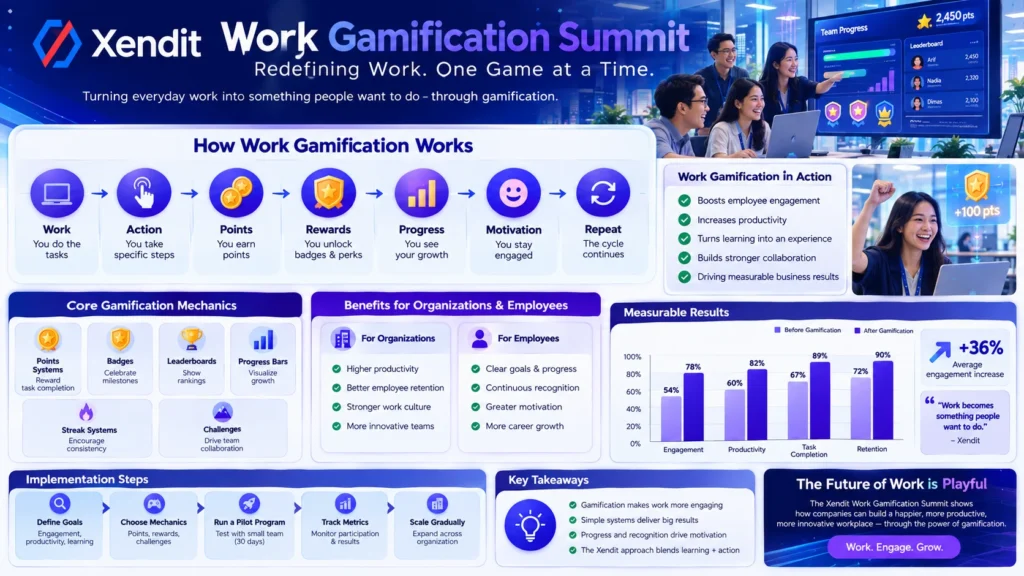
The Xendit Work Gamification Summit is a workplace innovation concept focused on applying gamification systems such as points, rewards, and leaderboards to improve employee engagement, productivity, and performance. By combining behavioral psychology with real-time feedback systems, it helps organizations turn everyday work into measurable, motivating experiences that drive consistent results.
Why the Xendit Work Gamification Summit Matters Now

Work has changed. Fast.
Teams no longer sit in rigid systems waiting for instructions. Instead, they expect feedback, recognition, and progress they can see. Yet many companies still rely on outdated structures. That gap creates disengagement.
Now imagine this:
You complete a task and instantly earn points. Your progress bar fills up. A leaderboard shows your rank. You unlock a reward.
Suddenly, work feels different.
That’s the core idea behind the Xendit Work Gamification Summit—a framework-driven approach that treats work like a system of challenges, rewards, and progression.
It doesn’t just talk about engagement. It designs it.
What Is Xendit Work Gamification Summit? (Clear Explanation)
The Xendit Work Gamification Summit represents a structured approach to workplace gamification. It blends event-style knowledge sharing with practical implementation frameworks used inside organizations.
At its core, it focuses on one thing:
Turning work into a system people want to participate in.
What It Actually Includes
- Gamification frameworks for teams
- Behavioral design strategies
- Employee engagement systems
- Productivity optimization tools
- Case-driven learning sessions
Key Reality Check
This isn’t just a traditional conference. It’s a hybrid concept:
- Part summit (learning, strategy, discussion)
- Part operational model (implementation inside teams)
That dual nature makes it powerful.
The Real Problem It Solves (Why It Exists)
Most companies don’t have a motivation problem. They have a system problem.
What’s Broken in Traditional Work Systems
- No immediate feedback
- Progress is invisible
- Recognition comes too late
- Work feels repetitive
What Happens Next
- Engagement drops
- Productivity becomes inconsistent
- Employees disconnect
Why Old Solutions Fail
| Traditional Solution | Why It Fails |
|---|---|
| Salary increases | Short-term motivation only |
| Bonuses | Delayed reward loop |
| Training programs | Lack of real-time engagement |
| Performance reviews | Too infrequent |
Core Insight
People don’t stay motivated by promises. They stay motivated by progress they can see.
That’s exactly what gamification solves.
The Science Behind Gamification in Workplaces
Gamification works because it taps into how humans naturally behave.
Key Psychological Drivers
- Dopamine loops → Reward anticipation
- Progress tracking → Sense of achievement
- Competition → Social motivation
- Recognition → Emotional satisfaction
Core Gamification Principles
- Immediate feedback
- Clear goals
- Visible progress
- Variable rewards
Example
Think of a fitness app:
- You walk → You earn points
- You hit a goal → You get a badge
- You compare → You stay motivated
Now apply that to work.
How the Xendit Gamification Summit Is Structured
The structure focuses on practical outcomes, not theory.
Event Format
- Keynote sessions
- Strategy workshops
- Case study breakdowns
- Interactive discussions
Core Tracks
- Engagement design
- Behavioral analytics
- Team performance systems
What Happens Inside Sessions
- Real-world examples
- Framework implementation
- Live system mapping
What Attendees Walk Away With
- Gamification playbooks
- KPI tracking templates
- Pilot program structures
Core Gamification Mechanics Used by Xendit
These mechanics form the backbone of the system.
Essential Elements
- Points Systems → Reward task completion
- Badges → Celebrate milestones
- Leaderboards → Show rankings
- Progress Bars → Visualize growth
- Streak Systems → Encourage consistency
- Challenges → Drive collaboration
Why These Work
They create a loop:
Action → Reward → Progress → Motivation → Repeat
How Xendit Applies Gamification in Real Work Systems
Let’s break this down with real use cases.
Onboarding Systems
New employees often feel overwhelmed.
Gamification changes that.
How It Works
- Step-by-step progress tracking
- Points for completing tasks
- Rewards for milestones
Result
- Faster onboarding
- Higher engagement
- Better knowledge retention
Customer Support Teams
Support roles demand consistency.
Gamification creates structure.
System Design
- Points per resolved ticket
- Leaderboards for performance
- Rewards for response speed
Outcome
- Increased productivity
- Better service quality
Retention and Transactions
Gamification also influences long-term behavior.
Example
- Surprise rewards
- Engagement streaks
- Performance-based incentives
Impact
- Higher retention rates
- Consistent performance
Measurable Results and Business Impact
Gamification doesn’t rely on guesswork. It produces measurable outcomes.
Key Improvements
- Engagement levels rise
- Productivity becomes consistent
- Collaboration improves
- Retention increases
Performance Comparison Table
| Metric | Before Gamification | After Gamification |
|---|---|---|
| Engagement | Low | High |
| Task Completion | Irregular | Consistent |
| Motivation | Declining | Sustained |
| Team Collaboration | Weak | Strong |
Example Insight
Organizations using structured gamification systems often report noticeable improvements in onboarding efficiency and task completion consistency.
Key Principles That Make Gamification Work
Not all gamification systems succeed.
The difference lies in design.
Core Principles
- Reward effort, not just results
- Keep systems simple
- Provide instant feedback
- Focus on small wins
- Make progress visible
Important Truth
Complexity kills engagement. Simplicity drives participation.
Step-by-Step Framework to Implement Work Gamification
You don’t need a massive system to start.
Step One: Define Goals
- Improve engagement
- Increase productivity
- Enhance learning
Step Two: Choose Mechanics
- Points
- Rewards
- Challenges
Step Three: Run a Pilot Program
- 30-day testing phase
- Small team implementation
Step Four: Track Metrics
- Participation rate
- Task completion
- Engagement levels
Step Five: Scale Gradually
- Expand across teams
- Optimize based on data
Benefits for Organizations and Employees
Gamification creates value on both sides.
For Organizations
- Higher productivity
- Better retention
- Stronger culture
For Employees
- Clear goals
- Continuous recognition
- Increased motivation
Challenges and Risks (Often Ignored)
Gamification isn’t perfect.
Poor design creates problems.
Common Risks
- Over-competition → burnout
- Too many metrics → confusion
- Weak rewards → disengagement
- Poor implementation → failure
Critical Insight
Gamification should feel natural, not forced.
Best Practices from the Xendit Approach
What Works
- Start small
- Focus on behavior
- Use meaningful rewards
- Balance competition with collaboration
- Track real data
Who Should Care About This Summit
This isn’t limited to HR teams.
Relevant Roles
- HR leaders
- Team managers
- Product leaders
- Startup founders
- Operations managers
If you manage people, this matters.
Future Trends in Work Gamification (2026 and Beyond)
The future looks interactive.
Emerging Trends
- AI-driven personalization
- Real-time dashboards
- Behavioral analytics
- Gamified remote work
Big Shift
Work will become:
- Measurable
- Interactive
- Adaptive
Key Takeaways
- Gamification transforms how people experience work
- The Xendit model focuses on real implementation
- Simple systems outperform complex ones
- Engagement increases when progress becomes visible
FAQs
What is Xendit Work Gamification Summit?
It’s a workplace innovation framework that uses gamification systems to improve engagement and productivity.
Is it a real event or a concept?
It combines elements of both—summit-style learning and real-world implementation strategies.
How does gamification improve productivity?
It creates motivation loops through rewards, feedback, and visible progress.
Can small businesses use this?
Yes. Even simple systems like points and rewards can work effectively.
Is it suitable for remote teams?
Absolutely. Digital dashboards and tracking tools make it ideal for remote work.
Core NLP Terms
- Xendit
- Work
- Gamification
- Summit
Expanded NLP Keywords & Variations
- Xendit summit
- Work gamification
- Employee engagement gamification
- Corporate gamification summit
- Workplace innovation summit
- Business gamification event
Semantic Entities
Organization
- Xendit
Event Type
- Summit
- Conference
- Business event
Workplace Concepts
- Employee engagement
- Productivity
- Work culture
- HR innovation
Gamification Concepts
- Game mechanics
- Reward systems
- Behavioral incentives
Conclusion
Work is no longer just about tasks.
It’s about experience.
The Xendit Work Gamification Summit shows how companies can redesign work into something engaging, measurable, and motivating.
Not through gimmicks. Through systems.
And those who adopt it early?
They won’t just improve productivity.
They’ll redefine how work feels.

Kevin Brooks is a grammar specialist at GramBrix.com, dedicated to helping readers understand language rules with clarity and confidence. He simplifies complex grammar concepts through practical examples and easy explanations.