
Last Updated on July 15, 2026
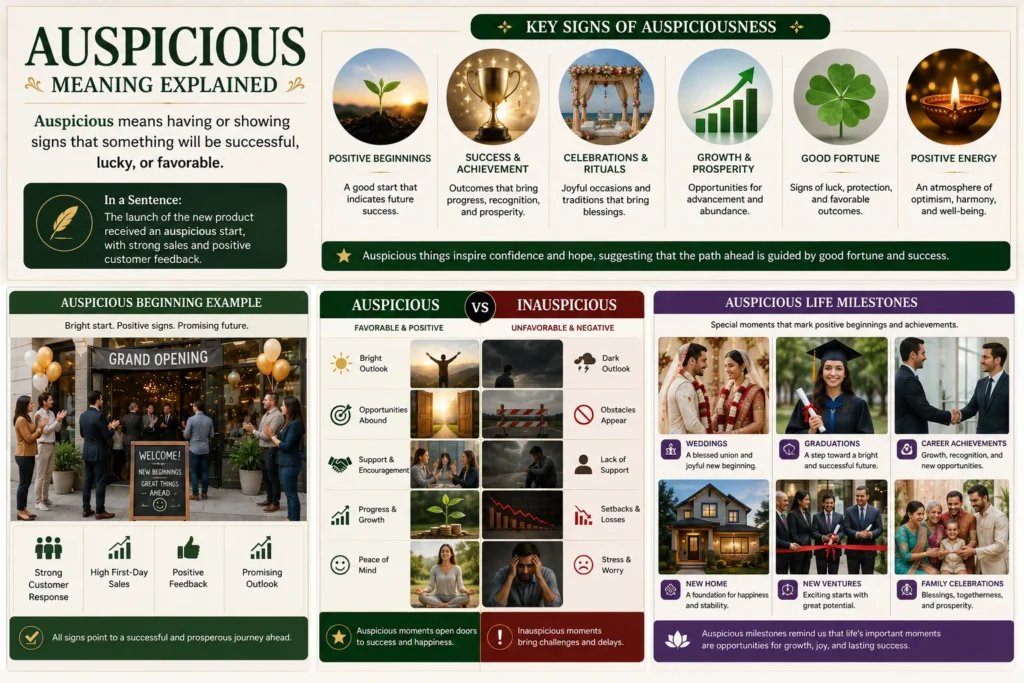
Auspicious means favorable, promising, or indicating future success, good fortune, or positive outcomes. People use the word to describe events, signs, occasions, dates, circumstances, or beginnings that suggest something good is likely to happen.
Have you ever heard someone say, “This is an auspicious beginning,” or “They chose an auspicious date for the wedding”? If so, you may have wondered exactly what the word auspicious means.
The word auspicious is often associated with luck, success, prosperity, and positive outcomes. People use it when discussing important events, celebrations, business launches, relationships, career opportunities, and cultural traditions. Moreover, the word appears frequently in literature, news articles, speeches, and everyday conversations.
Understanding the auspicious meaning can help you expand your vocabulary and communicate more precisely. Furthermore, it allows you to recognize situations where people express optimism about the future.
In this comprehensive guide, you’ll learn the exact meaning of auspicious, how native English speakers use it, real-life examples, platform-specific usage, common misconceptions, related words, conversation examples, and much more.
Quick Answer Box
| Category | Explanation |
|---|---|
| Meaning | Favorable, promising, or indicating future success |
| Context | Events, dates, beginnings, opportunities, celebrations |
| Usage | Describing positive signs or fortunate circumstances |
| Tone | Positive and optimistic |
| Common Platforms | Social media, business, education, culture, literature |
| Example | “The company experienced an auspicious start.” |
| Synonyms | Favorable, promising, fortunate, lucky |
| Opposites | Inauspicious, unfavorable, unlucky, ominous |
What Does It Mean?
The word auspicious describes something that appears likely to bring success, good fortune, happiness, or favorable results.
People often use it when discussing:
- New beginnings
- Important events
- Opportunities
- Signs of success
- Positive developments
- Celebrations
- Milestones
Simple Definition
Auspicious = favorable + promising + fortunate
For example:
- An auspicious business launch
- An auspicious start to a career
- An auspicious wedding date
- An auspicious sign for future success
In most cases, the word suggests optimism and positive expectations.
Full Definition
Auspicious refers to circumstances, events, signs, or situations that indicate future success, prosperity, happiness, or good fortune.
Unlike simple luck, auspicious often implies that something serves as a positive indicator or encouraging signal for what comes next.
Key Characteristics of Something Auspicious
An auspicious event is usually:
- Favorable
- Encouraging
- Promising
- Hopeful
- Positive
- Lucky
- Beneficial
- Success-oriented
For instance, if a new business attracts many customers on its first day, people may describe that as an auspicious beginning.
Origin and History of the Word
The word auspicious comes from the Latin term auspicium, which referred to observing birds to predict future events.
In ancient Roman culture, leaders often looked for signs in nature before making important decisions. Favorable signs were considered auspicious because they suggested positive outcomes.
Over time, English speakers adopted the word to describe anything associated with good fortune, success, or favorable circumstances.
Today, people use auspicious in both formal and informal settings.
Context and Usage
The meaning of auspicious remains consistent across contexts. However, the application may vary.
In Daily Life
People often use the word when discussing positive events.
Example:
“The sunny weather created an auspicious atmosphere for the ceremony.”
In Business
Organizations frequently describe successful launches or positive trends as auspicious.
Example:
“The company reported an auspicious first quarter.”
In Education
Teachers and students may use the word to describe promising academic opportunities.
Example:
“The scholarship marked an auspicious beginning to her college career.”
In Relationships
People often describe favorable circumstances surrounding relationships as auspicious.
Example:
“Their first meeting seemed auspicious from the start.”
In Public Speaking
Speakers frequently use auspicious to create a hopeful tone.
Example:
“This gathering represents an auspicious moment in our community’s history.”
Emotional Meaning of Auspicious
Beyond its dictionary definition, auspicious often carries emotional significance.
Optimism
The word naturally suggests hope.
People use it when they expect positive outcomes.
Example:
“The project has an auspicious future.”
Confidence
Auspicious situations often increase confidence.
Example:
“The team’s early success created an auspicious outlook.”
Celebration
Many people associate the word with important life events.
Example:
“Families gathered to celebrate the auspicious occasion.”
Encouragement
The word can motivate people.
Example:
“The favorable results provided an auspicious sign for the future.”
Real-Life Examples
These examples demonstrate how people use auspicious in everyday situations.
Example 1: Business Launch
A startup gains thousands of customers during its first week.
“The company enjoyed an auspicious launch.”
Example 2: Career Opportunity
A recent graduate receives multiple job offers.
“Her professional journey began under auspicious circumstances.”
Example 3: Wedding Planning
A couple selects a date considered lucky by their family.
“They chose an auspicious day for the wedding.”
Example 4: Sports Season
A team wins its first five games.
“The season began with an auspicious streak of victories.”
Example 5: Academic Achievement
A student earns top marks during the first semester.
“The results marked an auspicious start to college life.”
Conversation Examples
The following realistic conversations show how native speakers use the word naturally.
Conversation Example 1
Person A: How was the grand opening?
Person B: It was incredibly successful. It felt like an auspicious beginning.
Conversation Example 2
Person A: Why did they select that date?
Person B: They believed it was an auspicious day for marriage.
Conversation Example 3
Person A: How is your new job going?
Person B: Very well. So far, it’s been an auspicious start.
Conversation Example 4
Person A: What do you think about the project’s future?
Person B: The early results seem auspicious.
Conversation Example 5
Person A: Was the event successful?
Person B: Yes. Everything pointed toward an auspicious outcome.
Platform-Specific Meaning
Although the meaning remains the same, people use the word differently across digital platforms.
Auspicious on Social Media
Users often describe positive milestones as auspicious.
Examples include:
- Career achievements
- Graduation ceremonies
- Business launches
- Relationship announcements
Example post:
“An auspicious beginning to a new chapter of life.”
Auspicious on Instagram
Instagram users frequently connect the word with celebrations and life events.
Example:
“Starting the year with an auspicious opportunity.”
Auspicious on TikTok
Creators sometimes use auspicious when discussing motivation, manifestation, and personal growth.
Example:
“The signs seem auspicious for this new venture.”
Auspicious on X
Users often use the word when discussing politics, economics, sports, or business.
Example:
“The economic indicators suggest an auspicious outlook.”
Auspicious in Professional Networks
Professionals use the word to describe promising partnerships and projects.
Example:
“The collaboration began under auspicious circumstances.”
Cultural Significance of Auspicious
The word carries special importance in many cultures around the world.
Weddings
Many families choose auspicious dates for weddings.
They believe favorable timing may contribute to a successful marriage.
Business Openings
Business owners sometimes seek auspicious dates for launches.
This practice remains common in several cultures.
Festivals
Many celebrations include auspicious symbols and traditions.
Examples include:
- Good luck symbols
- Prosperity rituals
- Blessings
- Ceremonial practices
New Beginnings
People often associate auspicious signs with:
- New homes
- New jobs
- New businesses
- New relationships
Alternative Meanings
Although the primary meaning centers on favorable outcomes, auspicious can apply in different ways.
Auspicious Event
A significant event expected to bring positive results.
Example:
“The conference opened with an auspicious announcement.”
Auspicious Sign
A signal that suggests success.
Example:
“The early feedback was an auspicious sign.”
Auspicious Beginning
A strong and encouraging start.
Example:
“The organization enjoyed an auspicious beginning.”
Auspicious Circumstances
Conditions that favor success.
Example:
“The negotiations began under auspicious circumstances.”
Related Terms and NLP Variations
Search engines and AI systems associate auspicious with several related concepts.
Common Synonyms
- Favorable
- Promising
- Fortunate
- Lucky
- Beneficial
- Encouraging
- Positive
- Prosperous
- Successful
- Advantageous
Near Synonyms
- Hopeful
- Bright
- Positive
- Supportive
- Productive
- Rewarding
Opposites
- Inauspicious
- Unfavorable
- Ominous
- Unlucky
- Adverse
- Problematic
- Discouraging
- Negative
Related Concepts
- Good fortune
- Prosperity
- Positive signs
- Success indicators
- Favorable conditions
- Encouraging developments
Auspicious vs Similar Words
Many learners confuse auspicious with related terms.
Auspicious vs Lucky
Lucky focuses on good fortune.
Auspicious emphasizes signs or circumstances that suggest future success.
Example:
Winning a raffle is lucky.
A successful launch may be auspicious.
Auspicious vs Favorable
Favorable means beneficial.
Auspicious means favorable while also suggesting future success.
Auspicious vs Promising
Promising refers to potential.
Auspicious refers to positive indications and favorable prospects.
Auspicious vs Prosperous
Prosperous describes actual success.
Auspicious often refers to signs that success may occur.
How to Respond When Someone Uses the Word Auspicious
Your response depends on the context.
When Discussing Success
Possible responses:
- “That sounds very encouraging.”
- “Hopefully the positive trend continues.”
- “That’s great news.”
When Discussing New Beginnings
Possible responses:
- “A strong start can make a big difference.”
- “That seems like an excellent sign.”
When Discussing Opportunities
Possible responses:
- “The future looks bright.”
- “That certainly sounds promising.”
When Discussing Celebrations
Possible responses:
- “What a wonderful occasion.”
- “I hope everything goes well.”
Edge Cases and Special Situations
Some situations require a deeper understanding of the word.
Can a Person Be Auspicious?
Generally, people describe events or circumstances as auspicious.
However, some cultures may describe a person’s presence as auspicious.
Can Weather Be Auspicious?
Yes.
People often describe favorable weather during important events as auspicious.
Can Numbers Be Auspicious?
Many cultures associate specific numbers with good fortune.
Therefore, they may describe those numbers as auspicious.
Can Timing Be Auspicious?
Absolutely.
Many people choose auspicious times for important decisions and celebrations.
Common Misinterpretations
Several misconceptions surround the word.
Mistake 1: Assuming It Means Lucky Only
Auspicious is broader than lucky.
It often refers to signs of future success.
Mistake 2: Thinking It Is a Religious Word
The word may appear in religious contexts.
However, it is not exclusively religious.
Mistake 3: Using It for Guaranteed Success
An auspicious sign suggests positive outcomes.
It does not guarantee them.
Mistake 4: Confusing It With Prosperous
Prosperous means already successful.
Auspicious often describes favorable beginnings.
When NOT to Use It
Avoid using auspicious in situations involving clearly negative outcomes.
Incorrect Usage Examples
- A major financial loss
- A natural disaster
- A failed project
- A serious conflict
- An unfavorable forecast
These situations are not auspicious.
Better Alternatives
Consider using:
- Difficult
- Unfortunate
- Adverse
- Challenging
- Problematic
- Unfavorable
Usage Tips
These tips will help you use the word correctly.
Tip 1: Use It for Positive Beginnings
Good example:
“The event marked an auspicious start to the campaign.”
Tip 2: Connect It to Future Success
The word works best when future outcomes matter.
Example:
“The partnership began under auspicious circumstances.”
Tip 3: Use It in Professional Writing
Business reports often include the word.
Example:
“Sales data indicate an auspicious trend.”
Tip 4: Avoid Overuse
Mix in related words such as:
- Favorable
- Promising
- Encouraging
- Fortunate
Tip 5: Match the Tone
The word conveys optimism.
Therefore, use it when discussing positive developments.
Why Understanding Auspicious Matters
Learning advanced vocabulary improves communication.
Moreover, understanding auspicious helps you:
- Read literature more effectively
- Understand formal writing
- Interpret speeches and news articles
- Express optimism precisely
- Communicate professionally
Because the word appears in business, education, culture, and media, it remains valuable for English learners and native speakers alike.
Auspicious in Literature and Popular Culture
Writers often use auspicious to establish a positive tone.
In Novels
Authors frequently describe important beginnings as auspicious.
This creates anticipation and hope.
In Movies
Screenwriters use auspicious moments to signal future success.
As a result, audiences expect positive developments.
In Historical Writing
Historians often describe favorable events as auspicious turning points.
In Motivational Content
Speakers frequently use the word to inspire confidence and optimism.
Therefore, it remains popular in speeches and self-improvement content.
FAQs
What is the exact meaning of auspicious?
Auspicious means favorable, promising, or indicating future success and good fortune.
Is auspicious a positive word?
Yes. It carries a positive and optimistic meaning.
What is an auspicious day?
An auspicious day is considered favorable or lucky for important events.
What is the opposite of auspicious?
Common opposites include inauspicious, unfavorable, ominous, and unlucky.
Can a wedding be auspicious?
Yes. Many people describe wedding dates, ceremonies, and circumstances as auspicious.
Is auspicious the same as lucky?
Not exactly. Lucky refers to good fortune, while auspicious suggests signs of future success.
How do you use auspicious in a sentence?
Example: “The company enjoyed an auspicious start to the year.”
Can a business launch be auspicious?
Yes. Strong early performance often creates an auspicious beginning.
Is auspicious formal or informal?
It works in both settings. However, it appears more often in formal communication.
Why do people use the word auspicious?
People use it to describe favorable signs, positive beginnings, and circumstances that suggest success.
Conclusion
The auspicious meaning centers on positivity, promise, and favorable outcomes. Whether describing a wedding date, business launch, career opportunity, celebration, or important milestone, the word highlights circumstances that suggest success, prosperity, and good fortune.
Moreover, auspicious goes beyond simple luck. It refers to encouraging signs and favorable conditions that create optimism about the future. Therefore, the word remains popular in professional communication, cultural traditions, literature, public speaking, and everyday conversation.
By understanding the meaning, usage, examples, synonyms, cultural significance, and common mistakes associated with auspicious, you can confidently use this powerful and optimistic word in both formal and casual English.

Victoria Lane is a grammar-focused writer at GramBrix.com, passionate about helping readers master the rules of language. She provides clear explanations and practical examples that make writing more accurate, polished and confident.