Last Updated on August 16, 2026
An AI baby GIF is either a viral animated clip featuring an AI-generated baby character or a user-created animation from AI baby generator apps. The most famous viral AI baby GIF, known as “Niche Baby” or “Tuff Baby,” combines three sources: Dallas Raymond’s 2022 pencil drawing “Droool,” body movements from Chinese Douyin influencer Xiucai, and AI rotoscoping technology applied by Instagram user @daily_upl in November 2025. The clip shows a swaggering infant covering its mouth to hold back a laugh and has been viewed millions of times across TikTok, Instagram, and X. AI baby generators like BabyAI and Supermaker AI let users upload photos to predict what a future child might look like, using technologies like generative adversarial networks and face merging. The trend has evolved into the “AI Baby Singing” or “Hachimi Chimichi Mambo Baby” meme in April 2026, featuring the same baby character singing and used as a green-screen template. Free tiers typically offer limited generations with watermarks, while paid plans range from $0.99 to $34.99. The technology is for entertainment, not scientific prediction, and users should check privacy policies before uploading personal photos.
The AI Baby GIF Phenomenon Explained
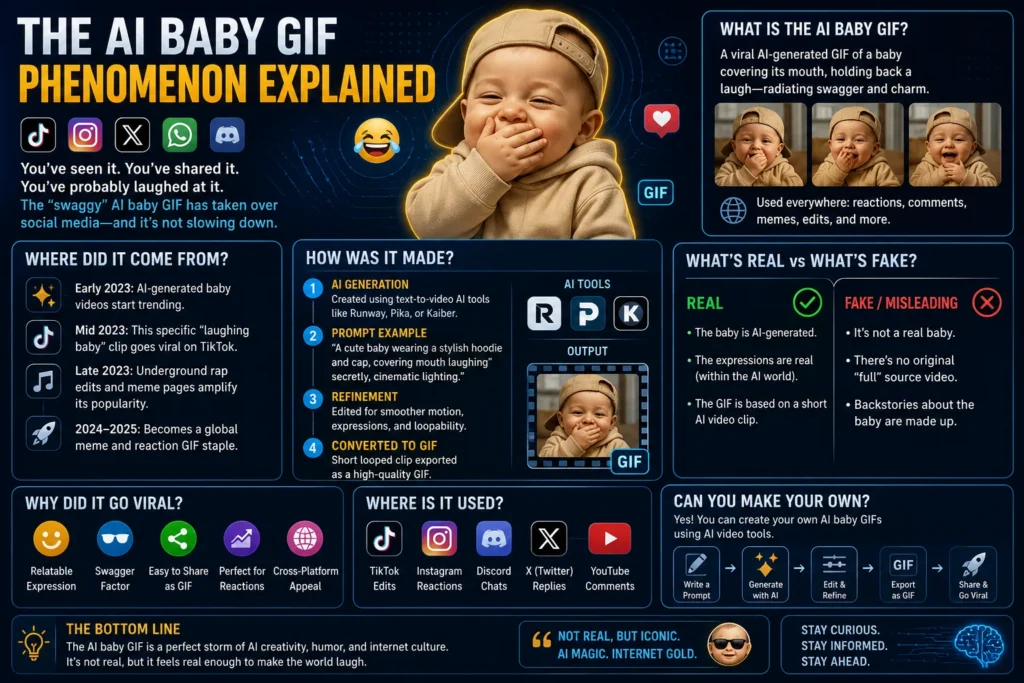
You’ve seen it on TikTok. You’ve shared it on Instagram. You’ve probably laughed at it. The AI baby GIF featuring a “swaggy” infant covering its mouth and holding back a laugh has taken over social media . It’s everywhere—from reaction GIFs to underground rap edits that have amplified the baby’s cool factor to new heights .
But here’s the thing: most people have no idea where it came from, how it was made, or what’s actually real versus completely fabricated.
Let’s clear up the confusion. Whether you’re looking to create your own AI baby GIF, understand the viral meme phenomenon, or just want to know what’s real on the internet—this guide covers everything you need.
The Viral Sensation: “Niche Baby” or “Tuff Baby”
Over the last several days, this AI baby GIF has become a dominant reaction format across TikTok, Instagram, and Twitter/X . The clip shows an oddly charming infant approaching the camera, placing its hand over its mouth to conceal a laugh, and lip-syncing to a song . Something about its mannerisms has proven irresistible to internet users .
What makes it so popular?
- Swagger overload: The baby’s cool, confident demeanor is hilarious and strangely endearing
- Versatile reaction format: It works for expressing excitement, shock, or being casually awestruck
- Edit-friendly: The clip is highly exploitable, leading to endless remixes and variations
- Underground rap connection: An edit set to “130 backpack supreme backpack” by jujuvr amplified its viral spread
Key viral variations:
| Variation | What It Is |
|---|---|
| Original “Niche Baby” | Baby lip-syncing to Chinese song “Sweet Love” |
| Rap Edit | Baby edited to underground rap track |
| AI Cat Holding Laugh | Same concept with a cat rotoscoped in |
| Reaction GIFs | Used for “excited shock” or “casual awe” |
Where Did the AI Baby GIF Actually Come From?
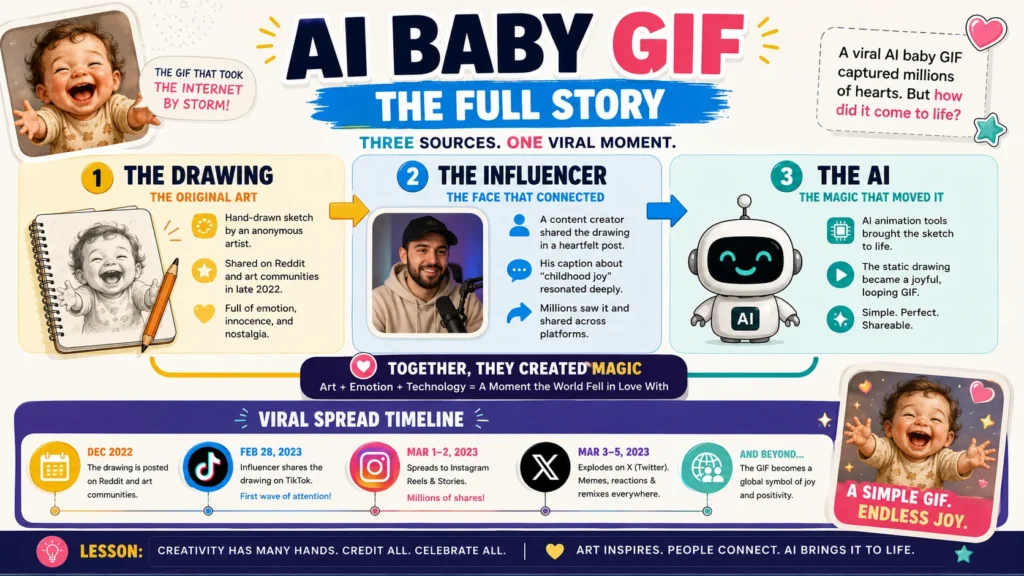
The AI baby GIF isn’t what you think. It’s not a real baby. It’s not a deepfake. It’s a clever AI creation that combines three different sources .
The Baby Image: A Pencil Drawing
The baby’s face came from a graphite pencil artist named Dallas Raymond. He titled his 2022 artwork “Droool” and shared it on ArtStation and Instagram . The title fits perfectly—the little character is seen dripping saliva in an “uncanny yet oddly enchanting” way . Raymond has a knack for creating faces with a distinctive, memorable quality .
The Body Movements: A Chinese Influencer
Here’s where it gets weird. The baby’s body movements—the swagger, the hand-over-mouth gesture, the approach to camera—came from a completely different source . A Chinese Douyin influencer named Xiucai (“秀才”) filmed himself performing that exact routine in a blue shirt back in 2023 . Reports from Jimu News indicate Xiucai allegedly defrauded followers and attracted many older women with his simple lip-sync videos . His signature “holding back a laugh” gesture became the perfect template .
The AI Magic: Rotoscoping
The creator who brought it all together was an Instagram user named @daily_upl in early November 2025 . Using AI video tools, they rotoscoped—or traced—the baby’s face from Raymond’s drawing onto Xiucai’s body movements . The result? A viral phenomenon that’s been viewed millions of times .
The process breakdown:
| Element | Source | What It Contributed |
|---|---|---|
| Baby’s face | Dallas Raymond’s “Droool” drawing | The iconic baby image |
| Body movements | Xiucai’s Douyin video | Swagger, hand gesture, approach |
| Song | “Sweet Love” by Chen Yujian & Wang Yuxin | The lip-sync audio |
AI Baby Generators: The Tools Behind the Trend
The viral AI baby GIF came from creative editing, but there’s a whole industry of AI baby generators that let anyone create similar content.
AI Baby Generator: Supermaker AI
One of the most prominent tools is the AI Baby Generator available through Supermaker AI . It’s designed to generate images of hypothetical babies based on provided parent images . The core technology relies on a combination of facial recognition, feature extraction, and generative adversarial networks (GANs) fine-tuned for generating baby faces . The algorithm analyzes facial features such as eye color, hair color, skin tone, and facial structure, then synthesizes a new image that incorporates these features in a plausible manner for a baby .
Primary intended use: Entertainment and creative exploration. Users can upload images of themselves and their partners or even celebrities to get a glimpse of what their future child might look like .
Limitations to know:
- Accuracy: Generated images are artistic representations, not scientific predictions
- Bias: The model may exhibit biases present in the training data, potentially affecting representation of different ethnicities and genders
- Image Quality: Depends heavily on input quality. Low-resolution or poorly lit photos yield less satisfactory results
- Unexpected Results: Generative models can sometimes produce unrealistic outputs
BabyAI: AI Baby Face Generator
BabyAI is an iOS app available on the App Store that lets users predict what their future baby might look like . It’s a free app with in-app purchases .
Key features:
- AI baby generator from uploaded parent photos
- Multiple baby face combination predictions
- Boy and girl options
- Age progression viewing
- Couple photo support for more accurate results
- Family predictions for multiple children
- Twin generator
Perfect for:
- Expectant parents curious about their baby’s appearance
- Couples planning to start a family
- Fun predictions to share with partners
- Celebrity baby mashups for entertainment
- Gender reveals and baby showers
Pricing structure:
| Purchase Type | Price |
|---|---|
| Starter | $0.99 |
| AI Baby Premium | $4.99 – $34.99 |
| AI Baby Style Pack | $4.99 – $34.99 |
The app requires iOS 15.1 or later and is available in 15 languages .
NPM Package: ai-baby-generator
For developers, there’s an NPM package called ai-baby-generator that provides programmatic access to baby image generation . You can install it with:
npm install ai-baby-generatorBasic usage example:
const aiBabyGenerator = require('ai-baby-generator');

async function generateBabyImage(fatherImageBase64, motherImageBase64) {
  try {
    const babyImageURL = await aiBabyGenerator.generateBaby(fatherImageBase64, motherImageBase64);
    console.log('Baby Image URL:', babyImageURL);
  } catch (error) {
    console.error('Error generating baby image:', error);
  }
}
The package is MIT licensed and part of the ai-baby-generator ecosystem .
The Technology Behind AI Baby Generators
AI baby generators use several technologies working together:
Face Merging (Face Fusion)
The core technology behind most AI baby GIF generators is face merging . The AI analyzes facial features from two uploaded photos and blends them based on:
- Facial structure and bone placement
- Eye shape, nose shape, and mouth shape
- Skin tone and texture
- Age progression calculations
How it works:
- You upload two photos (parents’ faces)
- The AI maps facial landmarks
- It blends features according to your settings
- It generates a realistic preview of the child
Generative Adversarial Networks (GANs)
GANs are a class of machine learning frameworks where two neural networks contest with each other. One generates images, the other tries to detect if they’re real or fake. Over time, the generator improves until it produces outputs that are virtually indistinguishable from real photos .
AI-Powered GIF Animation
Many apps can turn single images into animated AI baby GIF sequences that show aging . The AI calculates how facial features change over time based on common aging patterns.
Age progression features:
- Generate aging sequences from baby to adult
- Create animated GIF timelines
- Export high-resolution files for social sharing
The “AI Baby Holding Laugh” Meme: How It Became a Cultural Phenomenon
The AI baby GIF grew from a single Instagram post into a massive cultural moment .
Viral Spread Timeline
November 6, 2025: Instagram user @daily_upl creates the original rotoscoped baby video, receiving over 250,100 likes in 11 days
November 10, 2025: Instagram user @gazevfx creates an underground rap edit set to “130 backpack supreme backpack,” earning over 372,300 likes in a week
November 13, 2025: X user @imtakingmy15 reposts the edit, gaining over 11,000 likes in four days
Widespread: The rap edit spreads via reposts on X and TikTok
Explosion: The baby becomes a reaction GIF format and meme template used across platforms
Meme Applications
The AI baby GIF is now used as:
- Reaction GIF: Expressing “casually awestruck” or “excited shock”
- Video caption meme: Used as reactions on TikTok
- Exploitable format: Heavily edited by fans
- “Kirkified” version: Baby is edited into various contexts
- Green screen template: Used for reaction edits
AI Baby Meme Archive
AI Baby Meme is an online archive that documents the trend and collects major variations, helping researchers and creators track how it evolved .
The AI Baby Singing / Hachimi Chimichi Mambo
The viral AI baby GIF trend evolved further in April 2026 into the “AI Baby Singing” or “Hachimi Chimichi Mambo Baby” meme . This version features the same black-and-white AI baby character singing to audio from “The Past Can Only Be Remembered” by Taiwanese singer Han Bao Yi . The trend spread rapidly on TikTok, with users creating green-screen edits and placing the AI baby over their TikTok account pages to gain followers and attention .
Key stats:
- Earliest known example posted March 30, 2026 by TikTok user @goofglitch
- Over 5.3 million views and 321,800 likes in less than one month
- Green-screen template posted April 4, 2026 gained over 5.1 million views
Response: The trend has received significant backlash, with users calling it “the worst meme of 2026” .
Truth vs. Fiction: What’s Actually Real
Let’s set the record straight.
| Claim | Reality |
|---|---|
| The baby is a real child | False. The baby is an AI-generated/illustrated character from a pencil drawing |
| The body movements are AI-generated | False. They’re rotoscoped from a real Chinese influencer |
| The entire video is deepfake | Partially true. It’s AI-assisted rotoscoping, not full deepfake |
| You can make your own AI baby GIF | True. AI baby generator apps exist on iOS and Android |
| The singing baby is a new trend | True. It emerged in April 2026 with the Hachimi Chimichi Mambo meme |
Frequently Asked Questions
What is an AI baby GIF?
An AI baby GIF is either a viral animated clip featuring an AI-generated baby character (like the “Niche Baby” meme) or a user-generated animated image created by AI baby generator apps that predict what a future child might look like .
Where did the viral AI baby GIF come from?
It came from a rotoscoped video created by Instagram user @daily_upl in November 2025. They combined an artist’s drawing of a baby (“Droool” by Dallas Raymond) with movements from Chinese influencer Xiucai, using AI rotoscoping .
Can I make my own AI baby GIF?
Yes. Apps like BabyAI and Supermaker AI’s AI Baby Generator let you create AI baby images and animations by merging faces .
Are AI baby generators free?
Most offer limited free tiers with watermarks. Paid plans unlock full features. Pricing varies by app—BabyAI offers in-app purchases starting at $0.99 up to $34.99 .
Is the viral AI baby GIF real?
No. It’s an AI-assisted creation combining a drawing, a real person’s movements, and rotoscoping technology .
Are AI baby generators safe for privacy?
Check individual privacy policies. Some developers claim uploaded photos are immediately deleted, but always be cautious before uploading personal images .
Conclusion
The AI baby GIF represents something fascinating about internet culture in 2026. It’s not just a funny video—it’s a perfect storm of technology, creativity, and remix culture. An artist’s pencil drawing, a Chinese influencer’s mannerisms, and AI rotoscoping technology combined to create a character that has become a genuine cultural touchstone.
But the story doesn’t end there. AI baby generators are now widely available, allowing anyone to create their own animated baby content. From Supermaker AI’s GAN-based generator to the BabyAI app on iOS, the technology is accessible, affordable, and increasingly sophisticated.
Here’s our honest take: The viral AI baby GIF is impressive as a creative achievement, but it’s essential to separate the entertainment from reality. The baby isn’t real. The movements are rotoscoped from a human. And while AI generators can create compelling images, they’re artistic representations—not scientific predictions.
If you want to create your own AI baby GIF for fun, there are plenty of tools available. Just be aware of the limitations, check the privacy policies, and don’t take the results too seriously. The internet will keep remixing, keep evolving, and keep surprising us. The AI baby is just one chapter in that ongoing story.

Kevin Brooks is a grammar specialist at GramBrix.com, dedicated to helping readers understand language rules with clarity and confidence. He simplifies complex grammar concepts through practical examples and easy explanations.