
Last Updated on August 16, 2026
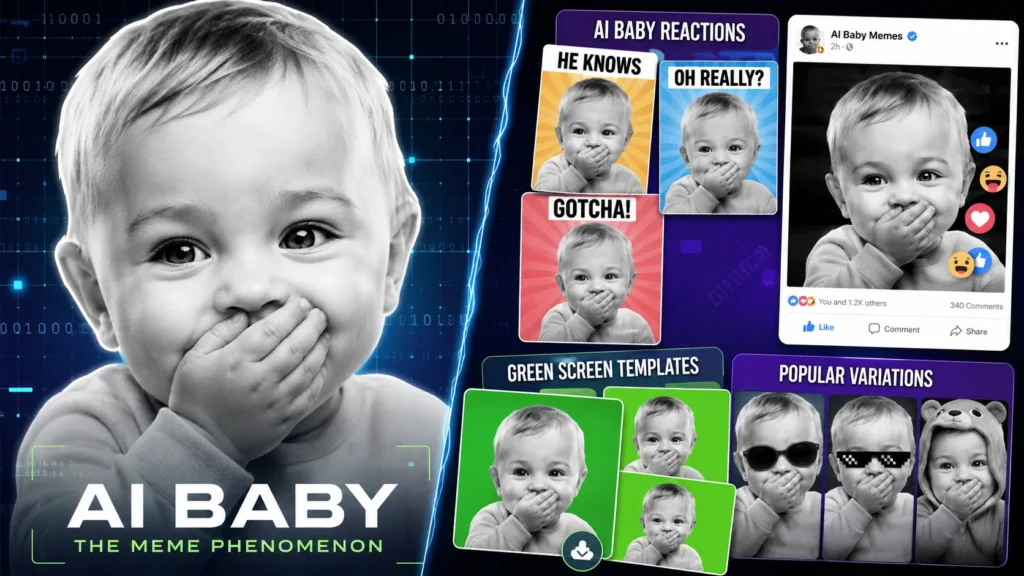
The AI baby meme is a viral internet sensation that emerged in late 2025 when an Instagram user rotoscoped an AI generated baby illustration onto a Chinese influencer’s lip sync video. The character, known by many names including Niche Baby, Tuff Baby, and Son Baby, features a black and white infant with a knowing smirk covering its mouth. The meme exploded when creators added underground rap tracks and green screen templates, making it one of 2026’s most recognizable reaction formats. Its appeal lies in the uncanny valley effect the baby looks almost real but performs adult gestures combined with the remix culture of short form video platforms.
You’ve seen it. You’ve probably laughed at it. You might have even shared it without knowing where it came from.
The AI baby meme is everywhere. That black-and-white infant approaches the camera with a knowing smirk. One hand hovers over its mouth like it’s holding back the juiciest secret. The expression says: I know something you don’t know.
But here’s the thing. Most people have no clue about the wild backstory behind this digital phenomenon. The AI baby isn’t just another funny face cycling through your social media feed. It’s a perfect storm of remix culture, artificial intelligence, internet scandal, and sheer creative chaos.
The meme has spawned countless variations. Green screen templates. Kirkified edits. Rap remixes. Singing covers. Reaction GIFs. It’s become the go to visual for moments of shock, suppressed laughter, or “I can’t believe this is happening” energy.
And it’s only getting bigger.
By April 2026, the meme had evolved into new formats. Users started placing the green-screened singing baby over their own TikTok accounts to gain followers. The backlash was swift — many called it “the worst meme of 2026” — but the internet’s hatred only fueled more engagement. The AI baby became a self-sustaining cycle of creation, remix, and reaction.
So what makes this meme so compelling? Why does a single AI-generated baby face resonate with millions of people across different platforms and cultures?
The answer is layered. The AI baby meme works on multiple levels. It captures a universal emotional gesture holding back a laugh — but delivers it in a package that feels alien and new.
Let’s break down the entire story. From the scandal-ridden Chinese influencer to the graphite pencil drawing by an American artist. From the Instagram mashup artist to the underground rap remix that changed everything. This is the complete guide to the AI baby meme.
The Three Threads: How the AI Baby Meme Was Born
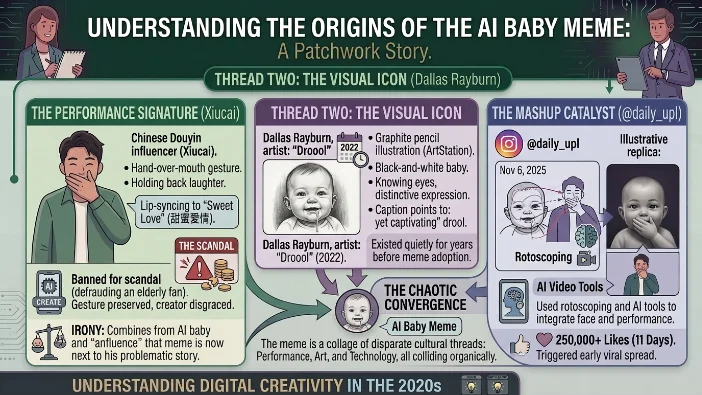
The AI baby meme wasn’t a single creation from a single moment. It’s a patchwork. Three separate threads had to come together before the digital infant could take its first viral steps.
Understanding each thread reveals just how chaotic and unpredictable internet culture really is. No one planned this meme. It emerged organically from the collision of different creative forces.
Thread One: The Man Behind the Moves
The performance that gives the AI baby its physical signature comes from a Chinese Douyin influencer named Xiucai.
Xiucai was a prominent creator on China’s version of TikTok. His signature move involved approaching the camera with a specific gesture — hand covering his mouth while holding back laughter. He lip-synced to the Chinese song “Sweet Love” (甜蜜愛情) by Chen Yujian and Wang Yuxin. The combination of the playful gesture and the romantic track created a distinctive performance style that fans immediately recognized.
But here’s where the story gets spicy.
Xiucai’s social media career ended in scandal. He was banned from Douyin after allegedly defrauding a 62-year-old female fan out of 520,000 yuan. That’s roughly $72,000 USD. The details remain murky, but the consequences were clear. Xiucai disappeared from the platform.
The irony is thick. The man whose performance anchors one of 2026’s biggest memes is a disgraced influencer who exploited an elderly fan. Yet his physical comedy lives on through an AI-generated baby that has no connection to his scandal whatsoever.
The internet has a strange way of preserving and transforming cultural artifacts. Xiucai’s gesture no longer belongs to him. It belongs to the AI baby. And the AI baby doesn’t care about scandal.
Thread Two: The Face That Launched a Thousand Memes
While Xiucai was building his Douyin following in China, an artist named Dallas Rayburn was working on something entirely different.
In 2022, Rayburn created a graphite pencil illustration titled “Droool” on ArtStation. The drawing depicted a black-and-white baby with a distinctive expression. Drool dripped from the infant’s mouth. The eyes had a knowing quality. The overall effect was oddly captivating yet slightly unsettling.
Rayburn’s illustration existed quietly on ArtStation for years. It was a piece of digital art, nothing more. The artist likely had no idea that his creation would eventually become one of the most recognizable memes on the planet.
The timeline gap matters. Rayburn created the baby years before it became a meme. The illustration existed in relative obscurity.
This delay between creation and appropriation is a hallmark of internet culture. Content can sit dormant for years before the right context or technology transforms it into something entirely new.
Thread Three: The Mashup Artist Who Connected Everything
On November 6, 2025, an Instagram user named @daily_upl made a decision that would change internet culture.
Using rotoscoping and AI video tools, @daily_upl mapped Rayburn’s baby illustration onto Xiucai’s performance. The baby moved like Xiucai. It lip-synced like Xiucai. It performed the hand-over-mouth gesture like Xiucai. But the face belonged to Rayburn’s drawing.
The result was hypnotic. The AI baby looked almost real but not quite. The contrast between the baby’s innocent appearance and the adult performance created an uncanny effect that viewers couldn’t look away from.
The video quickly gained traction. Within 11 days, it had over 250,000 likes. That’s impressive engagement for a single Instagram post, especially one featuring a previously obscure illustration mashed up with a banned Chinese influencer’s signature move.
But @daily_upl’s video was just the beginning. The AI baby meme had been born, but it hadn’t yet reached its full potential. That would require a different kind of transformation.
The Viral Spark: When the Audio Changed Everything
Popular videos sometimes go viral on their own. The AI baby meme needed a push.
The turning point came when another creator, @gazevfx, remixed @daily_upl’s video with an unexpected audio track. The song was “130 backpack supreme backpack” by jujuvr, an underground rap track with a gritty, lo-fi quality. The beat looped hypnotically. The lyrics were sparse and repetitive.
The contrast was electric.
The baby’s innocent/cute appearance clashed perfectly with the gritty rap beat. The combination created a hallucinogenic effect that was tailor-made for short-form video loops. Viewers couldn’t stop watching. The loop became addictive.
This remix also gave the AI baby a new name. The “Tuff Baby” persona emerged from the rap context. The baby wasn’t just cute anymore it was tough. It had attitude. The juxtaposition between the infant face and the hard-edged music created a comedic tension that audiences loved.
The “Tuff Baby” edit cemented the AI baby’s status as a reaction format rather than just a standalone clip. People began using it to express specific emotions — shock, amusement, disbelief, or the sense that they were in on a joke no one else understood.
The AI baby meme had officially entered the mainstream.
Formats and Spread: How the AI Baby Evolved
The AI baby didn’t stay in one form. It multiplied. Creators found new ways to use the character, each iteration building on the last.
Reaction Videos and GIFs
The most common use of the AI baby meme is as a reaction format. The baby’s hand-over-mouth gesture has become the visual shorthand for “I can’t believe what I’m seeing.”
When someone shares shocking news, the AI baby appears in the comments. When a video takes an unexpected turn, the AI baby punctuates the moment. The expression is versatile enough to convey multiple emotions — suppressed laughter, disbelief, scandalized amusement, or the sense that something is both funny and wrong.
This versatility is key. The AI baby works because it’s ambiguous. Different viewers interpret the expression differently, but everyone feels something.
Green Screen Templates
The AI baby’s most powerful evolution came through green screen templates.
Creators on CapCut and other editing platforms made templates that allowed anyone to insert the AI baby into their own content. This democratized the meme. You didn’t need sophisticated editing skills or AI tools to use the character. You just needed the template and a smartphone.
The green screen trend accelerated the meme’s spread exponentially. The AI baby appeared in countless contexts. It was inserted into movie scenes, news broadcasts, family photos, and absurd scenarios that had no connection to the original video.
This adaptability is the hallmark of a truly successful meme. The AI baby became a canvas for other people’s creativity. It stopped being a single video and started being a format.
Kirkified Edits
The “Kirkified” trend added another layer of chaos.
Kirkified edits involve splicing, repeating, and visually manipulating content into hypnotic loops. The technique originated with other memes but quickly attached itself to the AI baby. Creators would multiply the baby’s image, repeat its movements in rhythmic patterns, and create surreal visual sequences that felt almost psychedelic.
These edits pushed the AI baby further into the uncanny territory. The original illustration was already unsettling. Kirkified versions amplified that discomfort while also making it more comedic.
Image Macros and Whiteboard Art
The AI baby also spread through more traditional meme formats.
Image macros paired the baby’s face with text overlays. Whiteboard drawings simplified the character into a recognizable symbol. Derivative art transformed the baby into different styles and contexts.
This variety ensures the AI baby remains fresh. It’s not stuck in a single format. It adapts to whatever platform or creative trend emerges.
The Hachimi Chimichi Mambo Evolution
By April 2026, the AI baby had entered a new phase.
TikTok user @goofglitch used AI tools to make the baby sing “The Past Can Only Be Remembered” by Han Bao Yi. The vocal overlay used the “Hachimi chimichi” effect — a specific vocal processing technique that creates a distinctive sound.
The effect spread quickly. Users started placing the green-screened singing baby over their own TikTok account pages to gain followers. The tactic worked. The singing baby attracted attention and engagement, which boosted account visibility.
But the evolution also generated significant backlash. Many users called the singing baby “the worst meme of 2026.” Comments flooded in expressing disgust, annoyance, and exhaustion with the trend.
Here’s the irony: negative commentary only fuels more engagement. Every comment, even negative ones, signals to the algorithm that the content is interesting. The more people hate the AI baby, the more it spreads.
This paradox isn’t new to internet culture. Content that provokes strong reactions — positive or negative — consistently outperforms content that inspires indifference. The AI baby meme generates strong reactions across the spectrum. That’s exactly why it persists.
The Uncanny Valley Factor: Why This Meme Works
The AI baby meme operates in a sweet spot of the uncanny valley.
The uncanny valley is a concept in robotics and computer graphics. When a humanoid figure looks almost but not quite human, it triggers discomfort and unease. The AI baby hits that precise point. It’s realistic enough to feel familiar but off enough to feel unsettling.
Emotional Contradiction
The AI baby also works because of emotional contradiction. Babies are supposed to be innocent.
The AI baby violates these expectations. It performs adult behaviors but wears an infant’s face. The contradiction creates cognitive dissonance. You don’t know whether to laugh or feel disturbed. That uncertainty keeps you watching.
The Perfect Level of Realism
The AI baby is clearly AI-generated, but it’s just polished enough to feel almost real.
That’s the key. If the baby looked completely fake, it wouldn’t be unsettling. If it looked perfectly real, it would just be creepy. The in-between state — recognizable but not quite right — creates the maximum impact.
The Meme as Mirror
The AI baby meme also reflects the internet’s broader fascination with AI-altered content.
We live in an era where anyone can generate photorealistic images with a text prompt. Apps like Midjourney, DALL-E, and Stable Diffusion have democratized AI image creation. The AI baby meme is just one example of how this technology is being used for entertainment.
But the AI baby also taps into anxieties about AI. What happens when we can’t tell what’s real anymore? What happens when AI-generated content becomes indistinguishable from authentic human creation? The AI baby meme plays with these questions while making us laugh.
The Broader AI Baby Meme Ecosystem
The Niche Baby isn’t the only AI baby meme. It exists within a larger ecosystem of AI-generated infant content.
The Ash Baby
In 2022, Reddit users shared an image of a crying baby covered in ash. The image was titled “Ash Baby.” It became a popular reaction format, especially in gaming and dark humor communities.
The Ash Baby is less sophisticated than the Niche Baby. It’s a single image rather than an animated character. But it served a similar function — providing a baby’s face for reaction purposes.
The Redneck Baby Sinclair
AI generation tools have also created bizarre Baby Sinclair variants. Baby Sinclair is the infant character from the 1990s TV show Dinosaurs. AI tools have placed Baby Sinclair in redneck scenarios, creating absurd juxtapositions that resonate with specific internet subcultures.
The AI Baby Generator Ecosystem
Several AI tools specialize in creating AI baby images. These tools allow users to upload photos and generate “future baby” predictions or stylized infant portraits.
Popular AI baby generators include:
| Tool Name | Key Features | Platform |
|---|---|---|
| Midjourney | High-quality artistic outputs | Discord, Web |
| DALL-E 3 | Realistic image generation | OpenAI platform |
| Stable Diffusion | Open-source, customizable | Various |
| Canva AI | Integrated with design tools | Web, App |
| Adobe Firefly | Professional-grade editing | Adobe suite |
| Fotor AI | User-friendly interface | Web, App |
| DeepArt | Artistic transformations | Web |
| Reface | Face swap technology | Mobile App |
These tools range from professional-grade to consumer-friendly. Some require technical knowledge. Others work with a single tap.
How to Create Your Own AI Baby Meme
The barrier to entry is incredibly low. You don’t need coding skills or expensive software to create your own AI baby meme.
Step 1: Choose Your AI Image Generator
Select a tool that matches your skill level and needs.
Step 2: Craft Your Prompt
The prompt determines your output quality. Be specific about style, expression, and context.
Example prompts:
- “Black and white pencil drawing of a baby with a knowing smirk, hand covering mouth, photorealistic style”
- “AI-generated baby face with drool dripping, expressive eyes, holding back laughter, detailed illustration”
- “Baby with mischievous expression, digital art style, cinematic lighting, high contrast”
Step 3: Generate and Refine
Run your prompt through the generator. Review the results. Adjust your prompt based on what works and what doesn’t.
Sometimes you’ll need multiple attempts to get the right expression. That’s normal. AI generation is iterative.
Step 4: Animate or Remix
For video versions, use rotoscoping tools or AI animation software to bring your baby to life. Tools like Runway, Pika, and Kaiber can animate static images.
For meme formats, overlay text using Canva, Photoshop, or any basic image editor.
Step 5: Share and Engage
Post your creation on TikTok, Instagram, or X (Twitter). Use relevant hashtags like #AIBabyMeme, #TuffBaby, and #AIGenerated.
Engage with comments. The algorithm rewards interaction. Even negative engagement helps your visibility.
Prompt Engineering Tips
| Element | Best Practices |
|---|---|
| Style | Specify “photorealistic,” “pencil drawing,” or “digital art” for consistent results |
| Expression | Use “knowing smirk,” “holding back laugh,” or “mischievous” |
| Details | Include “drool,” “expressive eyes,” “hand covering mouth” for recognizability |
| Lighting | “Cinematic lighting” or “high contrast” adds visual interest |
| Format | “Black and white” maintains the original aesthetic |
The AI Baby Meme’s Cultural Impact
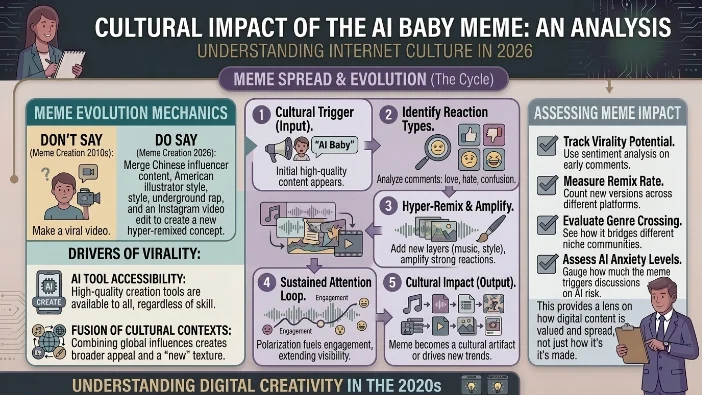
The AI baby meme isn’t just a funny video. It represents something larger about how internet culture operates in 2026.
Democratized Creation
AI tools have made high-quality content creation accessible to everyone. The AI baby meme exists because creators with no formal training can use sophisticated AI tools. This democratization of creativity is the defining feature of modern internet culture.
Remix as Cultural Practice
The AI baby is fundamentally a remix. It combines multiple sources — a Chinese influencer, an American artist’s illustration, an Instagram editor’s video, an underground rap track — into something entirely new.
Remix culture is how the internet works. Nothing is entirely original. Everything builds on everything else. The AI baby meme exemplifies this creative process.
The Attention Economy
The AI baby’s persistence proves that attention is the internet’s most valuable resource. Content that provokes strong reactions — love, hate, confusion, laughter — consistently outperforms content that inspires indifference.
The more people hate the AI baby, the more visible it becomes. This paradox fuels its continued spread.
AI Anxiety and Entertainment
The AI baby also reflects our complicated relationship with artificial intelligence. We’re fascinated by AI’s capabilities but also anxious about its implications. Memes like the AI baby allow us to engage with these feelings in a low-stakes, entertaining context.
FAQs
What exactly is the AI baby meme?
The AI baby meme is a viral internet character featuring a black-and-white infant with a knowing smirk, one hand covering its mouth as if holding back a laugh. It’s an AI-generated creation that combines a graphite pencil illustration by artist Dallas Rayburn with performance elements from Chinese influencer Xiucai. The meme exploded in late 2025 and became one of 2026’s most recognizable reaction formats across TikTok, Instagram, and X (Twitter).
Who created the AI baby meme?
No single person created it. The meme emerged from three separate sources. Artist Dallas Rayburn drew the original “Droool” baby illustration on ArtStation in 2022. Chinese Douyin influencer Xiucai provided the signature hand-over-mouth performance. Instagram user @daily_upl combined these elements using rotoscoping and AI video tools on November 6, 2025. The meme then evolved through countless remixes by other creators.
Why is the AI baby meme so popular?
The appeal lies in several factors. The uncanny valley effect makes it simultaneously cute and unsettling, which keeps viewers watching. The emotional contradiction of a baby performing adult gestures creates cognitive dissonance that’s both funny and intriguing. The meme’s versatility as a reaction format means people use it for countless situations. Plus the low barrier to entry — anyone can make their own version using green screen templates — accelerates its spread.
What does “Tuff Baby” mean in relation to this meme?
“Tuff Baby” is one of several nicknames for the AI baby character. It emerged when creator @gazevfx remixed the original video with the underground rap track “130 backpack supreme backpack” by jujuvr. The gritty, lo-fi beat contrasted perfectly with the baby’s innocent appearance, giving it a “tough” persona. Other nicknames include Niche Baby, Son Baby, and Say You Swear Baby.
How do I create my own AI baby meme?
You have several options. Use AI image generators like Midjourney, DALL-E, or Stable Diffusion with prompts describing a black-and-white baby with a knowing smirk. Try face swap apps like Reface to map baby features onto existing videos. Use Canva AI or Fotor AI for simpler creation. For animation, use tools like Runway or Pika to bring static images to life. Then overlay text or add green screen backgrounds using basic editing software.
Is the AI baby meme real or AI-generated?
It’s both. The face comes from a real graphite pencil drawing created by an artist, but the animation, lip-sync, and viral spread rely entirely on AI tools. The meme represents a hybrid — human artistic creation combined with machine learning capabilities. The character itself isn’t a real baby or even a photorealistic AI generation. It’s a stylized illustration brought to life through AI rotoscoping and video manipulation.
Why is there backlash against the AI baby meme?
The backlash stems from several complaints. Many users find the meme overused and exhausting, especially the singing baby variation that flooded TikTok in April 2026. Some find the uncanny valley effect genuinely unsettling rather than funny. Others resent how the meme clogs their feeds with repetitive content. The irony is that negative commentary actually fuels more engagement, which makes the meme even more visible.
What happened to Xiucai, the influencer whose performance inspired the meme?
Xiucai was a prominent Douyin influencer in China who rose to fame with his distinctive hand-over-mouth lip-sync performances. His career ended abruptly after he was banned from the platform for allegedly defrauding a 62-year-old female fan out of 520,000 yuan (approximately $72,000 USD). The details remain unclear, but the scandal permanently removed him from social media. His performance lives on through the AI baby meme, divorced from any connection to his personal controversy.
What tools were used to create the AI baby meme?
Creators used a combination of tools. The original mashup likely involved rotoscoping software to map the baby’s face onto Xiucai’s performance. AI video tools handled the lip-sync and movement tracking. Modern creators use CapCut templates, Runway, Pika, and various AI animation platforms. Static image versions come from generators like Midjourney, DALL-E, and Stable Diffusion. The remix culture means the specific tools keep changing as new apps emerge.
How long will the AI baby meme stay relevant?
Memes have unpredictable lifespans. Some fade within weeks, others persist for years through constant reinvention. The AI baby meme shows strong staying power because it exists in multiple formats reaction videos, green screen templates, image macros, and animated loops. Each new remix extends its life. Backlash creates paradoxical engagement. As long as creators keep finding fresh ways to use the character, the AI baby meme will continue spreading across social platforms.
Conclusion
The AI baby meme is more than a viral sensation. It’s a snapshot of internet culture in the AI era.
The character emerged from a perfect storm. A scandal-ridden Chinese influencer provided the performance. An American artist’s pencil drawing supplied the face. An Instagram editor connected them. An underground rap track gave it viral energy. Green screen templates spread it everywhere.
Each layer added something new. The meme evolved organically, without central planning or corporate oversight.
The AI baby’s appeal lies in its contradictions. It’s cute but unsettling. Innocent but knowing. Simple but culturally dense. It captures a universal emotional gesture while feeling entirely alien.
Most importantly, the AI baby meme reveals how technology transforms human expression. AI tools allowed creators to do something that wasn’t possible just a few years ago. They took a static illustration and brought it to life. They gave a paper baby personality and performance.
The AI baby isn’t going anywhere. It’s already spawned new formats and variations. It will continue to evolve as creators find new ways to use it. The backlash will continue, and so will the spread.
That’s the nature of internet culture. Nothing stays the same. Everything gets remixed. The AI baby is just the latest example of this ongoing creative process.
So the next time you see that knowing smirk on your feed, remember the story behind it. Remember Xiucai’s scandal and Rayburn’s illustration and @daily_upl’s mashup and @gazevfx’s rap remix. Remember the green screen templates and the Kirkified edits and the singing baby backlash.
The AI baby meme is a small piece of digital history. It captures this specific moment the AI era, the remix culture, the attention economy and packages it in a single unforgettable face.
That’s why it works. That’s why it spreads. And that’s why it’ll keep popping up in your feed for months to come.

Kevin Brooks is a grammar specialist at GramBrix.com, dedicated to helping readers understand language rules with clarity and confidence. He simplifies complex grammar concepts through practical examples and easy explanations.