Last Updated on August 4, 2026
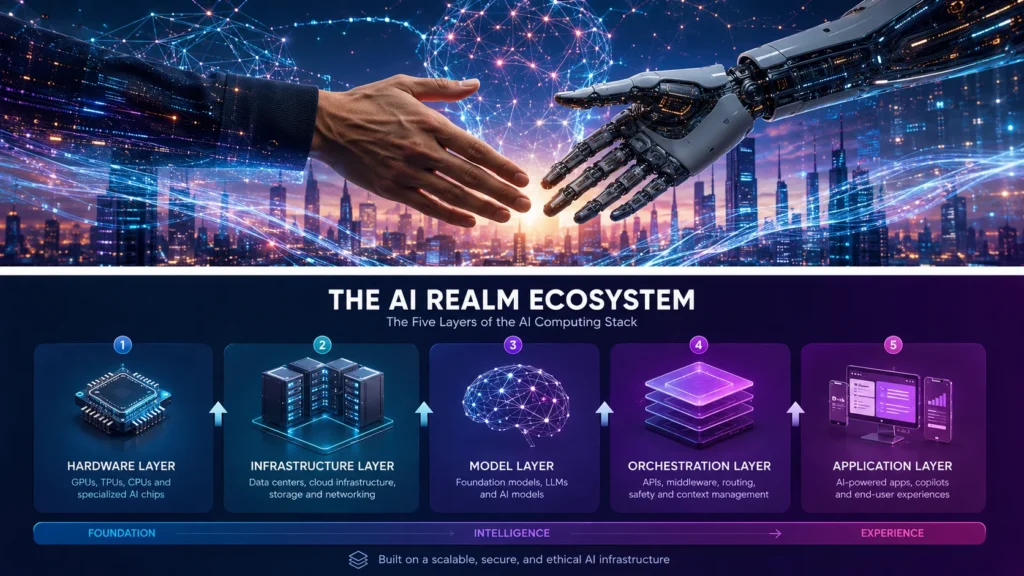
The AI realm represents the complete digital ecosystem of artificial intelligence technologies, from hardware infrastructure to user applications. The Handshake AI platform exemplifies how businesses leverage this ecosystem to automate workflows, enhance productivity, and unlock new capabilities. Major corporations invested over $581 billion in AI infrastructure in 2026, accelerating adoption across every industry. While the AI ecosystem delivers unprecedented efficiency, it also presents real challenges including environmental costs, security vulnerabilities, and transparency gaps. Understanding the AI realm is no longer optional; it is essential for staying competitive in a rapidly evolving digital landscape.
Artificial intelligence has stopped being science fiction. It’s no longer a distant possibility or a niche academic pursuit. We live in the AI realm now.
This isn’t hyperbole. Consider this: AI reached 53% population adoption faster than either the personal computer or the internet. That means more than half of us interact with AI systems regularly, often without even realizing it.
The AI realm encompasses everything from the massive data centers humming in Virginia to the generative AI tools on your smartphone. It includes the Handshake AI platform connecting businesses with intelligent agents and the neural networks quietly running your email spam filter.
Think of the AI ecosystem as a living digital organism.
But here’s the problem. Most people treat AI like magic. They type a question into a chatbot and accept the answer without understanding what happens behind the curtain. That’s like driving a car without knowing how the engine works. You can still get where you’re going, but you’ll be helpless when something goes wrong.
This guide changes that. We will explore the artificial intelligence ecosystem from the ground up. You will understand the infrastructure, the technology stack, the business applications, and the risks. By the end, you will navigate the AI realm with confidence and clarity.
The Blueprint: Understanding the AI Computing Stack
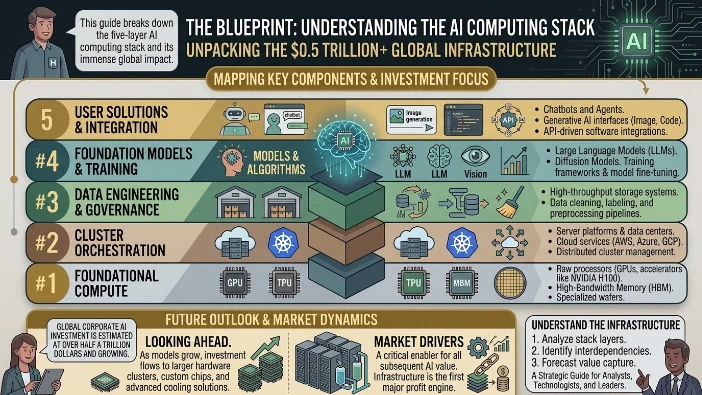
The AI ecosystem isn’t just about chatbots and image generators. It represents a massive technological infrastructure worth over half a trillion dollars in global corporate investment. To understand the AI realm, you must look under the hood.
The AI computing stack has five distinct layers. Each layer builds upon the one below it, creating a complete system from raw hardware to user-friendly applications.
Infrastructure Layer: The Physical Foundation
This is where the AI realm touches the physical world. We are talking about data centers, semiconductor fabrication plants, and energy grids.
NVIDIA dominates this space with their GPU chips. The H100 and upcoming B200 processors power most major AI deployments. TSMC manufactures nearly every leading AI chip, creating a geopolitical bottleneck centered in Taiwan.
The Scale Is Staggering:
- 5,427 data centers operate in the United States alone
- Each facility consumes electricity equivalent to a small city
- Training a frontier model can emit CO2 comparable to 17,000 cars driven for a year
Real Facts: The global semiconductor market reached $527 billion in 2024. AI chip demand drove 40% of that growth. NVIDIA’s data center revenue alone hit $47.5 billion last year.
This physical infrastructure determines what the AI realm can achieve.
Intelligence Layer: The Models Themselves
This is what most people think of when they hear artificial intelligence. The intelligence layer contains large language models like GPT-4, Claude 3, and Google Gemini.
These models are the brains of the AI ecosystem. They process language, generate images, and make predictions. The competition here is fierce, with U.S. and Chinese models achieving near-parity in performance.
Key Players in the Intelligence Layer:
- OpenAI leads in general-purpose language models
- Anthropic focuses on safety and interpretability
- Google leverages massive proprietary data
- Meta open-sources models for community development
- Chinese companies like DeepSeek match Western capabilities
The Foundation Model Transparency Index dropped significantly in the past year. This means the most powerful models are becoming less transparent about their training data, energy consumption, and safety measures.
Data Layer: The Semantic Foundation
Raw intelligence means nothing without data. The data layer organizes information so AI systems can understand and retrieve it efficiently.
This layer includes vector databases that store embeddings, knowledge graphs that map relationships between concepts, and proprietary datasets that give companies their competitive advantage.
Data Layer Components:
- Vector databases (Pinecone, Weaviate, Milvus)
- Knowledge graphs (Neo4j, Amazon Neptune)
- Data lakes and warehouses (Snowflake, Databricks)
- Real-time streaming pipelines (Kafka, Apache Flink)
The Handshake AI platform excels at this layer by connecting disparate data sources into a unified view. This enables AI agents to access the right information at the right time.
Orchestration Layer: Making It All Work Together
This is where AI moves from theory to practice. The orchestration layer manages how different AI components interact, coordinates workflows, and ensures business logic gets executed properly.
Orchestration Layer Functions:
- Managing API calls between services
- Implementing security and access controls
- Routing requests to the appropriate model
- Handling rate limiting and cost optimization
- Integrating with existing business systems
Major software vendors like Adobe, Salesforce, and Microsoft integrate AI deeply into their orchestration layers. This allows customers to use Handshake AI capabilities without changing their existing workflows.
Experience Layer: Where Users Interact
The experience layer is what you see and touch. This includes chat interfaces, voice assistants, image generators, and API endpoints.
Experience Layer Examples:
- ChatGPT web interface
- Handshake AI platform dashboard
- Microsoft Copilot integration
- Custom enterprise applications
- Mobile apps with AI features
The quality of the experience layer determines whether users embrace or reject AI. Good design makes the AI realm feel natural and helpful. Bad design makes it frustrating and confusing.
The Industry Impact: AI in the Real World
The AI realm isn’t abstract theory. It transforms how industries operate. But the impact is uneven. Some sectors see massive productivity gains while others struggle to integrate effectively.
Gaming: Interactive Worlds and Dynamic Narratives
The gaming industry has embraced AI faster than almost any other sector. AI Realm (the platform) exemplifies this trend with dynamic storylines and intelligent non-player characters.
Gaming AI Applications:
- Procedural content generation
- Adaptive difficulty scaling
- Intelligent NPC behavior
- Dynamic narrative generation
- Real-time player analytics
Market Reality: The AI in gaming market is projected to grow from $3.8 billion to $47.5 billion by 2034. That represents a compound annual growth rate of 29%.
Healthcare: Saving Lives and Reducing Burnout
Healthcare represents one of the most promising applications for the AI ecosystem. The results are already impressive.
Healthcare AI Facts:
- Clinical note-taking AI shows 83% reduction in doctor burnout
- Medical imaging AI detects cancers earlier than human radiologists
- Drug discovery timelines shorten from years to months
- Predictive analytics flag at-risk patients for intervention
The Challenge: Data privacy remains the biggest hurdle. Healthcare data is sensitive and heavily regulated. The Handshake AI platform addresses this with robust security and compliance features.
Finance: Fraud Detection and Algorithmic Trading
Banks and financial institutions use AI constantly. They just don’t talk about it much.
Finance AI Applications:
- Fraud detection systems that identify suspicious transactions
- Algorithmic trading executing millions of trades per second
- Credit scoring models assessing borrower risk
- Regulatory compliance monitoring
- Customer service chatbots handling routine inquiries
Real Facts: JPMorgan Chase employs over 2,000 AI professionals. Their AI systems save the bank approximately $1 billion annually through fraud prevention and operational efficiency.
The Risk: Interpretability remains a major concern. When an AI denies someone a loan or flags a transaction as fraudulent, we need to understand why. The AI realm still struggles with explaining its decisions.
Retail and E-commerce: Personalization at Scale
Retail represents the largest AI market sector by 2034. The artificial intelligence ecosystem enables personalization that was previously impossible.
Retail AI Capabilities:
- Hyper-personalized product recommendations
- Dynamic pricing based on demand signals
- Inventory optimization and demand forecasting
- Visual search for product discovery
- Chatbots handling customer service inquiries
Example: Amazon uses AI to recommend products, optimize shipping routes, and predict customer demand. Their AI systems account for 35% of total revenue through recommendation engines alone.
Media and Entertainment: The Content Creation Revolution
This sector is growing fastest in AI adoption. The AI realm enables content creation at unprecedented scale.
Media AI Applications:
- AI-generated articles and summaries
- Automated video editing and production
- Music composition and sound design
- Script writing and story development
- Voice synthesis and dubbing
The Tension: Copyright and attribution remain unresolved. Who owns AI-generated content? Courts are still figuring this out.
The Geopolitical Chessboard: AI as National Power
The AI realm isn’t just about technology. It’s about power. Nations compete for AI dominance like they once competed for nuclear weapons or oil reserves.
The U.S.-China Tug-of-War
The performance gap between American and Chinese AI models has nearly vanished. Both nations possess world-class capabilities.
Key Geopolitical Facts:
- The U.S. leads in foundational AI research and innovation
- China leads in patent applications and industrial applications
- The EU leads in regulation but lags in development
- Russia and India are rapidly building AI capabilities
The Brain Drain Has Stopped: The number of AI researchers moving to the U.S. dropped 89% since 2017. Countries are retaining their talent now.
The Taiwan Dependency
Nearly every leading AI chip depends on TSMC manufacturing in Taiwan. This creates a massive geopolitical bottleneck.
The Taiwan Reality:
- 92% of advanced AI chips come from TSMC
- The company produces chips for NVIDIA, AMD, Apple, and others
- A conflict in Taiwan would cripple the global AI ecosystem
- Both the U.S. and China are investing in domestic foundries
This dependency makes the AI realm fragile. Supply chain disruptions could set back AI development by years.
Strategic Specialization
Different regions specialize in different aspects of the AI realm.
| Region | Strength | Weakness |
|---|---|---|
| United States | Innovation, research, venture capital | Manufacturing dependency, political polarization |
| China | Manufacturing, data availability, government support | Censorship, export restrictions, talent retention |
| European Union | Regulation, ethics, privacy | Investment lag, limited hardware, fragmentation |
| India | Software talent, English proficiency | Hardware gaps, infrastructure deficits |
| Japan/Korea | Manufacturing, robotics integration | Software ecosystem gaps |
The Dark Side: Risks, Ethics, and Environmental Cost
The AI realm has shadows. Understanding the risks is essential for responsible navigation.
Environmental Cost: The Carbon Footprint
Training and running AI models consumes enormous energy. This creates a significant environmental impact.
Environmental Reality:
- Training GPT-4 likely emitted over 500 tons of CO2
- A single query to a large model uses 10-100x more energy than a Google search
- Data centers consume 1-2% of global electricity and growing
- Water usage for cooling data centers competes with local communities
The Tradeoff: AI can help solve climate problems through better energy management and scientific discovery. But the tools themselves create environmental costs. This paradox defines the AI ecosystem.
The Opacity Problem
The most powerful models are often the least transparent. Companies guard their training data and methods as trade secrets.
Opacity Examples:
- We don’t know what data GPT-4 was trained on
- Company safety protocols are often secret
- Decision-making processes are hidden behind proprietary algorithms
- Error rates and failure modes are rarely disclosed
This opacity undermines trust. How can we trust a system we don’t understand? The Handshake AI platform aims for transparency in its operations.
Security Threats: New Vulnerabilities
The AI realm creates new attack surfaces. Bad actors already exploit AI vulnerabilities.
AI Security Threats:
- Prompt injection attacks bypass safety filters
- Model poisoning corrupts training data
- Data extraction steals proprietary information
- Deepfakes and disinformation undermine trust
- Automated hacking tools scale cyberattacks
Real Example: Researchers prompted a chatbot to reveal its training data using specific queries. This extracted memorized information the developers thought was secure.
Safety vs. Accuracy Tradeoff
Improving safety features often degrades model accuracy. This creates a dangerous balancing act.
The Tradeoff Reality:
- Implementing guardrails reduces helpful responses
- Safety filters sometimes block legitimate queries
- Refusing harmful prompts can also refuse harmless variations
- Interpretability tools often reduce performance
Companies navigate this tradeoff differently. Some prioritize safety, others prioritize capability. The artificial intelligence ecosystem lacks consensus on the right balance.
The Future: What Comes Next in the AI Realm
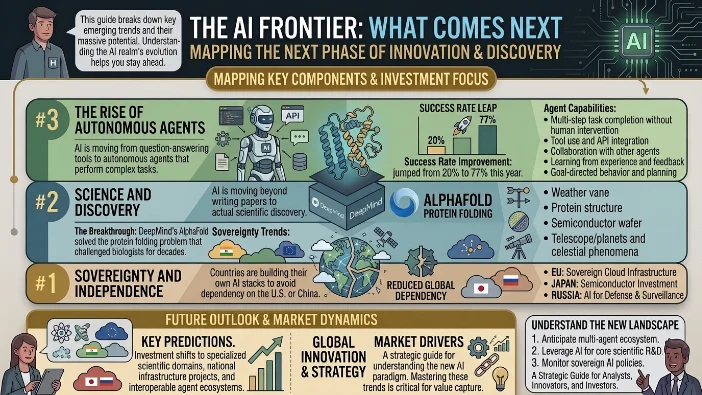
The AI realm evolves rapidly. Understanding emerging trends helps you stay ahead.
The Rise of Autonomous Agents
AI is moving from question-answering tools to autonomous agents that perform complex tasks.
Agent Capabilities:
- Multi-step task completion without human intervention
- Tool use and API integration
- Collaboration with other agents
- Learning from experience and feedback
- Goal-directed behavior and planning
Success Rate Improvement: Agent success rates jumped from 20% to 77% this year. This represents a massive leap in capability.
Science and Discovery
AI is moving beyond writing papers to actual scientific discovery.
Scientific AI Applications:
- Weather forecasting with higher accuracy than traditional models
- Protein folding prediction enabling drug discovery
- Materials science accelerating battery and semiconductor development
- Astronomical discovery identifying exoplanets and celestial phenomena
- Quantum chemistry simulating complex molecular interactions
The Breakthrough: DeepMind’s AlphaFold solved the protein folding problem that challenged biologists for decades. This represents the potential of the AI realm to accelerate human knowledge.
Sovereignty and Independence
Countries are building their own AI stacks to avoid dependency on the U.S. or China.
Sovereignty Trends:
- India developing domestic AI models
- European cloud infrastructure initiatives
- Japanese semiconductor investment
- Russian AI for defense and surveillance
This fragmentation may slow AI development but also reduces geopolitical risk.
The AI Ecosystem at a Glance
| Layer | Function | Key Players | Real-World Impact |
|---|---|---|---|
| Infrastructure | Hardware and data centers | NVIDIA, TSMC, AWS | Foundation of all AI capability |
| Intelligence | Models and algorithms | OpenAI, Google, Anthropic | Brain of the AI ecosystem |
| Data | Storage and organization | Pinecone, Snowflake | Powers learning and retrieval |
| Orchestration | Workflow and integration | Salesforce, Adobe | Connects AI to business |
| Experience | User interaction | ChatGPT, Handshake AI | Where users engage with AI |
Industry AI Adoption Comparison
| Industry | Adoption Rate | Key Application | Major Challenge |
|---|---|---|---|
| Technology | 89% | Software development | Quality control |
| Finance | 78% | Fraud detection | Interpretability |
| Healthcare | 56% | Clinical documentation | Data privacy |
| Retail | 82% | Personalization | Integration costs |
| Education | 34% | Tutoring systems | Academic integrity |
| Manufacturing | 61% | Predictive maintenance | Legacy systems |
Geopolitical AI Landscape
| Nation | Strengths | Weaknesses | Strategic Priority |
|---|---|---|---|
| United States | Innovation, capital | Manufacturing dependency | Maintain leadership |
| China | Data, applications | Talent retention | Achieve parity |
| European Union | Regulation, ethics | Hardware deficit | Compliance and ethics |
| India | Talent, English | Infrastructure | Build domestic models |
| Japan | Manufacturing | Software ecosystem | Robotics integration |
FAQs
What is the AI realm?
The AI realm encompasses the entire ecosystem of artificial intelligence technology, including hardware, software, data, applications, and the companies and people who build and use them.
How does the Handshake AI platform work?
The Handshake AI platform connects businesses with intelligent agents and AI capabilities through a unified interface. It orchestrates workflows, manages data access, and provides secure, compliant AI services.
Is AI safe to use in business?
AI can be safe with proper precautions. Use enterprise-grade tools with security features. Don’t feed sensitive data into public models. Verify AI outputs against human judgment.
What are the biggest risks in the AI ecosystem?
Environmental cost, opacity, security vulnerabilities, bias, and workforce displacement are the primary risks. Each requires specific mitigation strategies.
How can I prepare for AI in my career?
Learn to use AI tools in your field. Focus on skills AI can’t replicate: creativity, empathy, complex problem-solving, and ethical judgment. Stay current with AI developments in your industry.
Conclusion
The AI realm is no longer a distant future or a niche technology. It surrounds us. It powers our searches, writes our emails, and guides our business decisions. This isn’t going to change; it’s accelerating.
We have covered the massive infrastructure that makes AI possible. You now understand the five layers of the AI ecosystem, from silicon chips to user interfaces. You know which industries benefit most and where the adoption gaps remain.
The geopolitical dimension matters too. The AI realm reflects global power dynamics. The U.S. and China compete for dominance. Taiwan’s chip manufacturing represents a single point of failure. Nations race to build sovereign AI capabilities to reduce dependency.
But the AI ecosystem isn’t all progress and promise. The environmental cost is real. Training frontier models emits carbon comparable to thousands of cars. The opacity problem means we often don’t understand how AI systems reach their decisions. Security vulnerabilities create new attack surfaces that bad actors exploit daily.
The Handshake AI platform and similar tools offer a path forward.
Here is the bottom line. The AI ecosystem rewards those who understand it. Ignorance is no longer an option. You don’t need to become a machine learning engineer. But you do need to understand what AI can and cannot do. You need to recognize its limitations and risks. You need to use it thoughtfully rather than blindly trusting it.
The future belongs to those who collaborate with AI rather than compete against it. The AI realm amplifies human capability. It doesn’t replace human judgment. The most successful people and organizations will integrate AI tools into their workflows while maintaining critical thinking and ethical standards.
Your journey into the AI realm starts now. Stay curious. Stay skeptical. Embrace the tools but question the systems. The technology will keep evolving, but your ability to navigate it thoughtfully will keep you ahead. That is the real advantage in an AI-driven world.

Justin Powell is a writer at GramBrix.com who focuses on grammar, clarity and effective communication, helping readers strengthen their language skills.