Last Updated on August 16, 2026
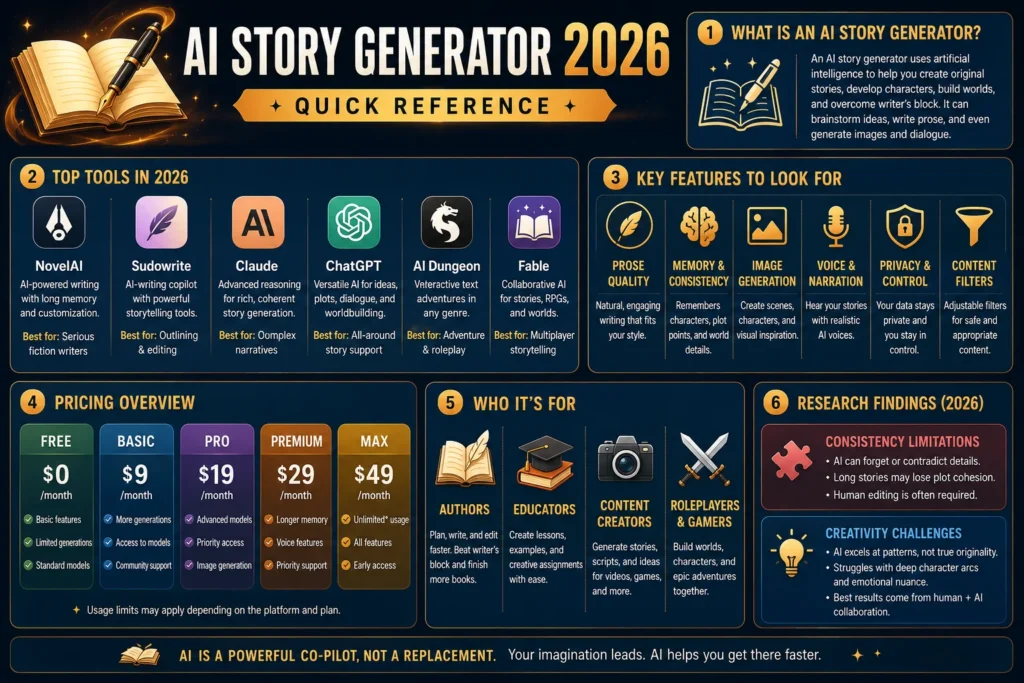
An AI story generator is an artificial intelligence tool that creates narrative text from prompts, character descriptions, or plot outlines. In 2026, the best tools produce high-quality prose and maintain consistency across long manuscripts. Top platforms include NovelAI for privacy and prose quality (starting at $10/month), Sudowrite for structured novel-writing workflows (starting at $10/month), Claude for literary prose with a 200K token context window (free tier available, Pro $20/month), ChatGPT for accessible brainstorming and image generation (free tier, Plus $20/month), AI Dungeon for interactive storytelling (free tier), and Fable for multimedia stories with voice cloning. Key features vary across platforms: NovelAI offers encrypted stories and a 128K context window; Sudowrite provides Story Bible and Canvas mind-mapping; Claude delivers the strongest stylistic range among general LLMs; ChatGPT integrates DALL-E image generation. Research from the University of Waterloo found that most AI models struggle with consistency and creative originality, often producing less lexically diverse stories. The human touch remains essential for refining and contextualizing AI-generated content. The 2025 U.S. Copyright Office guidance requires meaningful human authorship for copyright protection.
What Is an AI Story Generator?
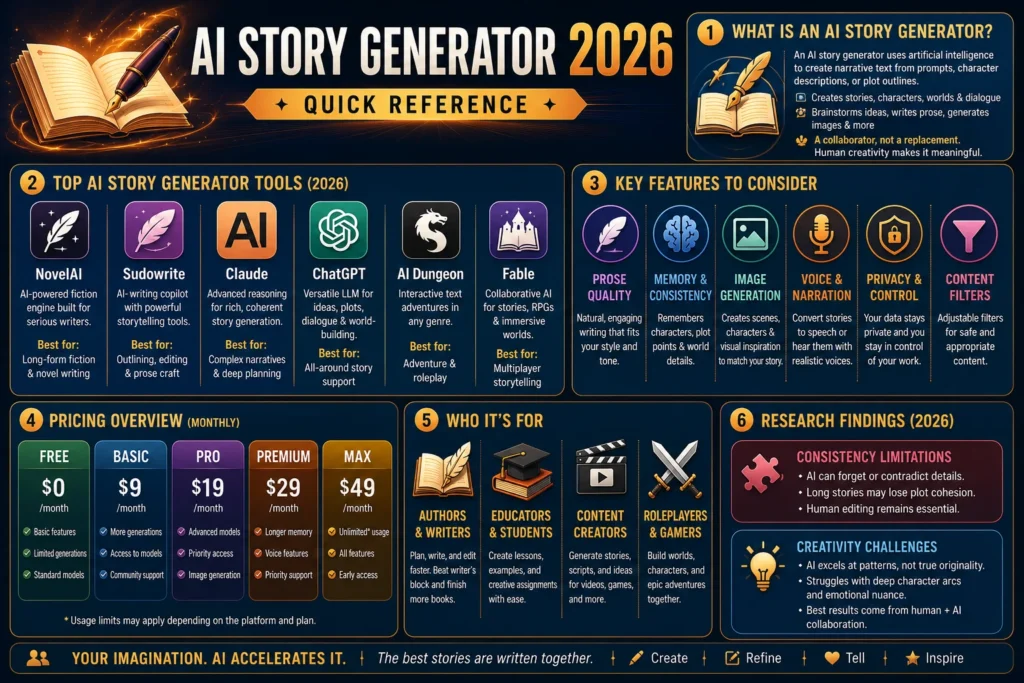
An AI story generator is a tool that uses artificial intelligence to create narrative text from prompts, character descriptions, or plot outlines. In 2026, the best tools produce writing that reads like it came from a person who actually reads books, not a language model trained on generic content. The technology has matured past the “generate a wall of text and hope” stage. Now the question is which tool matches the kind of story you are telling.
The category has split into distinct lanes. Dedicated fiction engines optimize for prose quality and manuscript-length consistency. General-purpose LLMs bring massive context windows and versatile ideation. Interactive platforms focus on collaborative, choose-your-own-adventure storytelling. And visual storytelling tools connect generated text to images, video, and audio for multimedia narratives.
An AI story generator is a collaborator, not a replacement. The human touch remains essential in refining and contextualizing the generated content, ensuring that it aligns with the intended emotional tone, narrative structure, and thematic elements.
Who Uses AI Story Generators?
AI story generators serve a surprisingly diverse audience. Here’s who’s actually using these tools:
- Aspiring authors who want to overcome writer’s block or accelerate their drafting process. Fiction writers using specialized tools like Sudowrite report completing first drafts 400% faster than their previous pace.
- Professional novelists who need help with world-building, character consistency, and manuscript-length continuity. Some use tools like NovelAI’s Lorebook system to store facts about characters, locations, and relationships across long projects.
- Parents and educators creating personalized bedtime stories for children. Apps like Fable let users put their family at the heart of the story, creating characters from photos and generating custom voices.
- Content creators and marketers generating social media narratives, branded content, and blog posts with visual storytelling elements.
- Game masters and roleplayers building interactive narratives and campaign worlds. AI Dungeon’s multiplayer mode lets multiple players contribute to the same story in real time.
- Students and researchers exploring creative writing and natural language generation in educational contexts.
Top AI Story Generators in 2026
1. NovelAI: The Uncensored Prose Specialist
NovelAI’s Kayra model consistently produces the strongest raw prose of any dedicated fiction tool. The writing reads like it came from someone who has read widely and writes with intention. Sensory details feel chosen rather than generated. Dialogue carries distinct character voices. Atmospheric passages have restraint, which is harder for AI to achieve than excess.
Key Features:
- Lorebook system manages story world consistency by storing facts about characters, locations, relationships, and rules. Keywords trigger relevant entries so the AI remembers continuity details automatically.
- Privacy is a genuine differentiator. NovelAI encrypts all user stories. The developers cannot read your content. In an era where most platforms quietly use your data for training, that matters for writers working on unpublished manuscripts.
- Kayra-XL model on the Opus tier offers a 128K token context window, enough to maintain coherence across an entire novel’s worth of content.
Pricing:
| Tier | Monthly Price | Key Features |
|---|---|---|
| Tablet | $10 | Standard Kayra model |
| Scroll | $15 | Enhanced features |
| Opus | $25 | Kayra-XL, 128K context |
Best For: Writers who prioritize prose quality, privacy, and long-form consistency.
2. Sudowrite: The Professional Novelist’s Toolkit
Sudowrite Muse is the most structured AI writing tool for fiction. The Story Engine 3.0 walks you through building a novel from premise to full draft: define your characters, outline the plot beats, set the style, and the system generates chapter by chapter while maintaining continuity across the manuscript.
Key Features:
- Story Bible stores character profiles, world-building details, genre conventions, and style preferences, keeping the AI consistent across long manuscripts.
- Describe tool transforms flat paragraphs into enriched text with specific sensory detail—sight, sound, smell, taste, or touch.
- Rewrite feature generates variations with targeted improvements: “show don’t tell,” “more inner conflict,” “increase tension.” For writers who draft fast and refine slowly, these editing tools save hours of manual revision.
- Canvas feature provides visual mind-mapping for plot points and character arcs.
The Trade-off: Sudowrite applies content filters that restrict darker or explicit themes. If you write horror, dark romance, or anything that pushes against mainstream boundaries, you will hit refusals.
Pricing:
| Tier | Monthly Price (Annual) | Best For |
|---|---|---|
| Hobby | $10 | Casual writers |
| Professional | $22 | Serious novelists |
| Max | $44 | Power users |
Best For: Writers who want a structured, opinionated writing system.
3. Claude: The Literary LLM
Claude by Anthropic has emerged as the preferred general-purpose LLM for fiction writers in 2026. The 200K token context window means you can paste an entire manuscript and ask for revisions, continuity checks, or new chapters that stay consistent with everything that came before. No dedicated fiction tool matches that raw context capacity.
Key Features:
- Literary depth: Claude sustains character voice across tens of thousands of words, follows complex stylistic instructions, and produces prose with more nuance than any competitor. Ask it to write in the style of Cormac McCarthy and it understands sparse punctuation, landscape-as-character, and fatalistic dialogue. Ask for Ursula K. Le Guin and it shifts to precise, philosophical world-building.
- Stylistic range: This makes Claude the strongest collaborator for writers with a defined voice who need AI to match it.
The Limitation: Claude is a conversational AI, not a writing application. There is no story bible, no chapter management, no export to EPUB. You manage your own workflow. For writers comfortable working in a chat interface and maintaining their own documents, that flexibility is fine. For writers who need structure imposed by the tool, dedicated platforms serve better.
Pricing: Free tier available, Pro $20/month, API usage varies.
Best For: Experienced writers who want the highest-quality prose collaborator and manage their own workflow.
4. ChatGPT: The Accessible All-Rounder
ChatGPT remains the most accessible AI story generator in 2026 because most people already have an account. GPT-5 excels at rapid ideation: plot outlines, character backstories, dialogue experiments, genre-blending concepts, and structural brainstorming. When you are staring at a blank page and need twenty story ideas in five minutes, nothing else matches ChatGPT’s speed and breadth.
Key Features:
- Native image generation through DALL-E means you can generate character portraits, setting illustrations, and scene visualizations within the same conversation. For writers who think visually, or for projects like children’s books and graphic novel scripts where text and image develop together, this integrated capability has practical value.
The Trade-off: For prose quality, ChatGPT sits below Claude and NovelAI. The writing tends toward clean, competent, and slightly generic. It follows instructions well but rarely surprises with a turn of phrase. Heavy editing is expected for publishable fiction.
A major complaint on Reddit is that these models (especially ChatGPT) tend to “sanitize” stories. One user noted that ChatGPT often removes nuance, turning a gritty scene into a polite office drama.
Pricing: Free tier, Plus $20/month, Pro $200/month.
Best For: Writers who need fast brainstorming, outlining, and visual concept art in one tool.
5. AI Dungeon: The Interactive Storytelling Platform
AI Dungeon is the original interactive fiction platform, and it has evolved significantly since its early days. The core experience is collaborative storytelling: you write an action or dialogue, the AI continues the narrative, and the story builds through this back-and-forth. It is closer to a tabletop RPG experience than a writing tool.
Key Features:
- Multiplayer mode lets multiple players contribute to the same story in real time.
- Pre-built genre scenarios (fantasy, sci-fi, mystery, horror) provide starting frameworks that the AI expands dynamically based on player choices.
- Memory Bank system stores character details and plot points across sessions, with capacity scaling from 25 memories on the free tier to 400 on Mythic.
- Image generation visualizes characters and scenes as you play.
The Catch: For traditional fiction writing, AI Dungeon is not the right tool. The output is designed for interactive exploration, not polished prose. But for worldbuilding experimentation, character discovery, and finding stories through play rather than planning, it offers a creative experience that structured writing tools cannot replicate.
Pricing:
| Tier | Monthly Price | Memory Capacity |
|---|---|---|
| Wanderer | Free | 25 memories |
| Champion | $14.99 | 100 memories |
| Legend | $29.99 | 200 memories |
| Mythic | $49.99 | 400 memories |
Best For: Players and writers who discover stories through interactive exploration and collaborative play.
6. Squibler: The Long-Form Specialist
Squibler’s AI writer is designed specifically for book-length projects. The split-screen editor combines your manuscript on one side with a visual storyboard on the other. The Elements board defines characters, locations, and lore in structured entries that the AI references during generation, reducing the continuity errors that break immersion in long manuscripts.
Key Features:
- Scene expansion workflow: Write a bullet-point outline of what happens in a scene, and Squibler expands it into full prose. This lets you plan at the structural level and generate at the prose level without losing the thread of your story.
- Corkboard organization mirrors physical index cards for visual plotting.
Best For: Writers aiming to write screenplays or massive novels (up to 300 pages) who want to generate a full draft quickly and organize it into chapters.
7. Fable: The Multimedia Storyteller
Fable is an AI story generator that turns your ideas into premium-quality short stories for every moment. Create a calming bedtime tale, an epic musical adventure, a cinematic video, or even a printed book, all from one simple idea.
Key Features:
- Character creation from photos: Create characters from photos or your imagination, then bring your child, family, friends, pets, or original heroes into every adventure.
- Voice cloning: Record a short sample to clone your own voice, or design a completely new narrator or character voice from a simple description. Create a warm bedtime narrator, a brave fantasy hero, a gentle grandparent, or a mysterious villain.
- Available in 24 languages.
The Catch: One user review notes “Too expensive. you need to pay real money after one use.” However, the developer responded that they added rewarded videos so users can earn tokens and use the app for free.
Best For: Families, teachers, and creators wanting personalized illustrated storybooks with voice narration.
8. Freepik AI Story Generator: The Visual Pipeline
Freepik’s AI text generator creates story content, blog narratives, social media copy, and creative text with tone customization across professional, casual, friendly, and confident styles. You can expand, condense, or rewrite generated text while maintaining the core message.
Key Feature: Where Freepik stands apart from pure text tools is the visual storytelling pipeline. The generated narrative connects to the same platform where you can produce AI-generated images of your characters and settings, create animated video sequences from key scenes, add voiceover narration via ElevenLabs and Gemini in 30+ languages, and layer AI-generated music for atmosphere.
Pricing: Free (limited), Pro from $6.99/month.
Best For: Creators who need story content paired with visuals, video, and audio in one workflow.
Feature Comparison Table
| Feature | NovelAI | Sudowrite | Claude | ChatGPT | AI Dungeon | Fable |
|---|---|---|---|---|---|---|
| Type | Dedicated fiction | Dedicated fiction | General LLM | General LLM | Interactive | Multimedia |
| Prose Quality | Excellent | Very Good | Excellent | Good | Moderate | Good |
| Context Window | 128K (Opus) | Story Bible | 200K | Large | Memory system | Not specified |
| Image Generation | Anime only | No | No | DALL-E | Yes | Yes |
| Voice Features | No | No | No | No | No | Yes (clone/design) |
| Privacy | Encrypted | Moderate | Moderate | Moderate | Moderate | Moderate |
| Content Filters | None | Moderate | Moderate | Strict | Light | Light |
| Free Plan | No (trial only) | Trial only | Yes (limited) | Yes (limited) | Yes (limited) | Very limited |
| Starting Price | $10/mo | $10/mo | $20/mo | $20/mo | Free | Not specified |
How to Choose the Right AI Story Generator
Use these evidence-driven checkpoints to avoid buyer’s remorse:
1. Coherence over long arcs
Look for long-context support and memory systems (story bible or lorebook). The bigger the project, the more you’ll rely on selective retrieval so chapters don’t contradict earlier facts. NovelAI’s Lorebook and Sudowrite’s Story Bible are specifically designed for this.
2. Style control and steerability
You’ll want granular prompt controls, extra instructions per scene, and the ability to condition on a short style sample so the voice stays yours. Claude excels at style matching—it can shift from McCarthy’s sparse prose to Le Guin’s philosophical world-building on command.
3. Safety settings and creative latitude
If your genre addresses mature themes, confirm the platform’s content filters can be tuned so you’re not fighting the guardrails every chapter. NovelAI offers zero censorship, making it the go-to choice for gritty or experimental storytelling.
4. Privacy, ownership, and compliance
Review data retention and whether your drafts are used for model training. NovelAI encrypts all user stories with zero developer access, making it the privacy leader. For rights protection in the U.S., keep meaningful human authorship and document your role, per the 2025 U.S. Copyright Office guidance.
5. Workflow fit and exports
Check for DOCX/EPUB or Scrivener exports, collaboration, and series management if you publish serially or with co-authors.
6. Trialability
Prefer tools with a free tier or trial so you can test on a pilot chapter before committing. ChatGPT and Claude offer free tiers. Sudowrite has a trial. NovelAI has no permanent free tier, only limited trials.
Hidden Gems and Specialized Tools
StoryForge (CLI Tool): A CLI/TUI that generates illustrated children’s stories using AI. Provides a prompt, gets a story and AI-generated images. Features customizable age range, length, tone, theme, and style. Offers AI illustrations in multiple art styles (chibi, realistic, cartoon, watercolor, sketch). Includes voice archetypes for narrator styles, world definitions for persistent characters and lore, story extension, and a checkpoint system for resuming interrupted sessions.
Perchance: A completely free, community-driven platform that is surprisingly powerful for “Choose Your Own Adventure” styles and unrestricted generation. Mentioned by Reddit users as a hidden gem.
Venice.ai: A rising star in 2025 that appeals to the privacy-focused crowd. Operates similarly to ChatGPT but without the “nanny” filters and with a promise that your data is stored locally or privately.
WaveSpeedAI: Offers an AI story generator at $0.035 per story (~28 stories per $1) with no subscription required. Supports fantasy, romance, mystery, and sci-fi with customizable length, perspective, and audience.
The Science: What Research Says About AI Story Generation
The Consistency Problem
Research from the University of Waterloo assessed language models’ ability to maintain a consistent worldview for fiction generation. The findings were striking: only two of nine models exhibited consistent worldview, while the rest were self-conflicting. Subsequent analysis of stories generated by four models revealed a strikingly uniform narrative pattern.
Key finding: “None of the models are perfectly consistent. Slight change in question wording can turn a model’s agreement to disagreement (or vice versa).” Inconsistency is most prevalent for controversy and misconception categories in all models. Some models even have inconsistency in facts and (dangerously) in stereotypes, which means that whether a model will agree with or disagree with a stereotype can be a consequence of simple changes in prompting.
The Creative Limitations
A study from the University of Warwick examined AI story generation from sequences of independent short descriptions. It found that current systems are limited in their creative abilities and struggle to produce semantically rich stories, often relying on co-occurrence statistics rather than true narrative understanding. Existing systems are categorized as weak AI, struggling with higher levels of creativity and originality in language generation tasks.
The SARD Research
SARD (a human-AI collaborative story generation tool) research found that while node-based visualization of the narrative may help writers build a mental model, it exerts unnecessary mental overhead and becomes a source of distraction as the story becomes more elaborated. The study also found that AI generates stories that are less lexically diverse, irrespective of the complexity of the story.
The Human Element: Why AI Story Generators Work Best as Collaborators
The most successful writers view AI story generators as co-authors, not replacements. Here’s why:
Generative AI should be viewed as a tool to augment human creativity rather than replace it. Writers can leverage these AI models to explore new ideas, overcome writer’s block, or even collaborate with the AI in co-authoring projects. The human touch remains essential in refining and contextualizing the generated content, ensuring that it aligns with the intended emotional tone, narrative structure, and thematic elements.
Key insight: One of the significant advantages of generative AI in story creation is its ability to break through creative barriers and expedite the writing process. Exposing the model to a myriad of writing styles and genres can produce content combining elements from various sources, resulting in novel and unique narratives. This not only aids writers in overcoming creative blocks but also fosters a collaborative relationship between human creativity and machine-generated content.
Pros and Cons: AI Story Generators at a Glance
Pros
- Break through creative blocks: AI can generate story ideas, character concepts, and plot twists when you’re stuck
- Accelerate drafting: Fiction writers using Sudowrite report completing first drafts 400% faster
- Maintain consistency: Tools like Lorebook and Story Bible help track characters, locations, and rules across long projects
- Explore multiple genres: Generate stories across fantasy, romance, mystery, sci-fi, and more
- Visual storytelling: Some tools integrate image, video, and audio generation for multimedia narratives
- Cost-effective: Some platforms offer free tiers or pay-per-use pricing
Cons
- Creativity limitations: Research shows AI-generated stories are less lexically diverse and follow uniform patterns
- Consistency issues: Many models are self-conflicting and cannot maintain a stable worldview
- Censorship: Mainstream models often “sanitize” gritty or mature content
- Privacy concerns: Some platforms may use your writing for model training
- Costs can escalate: Premium features and token-based pricing can become expensive
- Learning curve: Some tools require technical setup (e.g., API keys, command-line interface)
Frequently Asked Questions
What is the best AI story generator?
There is no single “best” tool—it depends on your needs. NovelAI offers the best prose quality and privacy for fiction writers. Sudowrite provides the most structured novel-writing workflow. Claude delivers the most literary prose among general LLMs. ChatGPT offers the most accessible ideation and brainstorming. AI Dungeon excels at interactive storytelling.
Are AI story generators free?
Some offer free tiers with limited features. ChatGPT and Claude have free tiers. AI Dungeon has a free Wanderer plan. NovelAI has no permanent free tier—only trials. Sudowrite offers trials. Perchance and Venice.ai are completely free options.
Can I use AI story generators for commercial projects?
Yes, but review each platform’s terms. Most paid plans include commercial rights. For rights protection in the U.S., keep meaningful human authorship and document your role, per the 2025 U.S. Copyright Office guidance.
Are AI-generated stories copyright protected?
In the U.S., works where AI is the sole author are not copyrightable. However, works with significant human authorship—where the human selects, arranges, and modifies AI-generated content—may qualify for protection. Document your creative contributions.
Do AI story generators work for long-form novels?
Yes, but choose tools designed for long-form. Sudowrite’s Story Engine and Story Bible manage consistency across manuscripts. NovelAI’s Lorebook and 128K context window maintain coherence. Claude’s 200K context window can process entire manuscripts in one go.
Can I generate images with my stories?
Yes. Fable creates illustrated storybooks with consistent characters. Freepik connects story generation to AI images, video, and audio. ChatGPT’s DALL-E generates character portraits and scene visualizations. AI Dungeon generates scene images. NovelAI offers anime-style image generation.
What’s the cheapest AI story generator?
WaveSpeedAI offers pay-per-use at $0.035 per story (~28 stories per $1) with no subscription required. Perchance and Venice.ai are completely free.
Conclusion
The AI story generator landscape in 2026 offers more choice and capability than ever before. Whether you’re an aspiring novelist looking to accelerate your first draft, a parent creating personalized bedtime stories, or a marketer building branded narratives, there’s a tool designed for your specific needs.
But the technology has limits. Research consistently shows that AI struggles with true creativity, often producing stories that are less lexically diverse and follow uniform patterns. The most successful writers view these tools as collaborators, not replacements—using them to overcome blocks, explore ideas, and accelerate drafting, while bringing their own human judgment, emotional depth, and creative vision to the final product.
The key is choosing the right tool for your workflow. NovelAI offers the best prose quality and privacy for fiction writers. Sudowrite provides the most structured novel-writing system. Claude delivers the most literary prose among general LLMs. ChatGPT offers the most accessible ideation and brainstorming. And visual tools like Fable and Freepik connect your stories to images, video, and audio for truly multimedia narratives.
Start with a free tier or trial, test on a pilot chapter, and see which tool feels like a true creative partner rather than a frustrating obstacle. The technology is evolving fast, but the human touch remains irreplaceable. Use these tools wisely, and they can unlock storytelling possibilities you never imagined.

Victoria Lane is a grammar-focused writer at GramBrix.com, passionate about helping readers master the rules of language. She provides clear explanations and practical examples that make writing more accurate, polished and confident.