
Last Updated on July 7, 2026
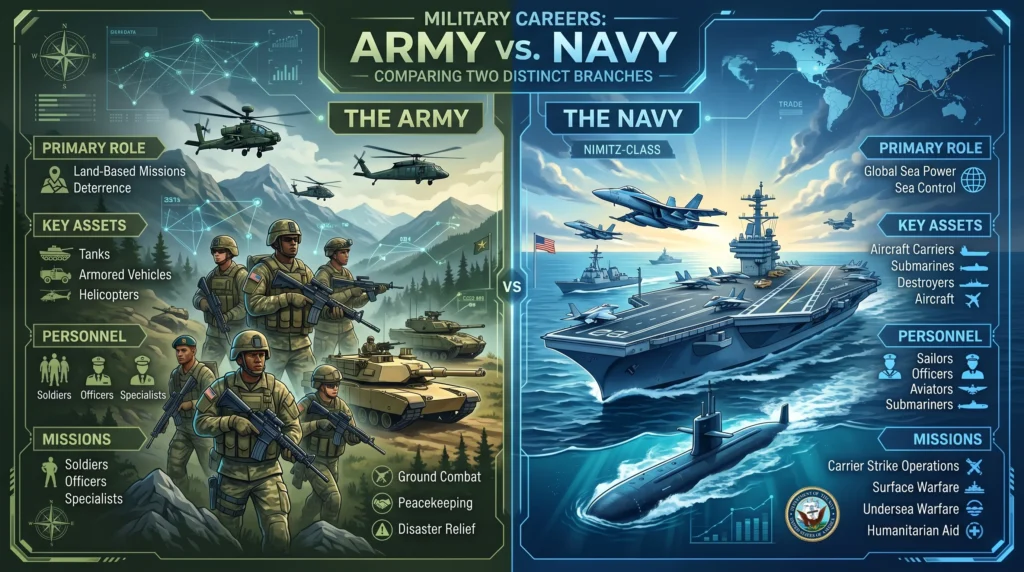
The Army and Navy are two major military branches with different missions, training styles, and career paths. The Army mainly focuses on land-based operations, while the Navy specializes in sea operations, ships, and global maritime security. The better choice depends on personal goals, lifestyle preferences, career interests, and travel expectations.
Choosing between the Army or Navy is one of the biggest decisions for people considering military service. Both branches offer:
- Career opportunities
- Education benefits
- Travel experiences
- Technical training
- Long-term career paths
However, daily life in each branch can feel completely different.
The United States Army mainly handles land warfare and ground operations, while the United States Navy focuses on sea operations, aircraft carriers, submarines, and global maritime missions.
Many people compare the two because they want answers about:
- Salary
- Lifestyle
- Deployment
- Difficulty
- Career growth
- Family life
The right choice depends on personality and long-term goals.
Some people enjoy:
- Structured ground operations
- Physical field training
- Large combat units
Others prefer:
- Ocean travel
- Technical careers
- Ship-based missions
In this guide, you will learn:
- Main differences between Army and Navy
- Training and lifestyle comparisons
- Career opportunities
- Real-world examples
- Pros and cons of each branch
- Common misconceptions
The explanations are simple and beginner-friendly.
Quick Answer
| Feature | Army | Navy |
|---|---|---|
| Main Mission | Land warfare | Sea operations |
| Work Environment | Bases and field operations | Ships and naval bases |
| Travel Style | Ground deployment | International sea travel |
| Technical Careers | Strong | Very strong |
| Combat Focus | Land combat | Maritime security |
| Lifestyle | Field-oriented | Ship-oriented |
Simple Summary
- The Army focuses on land operations and combat support.
- The Navy specializes in sea missions, ships, submarines, and global maritime defense.
What Is the Army?
Definition
The United States Army is the land warfare branch of the military.
Its main responsibilities include:
- Ground combat
- National defense
- Peacekeeping operations
- Humanitarian missions
Common Army Roles
Army careers include:
- Infantry
- Engineering
- Intelligence
- Medical services
- Cybersecurity
Army Work Environment
Army personnel often work:
- On military bases
- In training camps
- In field environments
What Is the Navy?
Definition
The United States Navy protects maritime interests and conducts operations at sea.
Common Navy Roles
Navy careers include:
- Aviation
- Nuclear engineering
- Ship operations
- Intelligence
- Cyber warfare
Navy Work Environment
Navy members may work:
- On aircraft carriers
- Submarines
- Naval bases
- International ports
Main Difference Between Army or Navy
Land vs Sea Operations
This is the biggest difference.
Army
- Primarily land-focused
Navy
- Primarily sea-focused
Living Conditions
Army
Army members often live:
- On bases
- In barracks
- In field camps
Navy
Navy personnel may spend months living aboard ships.
Travel Style
Army
Travel often involves deployments to military zones.
Navy
Travel frequently includes overseas ports and ocean missions.
Training Comparison
Army Basic Training
Army boot camp focuses heavily on:
- Physical fitness
- Weapons training
- Field exercises
Navy Basic Training
Navy training focuses on:
- Discipline
- Maritime operations
- Technical systems
Which Is Harder?
Difficulty depends on:
- Physical endurance
- Mental adaptation
- Career specialty
Career Opportunities
Army Career Paths
The Army offers:
- Combat roles
- Engineering
- Medical careers
- Logistics
Navy Career Paths
The Navy is highly known for:
- Technical careers
- Aviation
- Nuclear technology
- Ship systems
Technology and Cyber Roles
Both branches now invest heavily in:
- Cybersecurity
- AI systems
- Intelligence operations
Real World Examples
Army Example
A soldier may work:
- In ground operations
- Disaster response
- International deployment
Navy Example
A sailor may:
- Operate aboard aircraft carriers
- Travel internationally
- Work with advanced naval systems
Advantages of the Army
Strong Ground Leadership Training
The Army is famous for leadership development.
Wide Career Variety
Many different military occupations are available.
Large Global Presence
The Army operates worldwide.
Strong Physical Training
Excellent for people who enjoy active field environments.
Disadvantages of the Army
Harsh Field Conditions
Army deployments may involve difficult outdoor environments.
Physically Demanding
Many roles require high endurance and fitness.
Frequent Ground Deployments
Long land deployments can be challenging for families.
Advantages of the Navy
International Travel Opportunities
Navy members often visit multiple countries.
Strong Technical Training
The Navy is highly respected for technical career preparation.
Advanced Technology Exposure
Many naval careers involve sophisticated systems and engineering.
Maritime Lifestyle
Some people enjoy ship-based life and ocean operations.
Disadvantages of the Navy
Long Time at Sea
Deployments may last months away from home.
Limited Personal Space
Living aboard ships can feel crowded.
Isolation During Deployment
Ocean deployments may reduce communication access.
Salary and Benefits
Shared Military Benefits
Both branches generally provide:
- Healthcare
- Housing support
- Retirement plans
- Education assistance
Promotion Opportunities
Career growth depends on:
- Performance
- Rank progression
- Specialized training
Army or Navy for Different Personalities
| Personality Type | Better Fit |
|---|---|
| Outdoor and field-focused | Army |
| Technical and engineering-focused | Navy |
| Interested in ships and travel | Navy |
| Interested in land operations | Army |
Common Mistakes People Make
Choosing Based Only on Movies
Real military life is very different from entertainment portrayals.
Ignoring Lifestyle Differences
Daily routines differ greatly between branches.
Underestimating Deployments
Military service requires long-term commitment and flexibility.
Focusing Only on Combat Roles
Many military careers are technical or administrative.
Military Trends in 2026
Growing Cybersecurity Roles
Both branches continue expanding cyber operations.
AI and Technology Integration
Modern military systems increasingly rely on AI and automation.
Recruitment Modernization
Military branches are using more digital recruitment tools and career flexibility programs.
Related Military Concepts
Active Duty
Full-time military service.
Reserve Service
Part-time military service while maintaining civilian life.
Military Deployment
Temporary assignment to operational locations.
Exercises With Answers
Exercise 1
Which branch mainly focuses on sea operations?
Answer: Navy
Exercise 2
Which branch primarily handles land warfare?
Answer: Army
Exercise 3
Which branch is known for ship-based deployments?
Answer: Navy
Exercise 4
Do both branches offer technical careers?
Answer: Yes
Exercise 5
Can military service involve international travel?
Answer: Yes
FAQs
What is the main difference between Army or Navy?
The Army focuses on land operations, while the Navy specializes in sea and maritime missions.
Which branch travels more?
The Navy often provides more international travel opportunities through ship deployments.
Is the Army harder than the Navy?
Difficulty depends on career role, training, and personal adaptability.
Which branch is better for technology careers?
The Navy is especially known for technical and engineering roles, but both offer technology careers.
Can I get education benefits in both branches?
Yes. Both branches offer education and training programs.
Which branch deploys more often?
Deployment frequency depends on role and global military operations.
Do Navy members live on ships?
Yes. Many Navy personnel spend time living aboard ships or submarines.
Can Army members travel internationally?
Yes. Army deployments and assignments occur worldwide.
Which branch is better for leadership training?
Both provide leadership development, but the Army is especially known for ground leadership programs.
Is military life stressful?
Military service can be physically and mentally demanding depending on assignments and deployments.
Conclusion
Choosing between Army or Navy depends on your career goals, personality, and preferred lifestyle.
The Army is ideal for people interested in:
- Ground operations
- Physical field environments
- Leadership development
- Land-based missions
The Navy is often better for people who enjoy:
- Technical careers
- Maritime operations
- International travel
- Advanced engineering systems
Both branches provide valuable opportunities, including:
- Education benefits
- Career training
- Global experience
- Long-term professional development
The best decision comes from understanding the daily lifestyle, deployment expectations, and career options within each branch.
As military technology and global operations continue evolving in 2026, both the Army and Navy remain major career paths for people seeking structure, service, technical training, and leadership opportunities.

Victoria Lane is a grammar-focused writer at GramBrix.com, passionate about helping readers master the rules of language. She provides clear explanations and practical examples that make writing more accurate, polished and confident.