Last Updated on July 8, 2026
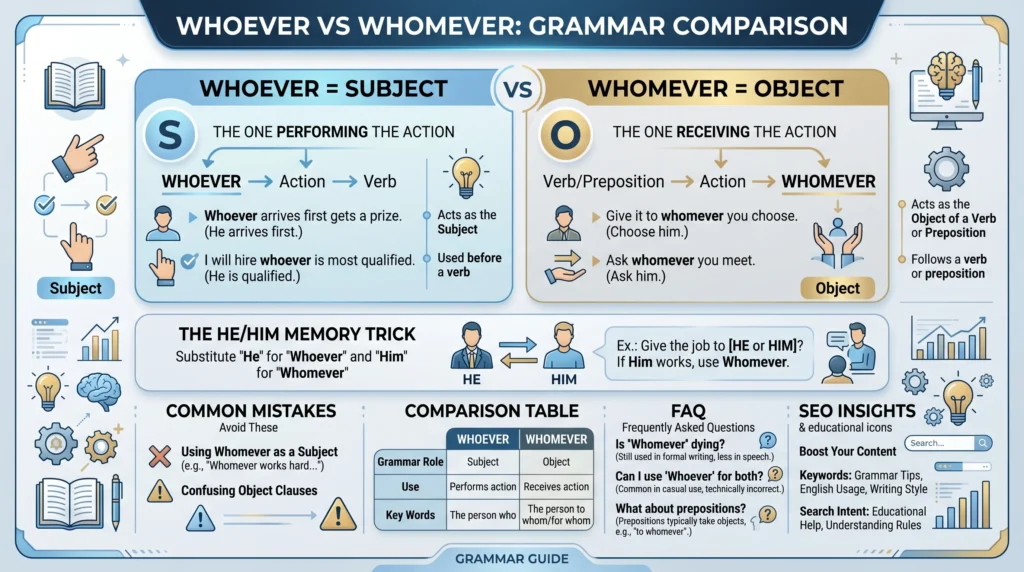
Both whoever and whomever are correct English words, but they serve different grammatical functions. Whoever is used as a subject, while whomever is used as an object. In modern English, whoever is far more common and often replaces whomever in everyday conversation. However, understanding the difference can help you write more accurately in formal and professional settings.
The debate over whoever or whomever has confused English speakers for generations.
Many people avoid using whomever altogether because it sounds formal and can be difficult to apply correctly. Others use it incorrectly, believing it sounds more sophisticated.
Consider these examples:
- Whoever arrives first can choose a seat. ✅
- Whomever arrives first can choose a seat. ❌
- Give the prize to whomever you choose. ✅
- Give the prize to whoever you choose. ❌
Both words are correct, but their usage depends on grammar.
This guide explains:
- The meaning of whoever and whomever
- Subject vs object rules
- Easy grammar tricks
- Common mistakes
- Examples
- FAQs
Quick Answer
| Word | Correct? | Function |
|---|---|---|
| Whoever | Yes | Subject |
| Whomever | Yes | Object |
| Most Common Today | Whoever | Everyday English |
Simple Summary
- Whoever = Subject
- Whomever = Object
- When in doubt, whoever is usually correct in modern English.
What Does Whoever Mean?
Definition
Whoever means:
- Any person who
- The person who
- Anyone who
It functions as a subject in a sentence.
Examples
- Whoever finishes first wins.
- Whoever called me did not leave a message.
- You may invite whoever wants to come.
Grammar Role
Whoever performs the action.
Common Usage
Whoever appears frequently in:
- Everyday speech
- Emails
- Academic writing
- News articles
What Does Whomever Mean?
Definition
Whomever means:
- Any person whom
- The person whom
- Anyone whom
It functions as an object.
Examples
- Hire whomever you prefer.
- Give the award to whomever deserves it.
- Speak with whomever you trust.
Grammar Role
Whomever receives the action.
Modern Usage
Whomever is much less common than whoever.
Main Difference Between Whoever and Whomever
Whoever
Acts as a subject.
Example:
- Whoever wins receives a trophy.
Whomever
Acts as an object.
Example:
- Give the trophy to whomever you choose.
Quick Comparison
| Feature | Whoever | Whomever |
|---|---|---|
| Subject | Yes | No |
| Object | No | Yes |
| Common Usage | Very Common | Less Common |
| Informal Writing | Yes | Rare |
| Formal Writing | Yes | Yes |
Understanding Subjects and Objects
What Is a Subject?
A subject performs the action.
Example:
- Sarah runs.
Sarah is the subject.
What Is an Object?
An object receives the action.
Example:
- I called Sarah.
Sarah is the object.
Applying the Rule
Whoever = Subject
Whomever = Object
Why It Matters
The grammatical role determines which word is correct.
How to Use Whoever Correctly
As the Subject
Examples:
- Whoever arrives first gets the tickets.
- Whoever wrote this deserves recognition.
- Whoever wants dessert may have some.
In Questions
Examples:
- Whoever told you that?
- Whoever made this decision?
In Everyday Speech
Most English speakers naturally use whoever.
Modern Preference
Whoever is becoming increasingly dominant.
How to Use Whomever Correctly
As the Object
Examples:
- Choose whomever you like.
- Invite whomever you want.
- Pay whomever completed the work.
After Prepositions
Examples:
- To whomever it may concern.
- With whomever you choose.
Formal Writing
Whomever appears most often in formal documents.
Legal Language
Many legal and professional texts use whomever.
The He/Him Test
Easy Grammar Trick
Replace the word with:
- He = Whoever
- Him = Whomever
Example 1
Whoever called deserves credit.
Test:
He called. ✅
Therefore:
Whoever is correct.
Example 2
Give the award to whomever you choose.
Test:
You choose him. ✅
Therefore:
Whomever is correct.
Why This Works
He is a subject.
Him is an object.
The same rule applies to whoever and whomever.
Common Examples of Whoever
Work
- Whoever finishes the report may leave early.
School
- Whoever studies hardest often succeeds.
Family
- Whoever cooks dinner chooses the movie.
Sports
- Whoever scores the most points wins.
Common Examples of Whomever
Employment
- Hire whomever you believe is qualified.
Awards
- Present the prize to whomever the committee selects.
Invitations
- Invite whomever you want.
Formal Correspondence
- Send the documents to whomever is responsible.
Common Mistakes People Make
Using Whomever to Sound Formal
Incorrect:
- Whomever arrives first wins.
Correct:
- Whoever arrives first wins.
Avoiding Whomever Completely
Some sentences genuinely require whomever.
Example:
- Give it to whomever you trust.
Ignoring Subject/Object Rules
Always identify the grammatical role.
Guessing Based on Appearance
Longer words are not automatically more formal or correct.
Why Whoever Is Becoming More Common
Language Simplification
Modern English favors simpler constructions.
Everyday Conversation
Most speakers rarely use whomever.
Media Influence
Journalists often choose whoever for readability.
Reader Preference
Whoever sounds more natural to many audiences.
Which Word Is More Common?
Online Usage
Whoever is dramatically more common.
Books and Articles
Whoever appears far more frequently.
Formal Documents
Whomever still appears regularly.
Search Trends
Whoever receives significantly more searches.
Which Version Is Better for SEO?
Search Volume
Whoever generally has higher search volume.
User Intent
Many users search this phrase to understand grammar rules.
Content Opportunity
Grammar comparison articles perform well.
SEO Recommendation
Target whoever or whomever while explaining the subject-object distinction clearly.
How to Remember the Difference
He/Him Rule
He = Whoever
Him = Whomever
Subject Rule
Action performer = Whoever
Object Rule
Action receiver = Whomever
Easy Formula
Whoever acts.
Whomever receives.
Related Grammar Comparisons
Who or Whom
Similar subject-object distinction.
Further or Farther
Frequently confused words.
Neither or Either
Common grammar comparison.
Whoever or Whomever
One of the most searched grammar questions.
Exercises With Answers
Exercise 1
_____ arrives first wins.
Answer: Whoever
Exercise 2
Choose _____ you prefer.
Answer: Whomever
Exercise 3
Which word functions as a subject?
Answer: Whoever
Exercise 4
Which word functions as an object?
Answer: Whomever
Exercise 5
Which word is more common in modern English?
Answer: Whoever
FAQs
Is it whoever or whomever?
Both are correct depending on grammar.
What is the difference between whoever and whomever?
Whoever is a subject. Whomever is an object.
Which word is more common?
Whoever.
Is whomever outdated?
No, but it is less common today.
Can I always use whoever?
In informal English, many people do, but formal grammar sometimes requires whomever.
What is the easiest way to remember the rule?
Use the He/Him test.
Is “To Whomever It May Concern” correct?
Yes.
Which word should I use in professional writing?
Use whichever fits the grammatical role.
Do native speakers use whomever often?
Not frequently.
Which version is better for SEO?
Whoever generally has greater search volume, but both terms should be included.
Conclusion
The answer to whoever or whomever depends on grammar.
Key takeaways include:
- Whoever functions as a subject.
- Whomever functions as an object.
- Whoever is much more common in modern English.
- The He/Him test helps determine the correct choice.
- Both words are grammatically correct when used properly.
Remember this simple rule:
He = Whoever
Him = Whomever
Mastering this distinction can improve your grammar, writing confidence, and professional communication in 2026 and beyond.

Kevin Brooks is a grammar specialist at GramBrix.com, dedicated to helping readers understand language rules with clarity and confidence. He simplifies complex grammar concepts through practical examples and easy explanations.