
Last Updated on August 16, 2026
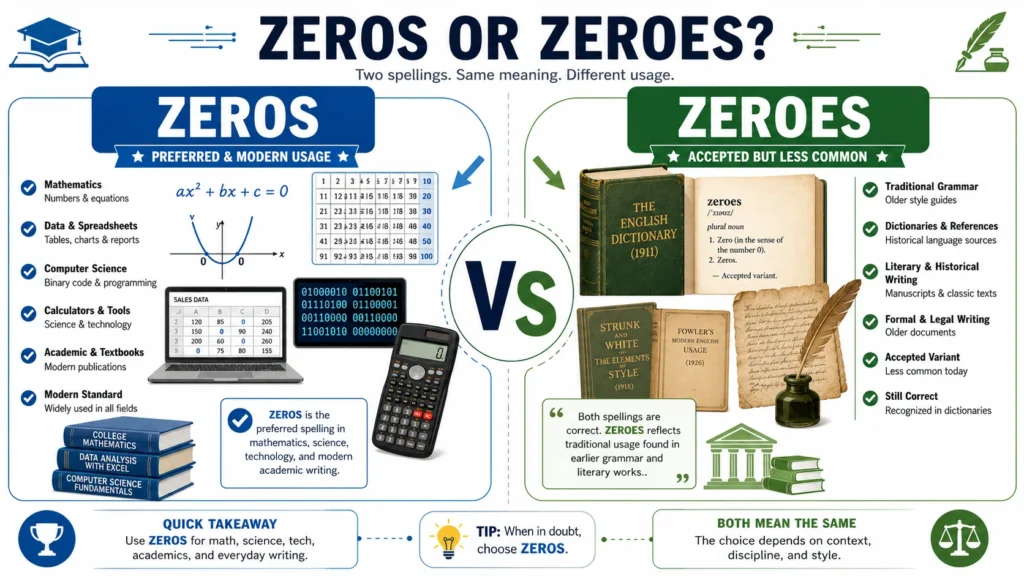
Zeros and zeroes are both accepted plural forms of the word zero. In modern English, zeros is the preferred spelling in most writing styles, especially in mathematics, science, business, and American English, while zeroes is less common and often appears in traditional or literary contexts.
Have you ever stopped while writing and wondered whether the plural of zero is zeros or zeroes?
You are not alone. Many writers, students, teachers, and professionals face this question. Both spellings appear in books, newspapers, websites, and academic papers. This can make it hard to know which one to use.
The confusion comes from English spelling rules. Some words ending in o form their plurals by adding es, while others simply add s. Because of this, both zeros and zeroes have been accepted over time.
Understanding the difference is important for clear and professional writing. Whether you are writing a math assignment, a business report, a research paper, or a blog post, choosing the right form helps maintain consistency and credibility.
This guide explains everything you need to know about zeros or zeroes, including definitions, usage rules, examples, regional preferences, common mistakes, exercises, and expert recommendations.
Quick Answer
The short answer is simple:
| Word | Correct? | Common Usage |
|---|---|---|
| Zeros | Yes | Preferred in modern English |
| Zeroes | Yes | Less common but accepted |
Recommended Usage
Use zeros in:
- Mathematics
- Science
- Technology
- Academic writing
- Business documents
- Modern journalism
Use zeroes only when:
- Following a specific style guide
- Writing in a traditional or literary style
- Maintaining consistency with older texts
Example
Correct:
- There are three zeros in the number 1,000.
- The test scores contained several zeros.
Also correct:
- There are three zeroes in the number 1,000.
However, most modern editors would choose zeros.
What Does Zero Mean?
The word zero has several meanings.
As a Number
Zero represents nothing or no quantity.
Example:
- The temperature dropped to zero degrees.
As a Score
It can mean no points earned.
Example:
- The team finished the game with zero points.
As a Placeholder
In mathematics, zero holds a place value.
Example:
- The number 105 contains one zero.
As a Symbol
Zero is represented by:
0
This symbol is one of the most important symbols in mathematics.
Understanding Zeros and Zeroes
Both words are plural forms of zero.
Zeros
Adding s creates:
zero → zeros
Examples:
- The spreadsheet contains many zeros.
- The code includes leading zeros.
- Remove unnecessary zeros from the calculation.
Zeroes
Adding es creates:
zero → zeroes
Examples:
- The report contains several zeroes.
- There were two zeroes in the final score.
Although correct, this form appears less often today.
Why Do Both Spellings Exist?
English has inconsistent pluralization rules.
Some words ending in o take only s:
- Pianos
- Photos
- Radios
- Videos
Others take es:
- Heroes
- Potatoes
- Tomatoes
Historically, the plural of zero developed in both forms.
As language evolved, modern usage increasingly favored zeros, especially in technical and academic contexts.
Historical Development of Zero
The concept of zero has a fascinating history.
The number originated in ancient mathematics and eventually spread across different cultures.
Important milestones include:
| Period | Development |
|---|---|
| Ancient India | Zero developed as a number |
| Islamic Golden Age | Concept expanded and transmitted |
| Medieval Europe | Zero entered European mathematics |
| Modern Era | Standardized mathematical usage |
As the mathematical concept spread, writers used different plural forms, leading to both zeros and zeroes.
Zeros vs Zeroes Comparison Table
| Feature | Zeros | Zeroes |
|---|---|---|
| Correct spelling | Yes | Yes |
| Modern preference | Yes | No |
| Academic writing | Common | Rare |
| Mathematical writing | Standard | Uncommon |
| Business writing | Standard | Rare |
| Journalism | Preferred | Less common |
| Literary writing | Sometimes | Sometimes |
| American English | Strongly preferred | Less common |
| British English | Preferred | Occasionally used |
Winner
For most situations, choose zeros.
When to Use Zeros

Mathematics
Mathematicians almost always use zeros.
Examples:
- The equation has two zeros.
- Count the zeros carefully.
- Add trailing zeros when necessary.
Science
Scientific papers generally prefer zeros.
Examples:
- Significant zeros affect precision.
- The data set contains several zeros.
Computing
Programmers often write:
- Leading zeros
- Trailing zeros
- Binary zeros
Examples:
- Remove leading zeros from the file.
- The system stores zeros and ones.
Finance
Examples:
- The account balance ended with three zeros.
- Investors like seeing more zeros in revenue figures.
When to Use Zeroes
Although less common, zeroes still appears in some contexts.
Traditional Writing
Older publications sometimes use zeroes.
Example:
- The score sheet displayed several zeroes.
Literary Style
Some authors prefer the more traditional spelling.
Example:
- The ledger showed endless zeroes.
Style Consistency
If a publication style guide requires zeroes, follow that preference consistently.
Zeros as a Noun vs Zeroes as a Verb
This is where confusion often increases.
Zeros as a Noun
Plural noun:
- Three zeros appear in the number.
- The data contains many zeros.
Zeroes as a Verb
The verb to zero often becomes:
zeroes
Examples:
- The pilot zeroes in on the target.
- She zeroes in on the problem quickly.
This usage is extremely common.
Comparison
| Usage | Example |
|---|---|
| Noun plural | The chart contains many zeros. |
| Verb | The camera zeroes in automatically. |
Many people encounter zeroes as a verb and mistakenly assume it is the preferred plural noun form.
Regional Usage Around the World
American English
American English strongly favors zeros.
Examples:
- Mathematical textbooks
- Scientific journals
- Newspapers
- Business reports
Most American style guides recommend zeros.
British English
British English also commonly uses zeros.
However, zeroes may appear slightly more often than in American English.
Even so, modern British publications increasingly favor zeros.
Australian English
Australian publications typically prefer zeros.
Examples include:
- Educational materials
- Government reports
- Academic papers
Canadian English
Canadian English generally follows the modern preference for zeros.
Advantages and Disadvantages of Each Form
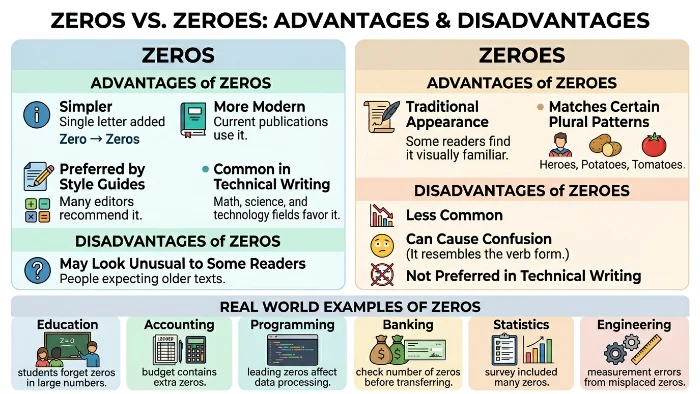
Advantages of Zeros
Simpler
Only one letter is added.
Example:
- Zero → Zeros
More Modern
Most current publications use it.
Preferred by Style Guides
Many editors recommend it.
Common in Technical Writing
Math, science, and technology fields favor it.
Disadvantages of Zeros
May Look Unusual to Some Readers
People familiar with older texts may expect zeroes.
Advantages of Zeroes
Traditional Appearance
Some readers find it visually familiar.
Matches Certain Plural Patterns
Like:
- Heroes
- Potatoes
- Tomatoes
Disadvantages of Zeroes
Less Common
Modern readers encounter it less often.
Can Cause Confusion
It resembles the verb form.
Not Preferred in Technical Writing
Many professional editors avoid it.
Real World Examples of Zeros
Education
- Students often forget the zeros in large numbers.
Accounting
- The budget contains several extra zeros.
Programming
- Leading zeros can affect data processing.
Banking
- Check the number of zeros before transferring money.
Statistics
- The survey included many zeros.
Engineering
- Measurement errors occurred because of misplaced zeros.
Zeros in Mathematics
Mathematics provides some of the most common uses of the word.
Place Value
Examples:
- 100
- 1,000
- 10,000
Each number contains zeros that determine value.
Polynomial Zeros
In algebra, a zero is a value that makes an equation equal zero.
Example:
For:
x² − 4 = 0
The zeros are:
- 2
- −2
Significant Zeros
Scientists analyze zeros carefully because they influence precision and measurement.
Common Expressions Using Zero
Leading Zeros
Example:
- ZIP codes often contain leading zeros.
Trailing Zeros
Example:
- The number 500 has two trailing zeros.
Double Zeros
Example:
- The passport number begins with double zeros.
Multiple Zeros
Example:
- The company added several zeros to its annual revenue.
Common Mistakes With Zeros and Zeroes
Mistake 1: Thinking One Form Is Wrong
Incorrect belief:
- Zeroes is wrong.
Reality:
- Both spellings are accepted.
Mistake 2: Using Both in the Same Document
Incorrect:
- The chart shows many zeros.
- Several zeroes appear later.
Correct:
Choose one style and remain consistent.
Mistake 3: Confusing Noun and Verb Forms
Incorrect understanding:
- Zeroes always means plural.
Correct:
- Zeroes can also be a verb.
Example:
- The missile zeroes in on its target.
Mistake 4: Following Outdated Preferences
Some writers automatically choose zeroes because they learned it years ago.
Modern style guides generally prefer zeros.
Related Plural Words Ending in O
The confusion with zeros or zeroes is part of a larger English pattern.
| Singular | Plural |
|---|---|
| Piano | Pianos |
| Radio | Radios |
| Photo | Photos |
| Video | Videos |
| Hero | Heroes |
| Tomato | Tomatoes |
| Potato | Potatoes |
| Zero | Zeros / Zeroes |
Because English contains both patterns, uncertainty is understandable.
Related Concepts and Comparisons
Zeros vs Ones
In computing:
- Zeros represent off states.
- Ones represent on states.
Together they create binary code.
Zero vs Nothing
They are similar but not identical.
| Term | Meaning |
|---|---|
| Zero | Numerical value |
| Nothing | Absence of anything |
Example:
- Zero apples is a count.
- Nothing on the table describes absence.
Zero vs Null
In computing:
| Term | Meaning |
|---|---|
| Zero | Actual value of 0 |
| Null | No value assigned |
Understanding this difference is important for databases and programming.
Practice Exercises
Exercise 1
Choose the preferred modern spelling.
- The number contains four (zeros/zeroes).
- Remove unnecessary (zeros/zeroes).
- The spreadsheet displays many (zeros/zeroes).
Answers
- zeros
- zeros
- zeros
Exercise 2
Identify the verb.
- The camera zeroes in on the object.
- The report contains zeros.
Answers
- Verb
- Noun
Exercise 3
Correct the inconsistency.
Sentence:
- The chart contains zeros, while the appendix lists several zeroes.
Answer
- The chart contains zeros, while the appendix lists several zeros.
Exercise 4
Fill in the blanks.
- The bank account number begins with two ______.
- The pilot ______ in on the runway.
Answers
- zeros
- zeroes
Style Guide Recommendations
Many editors and publishers recommend:
Preferred
- Zeros
Acceptable
- Zeroes
Best Practice
Use zeros unless a specific style guide requires otherwise.
This approach aligns with:
- Modern journalism
- Academic publishing
- Business communication
- Technical documentation
FAQs
Is it zeros or zeroes?
Both are correct, but zeros is the preferred spelling in modern English.
Which spelling is more common today?
Zeros appears far more frequently in academic, business, and technical writing.
Do mathematicians use zeros or zeroes?
Most mathematicians use zeros when referring to numerical values and polynomial zeros.
Is zeroes incorrect?
No. Zeroes is a recognized plural form, although it is less common.
Why do dictionaries list both zeros and zeroes?
Because both forms have been accepted in English usage for many years.
What is the plural of zero in American English?
American English strongly prefers zeros.
What is the plural of zero in British English?
Both forms appear, but zeros is generally more common in modern British English.
Should I use zeros or zeroes in a research paper?
Use zeros because it is the standard choice in academic writing.
Can zeroes be a verb?
Yes. Example: The radar zeroes in on the aircraft.
Which spelling should students learn first?
Students should learn zeros as the primary modern spelling while understanding that zeroes is also accepted.
Conclusion
The debate over zeros or zeroes is less about correctness and more about preference and modern usage. Both spellings are accepted by dictionaries and grammar authorities, but zeros has become the dominant form in contemporary English. It is widely used in mathematics, science, technology, education, business, and journalism.
For most writers, the safest choice is zeros. It looks modern, aligns with major style guides, and avoids confusion with the verb form zeroes, as in “zeroes in on a target.” Consistency is also important. Once you choose a spelling style, use it throughout your document.
When writing academic papers, technical manuals, financial reports, or online content, prefer zeros unless a specific publisher or editor requests otherwise. Understanding this small distinction helps improve clarity, professionalism, and confidence in your writing.
In short, both forms are correct, but zeros is usually the best choice for modern readers and professional communication.

Justin Powell is a writer at GramBrix.com who focuses on grammar, clarity and effective communication, helping readers strengthen their language skills.