Last Updated on August 8, 2026
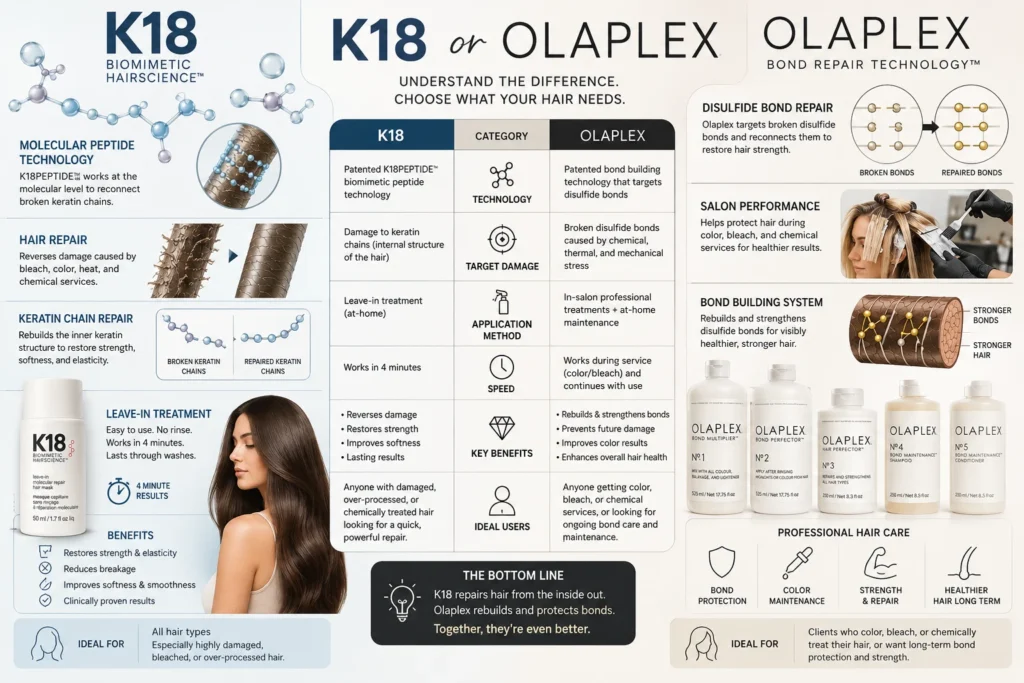
K18 or Olaplex? Both are popular hair repair treatments, but they work differently. K18 focuses on repairing damaged hair using a patented peptide technology that targets keratin chains, while Olaplex rebuilds broken hair bonds caused by coloring, bleaching, heat styling, and chemical treatments. The best choice depends on your hair type, level of damage, budget, and hair care goals.
If you have damaged hair, you have probably heard people talking about K18 or Olaplex. Both products have become famous in salons, beauty blogs, and social media. They promise healthier, stronger, and smoother hair. But many people are confused about which one actually works better.
Hair damage can happen for many reasons. Bleaching, coloring, heat styling, straightening treatments, pollution, and even daily brushing can weaken hair over time. When hair becomes dry, brittle, or frizzy, many people turn to repair treatments.
The problem is that K18 and Olaplex are often compared because they both claim to repair damage. However, they use different technologies and are designed to solve hair problems in different ways.
This guide explains everything you need to know about K18 or Olaplex, including how they work, their benefits and drawbacks, real-world examples, common mistakes, and expert recommendations. By the end, you will know exactly which product fits your hair needs.
Quick Answer
If you want the shortest answer to the K18 or Olaplex debate:
| Factor | K18 | Olaplex |
|---|---|---|
| Main Purpose | Repairs keratin chains | Repairs broken disulfide bonds |
| Application Time | Fast | Longer process |
| Best For | Severe damage and breakage | Chemical and color damage |
| Product Type | Leave in treatment | Full treatment system |
| Cost | Usually higher per use | Often more affordable per treatment |
| Salon Popularity | Growing rapidly | Industry standard for years |
| Hair Feel | Soft and lightweight | Strong and structured |
Choose K18 If:
- Your hair is severely damaged.
- You bleach frequently.
- You want a simple leave in treatment.
- You need fast results.
Choose Olaplex If:
- You color your hair regularly.
- You want a complete repair system.
- Your hair has bond damage from chemical services.
- You prefer a structured treatment routine.
What Is K18?
K18 is a hair treatment brand built around a patented peptide called K18Peptide™.
The company claims this peptide can reconnect broken keratin chains inside the hair structure. Keratin is the main protein that gives hair strength and flexibility.
Unlike traditional conditioners that coat the hair surface, K18 aims to work inside the hair fiber.
How K18 Works
Hair consists of:
- Keratin proteins
- Hydrogen bonds
- Salt bonds
- Disulfide bonds
When hair is damaged, these structures weaken.
K18 uses a bioactive peptide designed to travel into the hair shaft and reconnect damaged protein chains.
Popular K18 Products
- K18 Leave In Molecular Repair Hair Mask
- K18 Damage Shield Shampoo
- K18 Damage Shield Conditioner
- K18 Molecular Repair Hair Oil
What Is Olaplex?
Olaplex is a bond-building hair care system developed by scientists and widely used by professional salons.
Its key ingredient is Bis Aminopropyl Diglycol Dimaleate.
This ingredient helps reconnect broken disulfide bonds within the hair structure.
How Olaplex Works
Disulfide bonds help maintain hair strength and shape.
These bonds are commonly damaged by:
- Bleaching
- Hair coloring
- Perms
- Relaxers
- Heat styling
Olaplex works by helping reconnect these broken bonds.
Popular Olaplex Products
- No.0 Intensive Bond Building Treatment
- No.3 Hair Perfector
- No.4 Shampoo
- No.5 Conditioner
- No.6 Bond Smoother
- No.7 Bonding Oil
- No.8 Moisture Mask
Understanding Hair Damage
To understand the difference between K18 or Olaplex, it helps to know what hair damage looks like.
Physical Damage
Caused by:
- Brushing
- Tight hairstyles
- Friction
- Rough towel drying
Thermal Damage
Caused by:
- Flat irons
- Curling irons
- Blow dryers
Chemical Damage
Caused by:
- Bleaching
- Coloring
- Relaxers
- Perms
Environmental Damage
Caused by:
- Sun exposure
- Pollution
- Hard water
- Chlorine
Different types of damage affect different parts of the hair structure. This is one reason why K18 and Olaplex work differently.
K18 vs Olaplex Technology Comparison
| Feature | K18 | Olaplex |
|---|---|---|
| Technology | Peptide repair | Bond repair |
| Target | Keratin chains | Disulfide bonds |
| Application | Leave in | Multiple steps |
| Processing Time | About 4 minutes | Often 10 to 30 minutes |
| Professional Use | Yes | Yes |
| Home Use | Yes | Yes |
| Suitable for Colored Hair | Yes | Yes |
| Suitable for Bleached Hair | Yes | Yes |
Think of hair as a rope.
- Olaplex repairs the ropes that have snapped apart.
- K18 attempts to rebuild damaged fibers within the rope.
Both approaches can improve hair health.
Advantages of K18
Fast Application
One major benefit is convenience.
You wash your hair, apply the treatment, wait four minutes, and continue styling.
Lightweight Feel
Many users report:
- Less heaviness
- Better movement
- Softer texture
Strong Results for Severe Damage
People with heavily bleached hair often notice:
- Less breakage
- Improved elasticity
- Smoother strands
Minimal Product Routine
You do not need multiple treatment steps.
This makes K18 appealing to busy users.
Disadvantages of K18
Higher Cost
K18 products can be expensive compared to traditional hair masks.
Small Product Sizes
Many consumers feel the containers are small for the price.
Results May Vary
Not everyone experiences dramatic improvements.
Hair condition and damage level affect outcomes.
Learning Curve
Using too much product can reduce effectiveness.
Advantages of Olaplex
Proven Salon History
Olaplex has been used by salons worldwide for years.
Excellent for Chemical Damage
It was originally designed to protect hair during bleaching and coloring services.
Wide Product Range
Users can create a complete repair system.
Strength Improvement
Many users notice stronger hair over time.
Disadvantages of Olaplex
More Time Required
Some treatments involve multiple steps.
Can Feel Heavy for Some Hair Types
Fine hair users occasionally report buildup.
Results Build Gradually
Improvements may take several applications.
Higher Total Cost
Buying multiple products can become expensive.
K18 or Olaplex for Bleached Hair
Bleached hair is one of the most damaged hair types.
Bleach removes pigment by breaking down the hair’s internal structure.
K18 for Bleached Hair
Benefits include:
- Improved elasticity
- Reduced breakage
- Softer texture
- Faster treatment process
Olaplex for Bleached Hair
Benefits include:
- Bond protection
- Strengthening during bleaching
- Long term maintenance
- Salon integration
Winner for Bleached Hair
Many professionals use both.
However:
- K18 often excels for restoring heavily damaged hair.
- Olaplex excels during and after chemical services.
K18 or Olaplex for Curly Hair
Curly hair naturally tends to be drier because scalp oils struggle to travel down the hair shaft.
K18 Benefits for Curly Hair
- Lightweight hydration
- Better curl elasticity
- Reduced breakage
Olaplex Benefits for Curly Hair
- Stronger curls
- Improved resilience
- Better resistance to future damage
Best Choice
The answer depends on your curl pattern and damage level.
Many curly-haired users successfully alternate between the two.
K18 or Olaplex for Fine Hair
Fine hair can easily become weighed down.
K18
Advantages:
- Lightweight formula
- Less residue
- Natural movement
Olaplex
Advantages:
- Strengthens fragile strands
- Protects from future damage
For very fine hair, K18 often feels lighter.
K18 or Olaplex for Thick Hair
Thick hair can absorb more product and often needs intensive repair.
K18
Works well for:
- Extreme damage
- Bleached thick hair
- Heat damaged hair
Olaplex
Works well for:
- Ongoing maintenance
- Chemical treatment protection
- Strength building
Both products perform well on thick hair.
Real World Examples
Example One
Sarah bleaches her hair every six weeks.
Problems:
- Split ends
- Breakage
- Dryness
K18 helped improve softness and elasticity after several treatments.
Example Two
Maria colors her hair regularly at a salon.
Problems:
- Weakness after coloring
- Increased shedding
Her stylist incorporated Olaplex into color services and noticed improved strength.
Example Three
James uses heat styling daily.
Problems:
- Frizz
- Rough texture
A combination of bond repair and heat protection reduced visible damage.
Can You Use K18 and Olaplex Together?
Yes.
Many hair professionals combine both products strategically.
Example routine:
Weekly Routine
Day One:
- Olaplex treatment
Day Four:
- K18 treatment
Daily:
- Heat protectant
- Gentle shampoo
- Conditioner
The exact schedule depends on hair condition.
Regional and Global Usage
North America
Both brands are extremely popular.
Salons frequently recommend one or both systems.
Europe
Demand continues growing, especially among color-treated hair users.
Asia
Interest has increased due to social media beauty trends and advanced hair care routines.
Australia
Professional salons widely offer bond repair treatments and molecular repair services.
Middle East
High temperatures and sun exposure make repair products attractive to consumers dealing with dryness and heat damage.
Common Mistakes When Choosing Between K18 or Olaplex
Expecting Instant Permanent Repair
Hair care products improve hair condition but cannot completely reverse every form of damage forever.
Using Too Much Product
More product does not always mean better results.
Ignoring Heat Protection
Repair treatments cannot fully compensate for daily heat damage.
Choosing Based Only on Trends
What works for an influencer may not work for your hair.
Skipping Consistency
Regular use is often more important than brand choice.
Related Hair Care Concepts
Bond Builders
Bond builders focus on repairing structural damage.
Examples include:
- Olaplex
- Bond building masks
- Professional salon treatments
Protein Treatments
Protein treatments strengthen weakened hair.
They often contain:
- Keratin
- Amino acids
- Hydrolyzed proteins
Moisture Treatments
Moisture treatments help:
- Dry hair
- Frizzy hair
- Rough texture
Heat Protectants
Heat protectants reduce damage from:
- Blow dryers
- Flat irons
- Curling tools
K18 vs Olaplex Comparison Summary
| Category | K18 | Olaplex |
|---|---|---|
| Best for Severe Damage | Excellent | Very Good |
| Best for Color Damage | Very Good | Excellent |
| Ease of Use | Excellent | Good |
| Product Variety | Limited | Extensive |
| Salon Integration | Good | Excellent |
| Lightweight Feel | Excellent | Good |
| Long Term Maintenance | Good | Excellent |
| Speed | Excellent | Good |
Practice Exercises
Exercise 1
Which product primarily focuses on repairing disulfide bonds?
Answer: Olaplex.
Exercise 2
Which product uses peptide technology?
Answer: K18.
Exercise 3
A person with severe bleach damage wants a fast leave in treatment. Which option may fit better?
Answer: K18.
Exercise 4
A salon client wants bond protection during coloring services. Which option is commonly used?
Answer: Olaplex.
Exercise 5
Can K18 and Olaplex be used together?
Answer: Yes, many people successfully incorporate both into their routines.
Common Mistakes and Corrections
| Mistake | Correction |
|---|---|
| K18 and Olaplex are identical | They use different technologies |
| More product works better | Use recommended amounts |
| One treatment fixes all damage | Consistent care is required |
| Heat styling is harmless after treatment | Heat protection is still necessary |
| Expensive means better for everyone | Hair type matters most |
FAQs
Is K18 better than Olaplex?
Not necessarily. K18 and Olaplex target different forms of hair damage. The better choice depends on your specific hair condition.
Can I use K18 and Olaplex together?
Yes. Many people alternate K18 and Olaplex treatments for comprehensive hair repair.
Which is better for bleached hair, K18 or Olaplex?
K18 often performs well for severe bleach damage, while Olaplex excels at protecting and repairing bond damage from bleaching.
Does K18 replace conditioner?
During certain treatment applications, K18 is used without conditioner. Follow product instructions carefully.
How often should I use Olaplex?
Most users apply Olaplex treatments once or twice weekly, depending on damage levels.
Which is better for fine hair, K18 or Olaplex?
Many fine-haired users prefer K18 because it feels lighter and less likely to weigh hair down.
Can K18 repair split ends permanently?
No product can permanently repair split ends. Trimming remains the best solution for severe splits.
Is Olaplex only for colored hair?
No. Olaplex can help anyone experiencing bond damage from heat styling, chemical services, or environmental stress.
Why do people compare K18 or Olaplex so often?
Both are premium hair repair systems designed to improve damaged hair, making them common alternatives.
Should beginners choose K18 or Olaplex first?
If you want simplicity and speed, start with K18. If you want a complete bond repair system, start with Olaplex.
Conclusion
The debate between K18 or Olaplex is not about finding a single winner. Instead, it is about matching the right technology to your hair’s needs. K18 focuses on repairing keratin chains through peptide technology and is known for its quick application, lightweight feel, and impressive results on severely damaged hair. Olaplex focuses on rebuilding broken disulfide bonds and has earned a strong reputation in salons for protecting and repairing chemically treated hair.
If your hair has experienced heavy bleaching, significant breakage, or severe structural damage, K18 may provide the faster and more noticeable improvement you are seeking. If you regularly color, bleach, or chemically process your hair, Olaplex offers excellent bond protection and long term maintenance.
For many people, the best solution is not choosing one over the other. Using K18 and Olaplex strategically can create a well-rounded hair repair routine. Focus on your hair type, damage level, budget, and styling habits. Consistent care, gentle handling, and heat protection will always play a major role in achieving healthier, stronger hair.

Kevin Brooks is a grammar specialist at GramBrix.com, dedicated to helping readers understand language rules with clarity and confidence. He simplifies complex grammar concepts through practical examples and easy explanations.