Last Updated on June 16, 2026
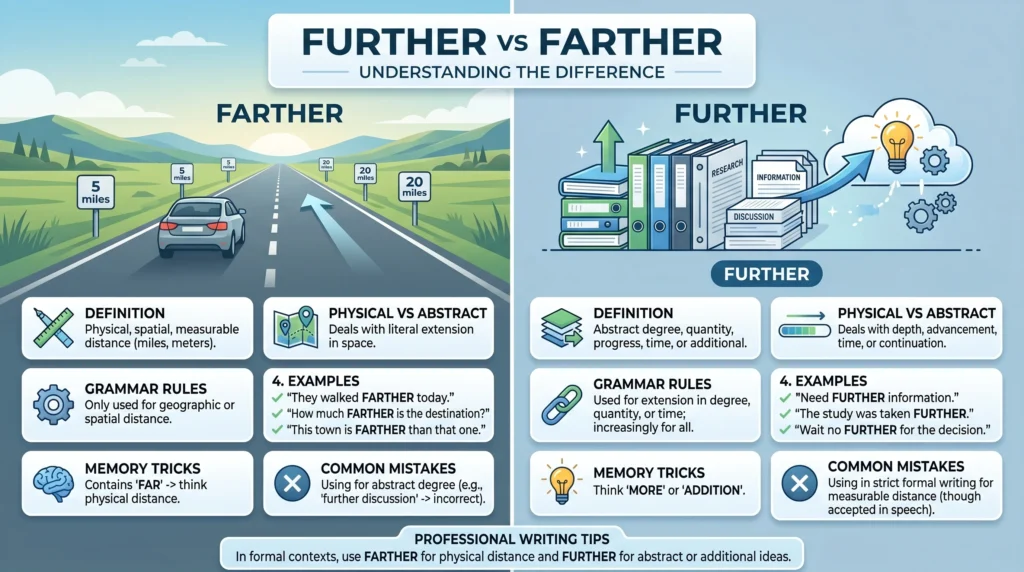
Farther is usually used for physical distance, while further is commonly used for figurative, abstract, or additional distance. Although many modern style guides accept some overlap, understanding the distinction between further or farther helps improve writing clarity and professionalism. In most cases, use farther for measurable distance and further for ideas, discussions, or additional progress.
The confusion between further or farther is one of the most common grammar questions in English.
Since both words relate to distance and often appear in similar contexts, many writers use them interchangeably. While modern English allows some flexibility, traditional grammar rules still recommend specific uses for each word.
Consider these examples:
- We walked farther down the road.
- Let’s discuss this further tomorrow.
Both sentences are correct, but they use different words for different reasons.
The simplest way to remember the difference is that farther usually refers to physical distance you can measure, while further often refers to abstract ideas, additional information, or progress.
Understanding when to use each term can improve your writing in academic, professional, and everyday situations.
This guide explains:
- Definitions
- Grammar rules
- Key differences
- Examples
- Common mistakes
- SEO recommendations
- FAQs
Quick Answer
| Word | Main Usage |
|---|---|
| Farther | Physical distance |
| Further | Additional or figurative distance |
Simple Summary
Use farther when talking about measurable physical distance. Use further when talking about additional information, progress, discussions, or abstract concepts.
What Does Farther Mean?
Definition
Farther refers to a greater physical distance.
Traditional Grammar Rule
Farther is used when distance can be measured.
Examples
- The store is farther away than I expected.
- We drove farther north.
- The hikers traveled farther into the mountains.
Common Contexts
Farther frequently appears in:
- Travel
- Geography
- Sports
- Navigation
What Does Further Mean?
Definition
Further means additional, more, or to a greater degree.
Abstract Usage
Further is often used for non-physical situations.
Examples
- We need further research.
- The meeting was postponed until further notice.
- Let’s discuss the issue further.
Common Contexts
Further commonly appears in:
- Business writing
- Education
- Legal documents
- Professional communication
Main Difference Between Further or Farther
Physical Distance
Farther
Used for measurable distance.
Example:
- She ran farther than her teammates.
Further
Usually not preferred for measurable distance under traditional grammar rules.
Figurative Distance
Further
Used for abstract progress.
Example:
- We need further investigation.
Farther
Rarely used in abstract situations.
Comparison Table
| Feature | Further | Farther |
|---|---|---|
| Physical Distance | Sometimes | Yes |
| Abstract Ideas | Yes | No |
| Additional Information | Yes | |
| Formal Writing | Very Common | Common |
| Traditional Grammar Preference | Abstract Use | Physical Use |
| Business Communication | Yes | Rare |
Easy Memory Trick
Think About “Far”
The word farther contains the word “far.”
This helps remind you that it relates to physical distance.
Think About “Further Discussion”
Further often appears in phrases involving ideas and progress.
Examples:
- Further information
- Further research
- Further action
Simple Rule
Farther = Distance
Further = More
Examples of Farther in Sentences
Travel
- We traveled farther than planned.
Sports
- The golfer hit the ball farther.
Navigation
- The gas station is farther down the highway.
Hiking
- They walked farther into the forest.
Examples of Further in Sentences
Education
- Further study is required.
Business
- We need further analysis.
Communication
- Please contact us for further details.
Research
- Scientists conducted further experiments.
Why Further Is More Common
Broader Meaning
Further works in many situations beyond physical distance.
Business Usage
Professional writing frequently uses further.
Academic Writing
Research papers often contain phrases like:
- Further investigation
- Further evidence
- Further discussion
Legal Documents
Further appears regularly in legal and governmental language.
Can Further Replace Farther?
Modern English Usage
Many writers use further for both physical and figurative distance.
Examples
Accepted by many style guides:
- We walked further down the road.
Traditional Preference
Grammar experts still prefer farther for measurable distance.
Best Practice
Use farther for physical distance and further for abstract ideas.
Common Expressions Using Further
Further Information
A very common phrase.
Further Education
Refers to additional learning.
Until Further Notice
Frequently used in official announcements.
Further Action
Common in business and legal communication.
Common Expressions Using Farther
Farther Away
Used for physical locations.
Farther Down the Road
Refers to distance.
Farther North
Geographic direction.
Farther Than Expected
Physical comparison.
Common Mistakes People Make
Using Farther for Abstract Concepts
Incorrect:
- We need farther research.
Correct:
- We need further research.
Using Further Without Considering Distance
Traditional grammar prefers:
- The park is farther away.
Assuming They Are Always Interchangeable
They overlap but are not identical.
Ignoring Context
Meaning often depends on whether the distance is physical or figurative.
Further or Farther in Professional Writing
Business Reports
Further is usually preferred.
Example:
- Further review is required.
Academic Papers
Further commonly appears in research writing.
Example:
- Further studies are necessary.
Technical Documents
Further is often used for recommendations and next steps.
Travel Writing
Farther may appear when discussing measurable distance.
Related Word Comparisons
Further or Additional
Often interchangeable.
Farther or Longer
Both can describe physical extension.
Further or More
Similar in many contexts.
Real World Examples
Road Trip
- We drove farther than planned.
University Research
- Further investigation was conducted.
Corporate Meeting
- The issue requires further discussion.
Marathon Training
- This year she ran farther than ever.
Exercises With Answers
Exercise 1
Which word refers to physical distance?
Answer: Farther
Exercise 2
Which word means additional?
Answer: Further
Exercise 3
Complete the sentence:
We need _____ information.
Answer: Further
Exercise 4
Complete the sentence:
The hotel is _____ down the road.
Answer: Farther
Exercise 5
Which word is more common in business writing?
Answer: Further
FAQs
What is the difference between further or farther?
Farther usually refers to physical distance, while further refers to additional or abstract distance.
Can further and farther be used interchangeably?
Sometimes, especially in modern English, but traditional grammar distinguishes them.
Which word is correct for physical distance?
Farther is traditionally preferred.
Which word is correct for additional information?
Further is the correct choice.
Is further more common than farther?
Yes. Further appears more frequently in professional and academic writing.
What does further notice mean?
It means additional instructions or information will come later.
Can I say further down the road?
Yes. Many native speakers do, although traditional grammar prefers farther for measurable distance.
Which spelling should students learn first?
Students should understand both and learn the traditional distinction.
What do style guides recommend?
Most recommend farther for physical distance and further for figurative use.
Which keyword has higher search volume?
Further generally appears more often because it has broader applications.
Conclusion
The difference between further or farther is mainly about the type of distance being discussed.
Farther traditionally refers to:
- Physical distance
- Geographic locations
- Measurable travel
Further usually refers to:
- Additional information
- Progress
- Ideas
- Discussions
- Abstract concepts
Key takeaways include:
- Farther = physical distance.
- Further = additional or figurative distance.
- Further is more common in professional writing.
- Many modern writers use further more broadly.
- Following the traditional distinction improves clarity.
For the clearest writing in 2026, use farther when measuring distance and further when discussing ideas, information, or progress.

Kevin Brooks is a grammar specialist at GramBrix.com, dedicated to helping readers understand language rules with clarity and confidence. He simplifies complex grammar concepts through practical examples and easy explanations.