Last Updated on July 15, 2026
Somatic vs visceral refers to two different types of body systems and sensations in the human body. Somatic relates to the skin, muscles, and voluntary movements, while visceral relates to internal organs such as the heart, stomach, and lungs. Understanding somatic vs visceral is important in anatomy, physiology, and pain diagnosis because each system produces different types of signals, control mechanisms, and clinical symptoms.
The human body is controlled by complex systems that work together to maintain life and function. Among these systems, the terms somatic vs visceral often create confusion for students, healthcare learners, and even patients trying to understand medical reports.
Somatic refers to the parts of the body we can control, like muscles and skin. Visceral refers to internal organs that work automatically, like the heart, liver, and intestines. These two systems also produce different types of pain and sensations, which is important in diagnosis and treatment.
Many people confuse somatic pain with visceral pain because both can feel intense but behave differently. Doctors rely on this difference to identify diseases accurately. This article explains somatic vs visceral in a simple, structured, and detailed way. You will learn definitions, comparisons, real-world examples, clinical importance, and common mistakes. By the end, you will clearly understand how somatic vs visceral systems work and why they matter in medicine and daily life.
Quick Answer Overview
Somatic vs visceral describes two different body systems and sensory pathways.
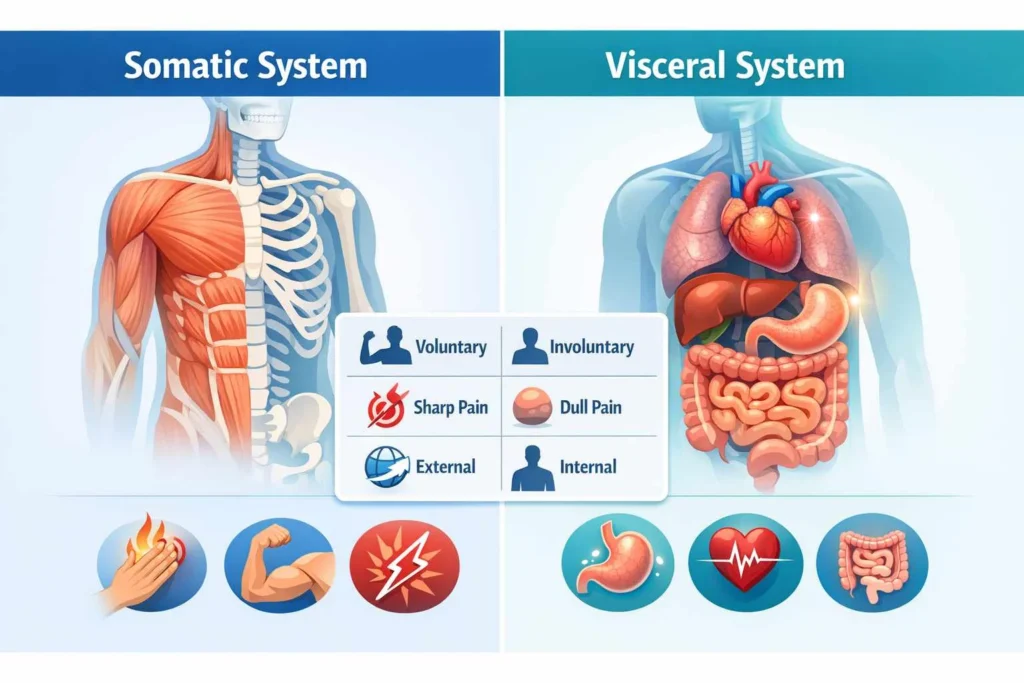
Somatic systems control voluntary movements and sensations from skin, muscles, and joints. Visceral systems control internal organs and automatic body functions like digestion and heartbeat.
In simple terms:
- Somatic = voluntary, external, sharp pain
- Visceral = involuntary, internal, dull pain
Both systems are part of the nervous system but serve different roles in maintaining body function and balance.
Definition of Somatic vs Visceral
Somatic Definition
The somatic system refers to structures that control voluntary movement and body awareness. It includes muscles, skin, and sensory nerves.
In the nervous system, this is linked to the Somatic Nervous System. This system allows conscious control of movement such as walking, writing, and speaking.
Somatic sensations include:
- Touch
- Pressure
- Pain from skin or muscles
- Temperature
Visceral Definition
The visceral system refers to internal organs and their functions. It works automatically without conscious control.
It is closely related to the Visceral Nervous System, which manages digestion, breathing rhythm, and heart activity.
Visceral sensations include:
- Organ pain
- Stretching of organs
- Cramping
- Deep internal discomfort
Somatic vs Visceral Quick Comparison
| Feature | Somatic System | Visceral System |
| Control | Voluntary | Involuntary |
| Location | Skin, muscles, joints | Internal organs |
| Pain type | Sharp, localized | Dull, diffuse |
| Awareness | Easily detected | Hard to locate |
| Nervous system | Somatic nervous system | Autonomic nervous system |
| Response speed | Fast | Slower |
| Example | Cutting finger | Stomach ache |
Understanding Somatic vs Visceral in Simple Words
To make somatic vs visceral easy to understand, think of your body as a house:
- Somatic system = doors, walls, and windows you can touch and control
- Visceral system = plumbing, heating, and internal wiring you cannot see
When you touch something hot, that is somatic. When your stomach hurts, that is visceral.
Somatic signals are clear and easy to locate. Visceral signals are vague and often felt in different areas than the actual problem.
Anatomy Behind Somatic vs Visceral
Somatic Anatomy
The somatic system includes:
- Skeletal muscles
- Skin receptors
- Sensory nerves
- Motor neurons
These structures send signals to the brain quickly. This allows fast reactions like pulling your hand away from heat.
Visceral Anatomy
The visceral system includes:
- Heart
- Lungs
- Stomach
- Liver
- Intestines
These organs are controlled automatically. You do not need to think about breathing or digestion.
The signals travel through slower nerve pathways, which is why visceral pain feels dull and hard to pinpoint.
Somatic vs Visceral Pain Differences
Pain is the most important way to understand somatic vs visceral.
Somatic Pain
Somatic pain comes from:
- Skin injury
- Muscle strain
- Bone damage
Characteristics:
- Sharp or stabbing
- Easy to locate
- Increases with movement
- Quick response
Example:
- Cutting your finger
- Sprained ankle
Visceral Pain
Visceral pain comes from:
- Organ inflammation
- Internal blockage
- Stretching of organs
Characteristics:
- Dull or cramping
- Hard to locate
- May spread to other areas
- Often associated with nausea or sweating
Example:
- Appendicitis
- Kidney stones
Advantages and Disadvantages of Somatic vs Visceral Systems
Somatic System Advantages
- Fast response to danger
- Precise control of movement
- Accurate sensory feedback
- Helps protect body from external harm
Somatic System Disadvantages
- Can be affected by injury easily
- Pain can be intense and immediate
- Requires conscious attention
Visceral System Advantages
- Works automatically
- Maintains internal balance
- Supports survival functions
- Operates continuously without effort
Visceral System Disadvantages
- Pain is hard to detect early
- Symptoms appear late in disease
- Hard to locate source of problem
Real-World Examples of Somatic vs Visceral
Somatic Examples
- Touching a hot pan
- Muscle cramps during exercise
- Skin cut or bruise
- Bone fracture pain
Visceral Examples
- Stomach cramps after eating
- Heartburn or chest discomfort
- Kidney stone pain
- Appendicitis pain
These examples show how somatic vs visceral differs in daily life and medical conditions.
Clinical Importance of Somatic vs Visceral
Doctors use somatic vs visceral differences to diagnose diseases.
Why it matters
- Helps identify organ-related problems
- Helps distinguish muscle pain from internal pain
- Guides emergency treatment decisions
Medical Example
A patient with chest pain:
- Somatic pain may come from muscle strain
- Visceral pain may indicate heart attack
This difference can save lives.
Somatic vs Visceral in the Nervous System
The nervous system is divided into:
- Central nervous system
- Peripheral nervous system
Somatic and visceral systems are part of the peripheral system.
Somatic system:
- Controls voluntary muscles
- Sends sensory information to brain
Visceral system:
- Controls internal organs
- Works with autonomic regulation
This balance keeps the body stable and responsive.
Regional and Educational Understanding
In medical education worldwide, somatic vs visceral is taught in anatomy and physiology courses.
- In Western medical schools, focus is on clinical application
- In Asian medical education, emphasis is often on organ systems
- In nursing training, focus is on pain recognition and patient symptoms
Understanding somatic vs visceral is essential for:
- Medical students
- Nurses
- Physiotherapists
- Emergency responders
Common Mistakes in Understanding Somatic vs Visceral
Mistake 1: Thinking all pain is the same
Correction: Pain type depends on origin, either somatic or visceral.
Mistake 2: Assuming visceral pain is always severe
Correction: Visceral pain can be mild or moderate but poorly localized.
Mistake 3: Confusing location of pain
Correction: Visceral pain may be felt in different body areas due to nerve pathways.
Mistake 4: Ignoring referred pain
Correction: Visceral pain often appears in unrelated body parts.
Exercises with Answers
Exercise 1
Which system controls voluntary movement?
Answer: Somatic system
Exercise 2
Which type of pain is sharp and localized?
Answer: Somatic pain
Exercise 3
What type of pain is associated with internal organs?
Answer: Visceral pain
Exercise 4
Is digestion controlled voluntarily or involuntarily?
Answer: Involuntarily (visceral system)
Exercise 5
Give one example of somatic pain.
Answer: Sprained ankle
Exercise 6
Give one example of visceral pain.
Answer: Stomach cramps
Related Concepts and Comparisons
Somatic vs Autonomic
- Somatic = voluntary control
- Autonomic = involuntary control
Visceral vs Referred Pain
- Visceral pain originates in organs
- Referred pain is felt in different locations
Somatic vs Visceral Sensation
Somatic sensations are external and clear. Visceral sensations are internal and vague.
FAQs
What is somatic vs visceral pain?
Somatic pain comes from skin and muscles, while visceral pain comes from internal organs like the stomach or heart.
Why is visceral pain hard to locate?
Visceral pain is hard to locate because internal organs share nerve pathways and send mixed signals to the brain.
Is somatic pain more serious than visceral pain?
Not always. Somatic pain is sharper, but visceral pain may indicate serious internal disease.
Can somatic vs visceral pain occur together?
Yes. In conditions like appendicitis, both somatic and visceral pain can occur.
What organs are involved in visceral sensation?
Organs such as the heart, lungs, stomach, liver, and intestines are part of visceral sensation.
How does the brain process somatic vs visceral signals?
Somatic signals are processed quickly and precisely. Visceral signals are processed more slowly and less accurately.
What is an example of somatic vs visceral difference in real life?
A paper cut is somatic pain, while stomach ache is visceral pain.
Why is somatic vs visceral important in medicine?
It helps doctors identify whether pain is coming from external tissues or internal organs.
Can stress affect somatic vs visceral systems?
Yes. Stress can increase visceral symptoms like stomach pain and somatic symptoms like muscle tension.
How do doctors test somatic vs visceral pain?
They use physical exams, imaging tests, and patient descriptions of pain quality and location.
Conclusion
Understanding somatic vs visceral is essential for anyone studying human biology, medicine, or health sciences. Somatic systems control voluntary movements and external sensations, while visceral systems manage internal organs and automatic body functions. The key difference lies in control, sensation type, and pain perception.
Somatic pain is sharp, clear, and easy to locate. Visceral pain is dull, vague, and often spreads across areas of the body. This difference helps doctors diagnose diseases accurately and quickly.
By learning somatic vs visceral concepts, you can better understand how your body responds to injury, illness, and internal changes. Whether you are a student or a healthcare professional, mastering this topic builds a strong foundation in anatomy and physiology.

Justin Powell is a writer at GramBrix.com who focuses on grammar, clarity and effective communication, helping readers strengthen their language skills.