
Last Updated on July 15, 2026
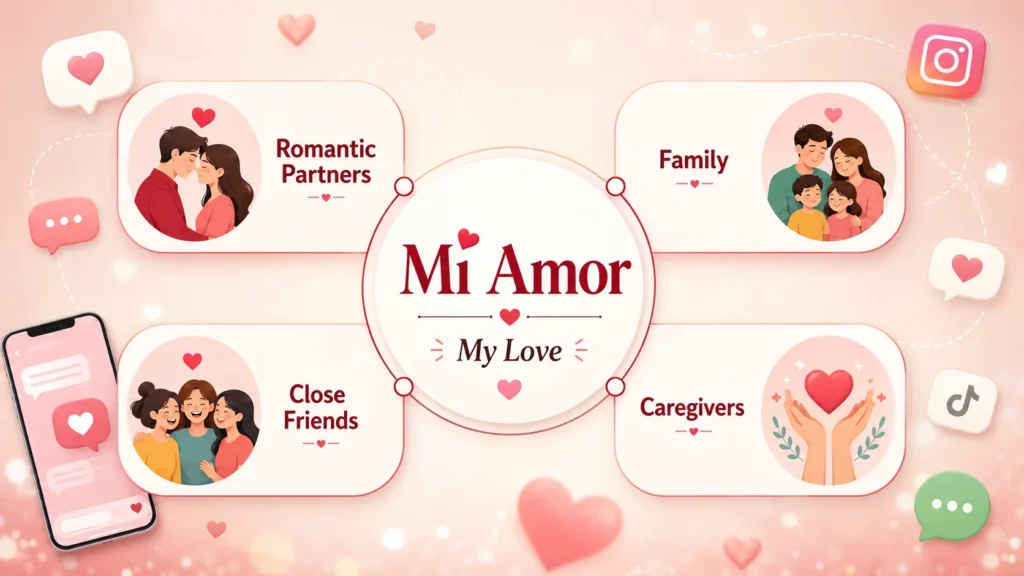
Mi amor is a Spanish phrase that literally translates to “my love.” It is widely used as a term of endearment for a romantic partner, spouse, family member, close friend, or even a child, depending on the relationship and cultural context. While it often expresses romantic affection, it can also convey warmth, care, tenderness, and emotional closeness in everyday conversations. Today, mi amor is commonly seen in text messages, social media posts, and online chats, making it a familiar expression even among people who don’t speak Spanish fluently.
If you’ve received a message saying “mi amor” or heard it in a song, movie, or social media video, you may wonder exactly what it means. While the literal translation is simple “my love” its actual meaning depends on the relationship, culture, and situation.
Today, mi amor has become popular far beyond Spanish-speaking countries. You’ll see it in text messages, Instagram captions, TikTok videos, WhatsApp chats, and even casual conversations between people who don’t speak fluent Spanish. Sometimes it’s deeply romantic, while other times it’s simply a warm, affectionate nickname.
In this guide, you’ll learn the exact mi amor meaning, how native speakers use it, when it’s appropriate, real-life examples, platform-specific usage, common misunderstandings, related expressions, and practical tips for using it naturally.
Quick Answer Box
| Topic | Explanation |
|---|---|
| Meaning | My love |
| Language | Spanish |
| Literal Translation | My love |
| Tone | Loving, affectionate, caring |
| Common Usage | Romantic partners, spouses, family, children, close friends |
| Popular Platforms | WhatsApp, Instagram, TikTok, Facebook, Snapchat, Messenger |
| Example | “Buenos días, mi amor.” |
| Formality | Informal and affectionate |
What Does Mi Amor Mean?
The phrase mi amor literally translates from Spanish as “my love.”
It combines two simple words:
- Mi = My
- Amor = Love
Together, they create one of the most common and affectionate expressions in Spanish.
Unlike English, where “my love” might sound poetic or reserved for romantic relationships, mi amor is often used much more naturally in everyday Spanish. Depending on the culture and relationship, it can express romance, tenderness, appreciation, or simple affection.
For example:
- “Hola, mi amor.”
- “Good morning, my love.”
- “Come here, mi amor.”
The exact meaning depends on who is saying it and to whom.
Full Definition
At its core, mi amor is a loving nickname or term of endearment.
It can communicate:
- Romantic love
- Emotional closeness
- Care
- Affection
- Comfort
- Warmth
- Appreciation
Rather than describing love as an emotion alone, it often functions as a substitute for someone’s name.
Instead of saying:
“Hi, Sarah.”
Someone might say:
“Hi, mi amor.”
This instantly creates a warmer and more personal tone.
Context & Usage
The meaning of mi amor changes slightly depending on the relationship between the speakers.
Romantic Relationships
This is the most common use.
Couples frequently call each other mi amor instead of using first names.
Examples include:
- Good morning, mi amor.
- I miss you, mi amor.
- Sleep well, mi amor.
It communicates love, intimacy, and emotional closeness.
Between Spouses
Married couples often use the phrase throughout daily conversations.
Examples:
- Can you grab the groceries, mi amor?
- Thanks for dinner, mi amor.
Here, it feels natural rather than overly romantic.
Parents and Children
Many Spanish-speaking parents lovingly call their children mi amor.
Examples:
- Come here, mi amor.
- Are you okay, mi amor?
In this context, it simply means “sweetheart” or “darling.”
Grandparents
Grandparents commonly use it with grandchildren.
It expresses warmth, protection, and affection rather than romance.
Close Family Members
In many Spanish-speaking cultures, siblings, aunts, uncles, and cousins may occasionally use affectionate nicknames like mi amor, especially with younger relatives.
Close Friends
Although less common, some close friends use mi amor, particularly in regions where affectionate language is part of everyday speech.
This usage usually signals friendliness rather than romantic interest.
Real-Life Examples
Below are realistic situations showing how mi amor is used naturally.
Conversation Example 1: Romantic Text
Alex: Good morning, mi amor ❤️
Emily: Morning! Hope you slept well.
Alex: I can’t wait to see you tonight.
Conversation Example 2: Parent and Child
Mom: Mi amor, dinner is ready.
Child: Coming!
Conversation Example 3: Husband and Wife
Husband: Did you get home safely, mi amor?
Wife: Yes, thanks for checking.
Conversation Example 4: Supportive Message
Friend: You’ve got this, mi amor.
Friend: I’m proud of you.
Conversation Example 5: Birthday Greeting
Person A: Happy Birthday, mi amor!
Person B: Thank you! That made my day.
Platform-Specific Meaning
The phrase appears frequently across social media and messaging apps.
On WhatsApp, mi amor is commonly used in:
- Morning greetings
- Goodnight messages
- Relationship chats
- Family conversations
Example:
“Goodnight, mi amor ❤️”
Instagram captions often use mi amor for:
- Couple photos
- Anniversary posts
- Engagement pictures
- Wedding photos
Example:
“My forever, mi amor.”
TikTok
On TikTok, you’ll often hear mi amor in:
- Couple trends
- Romantic edits
- Spanish audio clips
- Lifestyle videos
Many creators use the phrase even if they aren’t native Spanish speakers because it sounds affectionate and recognizable.
Snapchat
Friends and couples frequently send snaps saying:
- Miss you, mi amor.
- Thinking of you, mi amor.
Depending on the relationship, it can feel romantic or simply playful.
Facebook users often write:
- Happy anniversary, mi amor.
- Love you forever, mi amor.
It appears in comments, posts, and relationship updates.
Messenger
Private conversations often include the phrase because it feels warmer than using someone’s name repeatedly.
Alternative Meanings
Although mi amor almost always means “my love,” its emotional nuance changes with context.
It can imply:
- Darling
- Sweetheart
- Honey
- Dear
- My dear
- Beloved
- My sweetheart
Native speakers choose whichever English equivalent best fits the situation.
Related Terms / NLP Variations
Spanish includes many affectionate expressions related to mi amor.
Mi Vida
Means:
“My life.”
It often expresses deep emotional attachment.
Mi Cielo
Literally means:
“My sky.”
English speakers often interpret it as:
“My heaven.”
Mi Corazón
Means:
“My heart.”
It emphasizes emotional closeness.
Cariño
Means:
- Darling
- Dear
- Affection
Very common in Spain.
Querido / Querida
Means:
- Dear
- Beloved
Often used in letters or affectionate speech.
Amor
Sometimes people simply say:
“Amor.”
Instead of:
“Mi amor.”
Both are common among couples.
Bebé
Equivalent to:
- Baby
- Babe
Frequently used in modern relationships.
Emotional Meaning
Beyond its dictionary definition, mi amor carries emotional significance.
It may communicate:
- Safety
- Comfort
- Loyalty
- Appreciation
- Emotional intimacy
- Protection
- Kindness
- Compassion
That’s why the phrase often feels more meaningful than simply saying someone’s name.
Cultural Importance
In many Spanish-speaking countries, affectionate language is woven into everyday communication.
Parents call children:
“Mi amor.”
Grandparents use it naturally.
Couples say it daily.
Even customer service workers in some regions may politely address someone as mi amor or another affectionate term, though this varies by country and setting. In those cases, it usually reflects friendliness rather than romantic intent.
Because of these cultural differences, non-native speakers should avoid assuming romantic interest every time they hear the phrase.
How to Respond to Mi Amor
The best response depends on your relationship with the speaker.
If It’s Your Partner
Possible replies:
- Hi, mi amor ❤️
- I love you too.
- Good morning!
- Miss you too.
If It’s a Parent
You might answer:
- Love you!
- Thanks, Mom.
- Coming!
If It’s a Friend
You could respond with:
- Thanks!
- You’re the sweetest.
- Appreciate you!
If You’re Unsure
Keep the reply friendly.
Example:
“Thanks! Hope you’re doing well.”
This avoids misunderstanding until you know the person’s intention.
Misinterpretations
People sometimes misunderstand mi amor because they translate it too literally.
Assuming It’s Always Romantic
This is the biggest misconception.
In many families, parents say mi amor to children every day.
No romantic meaning exists in those situations.
Assuming Everyone Uses It
While common, not every Spanish speaker regularly uses affectionate nicknames.
Personal preference and regional culture both matter.
Thinking It’s Flirting
Sometimes yes.
Sometimes no.
Context is everything.
When NOT to Use It
Although affectionate, mi amor isn’t appropriate everywhere.
Avoid using it:
- In formal business emails
- With strangers unless culturally appropriate
- During professional meetings
- With clients unless the local culture clearly accepts it
- In academic writing
- During official presentations
If you don’t know the relationship well, using someone’s name is usually safer.
Usage Tips
To sound natural:
- Use it with people you genuinely care about.
- Understand the relationship first.
- Consider cultural differences.
- Match the other person’s comfort level.
- Don’t overuse it in professional environments.
- Pair it with kind, genuine communication.
If you’re learning Spanish, listening to native speakers in real conversations can help you understand when the phrase feels appropriate.
Common Situations Where You’ll Hear Mi Amor
Here are everyday scenarios where the phrase naturally appears:
Morning Greetings
- Good morning, mi amor.
- Rise and shine, mi amor.
Goodnight Messages
- Sweet dreams, mi amor.
- Sleep well, mi amor.
Celebrations
- Happy Birthday, mi amor.
- Congratulations, mi amor!
Encouragement
- You can do it, mi amor.
- I’m proud of you, mi amor.
Checking In
- Are you okay, mi amor?
- Did you get home safely, mi amor?
Why Has Mi Amor Become So Popular Online?
The popularity of mi amor has grown thanks to:
- Latin music
- Movies and TV shows
- Social media influencers
- International relationships
- Travel
- Language learning
- TikTok trends
- Instagram captions
Many English speakers now recognize the phrase even if they don’t speak Spanish.
Its warm, affectionate tone makes it appealing across cultures.
FAQs
What does mi amor mean in English?
It means “my love.”
Is mi amor romantic?
Often yes, but not always. Parents, grandparents, and close family members also use it affectionately.
Can friends say mi amor?
Yes. In some Spanish-speaking cultures, close friends use it casually without romantic intent.
Is mi amor flirting?
Sometimes. The relationship and context determine whether it’s flirtatious or simply affectionate.
Can I call my boyfriend mi amor?
Absolutely. It’s one of the most common romantic nicknames in Spanish.
Can I call my girlfriend mi amor?
Yes. Many couples use it daily as a loving term of endearment.
Is mi amor only used in Spanish-speaking countries?
No. The phrase is now widely recognized and used around the world, especially on social media and in multicultural communities.
What’s the difference between amor and mi amor?
Amor means “love” and can also be used as a nickname. Mi amor means “my love” and sounds slightly more personal and affectionate.
Is it okay to use mi amor if I don’t speak Spanish?
Yes, as long as you understand its meaning and use it respectfully with someone who is comfortable with it.
Is mi amor formal or informal?
It is an informal expression best suited for personal relationships rather than professional or official settings.
Conclusion
The mi amor meaning is simple on the surface it translates to “my love” but its real significance comes from the relationship and context in which it’s used. Whether shared between romantic partners, family members, close friends, or caregivers, the phrase expresses warmth, affection, and emotional connection.
As Spanish words and expressions continue to influence global communication through music, social media, and multicultural interactions, mi amor has become a familiar term even among people who don’t speak Spanish fluently. Understanding when and how to use it helps you communicate more naturally while respecting the cultural traditions behind the expression.
Whether you encounter mi amor in a text message, an Instagram caption, a TikTok video, or a heartfelt conversation, you’ll now recognize it as far more than a direct translation—it’s a timeless expression of care, closeness, and genuine affection.

Kevin Brooks is a grammar specialist at GramBrix.com, dedicated to helping readers understand language rules with clarity and confidence. He simplifies complex grammar concepts through practical examples and easy explanations.