
Last Updated on July 12, 2026
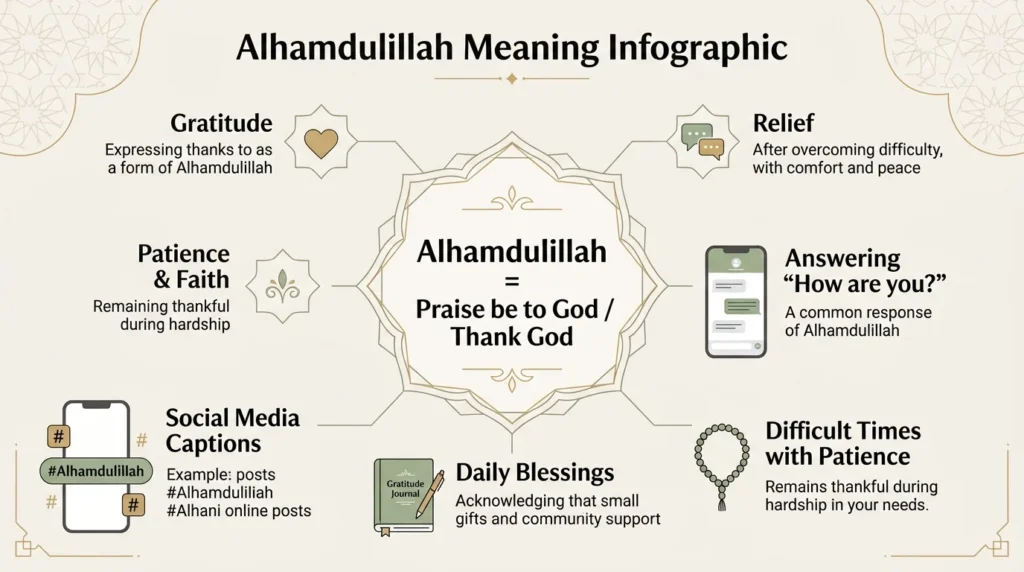
Alhamdulillah means “Praise be to God” or “All praise is due to God.” It is an Arabic phrase used by Muslims to express gratitude, relief, appreciation, or thankfulness for blessings, good news, everyday moments, and even difficult situations approached with faith and patience.
If you’ve seen Alhamdulillah in a text message, Instagram caption, TikTok comment, YouTube vlog, or everyday conversation, you may be wondering what it actually means and when people use it. The short answer is simple: Alhamdulillah is a phrase of gratitude and praise to God. But in real life, its meaning goes deeper than a oneline translation.
People say Alhamdulillah after good news, when they feel thankful, when they recover from something hard, when food is served, when they answer “How are you?”, and even when life is not perfect but they still want to acknowledge God’s mercy. That’s why the phrase can show gratitude, humility, relief, faith, patience, and contentment all at once.
In this guide, you’ll learn the full Alhamdulillah meaning, how to pronounce it, when to use it, how it appears on WhatsApp, TikTok, Instagram, and Snapchat, how to reply when someone says it, and what it does not mean. You’ll also get real conversation examples, related Islamic phrases, common misunderstandings, and image SEO prompts if you’re publishing content around the term.
Quick Answer Box
| Topic | Quick Answer |
| Meaning | Alhamdulillah means “Praise be to God” or “All praise is due to God.” |
| Language | Arabic |
| Used by | Primarily Muslims, but it may also appear in cultural, educational, or interfaith contexts |
| Main purpose | To express gratitude, appreciation, relief, and praise to God |
| Common situations | Good news, recovery, success, daily blessings, answering “How are you?”, after eating, after hardship |
| Tone | Thankful, humble, sincere, faithful, reflective |
| Texting / social use | Often used in captions, comments, DMs, status updates, and replies to share gratitude or relief |
| Example | “I got the job, Alhamdulillah.” |
| Typical reply | “MashaAllah,” “Allahumma barik,” “That’s wonderful,” or “Alhamdulillah” depending on context |
What Does Alhamdulillah Mean?
Alhamdulillah is an Arabic phrase that means:
- Praise be to God
- All praise is due to God
- Thanks be to God
- In some conversational contexts, it can also feel close to “Thank God”
The phrase is deeply rooted in Islamic language and everyday Muslim speech. It is not just a reaction to big blessings like a graduation, wedding, or new baby. It is also used for ordinary moments: waking up, finishing a task, getting home safely, feeling okay after being sick, or simply having food on the table.
In practice, Alhamdulillah can communicate several layers at once:
- Gratitude — “I’m thankful.”
- Praise — “All praise belongs to God.”
- Relief — “Thank God things worked out.”
- Contentment — “I’m okay and grateful.”
- Faith — “I recognize God’s role in what I have.”
- Perspective — “Even in difficulty, I still acknowledge blessings.”
So while the literal translation is short, the realworld use is much richer.
Full Definition of Alhamdulillah
To understand the phrase more fully, it helps to break it down.
Wordbyword breakdown
Alhamdulillah comes from Arabic:
- Al = “the”
- Hamd = praise, thanks, commendation
- Lillah = for God / to God
Put together, the phrase means “The praise belongs to God” or “All praise is due to God.”
Why “praise” and “thanks” both fit
In English, people often translate Alhamdulillah as “Thank God” because that sounds natural in conversation. But Alhamdulillah is broader than a casual “thanks.” It includes both:
- Thankfulness for blessings
- Praise and recognition of God’s goodness, mercy, and power
That’s why someone might say it not only after receiving something good, but also as a statement of faith during a difficult time.
Is it only about happy moments?
No. That’s one of the biggest things people miss.
Someone can say Alhamdulillah when:
- they got accepted into college
- they recovered from surgery
- they finally found their lost phone
- their family is safe
- they’re having a rough week but still want to express gratitude
- they’re answering “How are you?” with “Alhamdulillah” to mean “I’m okay, thankful to God”
So the phrase is not limited to excitement. It can also express quiet gratitude, resilience, patience, and spiritual grounding.
Context and Usage
The best way to understand Alhamdulillah meaning is to see the contexts where people naturally use it. The same phrase can carry slightly different emotional shades depending on the moment.
Saying Alhamdulillah for gratitude
This is the most common use. Someone receives a blessing, notices something good, or reflects on what they have and says Alhamdulillah.
Examples:
- “My exam went well, Alhamdulillah.”
- “We made it home safely, Alhamdulillah.”
- “Alhamdulillah for another year of life.”
Here, the phrase means I’m grateful to God.
Saying Alhamdulillah for relief
Sometimes the phrase comes after stress, fear, uncertainty, or worry. In that case it feels close to “Thank God” or “What a relief.”
Examples:
- “The surgery went well, Alhamdulillah.”
- “I thought I missed the deadline, but they extended it. Alhamdulillah.”
- “My mom’s test results were clear, Alhamdulillah.”
Here, the phrase signals relief plus gratitude.
Saying Alhamdulillah when answering “How are you?”
In many Muslim communities, if someone asks “How are you?” the answer may be:
- “Alhamdulillah”
- “I’m good, Alhamdulillah”
- “Alhamdulillah, how are you?”
This usually means:
- I’m doing okay
- I’m grateful
- I’m acknowledging God in my answer
- Even if life isn’t perfect, I still have reasons to be thankful
It’s not always a detailed health report. Often it’s a polite, warm, faithcentered way to say “I’m doing well, thank God.”
Saying Alhamdulillah after eating or drinking
Many Muslims say Alhamdulillah after finishing food or drink as a way of thanking God for provision. It can be part of a longer supplication, but even on its own it expresses gratitude for sustenance.
Examples:
- “That meal was amazing. Alhamdulillah.”
- “Alhamdulillah for good food and good company.”
Saying Alhamdulillah after success
This is common after achievements or milestones:
- passing an exam
- getting married
- buying a house
- finishing Hajj or Umrah
- landing a job
- welcoming a child
- completing a difficult project
Example:
- “I finally graduated, Alhamdulillah.”
The tone here is often joyful but humble. It says, I’m happy, but I’m also giving thanks to God rather than only taking credit for myself.
Saying Alhamdulillah during hardship
This is where the phrase can feel especially meaningful. A person may say Alhamdulillah even when life is difficult, not because the pain is fake or ignored, but because gratitude remains part of their faith.
Examples:
- “It’s been a hard month, but Alhamdulillah for everything.”
- “Recovery is slow, but Alhamdulillah, I’m getting stronger.”
- “We’re dealing with a lot right now. Alhamdulillah anyway.”
In these cases, the phrase can communicate:
- acceptance
- patience
- trust in God
- gratitude despite struggle
- emotional steadiness
RealLife Examples of Alhamdulillah in Conversation
Below are realistic examples showing how the phrase appears in everyday speech, texting, and online communication.
Conversation Example 1: Good news after a job interview
Scenario
Someone has been waiting to hear back from a company.
Friend 1: Did they call you back?
Friend 2: Yes, I got the offer! Alhamdulillah.
Friend 1: That’s amazing, congrats!
Friend 2: Thank you, I’m so relieved.
What Alhamdulillah means here
In this example, Alhamdulillah means:
- thank God
- I’m grateful
- I’m relieved
- I recognize this blessing came with God’s help
Conversation Example 2: Answering “How are you?”
Scenario
A cousin checks in after a few weeks.
Cousin: Hey, how have you been?
You: Alhamdulillah, I’m doing okay. Just busy with work.
Cousin: Glad to hear it.
What it means here
Here it works like “I’m doing well, thank God” or “I’m okay and grateful.”
It doesn’t necessarily mean life is perfect. It often means the person is choosing a grateful, faithbased response.
Conversation Example 3: Recovery after illness
Scenario
Someone had a rough week with the flu.
Friend: Are you feeling better now?
You: Yes, Alhamdulillah. I still have a cough, but I’m much better.
Friend: That’s good to hear.
What it means here
This use emphasizes relief and gratitude after difficulty.
Conversation Example 4: Social media caption after graduation
Scenario
Instagram graduation post.
Caption: Bachelor’s degree done, Alhamdulillah 🎓🤍 So grateful for my family, teachers, and every prayer that got me here.
What it means here
This use combines:
- celebration
- humility
- gratitude to God
- acknowledgment of support and blessings
Conversation Example 5: Hard time, but still grateful
Scenario
A close friend asks how things are going after a stressful family issue.
Friend: How are things at home?
You: Still a little difficult, honestly, but Alhamdulillah. We’re getting through it.
Friend: I’m praying it gets easier.
What it means here
This is not fake positivity. It means:
- things are still hard
- I still recognize blessings
- I’m trying to remain patient and thankful
- I trust that there is mercy even in hardship
PlatformSpecific Meaning of Alhamdulillah
Online, the phrase keeps its core meaning, but the tone can shift depending on where it’s used. On some platforms it’s heartfelt and reflective. On others it’s quick, casual, and attached to a photo dump, life update, or comment.
On WhatsApp, Alhamdulillah often appears in direct, personal communication with family and friends.
Common WhatsApp uses
- replying to “How are you?”
- sharing good news in family groups
- thanking God after travel, exams, weddings, or medical updates
- posting a status update with a grateful tone
WhatsApp examples
- “Reached safely, Alhamdulillah.”
- “Baby is doing well, Alhamdulillah.”
- “Interview went great Alhamdulillah, please make dua.”
Tone on WhatsApp
Usually warm, sincere, personal, and faithcentered.
On Instagram, Alhamdulillah is common in captions, story posts, milestone announcements, travel photos, wedding posts, Eid content, baby announcements, and personal reflections.
Common Instagram caption styles
- “New chapter, Alhamdulillah 🤍”
- “Forever grateful, Alhamdulillah.”
- “A dream I prayed for. Alhamdulillah.”
- “Another year older, Alhamdulillah for everything.”
What it signals on Instagram
- gratitude for a visible blessing
- humility in success
- a spiritual or religious identity marker
- appreciation for a life moment without sounding boastful
Typical post types
- graduation photos
- engagement announcements
- family pictures
- Ramadan or Eid reflections
- business launches
- travel milestones
- beforeandafter life updates
TikTok
On TikTok, Alhamdulillah often appears in captions, voiceovers, comments, or text overlays in videos about life updates, modest fashion, Muslim routines, food, study motivation, marriage, health journeys, and “day in my life” content.
TikTok examples
- “Got accepted into nursing school, Alhamdulillah.”
- “POV: the prayer you kept making finally got answered. Alhamdulillah.”
- “From rock bottom to healing, Alhamdulillah.”
TikTok tone
TikTok can make the phrase feel more emotional, storytellingbased, and reflective. It’s often tied to:
- transformation
- answered prayers
- gratitude after struggle
- life updates
- spiritual motivation
Snapchat
On Snapchat, Alhamdulillah may show up in private snaps, captions, or quick story posts.
Snapchatstyle examples
- “Done with finals alhamdulillah 😭”
- “Made it on time alhamdulillah”
- “Family dinner tonight, alhamdulillah ❤️”
Tone on Snapchat
Usually casual, quick, and personal. The spelling may be lowercase, and punctuation is often relaxed.
X / Twitter
On X, the phrase may be used in reactions to news, life updates, sports, personal reflections, or community posts.
Examples
- “Exam season is over, Alhamdulillah.”
- “Back home safe, Alhamdulillah.”
- “A lot has changed this year. Alhamdulillah for growth.”
Tone on X
Often concise, reflective, and publicfacing. Sometimes it’s celebratory, other times it’s quietly thankful.
YouTube
On YouTube, creators may say Alhamdulillah in vlogs, family updates, cooking videos, Islamic reminders, travel content, and milestone videos.
Common examples
- “We finally moved into our new home, Alhamdulillah.”
- “Health update: I’m doing much better, Alhamdulillah.”
- “100k subscribers, Alhamdulillah.”
Tone on YouTube
Usually spoken warmly and naturally, especially by Muslim creators who use it as part of their everyday vocabulary.
Inperson conversations
Offline, the phrase is often more frequent and more natural than online. In many Muslim households or communities, Alhamdulillah is part of ordinary speech.
You might hear it:
- when greeting elders
- after someone sneezes
- after meals
- when discussing health
- during weddings and family events
- after hearing good news
- when talking about work, studies, or children
In these settings, the phrase is not “extra” or dramatic. It’s simply normal speech.
Alternative Meanings and Nuances
Technically, Alhamdulillah has one core meaning rooted in praise and gratitude to God. But in English conversation, it can feel like different phrases depending on context.
“Thank God”
This is often the closest casual translation when someone says it after relief or good news.
Example:
“I found my wallet, Alhamdulillah.”
Approximate feel: “Thank God.”
“I’m grateful”
When the phrase is used reflectively, it can feel closer to “I’m grateful to God.”
Example:
“Alhamdulillah for my family and health.”
“I’m okay, thank God”
When used as an answer to “How are you?” it often functions this way.
Example:
“How are you?”
“Alhamdulillah.”
“Praise be to God”
This is the more literal and formal translation, especially in educational or religious writing.
“Things are hard, but I still trust God”
This is not a literal translation, but it can be the emotional message behind the phrase when said during hardship.
Example:
“It’s been a difficult year, but Alhamdulillah.”
Related Terms and NLP Variations
If someone is searching for Alhamdulillah meaning, they may also come across related Islamic phrases. Knowing the difference helps avoid confusion.
Alhamdulillah vs MashaAllah
These are not the same.
Alhamdulillah
Used to praise and thank God for blessings, relief, and gratitude.
Example: “I passed my exam, Alhamdulillah.”
MashaAllah
Means “What God has willed.” It is often said to admire something good while expressing appreciation and asking for protection from envy.
Example: “Your baby is beautiful, MashaAllah.”
Easy distinction
- Alhamdulillah = gratitude/praise to God
- MashaAllah = admiration, appreciation, blessing, protection from envy
Alhamdulillah vs InshaAllah
InshaAllah
Means “If God wills.”
It’s usually used for the future.
Example: “I’ll see you tomorrow, InshaAllah.”
Difference
- Alhamdulillah = about gratitude or praise, often for present/past blessings
- InshaAllah = about future plans depending on God’s will
Alhamdulillah vs SubhanAllah
SubhanAllah
Often translated as “Glory be to God.” It may be used when someone sees something amazing, reflects on creation, or wants to glorify God.
Example: “SubhanAllah, look at that sunset.”
Difference
- Alhamdulillah = gratitude and praise
- SubhanAllah = glorification and amazement
Alhamdulillah vs JazakAllah Khair
JazakAllah Khair
Means “May God reward you with goodness.” It is used to thank another person in an Islamic way.
Example: “JazakAllah khair for helping me.”
Difference
- Alhamdulillah = directed toward God in praise and gratitude
- JazakAllah khair = directed toward a person as a prayer of thanks
Common spelling variations
Because Arabic is transliterated into English letters, you may see different spellings:
- Alhamdulillah
- Alhamdulilah
- Alhumdulillah
- Alhamdu lillah
- AlHamdulillah
These usually point to the same phrase.
How to Respond When Someone Says Alhamdulillah
The best reply depends on the context. There isn’t only one correct response.
If they’re sharing good news
If someone says:
- “I got the job, Alhamdulillah.”
- “The baby is healthy, Alhamdulillah.”
- “I graduated, Alhamdulillah.”
You can respond with:
- MashaAllah, congratulations
- Alhamdulillah, that’s wonderful
- So happy for you
- May Allah continue to bless you
- Allahumma barik
- That’s amazing news
If they’re answering “How are you?”
If someone says, “Alhamdulillah, I’m good,” you can simply say:
- “Glad to hear that”
- “Alhamdulillah”
- “That’s good”
- “Hope things continue to go well”
If they’re describing recovery or relief
For example:
- “My surgery went well, Alhamdulillah.”
- “I’m feeling better now, Alhamdulillah.”
You might reply:
- “Alhamdulillah, I’m really glad to hear that”
- “That’s such a relief”
- “Wishing you continued healing”
- “So happy you’re doing better”
If they’re saying it during hardship
This is where sensitivity matters most. If someone says:
- “It’s been hard, but Alhamdulillah.”
- “We’re struggling right now, Alhamdulillah for everything.”
A thoughtful response could be:
- “May Allah make it easier for you”
- “I’m keeping you in my prayers”
- “I hope things get lighter soon”
- “Your strength is inspiring”
- “Alhamdulillah always, and I’m here if you need anything”
If you’re not Muslim and want to respond respectfully
You do not have to force unfamiliar religious phrases. A respectful, sincere reply is enough.
Examples:
- “I’m really happy for you.”
- “That’s wonderful news.”
- “I’m glad things are better.”
- “I hope it keeps getting easier.”
If you are comfortable using Islamic expressions and you know the person well, you can also say MashaAllah or Alhamdulillah in context.
Misinterpretations of Alhamdulillah
A lot of confusion around the phrase comes from flattening it into one English equivalent. Here are the most common misunderstandings.
Misinterpretation 1: It only means “thank you”
Not exactly. It includes gratitude, but it’s specifically gratitude and praise directed to God. It is not the same as thanking another person.
If someone helps you move apartments, you can say thank you or JazakAllah khair to them. Alhamdulillah is not a replacement for direct appreciation to people.
Misinterpretation 2: It’s only for major blessings
No. People say Alhamdulillah for tiny everyday things too:
- getting home safely
- having coffee in the morning
- finishing laundry
- a peaceful family dinner
- making it through a rough day
That everyday usage is part of the beauty of the phrase.
Misinterpretation 3: It means the person’s life is perfect
Definitely not. Someone can say Alhamdulillah while struggling emotionally, financially, physically, or spiritually. The phrase can coexist with pain. It often expresses gratitude despite difficulty, not denial of reality.
Misinterpretation 4: It’s always formal or deeply ceremonial
In religious lectures, yes, it can sound formal. But in many communities it’s also completely normal everyday language, like saying “thank God,” “I’m grateful,” or “all good.”
Misinterpretation 5: It’s only used online as an aesthetic phrase
You’ll see it in captions and pretty posts, sure, but it’s not just a vibe word. For many people it is a sincere expression of faith and gratitude used constantly in real life.
When Not to Use Alhamdulillah
If you’re learning the phrase, it helps to know where it may not fit naturally.
Don’t use it as a replacement for every thankyou
If a person gives you a gift or helps you with homework, saying thank you to them directly still matters. Alhamdulillah may express gratitude to God, but it doesn’t replace basic appreciation toward people.
Better approach:
- “Thank you so much, I really appreciate it.”
- If appropriate: “JazakAllah khair.”
Don’t use it sarcastically
Because the phrase has religious significance, using it mockingly or sarcastically can come across as disrespectful.
Not ideal:
- “My phone died again, alhamdulillah lol”
- “Failed the test, alhamdulillah I guess”
People’s tone and community norms vary, but if you’re not sure, avoid using it as a joke.
Don’t force it if you don’t understand the context
If you’re not Muslim and you’re interacting with Muslim friends, you don’t need to sprinkle Islamic phrases everywhere to sound culturally aware. It’s better to use a phrase sincerely and correctly than awkwardly.
Don’t assume it means the same thing in every sentence
Remember the context matters. “Alhamdulillah” after a wedding announcement is different in emotional tone from “Alhamdulillah” after a hospital update or “Alhamdulillah” when someone says they’re surviving a hard season.
Usage Tips for Natural, Respectful Use
If you want to use Alhamdulillah naturally, these tips help.
Use it for genuine gratitude
The most natural moments are when you truly feel thankful, relieved, blessed, or appreciative.
Examples:
- “I got there safely, Alhamdulillah.”
- “Alhamdulillah, my parents are doing well.”
- “I’ve been stressed, but Alhamdulillah for the support around me.”
Match the emotional context
If the situation is joyful, the phrase may sound celebratory. If the situation is heavy, it may sound more reflective or resilient.
Keep the tone sincere
It doesn’t need to be dramatic. In fact, the phrase often sounds strongest when it’s simple and honest.
Don’t overtranslate it in your head
If you always force a wordforword English equivalent, you may miss the emotional nuance. Think of it as a gratitudeandpraise phrase centered on God, with the exact feel shaped by context.
Notice who’s speaking and where
The phrase may sound different depending on whether it’s used by:
- a parent in daily conversation
- a creator in a TikTok caption
- someone sharing a health update
- a friend replying casually on WhatsApp
- an imam giving a khutbah
- a student posting graduation photos
Same phrase, different social texture.
Alhamdulillah in RealLife Scenarios
To make the meaning even clearer, here are more scenariobased examples with plainEnglish interpretations.
Scenario 1: Exam results
Text: “Passed chemistry alhamdulillah 😭”
Meaning: I passed, thank God, I’m relieved and grateful.
Scenario 2: Family health update
Text: “My dad’s surgery went well, Alhamdulillah.”
Meaning: I’m deeply relieved and thankful to God.
Scenario 3: Everyday checkin
Text: “How’s work?”
Reply: “Busy but good, Alhamdulillah.”
Meaning: Work is hectic, but overall I’m thankful and doing okay.
Scenario 4: Wedding post
Caption: “Married the love of my life, Alhamdulillah 🤍”
Meaning: I’m joyful, grateful, and giving thanks to God for this blessing.
Scenario 5: Hard season
Text: “It’s been a lot lately, but Alhamdulillah for everything.”
Meaning: Life is hard, but I’m still trying to stay grateful and grounded in faith.
Scenario 6: Food and hospitality
Text: “Dinner was amazing, Alhamdulillah.”
Meaning: Thank God for the meal and the blessing of food.
Scenario 7: Travel update
Text: “Landed safely alhamdulillah”
Meaning: I’m safe, relieved, and grateful.
Why Alhamdulillah Matters Culturally and Emotionally
For many Muslims, Alhamdulillah is not just a phrase. It’s a worldview in one word. It reminds the speaker to pause and recognize blessing, mercy, and perspective.
That matters because gratitude in Islamic life is not only about giant milestones. It’s also about ordinary grace:
- waking up
- having clean water
- being able to walk
- having people who care
- finding peace after stress
- learning from hardship
- staying hopeful when life feels messy
So when someone says Alhamdulillah, they may be doing more than translating “thank God.” They may be practicing a habit of gratitude that shapes how they move through life.
FAQs
What does Alhamdulillah mean in English?
Alhamdulillah means “Praise be to God,” “All praise is due to God,” or in some conversational contexts, “Thank God.”
Is Alhamdulillah Arabic?
Yes. Alhamdulillah is an Arabic phrase widely used by Muslims around the world, including people who do not speak Arabic as their first language.
Is Alhamdulillah only used by Muslims?
It is primarily used by Muslims because of its religious meaning and Islamic context. However, nonMuslims may encounter it in conversations, media, educational settings, cultural spaces, or interfaith environments.
Can Alhamdulillah mean “thank God”?
Yes, in many situations it can feel very close to “thank God.” But it’s broader and deeper than that because it also carries praise, gratitude, humility, and faith.
When do people say Alhamdulillah?
People say it when they feel grateful, receive good news, recover from hardship, answer “How are you?”, finish a meal, reach a milestone, or want to acknowledge blessings from God.
What is the difference between Alhamdulillah and MashaAllah?
Alhamdulillah is used for gratitude and praise to God.
MashaAllah is often used to admire something good and acknowledge it as part of God’s will, often with a protective or appreciative tone.
What is the difference between Alhamdulillah and InshaAllah?
Alhamdulillah is usually about gratitude or praise for something present or already experienced.
InshaAllah means “If God wills” and is usually used for future plans or hopes.
How do you reply to Alhamdulillah?
It depends on context. You can say:
- “Alhamdulillah”
- “MashaAllah”
- “That’s wonderful”
- “I’m glad to hear that”
- “May Allah continue to bless you”
- “May Allah make it easier” if the person is going through hardship
Is it okay to say Alhamdulillah in a text message?
Yes. It’s very common in texts, WhatsApp chats, Instagram captions, TikTok posts, and Snapchat stories. Many people write it casually in lowercase too: alhamdulillah.
How do you pronounce Alhamdulillah?
A simple Englishfriendly pronunciation is:
alhamdoolillah
Pronunciations vary slightly by accent and transliteration style, but that version is close enough for most learners.
Can you say Alhamdulillah when life is hard?
Yes. Many people say it during difficult times to express patience, trust in God, gratitude for what remains, and faith that hardship does not erase blessings.
Is Alhamdulillah a slang word?
No. It is not slang. It is a meaningful Arabic religious phrase. It may appear casually online, but its origin and significance are spiritual rather than slangbased.
Can Alhamdulillah be used in captions?
Absolutely. It’s common in captions for graduations, weddings, health updates, travel photos, Ramadan reflections, family moments, and personal milestones.
Does Alhamdulillah replace saying thank you to people?
No. You should still thank people directly when they help you. Alhamdulillah expresses gratitude to God; it does not replace appreciation toward other people.
Conclusion
The full Alhamdulillah meaning is “Praise be to God” or “All praise is due to God.” In real life, though, it does much more than provide a literal translation. It can express gratitude, relief, contentment, humility, patience, faith, and perspective depending on the moment.
People use Alhamdulillah after good news, during recovery, when answering “How are you?”, after meals, in captions, in WhatsApp chats, and even in difficult seasons when they want to stay grounded in gratitude. That’s why the phrase matters so much: it turns everyday life into a moment of recognition, not just reaction.
If you came here asking what Alhamdulillah means in text, online, or daily speech, the simplest answer is this: it’s a way of thanking and praising God for blessings, relief, and life itself. But the richer answer is that it’s also a habit of the heart—one that carries gratitude into both joy and struggle.

Kevin Brooks is a grammar specialist at GramBrix.com, dedicated to helping readers understand language rules with clarity and confidence. He simplifies complex grammar concepts through practical examples and easy explanations.