
Last Updated on July 15, 2026
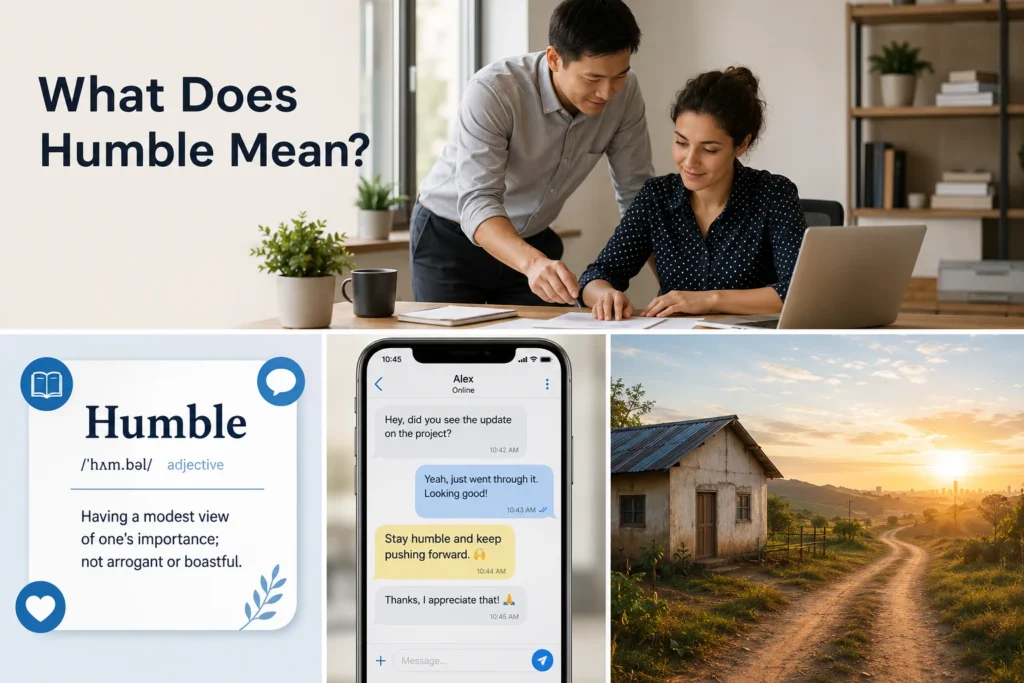
Humble means having or showing a modest view of your own importance — not boastful, not arrogant, and open to learning from others. It can describe a person’s character (a humble leader), an action (to humble someone), or a tone (a humble opinion). At its core, humble is about staying grounded regardless of success, status, or achievement.
You’ve probably seen the word “humble” everywhere in job interviews, Instagram captions, motivational quotes, and even in phrases like “humble brag” or “stay humble.” But what does humble actually mean, and why does it show up in so many different contexts? In this guide, you’ll get a complete breakdown of the humble meaning the dictionary definition, the everyday usage, the slang spins, and exactly how (and when) to use it correctly in real conversations.
Quick Answer Box
- Meaning: Modest, not arrogant, respectful of others
- Context: Personal character, opinions, actions, achievements
- Usage: Adjective (a humble person), verb (to humble someone), nounadjacent phrase (“humble opinion”)
- Platforms: Instagram, TikTok, LinkedIn, Twitter/X, everyday texting
- Example: “She stayed humble even after winning the award.”
- Tone: Positive, respectful, grounded — never boastful
What Does Humble Mean?
At its simplest, humble describes someone who doesn’t think too highly of themselves, even if they have every reason to. A humble person doesn’t need to announce their wins, doesn’t talk down to others, and stays open to feedback and growth. The word carries a quiet kind of confidence the opposite of arrogance, but also different from having low selfworth.
Humble isn’t about hiding your talent or pretending you’re not good at something. It’s about carrying your achievements without letting them define how you treat people.
The Core Idea Behind Humble
Think of humility as an internal setting rather than a performance. Someone can be extremely successful — a CEO, an athlete, a top student — and still be humble if they treat others with respect, credit their team, and stay teachable. The word signals character, not capability.
Full Definition
According to standard usage, humble functions in a few different grammatical roles:
- Adjective: having a modest opinion of one’s own importance (“a humble attitude”)
- Verb: to lower someone in condition or dignity, or to make someone realize their limitations (“the loss humbled the team”)
- Informal noun phrase: used in expressions like “humble opinion” or “humble beginnings”
The word traces back to the Latin humilis, meaning “low” or “on the ground” related to humus, meaning “earth.” That origin is where the idea of being “grounded” or “downtoearth” comes from. To be humble, historically, meant staying close to the ground rather than elevating yourself above others.
Context & Usage
Humble shows up in a wide range of everyday situations, and the meaning shifts slightly depending on context.
- Describing personality: “He’s one of the most humble people I know.”
- Describing achievements: “They come from humble beginnings.”
- Describing tone in opinions: “In my humble opinion, this is the best option.”
- As a verb (formal/literary): “The defeat humbled the champion.”
- As a request for modesty: “Stay humble, no matter how far you go.”
Each of these uses the same core idea staying grounded but applies it differently depending on whether you’re talking about a person, an origin story, or a statement.
RealLife Examples
Seeing humble in actual conversation makes the meaning click faster than any dictionary definition. Here are five realistic examples across different everyday contexts.
Conversation Example 1 — Text Message
Friend: “You literally aced every exam this semester, how??” You: “Ngl I got lucky on a couple, still feel like I have so much to learn tbh 😅” Friend: “That’s the humble in you talking lol”
Conversation Example 2 — Work Setting
Coworker: “Your presentation was incredible, the client loved it.” You: “Thank you, honestly the whole team made it happen, I just put the slides together.”
This response reflects humility by redirecting credit to the team instead of centering the praise entirely on yourself.
Conversation Example 3 — Social Media Caption
“Grateful for this opportunity. Started from nothing and still learning every single day. Humble beginnings, big dreams. 🙏”
Conversation Example 4 — Sports Context
Reporter: “You just broke the record — how does it feel?” Athlete: “It feels amazing, but honestly, my coaches and teammates deserve just as much credit as I do.”
Conversation Example 5 — Casual Debate
Person A: “I think remote work is way better than office work, no debate.” Person B: “That’s a strong take — in my humble opinion, it really depends on the job.”
Here, “humble opinion” softens the disagreement, making the statement feel respectful rather than confrontational.
PlatformSpecific Meaning
The word humble carries the same core meaning everywhere, but the tone and usage shift slightly depending on the platform.
On Instagram, “humble” often appears in captions tied to achievements, milestones, or personal growth posts. Phrases like “staying humble” or “humble beginnings” are common under photos celebrating a promotion, graduation, or fitness transformation. It signals gratitude rather than bragging.
TikTok
On TikTok, “stay humble” is frequently used as a caption or comment on videos showing talent, success, or glowups. It’s often paired with a grounded or selfaware tone, sometimes even humorously, like captioning a small personal win with “stay humble” as a joke about staying modest over something minor.
On LinkedIn, humble usually appears in a more professional tone — describing leadership style, career reflections, or gratitude posts. “I’m humbled by this opportunity” is one of the most common LinkedIn phrases, used when announcing a new job, award, or milestone.
Twitter/X
On X, “humble” often appears in short, punchy contexts — replying to viral achievement posts with “stay humble,” or using “humble opinion” (sometimes shortened to “tbh” or “imo”) to soften a hot take before stating it.
Alternative Meanings
While the everyday meaning of humble centers on modesty, there are a few related but distinct meanings worth knowing.
- Humble origins/beginnings: refers to a simple, modest, or lowincome starting point in life, not necessarily about personality.
- To humble someone (verb): to make someone realize their limitations, often through failure or a reality check — this can carry a slightly negative or corrective tone.
- Humble opinion: a conversational softener used before sharing a viewpoint, signaling respect rather than certainty.
- Humble request/apology: an oldfashioned but still used phrase implying sincerity and respect, common in formal writing.
Related Terms / NLP Variations
Words and phrases closely related to humble include:
- Modest
- Downtoearth
- Grounded
- Unpretentious
- Unassuming
- Meek (similar, but implies more passivity)
- Lowkey (informal synonym in casual speech)
- Humblebrag (a subtle boast disguised as modesty)
Understanding these variations helps clarify what humble is not — it isn’t the same as being meek or lacking confidence, and it’s the opposite of a humblebrag, which uses false modesty to actually show off.
How to Respond / Reply
If someone calls you humble, there are a few natural ways to respond without sounding awkward or falsely modest:
- “That means a lot, thank you.”
- “I just try to stay grounded, honestly.”
- “Appreciate you noticing — I don’t like making a big deal out of things.”
- “Thanks, I think staying humble keeps me motivated to keep growing.”
The goal is to accept the compliment gracefully without either dismissing it entirely or turning it into another opportunity to boast.
Misinterpretations
Humble is often misunderstood in a few common ways:
- Confused with low selfesteem: Being humble is not the same as underestimating your own worth. A humble person can be fully aware of their skills — they simply don’t feel the need to constantly prove it.
- Confused with weakness: Humility isn’t passivity. A humble person can still be assertive, confident, and direct.
- Mistaken for fake modesty: This is where the term “humblebrag” comes from — pretending to downplay an achievement while actually drawing attention to it (e.g., “ugh, I hate that I got picked for the lead role again”).
When NOT to Use It
While humble is generally a positive word, there are situations where it can come across as insincere or misplaced:
- Don’t use “humble opinion” right before an aggressive or dismissive statement — it reads as sarcastic.
- Avoid using “humble” to describe someone in a backhanded way (e.g., “humble beginnings” when the intent is to imply someone doesn’t belong somewhere).
- Don’t overuse “stay humble” as a caption for every single post — it loses meaning and can come across as performative.
Usage Tips
- Use “humble” to genuinely acknowledge others, not just to sound modest.
- Pair it with gratitude (“I’m humbled and grateful”) for a natural, sincere tone.
- In professional writing, “humble opinion” works well to soften disagreement politely.
- In casual chats, phrases like “stay humble” or “lowkey humbled” fit naturally without sounding forced.
FAQs
1. What does “humble” mean in simple terms? It means being modest and respectful, without bragging about your achievements or abilities.
2. Is “humble” a compliment? Yes, calling someone humble is generally a compliment, recognizing their modesty despite success or talent.
3. What does “stay humble” mean? It’s an encouragement to remain grounded and modest, even after achieving success or recognition.
4. What is a “humblebrag”? A humblebrag is a statement that appears modest on the surface but is actually meant to show off an achievement.
5. What does “in my humble opinion” mean? It’s a polite way of introducing a personal viewpoint, signaling respect for other perspectives before disagreeing.
6. Can humble be used as a verb? Yes. “To humble someone” means to make them realize their limitations, often through a setback or failure.
7. What’s the difference between humble and modest? They’re very similar, but “modest” leans more toward downplaying accomplishments, while “humble” emphasizes overall attitude and character.
8. Where does the word “humble” come from? It comes from the Latin word humilis, meaning “low” or “on the ground,” related to humus meaning “earth.”
9. Is being humble a weakness? No. Humility is compatible with confidence and assertiveness — it’s about attitude toward others, not lack of selfbelief.
10. What does “humble beginnings” mean? It refers to starting life or a career from a simple, modest, or financially limited background.
Conclusion
At its heart, the humble meaning is about staying grounded treating people with respect regardless of your achievements, status, or success. Whether you’re using it to describe a person’s character, softening an opinion, or captioning a milestone post, humble carries the same underlying idea: confidence without arrogance. Understanding its different forms as an adjective, a verb, and a conversational phrase helps you use it naturally and sincerely across everyday conversations, social media, and professional settings.

Justin Powell is a writer at GramBrix.com who focuses on grammar, clarity and effective communication, helping readers strengthen their language skills.