Last Updated on July 5, 2026
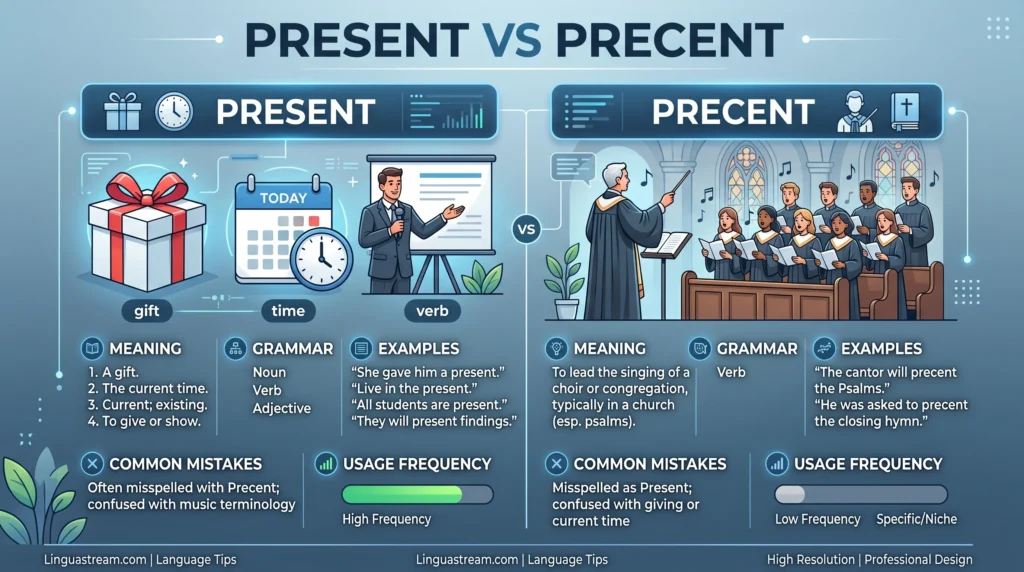
Present is a correct English word with several meanings, including a gift, the current time, or the act of introducing something. Precent is also a real but extremely rare word, mainly used in religious contexts to refer to leading church music or singing. In most situations, people searching for present or precent actually mean present, making it the correct choice for everyday writing, education, business, and SEO content.
The confusion between present or precent is not as common as other spelling mistakes, but it still appears in writing, search queries, and language-learning discussions.
At first glance, the two words look very similar. Only one letter separates them, yet their meanings are completely different.
Consider these examples:
- She received a birthday present.
- The church official was asked to precent the hymn.
Both sentences are correct, but they use different words in entirely different contexts.
The word present is one of the most frequently used words in English. It can function as a noun, verb, or adjective.
The word precent, however, is uncommon and mostly appears in historical, religious, or liturgical settings.
Understanding the difference can help improve spelling accuracy, professional writing, and overall communication skills.
This guide covers:
- Definitions
- Usage differences
- Examples
- Grammar explanations
- Common mistakes
- SEO recommendations
- FAQs
Quick Answer
| Word | Correct? | Common Usage |
|---|---|---|
| Present | Yes | Very Common |
| Precent | Yes | Very Rare |
Simple Summary
Use present in everyday writing. Use precent only when referring to leading church singing or liturgical music.
What Does Present Mean?
Definition
Present is a versatile English word with several meanings.
As a Noun
Present can mean:
- A gift
- Something given to another person
Examples:
- She received a present for her birthday.
- The wedding present was appreciated.
As an Adjective
Present can mean:
- Existing now
- Current
Examples:
- The present situation is challenging.
- We live in the present moment.
As a Verb
Present can mean:
- To introduce
- To display
- To offer
Examples:
- He will present the report.
- The teacher presented the award.
What Does Precent Mean?
Definition
Precent is a verb used mainly in religious contexts.
Religious Meaning
It means:
- To lead singing
- To direct musical worship
- To guide congregational hymns
Historical Usage
Precent appears most often in older church writings and liturgical traditions.
Main Difference Between Present or Precent
Everyday Usage
Present
Extremely common.
Precent
Rarely used outside religious settings.
Meaning
Present
Gift, current time, or introduction.
Precent
Leading church music or singing.
Frequency
Present
Appears millions of times in books, websites, and conversations.
Precent
Appears mainly in specialized religious texts.
Comparison Table
| Feature | Present | Precent |
|---|---|---|
| Common Word | Yes | No |
| Gift Meaning | Yes | No |
| Current Time Meaning | Yes | No |
| Religious Singing | No | Yes |
| Business Usage | Yes | No |
| Everyday Conversation | Yes | Rarely |
Examples of Present in Sentences
Gift Meaning
- She opened her present immediately.
- The birthday present was thoughtful.
Current Time Meaning
- We should focus on the present.
- The present economy is improving.
Verb Meaning
- I will present my findings tomorrow.
- The manager presented a new proposal.
Professional Context
- The team will present the project next week.
- Present information clearly and accurately.
Examples of Precent in Sentences
Religious Services
- He was chosen to precent the morning hymn.
- The choir director will precent during worship.
Historical Writing
- The minister would precent the congregation’s singing.
Liturgical Use
The word remains relevant in certain church traditions.
Why People Confuse Present and Precent
Similar Spelling
Only one letter differs.
Typing Errors
Fast typing may result in accidental substitutions.
Unfamiliar Vocabulary
Many people have never encountered the word precent.
Search Engine Queries
Users occasionally mistype present as precent.
Present as a Noun, Verb, and Adjective
Present as a Noun
Meaning:
A gift.
Example:
- The child received a present.
Present as a Verb
Meaning:
To introduce or display.
Example:
- The speaker will present the topic.
Present as an Adjective
Meaning:
Current or existing now.
Example:
- The present circumstances require action.
The Religious Role of Precent
Church Music
Precent often refers to leading congregational singing.
Historical Worship
Many older churches used designated song leaders.
Modern Usage
Today, the term is relatively uncommon but still appears in certain denominations.
SEO Recommendation for 2026
Use Present as the Primary Keyword
Most users search for:
- Present meaning
- Present tense
- Birthday present
- Present definition
Mention Precent Only for Clarification
The term has very limited search volume.
Focus on User Intent
Most searches involving “present or precent” seek spelling clarification.
Common Mistakes People Make
Writing Precent Instead of Present
Incorrect:
- I bought a precent for her birthday.
Correct:
- I bought a present for her birthday.
Assuming Precent Is a Misspelling
Precent is actually a real word.
Using Precent in Business Writing
The term is generally inappropriate outside religious contexts.
Confusing Meanings
Always consider the sentence context.
Related Word Comparisons
Present or Gift
Often interchangeable as nouns.
Present or Current
Present can mean current.
Precent or Chant
Both may relate to religious music leadership.
How to Remember the Difference
Think of Gifts
If you mean a gift, use present.
Think of the Present Moment
If you mean “now,” use present.
Think of Church Singing
If discussing worship music leadership, use precent.
Use Context
The surrounding sentence usually makes the correct choice obvious.
Exercises With Answers
Exercise 1
Which word means a gift?
Answer: Present
Exercise 2
Which word relates to church singing?
Answer: Precent
Exercise 3
Complete the sentence:
She received a birthday _____.
Answer: Present
Exercise 4
Complete the sentence:
The leader was asked to _____ the hymn.
Answer: Precent
Exercise 5
Which word is more common in everyday English?
Answer: Present
FAQs
Is it present or precent?
Both are real words, but present is far more common and correct in most situations.
What does present mean?
Present can mean a gift, the current time, or the act of introducing something.
What does precent mean?
Precent means to lead singing or music in a religious service.
Is precent a misspelling of present?
No. Precent is a legitimate English word with a different meaning.
Which spelling should I use for a gift?
Always use present.
Is precent used in modern English?
Yes, but mainly in religious or liturgical contexts.
Which word is better for SEO?
Present is significantly more common and receives much higher search interest.
Can present be a verb?
Yes. It can mean to introduce, offer, or display something.
Why do people confuse present and precent?
Because they are visually similar and differ by only one letter.
Which word appears more often in everyday conversation?
Present is vastly more common.
Conclusion
The difference between present or precent comes down to meaning and usage.
Present is one of the most commonly used words in English. It can refer to:
- A gift
- The current time
- Introducing or displaying something
Precent, while a real word, has a specialized meaning connected to leading singing in religious services.
Key takeaways include:
- Present is correct for everyday communication.
- Precent is a rare religious term.
- Present functions as a noun, verb, and adjective.
- Precent is mainly used in church-related contexts.
- Most people searching this comparison actually need the word present.
For modern writing, business communication, academic work, and SEO content in 2026, present is almost always the correct choice.

Kevin Brooks is a grammar specialist at GramBrix.com, dedicated to helping readers understand language rules with clarity and confidence. He simplifies complex grammar concepts through practical examples and easy explanations.