Last Updated on July 8, 2026
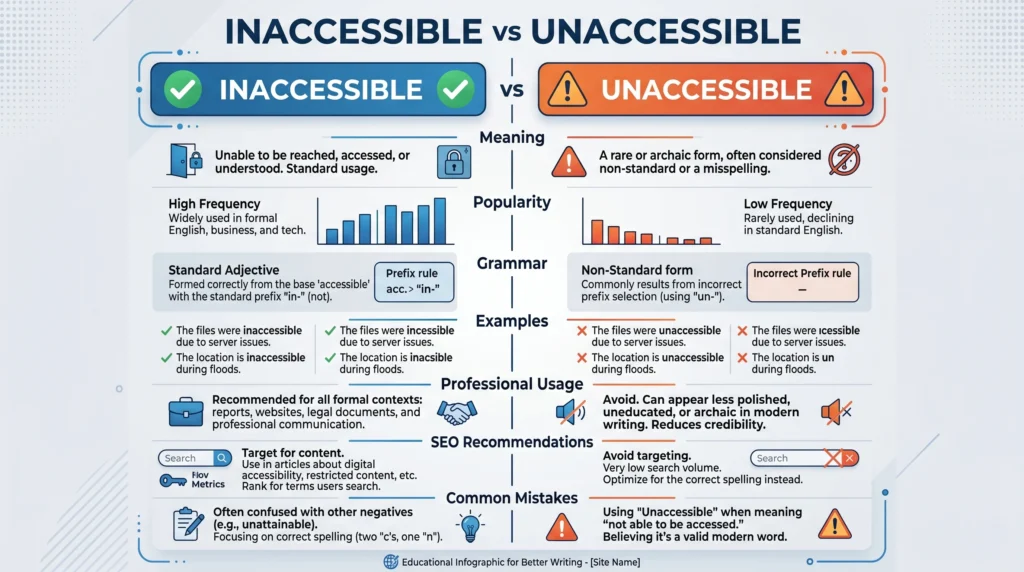
Inaccessible and unaccessible are both recognized English words, but inaccessible is overwhelmingly the preferred and standard form in modern English. It is used in academic writing, business communication, accessibility guidelines, technology, and everyday language. While unaccessible is technically valid, it is rare and often considered nonstandard by many writers and editors. For SEO and professional writing in 2026, inaccessible is usually the correct choice.
English contains many word pairs that create confusion because they appear similar and seem to mean the same thing. One such example is inaccessible or unaccessible.
If you’ve ever written a sentence like:
- The website is inaccessible.
- The website is unaccessible.
You may have wondered which version is correct.
The interesting answer is that both words exist in English dictionaries. However, they are not used equally.
In modern communication, professional writing, government documents, educational materials, and accessibility standards, inaccessible is by far the preferred spelling.
Understanding the difference can help improve your writing, boost credibility, and prevent common grammar mistakes.
This guide explains:
- Definitions
- Usage differences
- Grammar rules
- Real-world examples
- Common mistakes
- SEO recommendations
- FAQs
Quick Answer
| Word | Correct? | Common Usage |
|---|---|---|
| Inaccessible | Yes | Very Common |
| Unaccessible | Yes | Rare |
Simple Summary
Use inaccessible in almost all situations. Although unaccessible is a real word, it is rarely used in modern English.
What Does Inaccessible Mean?
Definition
Inaccessible means:
- Unable to be reached
- Difficult to enter
- Not easily obtained
- Unavailable to certain users
Common Usage
Examples:
- The road became inaccessible after the storm.
- The document is inaccessible without permission.
- The website is inaccessible to screen readers.
Professional Context
The word frequently appears in:
- Technology
- Accessibility standards
- Education
- Business writing
- Government publications
What Does Unaccessible Mean?
Definition
Unaccessible generally carries the same meaning as inaccessible.
Historical Usage
The term has appeared in English for centuries but has never become the dominant form.
Modern Usage
Today, unaccessible is rarely used in professional communication.
Main Difference Between Inaccessible or Unaccessible
Meaning
Inaccessible
Not reachable or available.
Unaccessible
Essentially the same meaning.
Popularity
Inaccessible
Used by most English speakers and writers.
Unaccessible
Appears much less frequently.
Professional Acceptance
Inaccessible
Widely accepted.
Unaccessible
Often viewed as unusual or outdated.
Comparison Table
| Feature | Inaccessible | Unaccessible |
|---|---|---|
| Real Word | Yes | Yes |
| Common in Modern English | Yes | No |
| Academic Writing | Preferred | Rare |
| Business Writing | Preferred | Rare |
| SEO-Friendly | Yes | Limited |
| Dictionary Recognition | Yes | Yes |
Why Inaccessible Is More Popular
Established Usage
Over time, inaccessible became the standard form.
Editorial Preference
Most style guides recommend inaccessible.
Better Recognition
Readers instantly recognize the word.
Search Trends
Online searches overwhelmingly favor inaccessible.
Examples of Inaccessible in Sentences
Technology
- The server became inaccessible during maintenance.
- Some pages were inaccessible after the update.
Travel
- The mountain trail was inaccessible due to snow.
Education
- Certain resources remained inaccessible to students.
Healthcare
- Rural healthcare services may be inaccessible in some regions.
Accessibility
- The website was inaccessible to users with disabilities.
Examples of Unaccessible in Sentences
Historical Example
- The region was considered unaccessible during winter.
Literary Example
- The fortress appeared unaccessible to invaders.
Modern Example
Although possible, most editors would replace unaccessible with inaccessible.
Inaccessible in Technology
Website Accessibility
One of the most common uses today.
Example:
- An inaccessible website may exclude users with disabilities.
Software Development
Developers frequently test for inaccessible features.
User Experience
Accessibility has become a major design priority.
Inaccessible in Everyday Life
Locations
- A road may become inaccessible after flooding.
Information
- Certain records may be inaccessible without authorization.
Services
- Transportation can be inaccessible in remote areas.
Grammar and Word Formation
Prefix “In”
The prefix in- often means:
- Not
- Opposite of
Examples:
- Incomplete
- Incorrect
- Inactive
- Inaccessible
Prefix “Un”
The prefix un- also means:
- Not
- Opposite of
Examples:
- Unhappy
- Unclear
- Unfair
Why Both Exist
English sometimes allows multiple negative prefixes, creating alternative forms of the same word.
SEO Recommendation for 2026
Use Inaccessible as the Primary Keyword
Searches commonly include:
- Inaccessible meaning
- Inaccessible website
- Inaccessible file
- Inaccessible location
Avoid Targeting Unaccessible Alone
Search volume is significantly lower.
Match Search Intent
Most users searching this topic want spelling clarification.
Common Mistakes People Make
Using Unaccessible in Professional Writing
While technically correct, it can sound unusual.
Assuming Unaccessible Is Always Wrong
It is a real word, just uncommon.
Overthinking the Choice
In most cases, simply choose inaccessible.
Ignoring Audience Expectations
Readers expect to see inaccessible.
Related Word Comparisons
Inaccessible or Unreachable
Both suggest something cannot be reached.
Inaccessible or Unavailable
Unavailable focuses more on access restrictions.
Accessible or Inaccessible
These are direct opposites.
How to Remember the Correct Choice
Think About Common Usage
Most books, articles, and websites use inaccessible.
Follow Professional Standards
Editors generally prefer inaccessible.
Use the Familiar Form
When uncertain, choose inaccessible.
Check Context
Professional and academic contexts almost always favor inaccessible.
Real World Examples
Website Accessibility
An inaccessible website may prevent users from accessing important information.
Natural Disasters
Flooding can make roads inaccessible.
Business Documents
Restricted files may be inaccessible without permission.
Transportation
Remote villages can become inaccessible during severe weather.
Exercises With Answers
Exercise 1
Which spelling is more common?
Answer: Inaccessible
Exercise 2
Which word is preferred in professional writing?
Answer: Inaccessible
Exercise 3
Complete the sentence:
The website became _____ after the update.
Answer: Inaccessible
Exercise 4
Is unaccessible a real word?
Answer: Yes
Exercise 5
Which spelling is better for SEO?
Answer: Inaccessible
FAQs
Is it inaccessible or unaccessible?
Both are real words, but inaccessible is the standard and preferred form.
Is unaccessible a real English word?
Yes. However, it is rarely used in modern English.
Which spelling should I use in professional writing?
Use inaccessible.
Do inaccessible and unaccessible mean the same thing?
Yes. They generally share the same meaning.
Why is inaccessible more common?
It became the accepted standard through widespread usage and editorial preference.
Is unaccessible grammatically incorrect?
No. It is grammatically valid but uncommon.
Which version is better for SEO in 2026?
Inaccessible is the stronger keyword because it matches user search behavior.
Can inaccessible describe websites?
Yes. It is frequently used in web accessibility discussions.
Can inaccessible describe places?
Yes. Roads, buildings, and locations can be inaccessible.
Should students use inaccessible or unaccessible?
Students should generally use inaccessible because it is the standard form.
Conclusion
The debate over inaccessible or unaccessible is less about correctness and more about usage.
Both words exist in English and carry nearly identical meanings. However, inaccessible has become the clear standard in modern communication.
Key takeaways include:
- Inaccessible is the preferred spelling.
- Unaccessible is a real but uncommon alternative.
- Professional writers almost always choose inaccessible.
- Accessibility, technology, education, and business fields favor inaccessible.
- For SEO and readability, inaccessible is the better option.
If you’re unsure which word to use, choosing inaccessible is the safest and most widely accepted choice in modern English.

Kevin Brooks is a grammar specialist at GramBrix.com, dedicated to helping readers understand language rules with clarity and confidence. He simplifies complex grammar concepts through practical examples and easy explanations.