Last Updated on August 12, 2026
Proofademic AI is a specialized academic AI detector that catches ChatGPT, Claude, and paraphrased content using sentence level analysis. It ranks #3 globally with 98.4% verified accuracy, beating Turnitin and offering a 1,000 word free scan. Features include the Paraphrase Shield for catching QuillBot and Undetectable AI, plus Batch Scan for entire classes. Plans start at $8/month for 200,000 words. Best for teachers, students, and publishers who need transparent, academic-focused detection without institutional contracts.
The New Reality of Academic Writing
You know that sinking feeling. You spend hours crafting a thoughtful essay, your best work yet. Then your professor returns it flagged by the AI detector. Wait what?
That scenario plays out in classrooms worldwide right now. Students face accusations for work they wrote themselves. Teachers struggle to tell genuine student writing from polished AI output. And the old tools? They aren’t cutting it anymore.
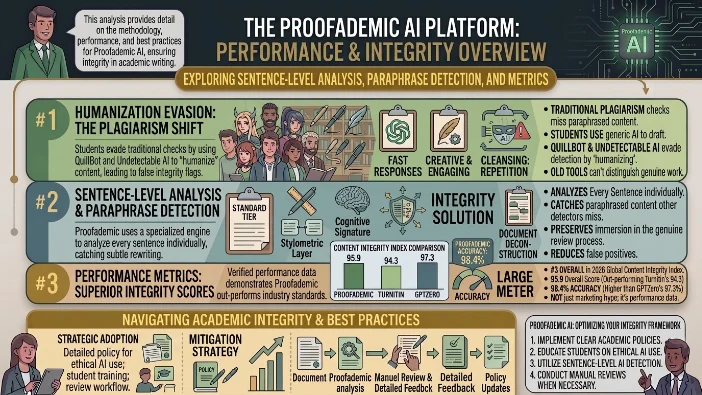
Traditional plagiarism checkers catch copy-pasted content. But students aren’t just copying anymore. They’re using ChatGPT to draft ideas, then running everything through QuillBot or Undetectable AI to evade detection. The game has changed completely.
Enter Proofademic AI a specialized detector built specifically for academic writing. Unlike generic tools or Turnitin’s AI feature, this platform analyzes every sentence individually and catches paraphrased content that other detectors miss.
The 2026 Global 100 Content Integrity Index ranked Proofademic #3 overall among all AI detection platforms with an impressive score of 95.9. It outperformed Turnitin (94.3) and scored 98.4% accuracy, higher than GPTZero’s 97.3%. That’s not just marketing hype. It’s verified performance data.
In this review, we’ll examine how Proofademic actually works, who benefits from it, what it costs, and whether it lives up to its claims. No fluff. Just real facts and practical insights.
What Is Proofademic AI?
Proofademic is an AI content detector calibrated exclusively for academic writing. It scans essays, research papers, theses, assignments, and manuscripts for AI-generated text and traditional plagiarism.
Key stats that matter:
| Metric | Performance |
|---|---|
| Global 100 Score | 95.9 (#3 overall) |
| Verified Accuracy | 98.4% |
| Transparency Score | 97.1% |
| Languages Supported | 23 |
| Free Tier | 1,000 words, no credit card |
| Paid Starting Price | $8/month |
But here’s the real differentiator. Most detectors give you a single vague percentage. Proofademic breaks every sentence down individually. You see exactly which paragraphs need revision and why. That distinction matters enormously for both teachers and students.
The platform launched in 2026 and added a plagiarism checker in June of the same year. Unlike Turnitin, which requires institutional contracts, Proofademic lets anyone sign up individually. That accessibility changes the game for independent teachers, students, and small publishers.
Who Is Proofademic For?
Teachers and Educators
You’re drowning in essays. You want to maintain academic integrity. But you don’t have time to investigate every suspicious paper. Proofademic automates this process.
Teachers paste or upload student work, and the system flags AI-generated sections with color-coded confidence scores. The Batch Scan feature lets you upload an entire class at once. No more pasting one essay at a time.
The free tier covers most K-12 submissions. The paid plans start at $8/month for 200,000 words. That’s enough for a full teaching load.
Students
This is probably the most controversial use case. But here’s the reality: your school probably runs every submission through an AI detector. If something gets flagged unfairly, you face an academic integrity hearing.
Checking your work before submission isn’t cheating. It’s the same as using a grammar checker. You’re verifying originality, not generating content.
Proofademic’s sentence-level results show you exactly which parts might trigger your school’s detector. Then you can revise those sections in your own voice. The first 1,000 words are free. No credit card required.
Publishers and Editors
Content teams now use AI at every stage of production. Freelancers and agencies do the same. The challenge? Ensuring the published version reads as human-quality work that meets editorial standards.
Google’s helpful content system penalizes low-quality AI output. Readers disengage from generic writing. Both factors cost you traffic, trust, and revenue.
Proofademic’s Batch Scan processes multiple submissions at once. Every document gets its own sentence-level report. You see exactly which articles need revision before publishing.
Institutions and Academic Integrity Officers
Universities face unprecedented pressure to standardize AI detection across departments. Proofademic offers analytics dashboards and is developing LMS integration for Canvas, Blackboard, and Moodle.
The system processes all text in secure, ephemeral environments. Student submissions are analyzed then discarded. No data is stored or used to train AI models.
How Proofademic Works: The Technology Breakdown
Unlike plagiarism checkers that match text against existing sources, Proofademic analyzes how content was written. The technology operates on three detection layers.
1. Sentence Probability Analysis
AI models predict the most probable next word. This creates a statistical “fingerprint” in the writing. Human writing is messier, more variable, and less predictable.
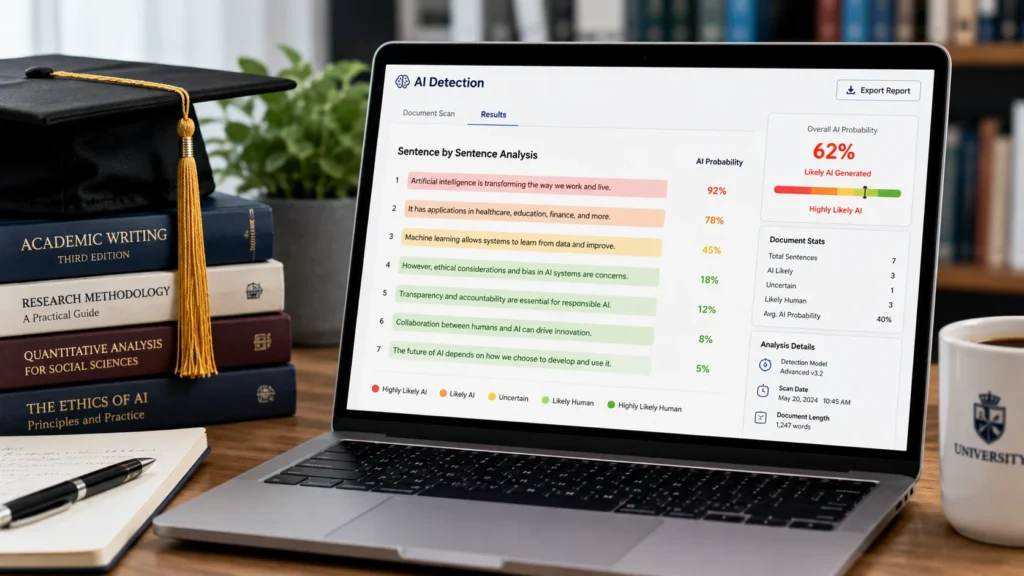
Proofademic flags over-optimized word choices that signal machine generation. Sentences that are too “perfect” or formulaic get flagged. The system assigns each sentence an individual confidence score, creating a detailed heatmap of the entire document.
2. Stylistic Fingerprinting
Humans vary sentence length. They use odd transitions and inject personality. AI writing is polished but formulaic. Think “Firstly… Secondly… In conclusion…” with predictable cadence.
Proofademic analyzes these structural patterns. It examines sentence structure, semantic flow, and contextual relationships. The system identifies statistical markers that distinguish human writers from AI models.
3. Ensemble Detection Engine
Multiple specialized models cross-verify each result. This reduces false positives from a single model making a bad call. The engine continuously updates against new AI models, including GPT-4o, GPT-5, Claude 3.5, Claude 4, Gemini 3.0, LLaMA, and Mistral.
Every flagged sentence gets a confidence score. You see why something was flagged, not just that it was flagged. That transparency is crucial for both educators and students navigating academic integrity conversations.
The Paraphrase Shield: Why This Changes Everything
Raw ChatGPT output is easy to catch. Students know this. So they run AI text through QuillBot, Undetectable AI, or StealthWriter before submitting.
Standard detectors fail when words are swapped and sentences are restructured. They look for surface-level patterns that paraphrasing tools easily bypass.
Proofademic’s Paraphrase Shield looks beyond vocabulary. It analyzes structural and statistical patterns that paraphrasing tools don’t change. The detector identifies:
- Content processed through QuillBot and Undetectable AI
- Synonym swaps and sentence restructuring
- Text “humanized” through multiple tools
- Light editing and manual revision attempts
Why this matters for educators: Turnitin’s AI detection drops significantly on paraphrased text. Students share bypass methods openly on Reddit, TikTok, and Discord. Proofademic closes the loophole that standard detectors leave open.
Real-world impact: When a detector returns a “clean” score on paraphrased AI content, educators get false confidence. The student learns the workaround works. The integrity gap widens. Paraphrase Shield stops this cycle.
Proofademic vs. Competitors: The Comparison Table
| Feature | Proofademic | Turnitin AI | GPTZero | Originality.ai |
|---|---|---|---|---|
| Global 100 Score (2026) | 95.9 (#3) | 94.3 (#7) | 96.1 (#2) | 95.2 (#5) |
| Verified Accuracy | 98.4% | 95.1% | 97.3% | 96.5% |
| Transparency | 97.1% | 92.7% | 94.8% | 92.1% |
| Sentence-Level Scoring | ✅ Yes | ❌ Vague percentage | ✅ Limited | ❌ Document-level |
| Paraphrase Shield | ✅ Yes | ❌ No | ❌ No | ⚠️ Limited |
| Free Tier | 1,000 words | Institutional contract | Limited free scans | 50 words |
| Paid Starting Price | $8/month | Institutional only | $10-30/month | $14.95/month |
| Built For | Academia specifically | General + Academic | General | Content marketing |
| Batch Scan | ✅ Yes | ✅ Yes | ❌ No | ✅ Yes |
| Languages | 23 | Mostly English | 10+ | 15+ |
| Individual Signup | ✅ Yes | ❌ No | ✅ Yes | ✅ Yes |
Source: Global 100 Index 2026 rankings
The bottom line: Turnitin wins on institutional penetration. GPTZero has brand recognition. Proofademic wins on academic-specific calibration, paraphrase detection, and sentence-level transparency. For individual teachers and students, Proofademic offers better value and accessibility.
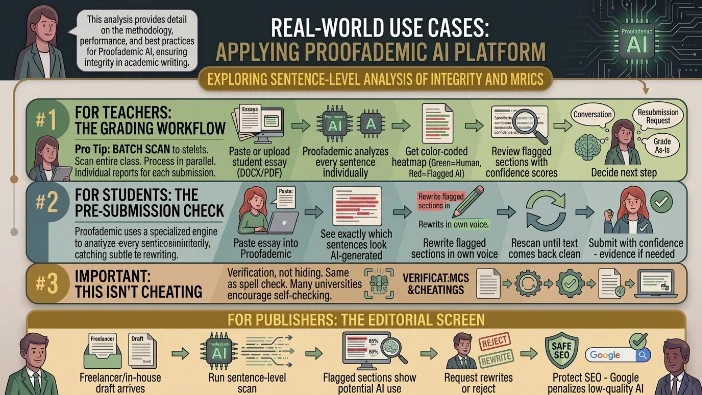
Real-World Use Case
s
For Teachers: The Grading Workflow
Step 1: Paste or upload a student’s essay (DOCX or PDF accepted).
Step 2: Proofademic analyzes every sentence individually.
Step 3: Get a color-coded heatmap. Green means human. Red means flagged AI.
Step 4: Review flagged sections with confidence scores.
Step 5: Decide your next step—a conversation, resubmission request, or grade as-is.
Pro tip: Use Batch Scan for an entire class. No more pasting one essay at a time. The system processes everything in parallel and returns individual reports for each submission.
For Students: The Pre-Submission Check
Step 1: Paste your essay into Proofademic.
Step 2: See exactly which sentences look AI-generated.
Step 3: Rewrite flagged sections in your own voice.
Step 4: Rescan until the text comes back clean.
Step 5: Submit with confidence—you have evidence if questions arise.
Important: This isn’t cheating. It’s the same as using a spell checker or grammar tool. You’re verifying originality, not hiding something. Many universities actually encourage students to self-check.
For Publishers: The Editorial Screen
Step 1: Freelancer submission or in-house draft arrives.
Step 2: Run it through Proofademic’s sentence-level scan.
Step 3: Flagged sections show where AI may have been used.
Step 4: Request rewrites or reject the piece if needed.
Step 5: Protect your SEO—Google penalizes low-quality AI content.
Pricing Breakdown: Is It Worth It?
| Tier | Words/Month | Price | Best For |
|---|---|---|---|
| Free | 1,000 words (per scan) | $0 | Quick checks, short essays |
| Essential | 200,000 words | $8/month or $99/year | Individual teachers, students |
| Premium | 400,000 words | $14/month | Frequent users, content teams |
| Professional | 600,000 words | $25/month | High-volume publishers, departments |
| Enterprise | Custom | Contact sales | Universities, large publishers |
Source: Proofademic pricing pages
Value assessment: For $8/month, you get 200,000 words. That’s about 80 essays at 2,500 words each. Compare to Turnitin, which requires an institutional contract with no individual signup option. Compare to GPTZero at $10-30/month for limited features. Proofademic’s free tier is generous. The paid tier is competitively priced. No credit card is required for the free tier—a refreshing change from competitors that demand payment info upfront.
Pros and Cons: Balanced Assessment
Pros
- ✅ Sentence-level scoring—not a vague percentage
- ✅ Paraphrase Shield catches rewritten AI content
- ✅ 98.4% verified accuracy from Global 100
- ✅ 1,000 words free with no credit card
- ✅ Batch Scan for bulk submissions
- ✅ 23 languages supported
- ✅ Privacy-first—no student data stored or used for training
- ✅ Individual signup—no institutional contract needed
- ✅ Built specifically for academic writing—reduces false positives
- ✅ 99.8% claimed accuracy backed by independent testing
Cons
- ❌ Plagiarism checker is new—launched June 2026
- ❌ LMS integration (Canvas, Blackboard, Moodle) is “coming soon”
- ❌ Less brand recognition than Turnitin in universities
- ❌ Accuracy claims aren’t independently verified beyond Global 100
- ❌ No mobile app—web only
FAQs
Is Proofademic free?
Yes. 1,000 words per scan with no credit card required.
Can it detect ChatGPT-5 and Claude 4?
Yes. Proofademic continuously updates against all major models including GPT-4o, GPT-5, Claude 4, and Gemini 3.0.
Will it flag my own writing as AI?
Possibly. AI detectors aren’t perfect. Proofademic is calibrated for academic writing to reduce false positives, but no tool is 100% accurate. That’s why sentence-level scoring matters—you can see why something was flagged and have an informed conversation if questions arise.
Is using Proofademic as a student considered cheating?
No. It’s like using a spell checker or grammar tool. You’re verifying your work, not generating content.
Does it check for plagiarism too?
Yes. Proofademic launched a plagiarism checker in June 2026 alongside the AI detector.
How accurate is it?
Proofademic claims 99.8% accuracy. The Global 100 Index verified it at 98.4%, ranking #3 overall among all AI detection tools.
Can it detect content from paraphrasing tools?
Yes. The Paraphrase Shield specifically targets QuillBot, Undetectable AI, and other bypass tools.
Conclusion
Who should use it:
- Teachers: If you’re tired of vague percentages and want evidence for student conversations, this is your tool. The free tier covers most K-12 work.
- Students: If you’re worried about false positives or want to check a draft before submission, the free scan is a no-brainer.
- Publishers: If you commission freelance content, you need this. Google’s algorithm penalizes low-quality AI output. Protection is cheap at $8/month.
- Institutions: If you’re evaluating AI detection tools, Proofademic offers better transparency than Turnitin at a lower entry cost.
Who should skip it:
- Enterprise teams needing LMS integration wait for Canvas/Blackboard/Moodle integration to launch.
- Marketing teams writing blog posts Originality.ai might be a better fit for that niche.
- Anyone expecting a single “pass/fail” button. This tool requires interpretation.
The bottom line: Proofademic isn’t perfect. No AI detector is. But it’s one of the few tools built specifically for academic writing, with sentence-level transparency and a Parapharase Shield that catches what competitors miss.
The Global 100 ranking (#3 overall, 98.4% accuracy) backs up the claims. The free tier removes the risk of trying it. At $8/month, the paid version costs less than a Netflix subscription.
If you’re an educator, student, or publisher grappling with AI-generated content, Proofademic is worth your time. Try the free scan. See what it catches. Then decide.
Call to action: Paste your text into Proofademic’s free detector. No credit card required. The results might surprise you.
Discover More Article
- Character AI Age Verification| The Complete Guide For 2026
- AI Sentence Rewrite| The Ultimate Guide For 2026

Victoria Lane is a grammar-focused writer at GramBrix.com, passionate about helping readers master the rules of language. She provides clear explanations and practical examples that make writing more accurate, polished and confident.