
Last Updated on August 4, 2026
AI clothes remover tools use generative AI to digitally remove clothing from photos. Legitimate versions like GarmentAI, ComfyUI-RMBG, and QIE-2511-Extract-Outfit are used by fashion designers and e-commerce sellers for virtual try-ons, flat mockups, and fashion segmentation. However, harmful “nudify” apps like ClothOff have caused serious harm. A New Jersey teen sued ClothOff’s developer after a classmate created a fake nude image of her using the tool when she was 14. The Italian Data Protection Authority blocked ClothOff in October 2025 for GDPR violations. The UK Government announced plans to ban nudifying AI apps in December 2025. A global coalition of more than 100 child protection organizations called for universal banning of these tools on Safer Internet Day 2026. Nearly 1 in 5 confirmed reports of child sexual imagery in the UK involve AI-generated or manipulated content. The EU is investigating undressing applications under existing legislation.
What Is an AI Clothes Remover?
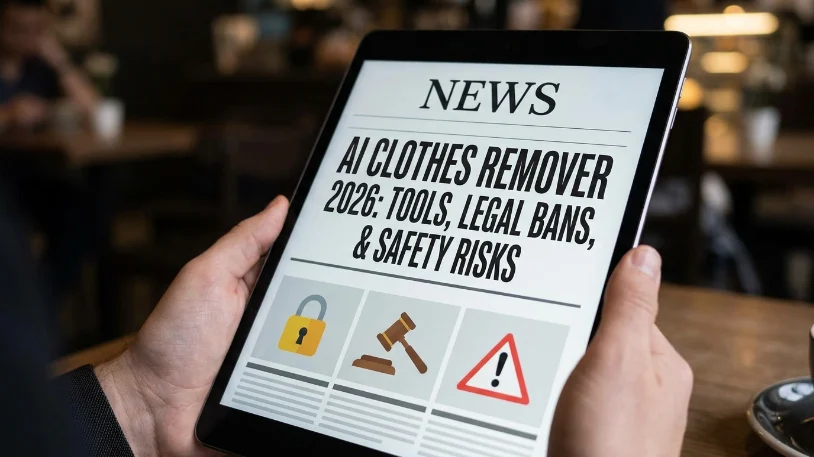
An AI clothes remover is a generative AI tool that digitally removes clothing from photos of people using advanced machine learning models. These tools use computer vision algorithms to analyze images, identify clothing items, and generate realistic nude versions of the subjects. While some legitimate photo editing apps include clothing removal features for legitimate uses like virtual try-ons, the technology has become notorious for its misuse in creating non-consensual intimate imagery.
The legal landscape is shifting rapidly. In October 2025, the Italian Data Protection Authority blocked ClothOff, one of the most prominent AI clothes remover platforms, citing serious GDPR violations. The UK government announced plans to outlaw AI apps that digitally remove clothing from images as part of its Violence Against Women and Girls strategy. And a New Jersey teenager is suing the maker of ClothOff after a classmate used the tool to create a fake nude image of her when she was 14.
How AI Clothes Removers Actually Work
The technology behind AI clothes removers falls into two main categories: legitimate clothing extraction tools used by professionals, and harmful “nudify” apps designed for non-consensual use.
Legitimate Clothing Extraction Tools
GarmentAI is a Chrome extension that uses Google Gemini AI to extract clothing from images, remove backgrounds, and swap outfits. It’s designed for fashion designers, e-commerce sellers, and content creators. Features include:
- Clothing extraction for flat-lay or ghost mannequin outputs
- Background removal with AI precision
- Outfit swapping between images
- Face swapping capabilities
GarmentAI operates on a credit system with packages starting at $4 for 100 jobs. Images are processed temporarily and automatically deleted after 24 hours, and the extension uses HTTPS encryption for data security.
ComfyUI-RMBG is an open-source custom node for image background removal and fashion segmentation. It supports:
- 18 different clothing categories for intelligent segmentation
- Fashion accessories segmentation
- Face parsing with 19 facial feature categories
- Multiple AI models including RMBG-2.0, INSPYRENET, BEN, SAM, and GroundingDINO
QIE-2511-Extract-Outfit is an adapter LoRA developed for Qwen’s image editing model that extracts clothing and converts it into a clean flat mockup. It preserves original fabric details, textures, colors, stitching, and patterns while removing the body, pose, and background influence.
Harmful “Nudify” Apps
The dangerous version of AI clothes removers includes tools like ClothOff, which gained notoriety for allowing users to digitally remove clothing from uploaded photos. These tools offer editing options like pose changes and face swapping to create sexually explicit content without consent.
Critical distinction: Legitimate clothing extraction tools remove the clothing itself as an object while preserving the person. Harmful “nudify” apps generate fake nude versions of the person in the image.
The Legal and Regulatory Response
Italy’s Groundbreaking Action
On October 1, 2025, the Italian Data Protection Authority (Garante) issued an urgent order against AI/Robotics Venture Strategy 3 Ltd., the British Virgin Islands-based operator of ClothOff. The Authority declared the company’s processing of personal data unlawful and immediately limited data processing for Italian users.
The Authority identified three main violations:
- Failure to prevent minors from using the service or uploading photos of children
- GDPR violations regarding lawfulness, fairness, and accountability in processing personal data, including biometric data
- Inadequate watermarking showing AI-generated nature of pictures — the word “Fake” was barely visible and easily removable
UK Government Ban
In December 2025, following campaigning by the Internet Watch Foundation (IWF) and partners, the UK Government announced plans to outlaw AI apps that digitally remove clothing or nudify people in images. This measure sits within the Government’s Violence Against Women and Girls strategy and aligns with Labour’s 2024 manifesto commitment to halve violence against women and girls within a decade.
IWF data underlines why this matters: In 2024, 98 percent of confirmed AI-generated child sexual abuse imagery where sex was depicted involved girls.
Global Coalition Against Nudify Apps
On Safer Internet Day 2026, a global coalition of child protection organizations united behind a clear message: nudifying apps should not exist. Organizations including the IWF, Child Helpline International, INHOPE, NCMEC, Offlimits, Safe Online, and the We Protect Global Alliance, supported by more than 100 organizations globally, called for the explicit and universal banning of nudifying tools.
The coalition’s demands:
- Governments and legislators to urgently enact and enforce regulation to prohibit nudifying tools
- The European Commission to classify AI-powered nudification apps as a prohibited practice under the EU AI Act
- Full use of Digital Services Act powers to push platforms to mitigate systemic risks
European Parliament Action
In January 2026, European Parliament members submitted a formal question to the European Commission regarding undressing applications. The parliamentarians asked:
- Does the Commission intend to investigate companies providing undressing features under existing legislation?
- Does it plan to present an initiative addressing this harmful trend?
The question notes that these tools do not distinguish between adults and children, making them capable of producing child sexual abuse material. It also references the EU Artificial Intelligence Act, which establishes ethics and trustworthiness as horizontal principles.
Malaysia’s Call for Criminalization
The Communications and Multimedia Content Forum of Malaysia called for AI tools that strip individuals of their clothing to be criminalized. CEO Mediha Mahmood stated: “Maybe we should explicitly criminalise the act of generation. We move the legal line so that using an AI tool to strip someone’s clothes or tudung is a crime the moment it is created, regardless of whether the perpetrator clicks ‘share’.”
She rejected calls to regulate women’s behaviour online, instead placing responsibility on the product that causes harm: “If a developer releases a tool that bypasses consent to enable digital assault, that is a product defect, not just some new feature.”
Real-World Harm: The ClothOff Lawsuits
The New Jersey Teen Case
A now 17-year-old from New Jersey is suing AI/Robotics Venture Strategy3, the developer of ClothOff, after a classmate used the tool to create a fake nude image of her when she was 14. The incident occurred at Westfield High School, where the girl was one of several students who discovered a classmate had used photos from their social media accounts to generate the fake nude images.
The lawsuit’s allegations:
- The plaintiff lives in “constant fear” that the fake image is circulating online
- Images of her and her classmates are being used to train ClothOff’s AI model
- Creating these images amounts to child sexual abuse material (CSAM)
What the plaintiff is requesting:
- Delete all nude images of adults and children created without consent
- Stop using them to train AI models
- Take down both the website and the ClothOff tool
The developer claims its tool cannot process photos of minors and that any attempt to do so results in an account ban. The company also says it does not store user data.
The Guardian Investigation
In 2024, The Guardian investigated ClothOff, which had over 4 million monthly visitors. The investigation found that the app had been used to generate fake nude images of children globally.
Legal Precedent
This case is a first-of-its-kind lawsuit alleging website owners and operators violate California and federal laws prohibiting deepfake pornography, revenge pornography, and child pornography. Experts believe this case could reshape how courts view AI liability and whether developers are responsible when people misuse their tools.
Mobile Apps: Legitimate Features with Misleading Labels
Several photo editing apps include AI clothes remover or clothes changer features, but these are often marketed deceptively.
PixVibe AI Photo Editor
PixVibe includes a “clothes remover and AI cutout” feature as part of its photo editing suite. Other features include:
- Magic Eraser for object removal
- Background remover and changer
- Body editor for reshaping body proportions
- AI avatar and image generation
The app is free with in-app purchases and subscription for unlimited premium features.
Retouch: AI Object Remover
Retouch offers an “AI Outfit Changer: Try-on new dresses with our outfit generator” feature. It also includes:
- Object removal for tourists, wires, or stains
- AI retouch for blemishes and skin smoothing
- Background replacement and blur
- Sky changer and photo blending
Key finding: When searching app stores for “AI clothes remover” or similar terms, legitimate photo editing apps appear alongside potentially harmful tools. The language used in app descriptions is often vague, making it difficult to distinguish between legitimate outfit try-on features and harmful “nudify” capabilities.
The Technical Reality: What’s Actually Possible
Legitimate Clothing Extraction
The “QIE-2511-Extract-Outfit” model on Hugging Face demonstrates legitimate clothing extraction technology. It’s designed to:
- Extract clothing from images and convert it into a clean, flat mockup
- Preserve original fabric details, textures, colors, stitching, and patterns
- Remove body, pose, and background influence
- Produce studio-style flat outfit layouts suitable for fashion design, catalogs, and product visualization
This model is trained on ModelScope.cn and uses a trigger prompt: “Extract the clothing and create a flat mockup.”
Textile Recycling Applications
A 2025 IEEE research paper explores AI systems for automated accessory removal in textile recycling. The paper notes that only about 1% of textiles are recycled into new clothing, mainly because metal or plastic fasteners like buttons, rivets, and zippers hinder the process. Manual removal is slow, labor-intensive, error-prone, and difficult to scale industrially.
This represents a legitimate, socially beneficial application of AI clothes removal technology.
AI Clothes Remover Tools Comparison
| Tool/App | Category | Purpose | Platform |
|---|---|---|---|
| GarmentAI | Legitimate | Clothing extraction, virtual try-on, background removal | Chrome extension |
| ComfyUI-RMBG | Legitimate | Fashion segmentation, background removal | ComfyUI custom node |
| QIE-2511-Extract-Outfit | Legitimate | Clothing extraction for flat mockups | Hugging Face model |
| ClothOff | Harmful | Non-consensual nude image generation | Web platform (blocked in some countries) |
| PixVibe | Mixed | Photo editing with “clothes remover” feature | iOS app |
| Retouch | Mixed | AI object remover with “outfit changer” | iOS app |
| Photo Eraser | Mixed | Object removal with AI clothes changer | iOS app |
What Parents and Schools Need to Know
The Scale of the Problem
Nearly one in five confirmed reports of nude or sexual imagery of children and young people made to the UK’s Report Remove service involve digitally altered or manipulated content, including through AI or nudification apps. The growing presence of fake imagery in these reports shows how rapidly this technology is being abused.
Key Risks for Teens
- Non-consensual imagery creation: Photos posted on social media can be easily downloaded and uploaded to AI clothes remover tools
- Image sharing: Fake nudes spread quickly through group chats and social media
- Emotional harm: Victims live in “constant fear” of images circulating online
- CSAM creation: Tools can produce child sexual abuse material in seconds
- Bullying and extortion: AI-generated images are used to humiliate, harass, and blackmail victims
What Schools Can Do
- Educate students about AI-generated image risks
- Create clear policies on AI misuse and consequences
- Provide support resources for victims
- Monitor for AI-generated imagery circulating in school communities
What to Do If Your Child Is Affected
- Save screenshots, links, and dates before content disappears
- Request immediate removal from platforms hosting the image
- Seek legal help to understand rights under state and federal law
- Contact the Report Remove service (UK) or NCMEC (US) for support
Frequently Asked Questions
What is an AI clothes remover?
An AI clothes remover is a generative AI tool that uses machine learning and computer vision to digitally remove clothing from photos of people. Some are legitimate fashion tools, while others are harmful “nudify” apps.
Are AI clothes removers legal?
Legitimate clothing extraction tools used by fashion designers are legal. However, harmful “nudify” apps that create non-consensual intimate imagery are illegal in many countries and are being banned by governments globally.
Is ClothOff still available?
ClothOff has been blocked in Italy and faces legal action from a New Jersey teen lawsuit. The company’s future is uncertain as regulators and courts take action.
How can I protect my child from AI clothes removers?
Talk to your child about AI risks, encourage privacy settings on social media, monitor for signs of image-based bullying, and know how to report fake images to platforms and law enforcement.
What should I do if someone uses my image in an AI clothes remover?
Save evidence, request platform removal immediately, contact law enforcement, and seek legal advice. You have rights under laws prohibiting deepfake and revenge pornography.
Conclusion
The story of AI clothes remover tools reflects a broader tension in artificial intelligence: powerful technology can be used for both legitimate and harmful purposes. For fashion designers, e-commerce sellers, and textile recyclers, AI clothing extraction offers genuine value. For victims of non-consensual imagery creation, the technology represents a profound violation of privacy and dignity.
The legal response is catching up. Italy, the UK, Malaysia, the EU, and a global coalition of child protection organizations are all taking action. The New Jersey teen lawsuit could establish precedent for holding AI developers accountable when their tools are misused.
If you’re a parent: Talk to your children about the risks of AI-generated imagery. Even innocent social media photos can be misused. Know the warning signs and the reporting resources.
- If you’re considering using an AI clothes remover: Ask yourself whether you’re using a legitimate tool for a legitimate purpose. If you’re not, you may be committing a crime and you could be sued, fined, or face prison time.
If you’re a victim: You are not alone. Seek help immediately. Save evidence. Report to platforms. Contact law enforcement. You have legal rights, and more protections are coming every day.
The technology is here to stay, but we have the power to decide how it’s used. Choose wisely.

Justin Powell is a writer at GramBrix.com who focuses on grammar, clarity and effective communication, helping readers strengthen their language skills.