Last Updated on August 16, 2026
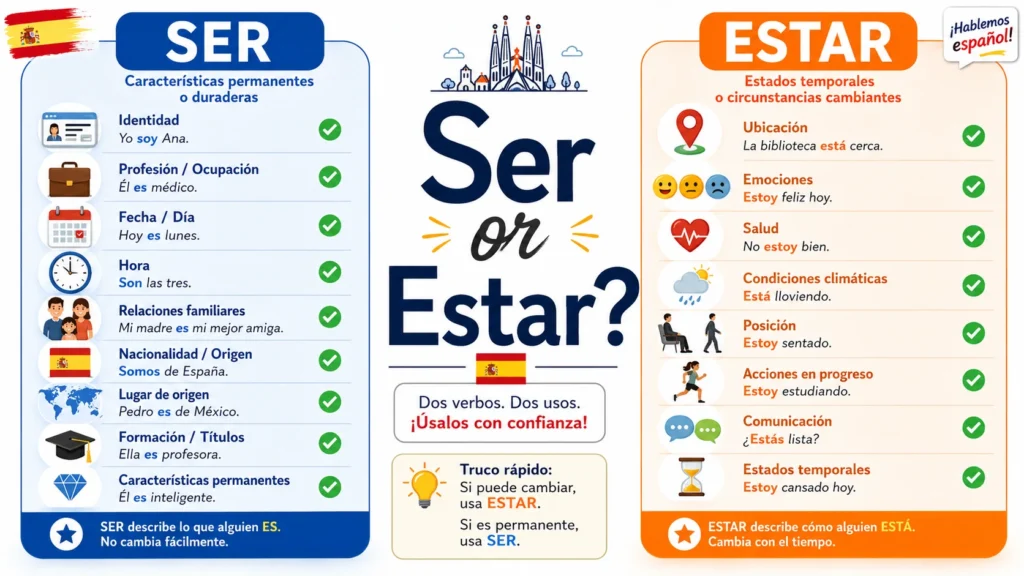
Ser and estar both mean “to be” in Spanish, but they are used in different situations. Ser describes permanent traits, identity, origin, and time, while estar describes temporary conditions, locations, emotions, and states. Learning the difference between ser or estar is one of the most important steps toward speaking Spanish correctly.
Ser or estar? It is one of the first big challenges for Spanish learners. Both verbs mean “to be,” but they describe different kinds of situations. That is where things get interesting.
If you say soy feliz, you are describing happiness as part of your identity or characteristic. If you say estoy feliz, you are describing how you feel right now. One small verb can change the meaning.
For English speakers, this can feel confusing because English uses only “to be.” Spanish makes a distinction that English does not. Learning that distinction takes practice, but it does not have to be difficult.
In this guide, you will learn when to use ser or estar, understand their key differences, explore clear examples, discover common mistakes, and practice with useful exercises. By the end, choosing between ser and estar will feel much more natural.
Quick Answer: Ser or Estar
Here is the simplest explanation:
| Use | Ser | Estar |
|---|---|---|
| Identity | ✓ | ✗ |
| Profession | ✓ | ✗ |
| Nationality | ✓ | ✗ |
| Origin | ✓ | ✗ |
| Time and Date | ✓ | ✗ |
| Permanent Characteristics | ✓ | ✗ |
| Location | ✗ | ✓ |
| Emotions | ✗ | ✓ |
| Temporary Conditions | ✗ | ✓ |
| Physical States | ✗ | ✓ |
Simple Rule
Use ser for things that define a person or object.
Use estar for conditions, locations, emotions, and temporary states.
Examples:
- Soy estudiante.
(I am a student.) - Estoy cansado.
(I am tired.) - Ella es mexicana.
(She is Mexican.) - Ella está feliz.
(She is happy.)
What Does Ser Mean?
Ser is used to describe essential characteristics.
These are qualities that help identify a person, place, or thing.
Ser Conjugation
| Subject | Ser |
|---|---|
| Yo | Soy |
| Tú | Eres |
| Él/Ella | Es |
| Nosotros | Somos |
| Vosotros | Sois |
| Ellos | Son |
When to Use Ser
Many students remember the acronym DOCTOR.
| Letter | Meaning |
|---|---|
| D | Description |
| O | Occupation |
| C | Characteristic |
| T | Time |
| O | Origin |
| R | Relationship |
Let’s look at each one.
Description
Used for physical and personality traits.
Examples:
- El coche es rojo.
- Mi hermano es alto.
- Ana es inteligente.
Occupation
Used for jobs and professions.
Examples:
- Soy médico.
- Ella es profesora.
- Mi padre es ingeniero.
Characteristics
Used for qualities that define something.
Examples:
- El agua es transparente.
- El oro es valioso.
- La nieve es blanca.
Time and Date
Examples:
- Son las tres.
- Hoy es lunes.
- Es enero.
Origin
Examples:
- Soy de España.
- Ella es de México.
- Somos de Argentina.
Relationships
Examples:
- Él es mi amigo.
- Marta es mi hermana.
- Juan es mi esposo.
What Does Estar Mean?
Estar is used for states, conditions, emotions, and locations.
Estar Conjugation
| Subject | Estar |
|---|---|
| Yo | Estoy |
| Tú | Estás |
| Él/Ella | Está |
| Nosotros | Estamos |
| Vosotros | Estáis |
| Ellos | Están |
When to Use Estar
Many learners remember the acronym PLACE.
| Letter | Meaning |
|---|---|
| P | Position |
| L | Location |
| A | Action |
| C | Condition |
| E | Emotion |
Position
Examples:
- Estoy sentado.
- Está acostada.
- Estamos de pie.
Location
Examples:
- Madrid está en España.
- El libro está en la mesa.
- Los niños están en el parque.
Action
Used with present participles.
Examples:
- Estoy estudiando.
- Está comiendo.
- Estamos trabajando.
Condition
Examples:
- Estoy enfermo.
- Está cansada.
- El café está caliente.
Emotion
Examples:
- Estoy feliz.
- Está triste.
- Estamos emocionados.
The Core Difference Between Ser or Estar
The easiest way to understand ser or estar is to think about permanence versus condition.
| Ser | Estar |
|---|---|
| What something is | How something is |
| Identity | Condition |
| Permanent traits | Temporary states |
| Essential qualities | Current situations |
Examples:
Ser
- La manzana es verde.
(The apple is green by nature.)
Estar
- La manzana está verde.
(The apple is unripe.)
Notice how the meaning changes.
The same adjective can create a completely different message depending on whether you use ser or estar.
Ser vs Estar Comparison Table
| Situation | Correct Verb | Example |
|---|---|---|
| Name | Ser | Soy Carlos |
| Nationality | Ser | Soy colombiano |
| Profession | Ser | Soy abogado |
| Date | Ser | Hoy es martes |
| Time | Ser | Son las ocho |
| Location | Estar | Estoy en casa |
| Mood | Estar | Estoy contento |
| Health | Estar | Estoy enfermo |
| Ongoing Action | Estar | Estoy leyendo |
| Physical State | Estar | Está cansado |
Advantages and Disadvantages of Learning Ser and Estar Separately
Advantages
Better Communication
You can express yourself more accurately.
Fewer Grammar Mistakes
Understanding the difference prevents common errors.
Improved Fluency
Native speakers naturally use the correct verb.
Better Listening Skills
You can understand subtle meaning differences.
Disadvantages
Initial Confusion
Beginners often struggle because English has only one equivalent verb.
Requires Memorization
Some expressions must be learned individually.
Meaning Changes
The same adjective can mean different things depending on the verb.
Despite these challenges, mastery comes with practice.
Real World Examples of Ser or Estar
Talking About Yourself
Identity:
- Soy estudiante.
- Soy canadiense.
Condition:
- Estoy cansado.
- Estoy feliz.
At Work
Profession:
- Soy diseñador gráfico.
Current State:
- Estoy ocupado.
Traveling
Origin:
- Somos de Chile.
Location:
- Estamos en Barcelona.
Talking About Food
Permanent Characteristic:
- El queso es salado.
Current Condition:
- El queso está frío.
Adjectives That Change Meaning with Ser and Estar
This is one of the most interesting parts of Spanish grammar.
| Adjective | With Ser | With Estar |
|---|---|---|
| Aburrido | Boring | Bored |
| Rico | Rich | Delicious |
| Verde | Green | Unripe |
| Listo | Clever | Ready |
| Malo | Bad | Sick |
| Seguro | Safe | Certain |
Aburrido
- Es aburrido.
(He is boring.) - Está aburrido.
(He is bored.)
Listo
- Es listo.
(He is clever.) - Está listo.
(He is ready.)
Rico
- Es rico.
(He is rich.) - Está rico.
(It tastes delicious.)
Regional and Global Usage
Spanish speakers around the world use ser and estar according to the same core grammar rules.
However, there are small differences in expression.
Spain
Spanish speakers in Spain often use more formal constructions and the vosotros form.
Example:
- Vosotros sois estudiantes.
Latin America
Most countries use ustedes instead of vosotros.
Example:
- Ustedes son estudiantes.
Shared Grammar
Whether you are in:
- Spain
- Mexico
- Argentina
- Colombia
The distinction between ser and estar remains largely the same.
Common Mistakes When Using Ser or Estar
Using Estar for Occupations
Incorrect:
- Estoy profesor.
Correct:
- Soy profesor.
Using Ser for Feelings
Incorrect:
- Soy feliz hoy.
Correct:
- Estoy feliz hoy.
Using Ser for Locations
Incorrect:
- La biblioteca es aquí.
Correct:
- La biblioteca está aquí.
Forgetting Meaning Changes
Incorrect understanding:
- Está aburrido = He is boring.
- Está aburrido = He is bored.
Translating Directly from English
English often causes mistakes because it only uses one verb.
Always think about the Spanish meaning rather than translating word for word.
Memory Tricks for Ser or Estar
Remember DOCTOR for Ser
- Description
- Occupation
- Characteristic
- Time
- Origin
- Relationship
Remember PLACE for Estar
- Position
- Location
- Action
- Condition
- Emotion
These two acronyms help many learners remember the rules quickly.
Related Concepts and Comparisons
Ser vs Estar vs English “To Be”
| English | Spanish Option |
|---|---|
| I am a teacher | Soy profesor |
| I am tired | Estoy cansado |
| She is Mexican | Es mexicana |
| She is happy | Está feliz |
English combines both meanings into one verb.
Spanish separates them into two verbs.
Ser vs Tener
Sometimes English says “to be,” but Spanish uses tener.
Examples:
English:
- I am hungry.
Spanish:
- Tengo hambre.
English:
- I am thirsty.
Spanish:
- Tengo sed.
This is another important concept for Spanish learners.
Ser vs Estar in the Past
Ser
- Era estudiante.
- Fue profesor.
Estar
- Estaba cansado.
- Estuvo enfermo.
The distinction remains similar even in past tenses.
Exercises with Answers
Exercise 1
Choose ser or estar.
- Yo ___ médico.
- Ella ___ cansada.
- Nosotros ___ en casa.
- Tú ___ inteligente.
- Ellos ___ felices.
Answers
- Soy
- Está
- Estamos
- Eres
- Están
Exercise 2
Fill in the blank.
- Madrid ___ en España.
- Mi hermano ___ ingeniero.
- Hoy ___ viernes.
- Yo ___ triste.
- El libro ___ sobre la mesa.
Answers
- Está
- Es
- Es
- Estoy
- Está
Exercise 3
Identify the Correct Sentence
A. Estoy estudiante.
B. Soy estudiante.
Answer: B
A. Está aburrido.
B. Es aburrido.
Answer:
Both are correct but have different meanings.
- Está aburrido = He is bored.
- Es aburrido = He is boring.
Exercise 4
Translate into Spanish
- I am happy.
- She is a doctor.
- We are in the park.
- They are tired.
Answers
- Estoy feliz.
- Ella es doctora.
- Estamos en el parque.
- Están cansados.
Advanced Tips for Mastering Ser or Estar
Learn Common Expressions
Some phrases always use one verb.
Examples:
Ser:
- Es importante.
- Es verdad.
- Es posible.
Estar:
- Está bien.
- Está mal.
- Está claro.
Practice with Native Content
Read articles, watch videos, and listen to conversations.
Pay attention to when speakers choose ser or estar.
Focus on Meaning
Ask yourself:
“Am I describing what something is?”
Use ser.
“Am I describing its condition, location, or state?”
Use estar.
FAQs
What is the difference between ser or estar?
Ser describes identity, origin, profession, and permanent traits. Estar describes temporary conditions, emotions, actions, and locations.
When should I use ser in Spanish?
Use ser for identity, characteristics, occupation, relationships, time, and origin.
When should I use estar in Spanish?
Use estar for locations, emotions, health conditions, temporary states, and ongoing actions.
Is ser always permanent and estar always temporary?
Not always. The rule helps beginners, but some meanings depend on context rather than permanence.
Why does Spanish have ser and estar?
Spanish developed two separate verbs to express different types of existence and states more precisely than English.
Can the same adjective use both ser and estar?
Yes. Many adjectives change meaning depending on which verb is used.
How do native speakers learn ser or estar?
Native speakers acquire the distinction naturally through exposure and practice from childhood.
What is the easiest way to remember ser or estar?
Use the memory aids DOCTOR for ser and PLACE for estar.
Is location always expressed with estar?
Almost always. Physical locations of people, places, and objects generally use estar.
How can I master ser or estar quickly?
Practice daily, learn common phrases, complete exercises, and focus on the meaning behind each verb rather than translating directly from English.
Conclusion
Understanding ser or estar is one of the biggest milestones in learning Spanish. Although both verbs translate as “to be,” they serve different purposes. Ser is used for identity, origin, profession, characteristics, relationships, and time. Estar is used for locations, emotions, temporary conditions, physical states, and ongoing actions.
The distinction may seem difficult at first, especially for English speakers who only use one verb. However, once you learn the core principles and practice regularly, choosing between ser and estar becomes much more natural.
Remember the helpful acronyms DOCTOR for ser and PLACE for estar. Pay attention to how native speakers use these verbs in conversation, books, and media. Complete exercises frequently and focus on the meaning you want to express.
With consistent practice, you will not only avoid common mistakes but also communicate more clearly and confidently in Spanish. Mastering ser or estar is a key step toward achieving fluency and understanding the deeper structure of the Spanish language.
Discover more Articles:
- Mustang vs Camaro: Key Differences Explained Clearly For 2026
- Memrise vs Duolingo Comparison Guide 2026: Which Language App Is Better for You?

Justin Powell is a writer at GramBrix.com who focuses on grammar, clarity and effective communication, helping readers strengthen their language skills.