
Last Updated on August 4, 2026
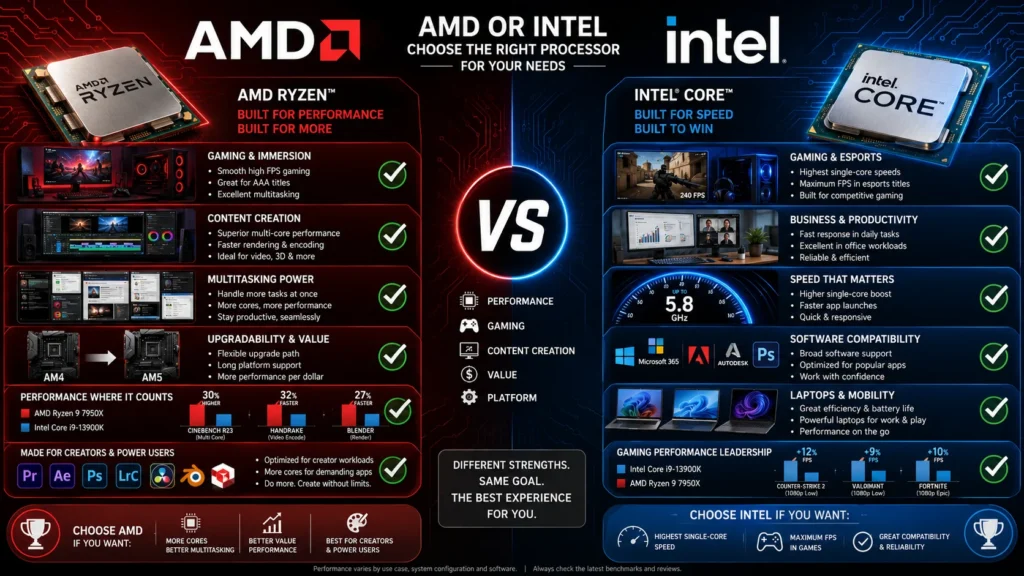
AMD or Intel is one of the most common questions when buying a computer or upgrading a processor. AMD often offers better value and multi core performance, while Intel is known for strong single core speed, gaming performance, and broad software compatibility. The best choice depends on your budget, workload, and future upgrade plans.
When buying a new computer, one question appears again and again: AMD or Intel?
The processor, also called the CPU, is the brain of your computer. It controls tasks, runs programs, and affects how fast your system feels. Whether you play games, edit videos, create content, or simply browse the web, your CPU plays a major role.
For many years, Intel dominated the processor market. Then AMD introduced powerful Ryzen processors that challenged Intel in gaming, productivity, and pricing. Today, both companies offer excellent CPUs, making the decision harder than ever.
Many buyers feel confused because benchmark numbers, clock speeds, cores, threads, and technical specifications can seem overwhelming. A processor that is perfect for gaming may not be the best choice for video editing. Likewise, a budget CPU may outperform a more expensive model in specific situations.
This guide explains everything you need to know about AMD or Intel in simple language. By the end, you will understand the differences, strengths, weaknesses, and ideal use cases for each platform.
Quick Answer: AMD or Intel?
If you want the short answer:
| Use Case | Recommended Choice |
|---|---|
| Budget Gaming | AMD |
| High End Gaming | AMD or Intel |
| Video Editing | AMD |
| Streaming | AMD |
| Office Work | Intel or AMD |
| Multitasking | AMD |
| Power Efficiency | Depends on Generation |
| Upgrade Flexibility | AMD |
| Single Core Performance | Intel often excels |
| Best Value | AMD frequently leads |
The reality is that modern AMD and Intel processors are both excellent. Your specific needs matter more than the brand name.
Understanding CPUs Before Comparing AMD or Intel
Before comparing AMD and Intel, it helps to understand a few important terms.
What Is a CPU?
A CPU (Central Processing Unit) is the primary processing component of a computer.
Think of the CPU as the manager of a busy office. It receives instructions, processes information, and tells other components what to do.
What Are Cores?
A core is an individual processing unit inside a CPU.
More cores allow the processor to handle multiple tasks at once.
Examples:
- 4 Core CPU
- 6 Core CPU
- 8 Core CPU
- 12 Core CPU
- 16 Core CPU
What Are Threads?
Threads allow a CPU core to handle multiple instruction streams.
More threads usually improve multitasking and productivity workloads.
What Is Clock Speed?
Clock speed measures how quickly a CPU performs operations.
Higher clock speeds generally improve responsiveness and gaming performance.
What Is AMD?
Advanced Micro Devices, commonly called AMD, is a semiconductor company that designs processors and graphics cards.
Its popular CPU families include:
- Ryzen 3
- Ryzen 5
- Ryzen 7
- Ryzen 9
- Threadripper
AMD gained major popularity with the Ryzen lineup due to strong performance and competitive pricing.
AMD Philosophy
AMD often focuses on:
- High core counts
- Excellent multitasking
- Competitive prices
- Long platform support
- Strong productivity performance
What Is Intel?
Intel is one of the world’s largest processor manufacturers.
Its major CPU families include:
- Core i3
- Core i5
- Core i7
- Core i9
- Xeon
Intel processors power millions of laptops, desktops, and servers worldwide.
Intel Philosophy
Intel often emphasizes:
- High clock speeds
- Strong gaming performance
- Broad compatibility
- Advanced optimization
- Reliable single core performance
AMD or Intel Performance Comparison
Performance is usually the biggest factor when choosing a CPU.
Single Core Performance
Single core performance affects:
- Gaming
- Older software
- Everyday responsiveness
- Light workloads
Historically, Intel led this category.
Today, both AMD Ryzen and Intel Core processors deliver excellent single core speeds, with leadership changing depending on the processor generation.
Multi Core Performance
Multi core performance affects:
- Video editing
- 3D rendering
- Programming
- Streaming
- Virtual machines
AMD became famous for offering more cores at competitive prices.
As a result, many content creators prefer AMD systems.
General Performance Table
| Task | AMD | Intel |
|---|---|---|
| Web Browsing | Excellent | Excellent |
| Gaming | Excellent | Excellent |
| Streaming | Excellent | Very Good |
| Video Editing | Excellent | Very Good |
| Rendering | Excellent | Good |
| Programming | Excellent | Excellent |
| Office Work | Excellent | Excellent |
AMD or Intel for Gaming
Gaming is one of the most popular reasons people compare AMD and Intel.
Why Gaming Performance Matters
A gaming CPU influences:
- Frame rates
- Stability
- Loading times
- Background multitasking
AMD Gaming Strengths
AMD offers:
- Large cache technologies
- Strong value
- Excellent gaming CPUs
- Good power efficiency
Many gamers choose Ryzen processors because they provide outstanding performance per dollar.
Intel Gaming Strengths
Intel offers:
- High clock speeds
- Strong single thread performance
- Excellent game optimization
Many esports players prefer Intel because of its historically strong frame rates.
Best Gaming Verdict
For gaming:
- Budget builds often favor AMD.
- Premium builds can use either AMD or Intel successfully.
- Differences are usually small when paired with a powerful graphics card.
AMD or Intel for Productivity
Productivity workloads include:
- Video editing
- Graphic design
- CAD software
- Software development
- Streaming
AMD Advantages
AMD often provides:
- More cores
- More threads
- Better rendering performance
- Faster export times
Intel Advantages
Intel provides:
- Strong optimization
- Excellent responsiveness
- Reliable software support
Productivity Winner
For heavily threaded workloads, AMD frequently provides better value.
AMD or Intel for Students
Students typically need:
- Web browsing
- Research
- Office applications
- Online classes
Both brands work well.
A mid range AMD Ryzen 5 or Intel Core i5 processor is usually enough for most students.
Recommended Student CPUs
| Budget | AMD | Intel |
|---|---|---|
| Entry Level | Ryzen 3 | Core i3 |
| Mid Range | Ryzen 5 | Core i5 |
| Premium | Ryzen 7 | Core i7 |
AMD or Intel for Video Editing
Video editing software benefits from multiple cores.
Programs include:
- Adobe Premiere Pro
- DaVinci Resolve
- Final Cut alternatives
- After Effects
Why AMD Often Wins
AMD CPUs frequently include:
- More cores
- More threads
- Better rendering value
This helps reduce export times.
When Intel Is Better
Intel can perform exceptionally well in applications optimized for Intel technologies.
The gap often depends on specific software versions and processor generations.
AMD or Intel for Streaming
Streaming requires your system to:
- Run games
- Encode video
- Manage chat
- Handle background applications
AMD’s higher core counts often make multitasking easier.
A Ryzen 7 or Ryzen 9 processor is particularly popular among streamers.
AMD or Intel Laptop Processors
Laptop CPUs differ from desktop CPUs.
Important factors include:
- Battery life
- Heat output
- Performance per watt
AMD Laptop Advantages
- Excellent efficiency
- Strong integrated graphics
- Competitive battery life
Intel Laptop Advantages
- Wide laptop availability
- Strong software optimization
- Excellent business laptop support
Laptop Verdict
Choose the laptop based on the overall package rather than only the CPU brand.
The manufacturer, cooling system, battery, and display matter just as much.
AMD or Intel Integrated Graphics
Integrated graphics allow a computer to display images without a dedicated graphics card.
AMD Integrated Graphics
AMD APUs often include strong integrated graphics.
Benefits:
- Better casual gaming
- Reduced hardware costs
- Good multimedia performance
Intel Integrated Graphics
Intel integrated graphics have improved significantly.
Benefits:
- Everyday productivity
- Video playback
- Business applications
For gaming without a dedicated GPU, AMD often provides stronger integrated graphics performance.
AMD or Intel Power Efficiency
Power efficiency affects:
- Electricity usage
- Heat generation
- Battery life
- Cooling requirements
AMD Efficiency
Recent AMD architectures have delivered impressive efficiency.
Benefits include:
- Lower temperatures
- Reduced power consumption
- Quieter systems
Intel Efficiency
Intel has improved dramatically with newer processor designs.
Many modern Intel CPUs balance performance and efficiency very effectively.
AMD or Intel Motherboard Compatibility
The motherboard determines what CPU you can install.
AMD Upgrade Path
AMD is often praised for longer socket support.
Advantages:
- Easier upgrades
- Lower upgrade costs
- Better long term value
Intel Upgrade Path
Intel sometimes changes sockets more frequently.
This may require a new motherboard during major upgrades.
Example
A homeowner upgrading a kitchen may only replace appliances.
Similarly, AMD users often upgrade only the CPU while keeping the same motherboard.
AMD or Intel Pricing
Price is one of the biggest deciding factors.
AMD Pricing Strategy
AMD often competes aggressively by offering:
- More cores
- Lower prices
- Better bundled value
Intel Pricing Strategy
Intel frequently competes through:
- Premium features
- Strong gaming reputation
- Broad availability
Value Comparison
| Category | AMD | Intel |
|---|---|---|
| Budget | Excellent | Good |
| Mid Range | Excellent | Very Good |
| High End | Excellent | Excellent |
| Workstations | Excellent | Good |
Advantages of AMD
AMD offers many benefits.
Pros of AMD
- Excellent price to performance ratio
- Strong multi core performance
- Good upgrade flexibility
- Competitive gaming performance
- Powerful integrated graphics options
- Efficient modern architectures
Cons of AMD
- Some software may favor Intel
- High demand can affect availability
- Performance varies by generation
Advantages of Intel
Intel remains an excellent choice.
Pros of Intel
- Strong single core speed
- Excellent gaming performance
- Wide software compatibility
- Strong laptop ecosystem
- Extensive market presence
Cons of Intel
- Sometimes higher prices
- Potentially shorter motherboard support
- Can consume more power in some models
Real World Examples
Example 1: Casual User
Sarah uses:
- Web browser
- Microsoft Office
- Video calls
Either AMD or Intel works perfectly.
Example 2: Gamer
James plays:
- Fortnite
- Call of Duty
- Valorant
A Ryzen 7 or Core i7 provides excellent performance.
Example 3: Video Editor
Maria edits 4K videos daily.
AMD’s higher core counts may provide faster rendering.
Example 4: Software Developer
Ahmed runs virtual machines and development tools.
Both AMD and Intel perform well, but AMD’s extra cores can improve multitasking.
Regional and Global Usage
The AMD versus Intel debate exists worldwide.
North America
Both brands have strong market share.
Europe
AMD has gained popularity due to value and efficiency.
Asia
Both companies compete aggressively in gaming and business markets.
Global Trend
Modern buyers focus less on brand loyalty and more on:
- Performance
- Budget
- Availability
- Upgrade options
Common Mistakes When Choosing AMD or Intel
Buying Based Only on Brand
A modern Ryzen 5 may outperform an older Core i7.
Always compare actual models.
Ignoring the GPU
Gaming performance depends heavily on the graphics card.
Overbuying
Many users purchase CPUs far more powerful than they need.
Ignoring Motherboard Costs
The motherboard affects total platform cost.
Focusing Only on Clock Speed
Clock speed is important but not the whole story.
Architecture matters too.
Related Concepts and Comparisons
AMD or Intel vs Apple Silicon
Apple Silicon processors focus on efficiency and ecosystem integration.
AMD and Intel offer broader upgrade options and Windows compatibility.
Ryzen 5 vs Core i5
These are the most commonly compared processor categories.
Both are excellent for:
- Gaming
- Productivity
- Students
- Everyday users
Ryzen 7 vs Core i7
These CPUs target enthusiasts who need additional performance.
CPU vs GPU
CPU:
- General processing
GPU:
- Graphics and parallel computing
Both are important for gaming and content creation.
AMD or Intel Comparison Table
| Feature | AMD | Intel |
|---|---|---|
| Gaming | Excellent | Excellent |
| Productivity | Excellent | Very Good |
| Multi Core Workloads | Excellent | Good |
| Single Core Workloads | Very Good | Excellent |
| Upgrade Path | Excellent | Good |
| Integrated Graphics | Strong APUs | Improving |
| Efficiency | Excellent | Very Good |
| Value | Excellent | Good |
| Availability | Good | Excellent |
| Business Systems | Good | Excellent |
Exercises With Answers
Exercise 1
Which processor characteristic helps multitasking most?
A. RGB Lighting
B. Core Count
C. Case Size
D. Keyboard Type
Answer: B. Core Count
Exercise 2
Which workload benefits most from multiple CPU cores?
A. Video Rendering
B. Mouse Movement
C. Wallpaper Selection
D. File Naming
Answer: A. Video Rendering
Exercise 3
True or False:
AMD processors are always better than Intel processors.
Answer: False
Performance depends on the specific CPU model and workload.
Exercise 4
True or False:
Intel processors can be excellent gaming CPUs.
Answer: True
Many Intel processors deliver outstanding gaming performance.
Exercise 5
Which factor should be considered besides the CPU?
A. GPU
B. RAM
C. Storage
D. All of the Above
Answer: D. All of the Above
FAQs
AMD or Intel for gaming?
Both are excellent. AMD often provides outstanding value, while Intel frequently offers strong gaming performance and high clock speeds.
Which is better, AMD or Intel for video editing?
AMD is often preferred because many Ryzen processors include more cores and threads for rendering workloads.
AMD or Intel for programming?
Both platforms work very well. Developers who run virtual machines may appreciate AMD’s higher core counts.
Is AMD cheaper than Intel?
AMD often provides better value, though pricing changes frequently based on model and market conditions.
Do AMD processors run hotter than Intel?
Not necessarily. Heat output depends on the specific processor generation, cooling solution, and workload.
Which lasts longer, AMD or Intel?
Both can last many years when properly cooled and maintained.
AMD or Intel for laptops?
Choose the laptop as a whole package. Battery life, display quality, cooling, and build quality are equally important.
Which brand is better for students?
A Ryzen 5 or Core i5 processor is usually ideal for most students.
Can I upgrade from Intel to AMD without changing the motherboard?
No. AMD and Intel processors use different motherboard platforms.
AMD or Intel for streaming and gaming together?
AMD is often favored because additional cores can help manage gaming and streaming simultaneously.
Should I buy AMD or Intel in 2026?
Compare current processor generations, prices, and benchmarks. The best choice depends on your specific needs and budget.
Conclusion
The debate over AMD or Intel is no longer about one company being universally better than the other. Both manufacturers produce powerful, efficient, and reliable processors capable of handling gaming, productivity, content creation, business tasks, and everyday computing.
AMD has built a strong reputation for excellent value, higher core counts, impressive multitasking capabilities, and long platform support. These strengths make Ryzen processors especially attractive for creators, streamers, and users seeking maximum performance per dollar.
Intel remains a top competitor with exceptional single core performance, strong gaming results, broad software compatibility, and a mature ecosystem. Many professionals and gamers continue to rely on Intel systems because of their consistent performance and availability.
The smartest approach is to compare specific CPU models rather than focusing only on the brand. Consider your budget, gaming goals, productivity needs, motherboard costs, upgrade plans, power consumption, and overall system requirements.
For most buyers, the best processor is the one that delivers the right balance of performance, value, and future flexibility for their unique workload.

Kevin Brooks is a grammar specialist at GramBrix.com, dedicated to helping readers understand language rules with clarity and confidence. He simplifies complex grammar concepts through practical examples and easy explanations.