Last Updated on June 18, 2026
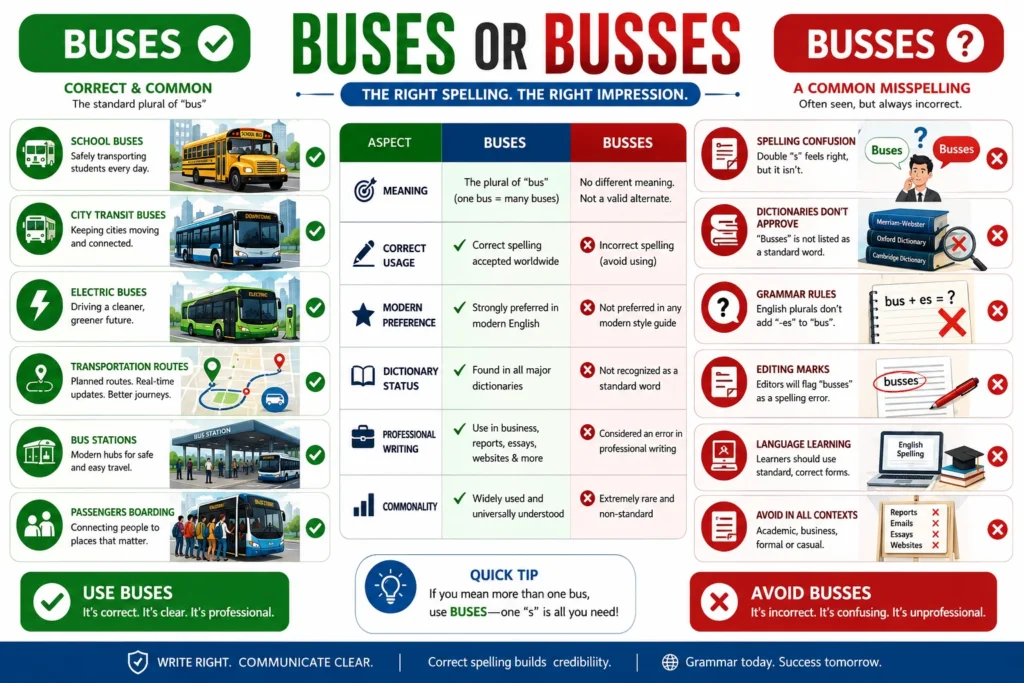
Buses is the standard and most widely accepted plural form of bus in modern English. Busses is also technically correct in some dictionaries, but it is far less common and can create confusion because busses is also a verb meaning “kisses.” For most writing situations, buses is the preferred choice.
Many English words create confusion when they change from singular to plural. One common example is buses or busses. If you have ever written about public transportation, school vehicles, tour coaches, or city transit systems, you may have wondered which spelling is correct.
The confusion happens because English has many rules for forming plurals. Some words ending in s add es, while others seem to double letters before adding a suffix. As a result, both buses and busses appear in dictionaries, books, and online articles.
However, one spelling is much more common than the other. Knowing the difference can help you write clearly and professionally. Whether you are a student, teacher, blogger, business writer, or English learner, understanding the correct usage will improve your communication.
This guide explains the meaning, history, grammar, examples, regional preferences, common mistakes, and practical exercises related to buses or busses. By the end, you will know exactly when to use each form.
Quick Answer
| Word | Meaning | Commonness |
|---|---|---|
| Buses | Plural of bus | Very common and preferred |
| Busses | Alternative plural of bus; also a verb form of “buss” | Less common |
Short Answer
If you are talking about more than one bus, use buses.
Examples:
✔ Three buses arrived at the station.
✔ School buses are parked outside.
✔ City buses run every fifteen minutes.
Although busses can be used as a plural in some dictionaries, modern style guides strongly favor buses.
Understanding the Word Bus
A bus is a large road vehicle designed to carry many passengers.
Examples include:
- School buses
- City buses
- Tourist buses
- Airport shuttle buses
- Electric buses
The singular form is:
- One bus
The plural form is:
- Two buses
This follows a common English rule where nouns ending in s often add es to create the plural.
Examples:
| Singular | Plural |
|---|---|
| Bus | Buses |
| Class | Classes |
| Glass | Glasses |
| Kiss | Kisses |
| Box | Boxes |
Because bus ends with s, adding es creates the standard plural buses.
Why Do People Write Busses?
The spelling busses appears because English sometimes doubles a final consonant before adding a suffix.
Examples include:
| Base Word | Changed Form |
|---|---|
| Stop | Stopped |
| Plan | Planned |
| Run | Running |
Some writers mistakenly apply this pattern to bus and write busses.
Historically, dictionaries accepted busses as a plural spelling. Over time, however, buses became the dominant form in newspapers, books, educational materials, and professional writing.
Today, most readers expect to see buses.
Definition and Explanation of Buses
Meaning
Buses means more than one bus.
Examples
- The buses arrived late because of traffic.
- New electric buses reduce pollution.
- School buses transport students safely.
- The city added more buses to improve service.
In modern English, this is the standard spelling used worldwide.
Definition and Explanation of Busses
As a Plural Noun
Historically, busses could mean multiple buses.
Example:
- Several busses waited outside.
This usage still appears occasionally but is uncommon.
As a Verb
The word buss means a kiss.
Examples:
- He busses his grandmother on the cheek.
- She bussed the child goodnight.
Because of this second meaning, using busses as a plural noun can sometimes confuse readers.
Historical Development of Buses and Busses
Language changes over time.
When the word bus first became popular, both plural forms appeared in print:
- buses
- busses
As dictionaries evolved and style guides became more standardized, buses gradually became preferred.
Modern publishing, journalism, education, and business writing overwhelmingly use buses.
The shift happened because:
- The spelling is simpler.
- It matches common plural rules.
- It avoids confusion with the verb buss.
Today, buses is considered the standard form.
Buses vs Busses Comparison Table
| Feature | Buses | Busses |
|---|---|---|
| Standard modern plural | Yes | Rare |
| Found in dictionaries | Yes | Yes |
| Preferred in schools | Yes | No |
| Preferred in journalism | Yes | No |
| Preferred in business writing | Yes | No |
| Can cause confusion | No | Sometimes |
| Common in modern English | Very common | Uncommon |
Winner
For almost every situation, choose buses.
Advantages and Disadvantages
Advantages of Using Buses
Clear Communication
Readers instantly recognize the word.
Widely Accepted
Used in schools, universities, and professional publications.
Matches Modern Standards
Most grammar guides recommend it.
Avoids Confusion
Readers will not confuse it with the verb form of buss.
Disadvantages of Using Buses
There are very few disadvantages.
The only issue is that older texts may use busses, which can surprise modern readers.
Advantages of Using Busses
Historically Recognized
Some dictionaries still list it as acceptable.
Found in Older Literature
You may encounter it in historical texts.
Disadvantages of Using Busses
Less Common
Many readers view it as unusual.
Potential Ambiguity
It may be confused with the verb related to kissing.
Not Preferred by Style Guides
Most editors will change it to buses.
Real World Examples
Public Transportation
Correct:
- City buses operate twenty four hours a day.
Incorrect or less preferred:
- City busses operate twenty four hours a day.
School Transportation
Correct:
- The school district purchased ten new buses.
Less preferred:
- The school district purchased ten new busses.
Tourism
Correct:
- Tour buses carried visitors across the city.
Less preferred:
- Tour busses carried visitors across the city.
News Reporting
Journalists almost always write:
- Hundreds of buses were delayed by snow.
This reflects current editorial standards.
Regional and Global Usage
United States
American English strongly prefers buses.
You will see it in:
- Newspapers
- Government reports
- School materials
- Transit websites
United Kingdom
British English also favors buses.
Examples include:
- London buses
- School buses
- Tourist buses
Canada
Canadian English overwhelmingly uses buses.
Australia
Australian publications generally use buses.
International English
Across most English-speaking regions, buses is the dominant spelling.
Grammar Rule Behind Buses
The simplest rule is:
Nouns Ending in S Usually Add ES
Examples:
| Singular | Plural |
|---|---|
| Bus | Buses |
| Class | Classes |
| Kiss | Kisses |
| Dress | Dresses |
| Glass | Glasses |
This rule explains why buses feels natural to most English speakers.
Common Mistakes
Mistake 1: Using Busses in Formal Writing
Less preferred:
- The city purchased new busses.
Better:
- The city purchased new buses.
Mistake 2: Confusing the Verb Buss
Incorrect understanding:
- He busses his mother goodbye.
This sentence uses busses as a verb, not as a plural noun.
Mistake 3: Assuming Double S Is Always Needed
English spelling rules vary.
Not every word requires consonant doubling.
Correct:
- Bus → Buses
Not necessarily:
- Bus → Busses
Mistake 4: Mixing Forms in One Document
Incorrect:
- The buses arrived yesterday. Several busses remain in storage.
Correct:
- The buses arrived yesterday. Several buses remain in storage.
Consistency matters.
Related Grammar Concepts
Understanding similar words can help reinforce the rule.
Bus and Buses
- One bus
- Two buses
Class and Classes
- One class
- Two classes
Kiss and Kisses
- One kiss
- Two kisses
Glass and Glasses
- One glass
- Two glasses
These examples follow the same pattern.
Buses in Different Contexts
School Buses
School buses transport students between home and school.
Example:
- The district added five new school buses.
City Buses
City buses support public transportation systems.
Example:
- Electric city buses reduce emissions.
Shuttle Buses
Shuttle buses carry passengers short distances.
Example:
- Airport shuttle buses run every thirty minutes.
Tour Buses
Tour buses help travelers explore attractions.
Example:
- Tour buses visited several landmarks.
Electric Buses
Electric buses are becoming popular worldwide.
Example:
- Many cities now operate electric buses.
Memory Trick
A simple trick can help you remember the correct spelling.
Think about these words:
- class → classes
- glass → glasses
- bus → buses
The pattern is the same.
If you remember classes, remembering buses becomes easy.
Exercises With Answers
Exercise 1
Choose the correct word.
- The city purchased five new ______.
- School ______ transport students every day.
- Several ______ were delayed by traffic.
Answers
- buses
- buses
- buses
Exercise 2
Correct the sentence.
Sentence
The tour busses arrived early.
Answer
The tour buses arrived early.
Exercise 3
Choose the better option.
A. Buses
B. Busses
Sentence:
The airport added more ______ for travelers.
Answer
A. Buses
Exercise 4
Fill in the blank.
The electric ______ reduce air pollution.
Answer
buses
Exercise 5
Identify the preferred modern spelling.
- buses
- busses
Answer
buses
Advanced Usage Notes
Academic Writing
Universities generally recommend buses.
Example:
- Researchers studied the efficiency of urban buses.
Business Writing
Professional reports typically use buses.
Example:
- The company maintains a fleet of buses.
Government Documents
Government transportation departments almost always write buses.
Example:
- New buses will improve regional transit.
Technical Transportation Reports
Transportation experts consistently prefer buses.
Example:
- Electric buses lowered operating costs.
Buses or Busses in Search Engines
Search engines recognize both spellings.
However, buses is searched far more often.
This means:
- Better readability
- Better SEO alignment
- Better user expectations
Writers creating online content should generally choose buses.
Related Concepts and Comparisons
Bus vs Coach
| Bus | Coach |
|---|---|
| General passenger vehicle | Long distance passenger vehicle |
| Common in cities | Common for travel |
| Frequent stops | Fewer stops |
Bus vs Shuttle
| Bus | Shuttle |
|---|---|
| General transport | Short route service |
| Public transit | Specific destination service |
Public Transit Vocabulary
Related words include:
- transportation
- transit
- route
- passenger
- terminal
- station
- coach
- shuttle
- commuter
- fleet
Understanding these terms helps when discussing buses.
FAQs
Is buses or busses correct?
Both can appear in dictionaries, but buses is the preferred and standard modern plural form.
Why is buses more common than busses?
Modern English style guides, schools, and publishers overwhelmingly favor buses because it is simpler and clearer.
Can I use busses in formal writing?
It is usually better to use buses in formal, academic, and professional writing.
Is busses wrong?
Not completely. Some dictionaries recognize it, but it is uncommon and generally not preferred.
What is the plural of bus in American English?
The standard plural is buses.
What is the plural of bus in British English?
British English also uses buses as the standard plural form.
Why do dictionaries list busses?
Older usage accepted busses as a plural spelling, so some dictionaries continue to include it.
Does busses have another meaning?
Yes. Busses can be the verb form of buss, meaning to kiss.
Should students write buses or busses?
Students should normally write buses because it matches modern educational standards.
Which spelling is best for SEO and online content?
Buses is generally the best choice because it is far more common in searches and online reading.
Conclusion
The debate over buses or busses is much simpler than it first appears. While both spellings have existed in English, buses has become the clear standard in modern usage. It is the preferred form in schools, universities, newspapers, government documents, business reports, and online content.
The main reason for choosing buses is clarity. Readers recognize it immediately, and it avoids confusion with busses, which can also function as a verb related to kissing. Although dictionaries may still list busses as an alternative spelling, it is rarely used in contemporary writing.
When in doubt, remember the pattern shared by words such as classes, glasses, and kisses. Just as these nouns form their plurals by adding es, bus becomes buses.
For students, professionals, bloggers, and English learners, the best practice is simple: use buses in nearly every situation. Doing so ensures clear communication, follows modern grammar conventions, and matches the expectations of today’s readers.

Justin Powell is a writer at GramBrix.com who focuses on grammar, clarity and effective communication, helping readers strengthen their language skills.