
Last Updated on July 31, 2026
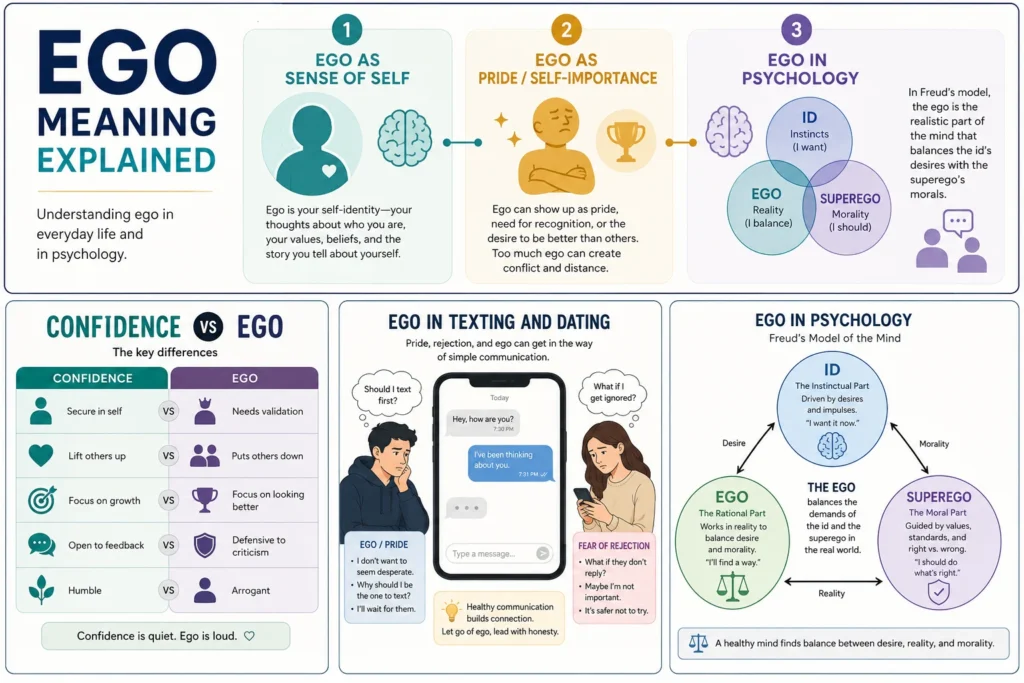
Ego usually means a person’s sense of self, self importance, or identity. In psychology, it refers to the part of the mind that helps balance impulses, reality, and morals. In everyday conversation, “ego” often describes pride, confidence, arrogance, or someone’s need to protect their self-image.
If you’ve searched for the ego meaning, you’re probably trying to understand whether the word refers to confidence, arrogance, self respect, personal identity, or the psychological concept you’ve heard about in school, books, or online discussions. The answer depends on the context. If you’re wondering what does ego mean, the term can describe anything from a healthy sense of self to an inflated view of one’s own importance, while in psychology it has a more specific technical meaning.
The ego meaning changes depending on how the word is used. In everyday conversation, people often use ego to describe someone who appears overly proud, self centered, or unwilling to admit mistakes. In contrast, the ego definition in psychology refers to the part of the mind that helps balance instinctive desires, rational thinking, and social expectations. Understanding these different meanings is essential because the same word can have positive, neutral, or negative interpretations.
Because ego appears frequently in self-improvement discussions, workplace communication, relationships, motivational content, and social media, learning to define ego accurately helps avoid common misunderstandings. Expressions such as “you have a big ego,” “leave your ego at the door,” or “check your ego” often carry meanings that extend beyond the basic dictionary definition and depend heavily on tone and context.
In this comprehensive guide, you’ll explore the complete ego meaning, its dictionary definition, psychological significance, real world usage, texting and social media interpretations, common misconceptions, related terms, practical examples, frequently asked questions, and tips for understanding and using the word correctly in everyday conversations.
Quick Answer Box
| Topic | Answer |
|---|---|
| Word | Ego |
| Basic meaning | A person’s sense of self, self-image, or self-importance |
| In psychology | The part of the mind that deals with reality and balances inner desires with rules and values |
| In everyday speech | Pride, self-confidence, self-importance, or arrogance depending on tone and context |
| Common negative use | “He has a big ego” = he thinks too highly of himself |
| Common neutral use | “Her ego was hurt” = her self-esteem or pride took a hit |
| Common positive use | “You need a healthy ego” = you need self-respect and confidence |
| Where it’s used | Daily conversation, social media, texting, relationships, sports, work, and psychology discussions |
| Example | “He couldn’t admit he was wrong because his ego got in the way.” |
| Tone | Can be neutral, negative, reflective, or analytical depending on context |
What Does Ego Mean?
At its most basic level, ego refers to a person’s sense of self—how they see themselves, how important they feel, and how strongly they protect their image, pride, or identity.
In plain English, ego meaning usually falls into one of these three buckets:
- Your sense of self or identity
This is the broadest meaning. It refers to your awareness of yourself as an individual—your thoughts, personality, and self-image. - Your pride or self-importance
In everyday speech, “ego” often refers to how much someone values their own importance, abilities, opinions, or status. - A psychology concept
In psychoanalytic psychology, the ego is the part of the mind that helps you deal with reality and manage internal conflict.
So if someone asks, “What does ego mean?” the best answer is:
Ego means a person’s sense of self. Depending on context, it can refer to self-image, pride, confidence, self-importance, or a psychological function that helps manage reality.
Full Definition of Ego
A fuller definition of ego looks like this:
Ego is the part of a person’s identity or self-concept that relates to how they view themselves, protect their self-worth, and interact with the world. In everyday use, it often refers to pride, self-importance, or confidence. In psychology, it refers to the mental function that balances desires, morals, and reality.
That definition matters because ego is not always bad. A lot of people hear the word and instantly think of arrogance, narcissism, or someone acting superior. But ego can also refer to healthy self-respect, self-awareness, or the normal human tendency to defend one’s feelings and identity.
Ego Meaning in Simple Words
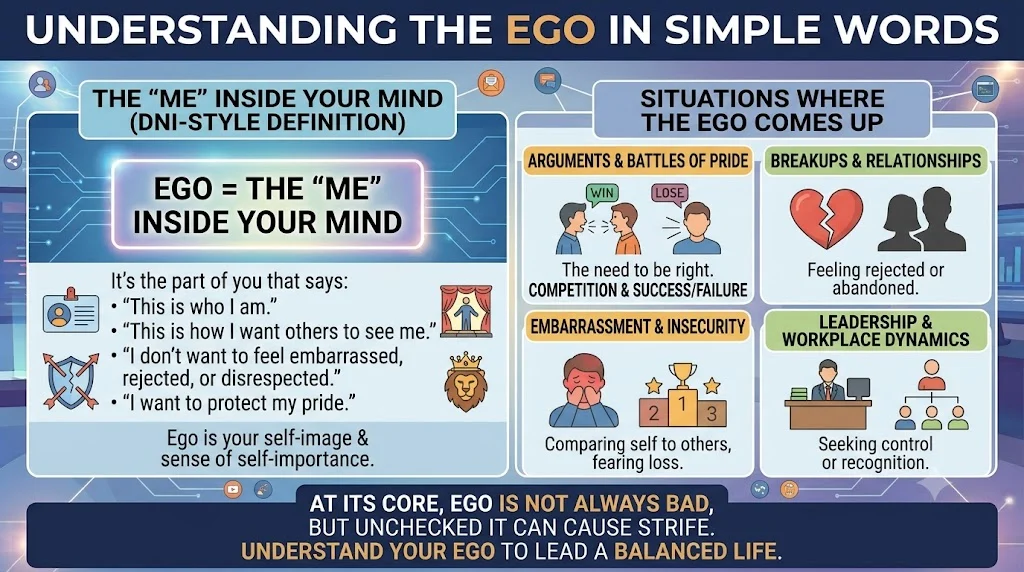
If you want the easiest explanation possible, here it is:
- Ego = the “me” inside your mind
- It’s the part of you that says:
- “This is who I am.”
- “This is how I want others to see me.”
- “I don’t want to feel embarrassed, rejected, or disrespected.”
- “I want to protect my pride.”
That’s why ego comes up in so many different situations:
- arguments
- breakups
- competition
- success and failure
- embarrassment
- insecurity
- confidence
- social media behavior
- leadership and workplace dynamics
Ego Meaning in Psychology
In psychology—especially in the ideas of Sigmund Freud—the ego has a more specific meaning.
Freud divided the mind into three parts:
- Id – instinctive desires, urges, and immediate wants
- Ego – the realistic part that makes decisions and deals with the real world
- Superego – morals, values, guilt, and ideas of right and wrong
How the Ego Works in Psychology
In this model, the ego is the middle manager. It tries to balance:
- what you want right now (id),
- what is morally right (superego),
- and what is actually possible in real life (reality).
Example of Ego in Psychology
Imagine you’re angry at your boss.
- Your id says: “Yell at them right now.”
- Your superego says: “That’s wrong and disrespectful.”
- Your ego says: “Take a breath, stay professional, and address it calmly later.”
So in psychology, the ego is not just “pride.” It’s a reality-based decision-making system that helps you function in the world.
Why This Matters
When people use the word casually, they usually do not mean Freud’s exact theory. But understanding the psychology meaning helps explain why the word can feel deeper than just “arrogance.” Ego is tied to identity, defense, emotional reactions, and how people maintain a stable sense of self.
Ego Meaning in Everyday Conversation
In everyday American English, ego is most commonly used in a social and emotional sense rather than a technical psychology sense.
Here are the most common everyday meanings:
Ego as Pride
This is one of the most common uses.
Example:
- “He didn’t apologize because his ego wouldn’t let him.”
Meaning: His pride got in the way.
Ego as Arrogance
Sometimes ego means someone thinks too highly of themselves or wants attention, praise, or control.
Example:
- “She’s talented, but her ego is out of control.”
Meaning: She may be acting arrogant, self-centered, or overly impressed with herself.
Ego as Self-Image
Ego can also refer to how someone sees themselves and how easily that image gets hurt.
Example:
- “Losing that game really bruised his ego.”
Meaning: It hurt his pride, confidence, or self-image.
Ego as Confidence or Self-Belief
Not every use is negative. Sometimes ego refers to a person’s sense of worth or confidence.
Example:
- “You need enough ego to believe you can do the job.”
Meaning: You need healthy self-belief and self-respect.
Context & Usage: How the Meaning Changes by Situation
The meaning of ego changes a lot depending on tone, speaker, and situation. That’s why context matters.
Ego in Arguments
During conflict, ego often means pride, defensiveness, or refusal to admit fault.
Examples:
- “This isn’t about the issue anymore—it’s about ego.”
- “Put your ego aside and listen.”
- “Their egos clashed.”
In this context, ego often means:
- wanting to be right
- refusing to back down
- feeling threatened by criticism
- protecting pride instead of solving the problem
Ego in Relationships
In relationships, the word often comes up when discussing emotional walls, stubbornness, insecurity, or control.
Examples:
- “His ego won’t let him text first.”
- “She took it personally because it hit her ego.”
- “Their breakup was made worse by ego.”
In relationship talk, ego may refer to:
- fear of rejection
- pride after an argument
- not wanting to look weak
- needing validation
- reacting from insecurity rather than honesty
Ego at Work
In professional settings, ego often refers to status, recognition, leadership style, or resistance to feedback.
Examples:
- “A strong ego can ruin team collaboration.”
- “He’s smart, but his ego makes him hard to work with.”
- “Leave your ego at the door.”
At work, ego may show up as:
- needing credit
- rejecting criticism
- dominating meetings
- refusing help
- competing instead of collaborating
- being more focused on image than results
Ego in Sports and Competition
In sports, ego can be both useful and harmful.
Useful:
- confidence
- mental toughness
- belief in your skills
Harmful:
- underestimating opponents
- refusing coaching
- playing selfishly
- taking losses personally
Example:
- “You need confidence to compete, but too much ego can destroy discipline.”
Ego in Personal Growth Conversations
In self-help, mindfulness, and personal development spaces, ego often means the part of you that is attached to identity, validation, comparison, and control.
Examples:
- “Your ego wants approval.”
- “The ego hates being wrong.”
- “Let go of ego.”
In these spaces, ego can refer to:
- attachment to image
- insecurity hiding behind pride
- defensiveness
- comparison with others
- fear of failure
- the need to look important
Emotional Meaning of Ego
The hidden emotional layer of ego meaning is important. When people talk about ego, they are often indirectly talking about emotional vulnerability.
Underneath “ego” you may find feelings like:
- embarrassment
- insecurity
- shame
- fear of rejection
- fear of being wrong
- fear of looking weak
- desire for respect
- desire for control
- need for approval
That’s why statements about ego often carry emotional weight.
Example
If someone says:
- “His ego is too big,”
they may mean:
- he’s arrogant,
- he can’t handle criticism,
- he needs attention,
- or he’s insecure and overcompensating.
If someone says:
- “That hurt my ego,”
they may mean:
- I felt embarrassed,
- I felt rejected,
- I felt less confident,
- or I took it personally.
So ego is often a surface word for deeper emotional experiences.
Real Life Examples of Ego Meaning
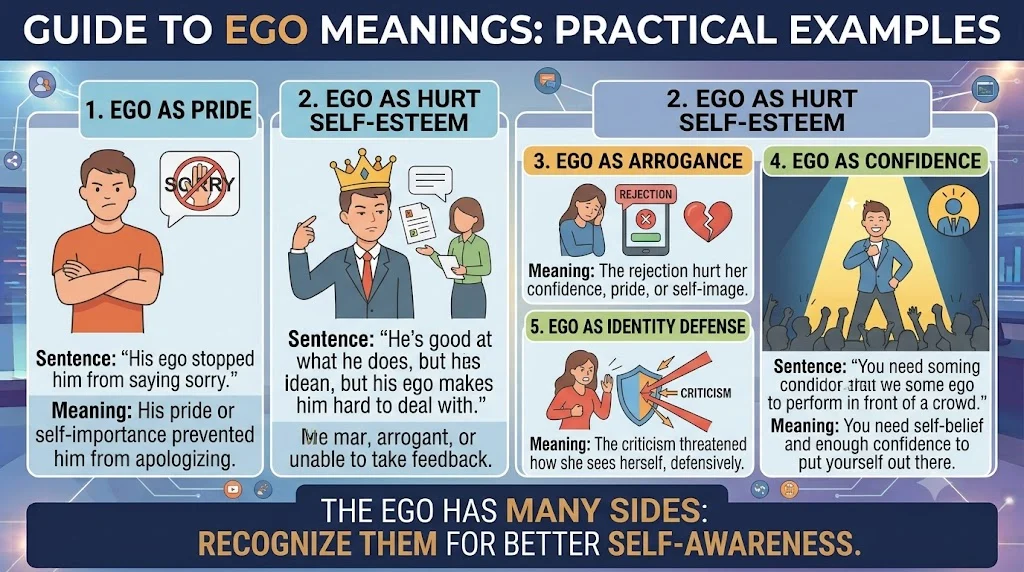
Here are practical examples of how the word works in real conversation.
Example 1: Ego as Pride
Sentence:
“His ego stopped him from saying sorry.”
Meaning:
His pride or self-importance prevented him from apologizing.
Example 2: Ego as Hurt Self-Esteem
Sentence:
“Getting rejected bruised her ego.”
Meaning:
The rejection hurt her confidence, pride, or self-image.
Example 3: Ego as Arrogance
Sentence:
“He’s good at what he does, but his ego makes him hard to deal with.”
Meaning:
He may be overly self-important, arrogant, or unable to take feedback.
Example 4: Ego as Confidence
Sentence:
“You need some ego to perform in front of a crowd.”
Meaning:
You need self-belief and enough confidence to put yourself out there.
Example 5: Ego as Identity Defense
Sentence:
“She took the criticism badly because it challenged her ego.”
Meaning:
The criticism threatened how she sees herself, so she reacted defensively.
5 Conversation Examples in Natural Chat Style
Below are realistic dialogue-style examples showing how ego meaning works in modern conversation.
Conversation Example 1: After an Argument
Situation
Two friends are talking about a couple who had a fight.
Friend 1: “Why hasn’t he apologized yet?”
Friend 2: “Probably ego. He knows he messed up, but he doesn’t want to admit it.”
Meaning of ego here:
Pride and stubbornness are blocking an apology.
Conversation Example 2: Workplace Feedback
Situation
Coworkers discussing a difficult manager.
Coworker 1: “Did he listen to the team’s feedback?”
Coworker 2: “Not really. His ego can’t handle being challenged.”
Meaning of ego here:
He reacts badly to criticism because he’s overly attached to being right or in control.
Conversation Example 3: Dating and Texting
Situation
A friend is deciding whether to text someone first.
Friend 1: “You miss her, so why not text?”
Friend 2: “Because my ego won’t let me after the way things ended.”
Meaning of ego here:
Pride, hurt feelings, and fear of looking vulnerable.
Conversation Example 4: Sports Confidence
Situation
A coach talking about an athlete.
Coach: “She needs confidence, but not so much ego that she stops listening.”
Meaning of ego here:
Self-belief is good, but arrogance can become a problem.
Conversation Example 5: Social Media Behavior
Situation
Friends talking about someone who always wants praise online.
Friend 1: “Why does he post every tiny achievement like it’s a world record?”
Friend 2: “Honestly, ego. He needs constant validation.”
Meaning of ego here:
A strong need for attention, recognition, or admiration.
Platform-Specific Meaning of Ego
The word ego can show up differently depending on where people are talking. The core idea stays the same, but the tone and implication shift.
Ego Meaning on Text Messages and DMs
In texts and private chats, “ego” often means:
- pride
- emotional stubbornness
- acting too important
- refusing to reach out first
- taking things personally
Examples:
- “Text her. Don’t let your ego ruin this.”
- “He left me on read because of his ego.”
- “That comment hit my ego, ngl.”
What it usually implies in texting
Texting language tends to make ego feel personal and emotional. It often means:
- “I don’t want to look desperate.”
- “I don’t want to admit I care.”
- “I’m protecting my pride.”
- “I felt insulted.”
Ego Meaning on TikTok
On TikTok, ego often appears in:
- dating advice videos
- breakup content
- self-help content
- “high value” dating debates
- motivational clips
- psychology explainers
Typical uses:
- “Your ego is keeping you stuck.”
- “Stop confusing intuition with ego.”
- “His ego got hurt.”
- “She moved from confidence to ego.”
TikTok tone
On TikTok, the word can be used in a dramatic or self-awareness-focused way. Sometimes it’s insightful; other times it’s oversimplified. A creator may use “ego” to describe:
- attachment to image
- refusal to be vulnerable
- fear of rejection
- arrogance
- performative confidence
Ego Meaning on Instagram
On Instagram, “ego” often appears in captions, comments, mindset posts, or relationship quotes.
Examples:
- “Starve the ego, feed the soul.”
- “Confidence is quiet. Ego is loud.”
- “My ego made me stay silent when I should’ve spoken.”
Instagram usage usually leans toward:
- motivational/self-growth language
- image and identity themes
- quote-style reflections
- confidence vs arrogance discussions
Ego Meaning on X or Social Media Debates
In public debate spaces, “ego” often becomes a criticism.
Examples:
- “This isn’t leadership, it’s ego.”
- “His ego won’t let anyone else shine.”
- “People with fragile egos always turn criticism into drama.”
Here, ego often implies:
- power struggles
- insecurity disguised as confidence
- need for control
- public self-importance
Ego Meaning on Reddit, Forums, and Advice Threads
In advice communities and discussion forums, ego often appears in deeper conversations about:
- breakups
- healing
- toxic behavior
- insecurity
- mental patterns
- conflict resolution
Examples:
- “Was it my ego or actual self-respect?”
- “I can’t tell if he’s confident or just ego-driven.”
- “My ego is stopping me from admitting I miss them.”
This kind of usage is often more reflective and nuanced.
Alternative Meanings of Ego
The word ego doesn’t always mean the exact same thing. Here are the main variations.
Ego as Self-Identity
This is the broadest meaning:
- your sense of “I”
- your self-concept
- the image you hold of yourself
Example:
- “Her ego is tied closely to her career success.”
Meaning: Her identity and self-worth are strongly connected to her job.
Ego as Pride
This is one of the most common conversational meanings.
Example:
- “He won’t call because of ego.”
Meaning: Pride is stopping him.
Ego as Arrogance
Sometimes ego means inflated self-importance.
Example:
- “His ego fills the whole room.”
Meaning: He acts superior or overly impressed with himself.
Ego as Self-Esteem
In some contexts, ego overlaps with confidence or self-esteem.
Example:
- “That failure crushed my ego.”
Meaning: It damaged my confidence or self-worth.
Ego as Defensive Self-Protection
Ego can also mean the part of you that protects your self-image.
Example:
- “My ego got defensive when she criticized me.”
Meaning: I felt threatened, so I reacted to protect my self-image.
Related Terms and NLP Variations
If you’re researching ego meaning, you’ll also come across related words and phrases. They overlap, but they are not always identical.
Pride
Pride is one of the closest everyday synonyms for ego, but it’s narrower. Pride usually refers to dignity, self-respect, or unwillingness to be humbled.
Example:
“His pride wouldn’t let him apologize.”
Arrogance
Arrogance is a more clearly negative term. It means behaving as if you’re better than other people.
Difference from ego:
Ego can be neutral or positive in some contexts. Arrogance is almost always negative.
Self-Esteem
Self-esteem refers to how much you value yourself. It’s more psychological and emotional than ego in everyday speech.
Difference from ego:
Self-esteem is often about inner worth. Ego is often about self-image, pride, identity, and defensiveness.
Confidence
Confidence means belief in your abilities or worth.
Difference from ego:
Confidence is usually healthy and stable. Ego can become defensive, inflated, or fragile.
Self-Importance
This phrase usually refers to feeling overly important.
Example:
“He’s full of self-importance.”
This is close to the negative meaning of ego.
Narcissism
Narcissism is more extreme than ego. It refers to a pattern of excessive self-focus, admiration-seeking, and lack of empathy.
Important difference:
Not everyone with “a big ego” is narcissistic. The terms are not interchangeable.
Vanity
Vanity refers to excessive concern with appearance, image, or admiration.
This can overlap with ego when someone is highly invested in how they look or how they’re perceived.
Insecurity
Ironically, ego and insecurity often go together. A person with a huge ego may actually be protecting a fragile self-image.
That’s why people sometimes say:
- “It’s not confidence. It’s insecurity hiding behind ego.”
Confidence vs Ego: What’s the Difference?
This is one of the biggest points of confusion, so it deserves a clear breakdown.
| Based on self-belief | Often tied to self-image or pride |
| Can be quiet and steady | Can be loud, defensive, or fragile |
| Doesn’t need constant validation | Often reacts strongly to criticism or disrespect |
| Can celebrate others too | May compete for attention or status |
| Helps performance | Can help or hurt depending on how inflated it becomes |
Simple way to think about it
- Confidence says: “I know my worth.”
- Ego says: “I need to prove my worth.”
- Healthy self-respect says: “I don’t need to dominate the room.”
- Unhealthy ego says: “I need everyone to know I matter.”
That contrast isn’t perfect in every situation, but it helps explain why people often use “ego” critically.
Healthy Ego vs Unhealthy Ego
Not all ego is bad. A healthier way to understand the word is to separate it into two forms.
Healthy Ego
A healthy ego can include:
- self-respect
- a stable sense of identity
- confidence without arrogance
- emotional boundaries
- the ability to function independently
- resilience after failure
A healthy ego helps you:
- speak up for yourself
- believe in your abilities
- recover from criticism without falling apart
- maintain dignity
- make decisions based on reality rather than panic
Unhealthy Ego
An unhealthy ego often shows up as:
- arrogance
- constant defensiveness
- inability to admit mistakes
- need for praise
- jealousy of others’ success
- controlling behavior
- taking everything personally
- refusing to apologize
- acting superior to hide insecurity
This is the version people usually mean when they say:
- “Check your ego.”
- “He has an ego problem.”
- “Her ego is fragile.”
- “Don’t let ego ruin a good thing.”
How to Respond When Someone Says “It’s Your Ego”
If someone tells you that your ego is getting in the way, the best response depends on whether they mean it as criticism, insight, or manipulation.
If They Mean You’re Being Defensive
You could respond with:
- “Maybe you’re right. I’m taking it personally.”
- “I need to think about whether pride is getting in the way.”
- “I hear what you’re saying. Let me step back and look at it.”
This response works when the other person is making a fair point.
If They Mean You’re Acting Arrogant
Possible responses:
- “I’m not trying to come off that way.”
- “If I sounded dismissive, that wasn’t my intention.”
- “Thanks for saying it directly. I’ll watch that.”
If They Mean Your Pride Is Blocking Action
For example, if someone says your ego is stopping you from apologizing or reaching out, you might say:
- “You might be right—I’ve been leading with pride.”
- “Part of me doesn’t want to look weak.”
- “I’m trying to figure out the difference between self-respect and ego.”
If the Comment Feels Unfair
Not every accusation about ego is accurate. Sometimes people use “ego” to dismiss your boundaries, confidence, or legitimate disagreement.
You can respond with:
- “I’m open to feedback, but I don’t think this is just ego.”
- “Can you be specific about what I’m doing?”
- “I’m willing to listen, but I need more than a label.”
That response is useful when someone is using “ego” vaguely or manipulatively.
Reply Strategies in Common Situations
Here are practical ways to respond when ego comes up in different scenarios.
If a Friend Says, “Your Ego Got Hurt”
Possible replies:
- “Yeah, it probably did.”
- “I think it hit my pride more than I wanted to admit.”
- “Maybe I reacted because I felt embarrassed.”
If Someone Says, “He Has a Big Ego”
Possible replies:
- “Do you mean confident, arrogant, or just defensive?”
- “Yeah, he seems very attached to being right.”
- “Maybe it’s insecurity coming out as arrogance.”
If Someone Says, “Leave Your Ego at the Door”
Possible replies:
- “Fair enough. Let’s focus on solving the issue.”
- “Got it—let’s keep this constructive.”
- “I’m open to feedback if we stay specific.”
If You Want to Admit Ego Is Involved
You can say:
- “I know my pride is part of the problem.”
- “I’m trying not to react from ego.”
- “I want to respond thoughtfully, not defensively.”
Misinterpretations of Ego
The word ego gets misused a lot. Here are the most common misunderstandings.
Misinterpretation 1: Ego Always Means Arrogance
Not true. Ego can mean:
- identity
- self-image
- pride
- confidence
- psychological self-structure
- defensiveness
Arrogance is only one possible meaning.
Misinterpretation 2: Having an Ego Is Always Bad
Also not true. Everyone has an ego in the sense that everyone has a sense of self. The real issue is whether that ego is healthy, fragile, inflated, defensive, or balanced.
Misinterpretation 3: Confidence and Ego Are the Same
They overlap sometimes, but they’re not identical. Confidence can exist without arrogance, while ego often involves self-image protection and emotional defensiveness.
Misinterpretation 4: Ego Means the Same Thing in Psychology and Daily Speech
Not exactly. In psychology, ego has a more technical meaning. In everyday speech, it’s broader and more emotional.
Misinterpretation 5: If Someone Defends Themselves, It Must Be Ego
Not always. Sometimes people are:
- setting a boundary
- protecting their dignity
- standing up for themselves
- disagreeing reasonably
Calling all self-protection “ego” oversimplifies the situation.
When NOT to Use the Word Ego
Because the word is broad and emotionally loaded, there are times when using it may confuse the conversation or make it worse.
Don’t Use It When You Really Mean “Confidence”
If someone is simply self-assured, saying they “have an ego” may sound unfairly negative.
Better alternatives:
- confident
- self-assured
- assertive
- ambitious
Don’t Use It as a Lazy Insult
Saying “that’s just your ego” without explanation can shut down real discussion. It’s better to be specific:
- “You seem defensive.”
- “I think pride is making this harder.”
- “It sounds like criticism is hitting a nerve.”
Don’t Use It to Dismiss Healthy Boundaries
If someone doesn’t want to tolerate disrespect, that doesn’t automatically mean “ego.” It may mean self-respect.
Don’t Assume Ego Is the Whole Story
Sometimes what looks like ego is actually:
- anxiety
- shame
- grief
- insecurity
- trauma
- social pressure
- burnout
- fear of rejection
Usage Tips: How to Use Ego Correctly
If you want to use the word ego accurately in conversation or writing, these tips help.
Tip 1: Match the Meaning to the Context
Ask yourself: do you mean:
- identity?
- pride?
- arrogance?
- defensiveness?
- confidence?
- psychological self?
Choosing the right shade of meaning makes your writing clearer.
Tip 2: Use Specific Phrases
Common phrases include:
- big ego
- fragile ego
- ego boost
- ego trip
- bruised ego
- ego clash
- leave your ego at the door
- put your ego aside
- check your ego
Each phrase has a slightly different meaning.
Big ego
Usually means someone seems overly self-important or arrogant.
Fragile ego
Means someone gets easily offended, defensive, or insecure when challenged.
Ego boost
Something that makes a person feel more confident, admired, or important.
Ego trip
Behavior driven by power, praise, status, or control.
Bruised ego
Hurt pride or damaged self-esteem.
Tip 3: Be Careful with Tone
Calling out someone’s ego can sound harsh. In personal relationships, it often works better to describe the behavior instead of labeling the person.
Instead of:
- “You’re so ego-driven.”
Try:
- “I think pride is making this harder.”
- “It feels like you’re reacting defensively.”
- “I don’t think you’re hearing feedback right now.”
Tip 4: Distinguish Ego from Self-Respect
This matters a lot in dating, conflict, and personal growth spaces.
Ego says:
- “I need to win.”
- “I can’t admit I was wrong.”
- “I can’t let them think they hurt me.”
Self-respect says:
- “I don’t deserve to be mistreated.”
- “I can apologize without losing my dignity.”
- “I can walk away without needing revenge or validation.”
Tip 5: Remember That Ego Can Be Fragile or Inflated
A loud ego isn’t always a strong ego. Sometimes the most ego-driven behavior comes from insecurity.
For example:
- bragging constantly
- overreacting to criticism
- needing attention
- refusing to admit mistakes
- acting superior
These can be signs of a fragile self-image, not true confidence.
Common Phrases with Ego and What They Mean
“Check your ego”
Meaning: stop being arrogant, defensive, or overly proud.
“His ego got hurt”
Meaning: his pride or self-esteem was damaged.
“She has a huge ego”
Meaning: she may be arrogant, self-important, or very attached to status and image.
“It was an ego boost”
Meaning: it made someone feel validated, attractive, admired, or important.
“Don’t let ego win”
Meaning: don’t let pride, stubbornness, or defensiveness control your decisions.
“That was just ego talking”
Meaning: the reaction came from pride, insecurity, or self-image protection rather than calm judgment.
Edge Cases: Situations Where Ego Is Hard to Read
Sometimes it’s hard to tell whether something is ego, confidence, insecurity, or self-respect. These gray areas matter because people throw the word around too loosely.
Case 1: Refusing to Text First After a Breakup
Is that ego or self-protection?
It depends. It might be ego if:
- the person wants to text but refuses only to “win”
- they care more about not looking weak than being honest
It might be self-protection if:
- the relationship was unhealthy
- they’re trying to maintain a necessary boundary
- texting would reopen emotional harm
Case 2: Rejecting Feedback at Work
Is that ego or a reasonable disagreement?
It might be ego if:
- the person can’t tolerate criticism
- they shut down every suggestion
- they treat disagreement like disrespect
It might not be ego if:
- the feedback is poorly informed
- the person asks thoughtful questions
- they simply disagree on strategy
Case 3: Feeling Hurt by Rejection
Is that ego or normal emotion?
Sometimes people say “your ego is hurt” when what they really mean is “you’re human.” Rejection naturally affects self-esteem and pride. That doesn’t automatically mean you’re vain or self-obsessed.
Case 4: Celebrating Your Success
Is that confidence or ego?
It depends on how it’s expressed.
Healthy confidence:
- “I worked hard for this and I’m proud.”
Unhealthy ego:
- “I’m better than everyone else and need constant applause.”
FAQs
What is the simple meaning of ego?
The simple meaning of ego is a person’s sense of self, self-image, pride, or self-importance. Depending on the context, it can be positive, neutral, or negative.
Does ego mean confidence?
Not exactly. Ego can include confidence, but it often refers more broadly to self-image, pride, or defensiveness. Confidence is usually healthier and less reactive than ego.
Is ego always a bad thing?
No. Everyone has an ego in the sense that everyone has a sense of self. A healthy ego can mean self-respect and emotional stability. The problem is usually an inflated or fragile ego.
What does “big ego” mean?
“Big ego” usually means someone seems arrogant, overly self-important, attention-seeking, or too attached to being admired, respected, or seen as superior.
What does “hurt ego” mean?
A hurt ego means someone’s pride, confidence, or self-image has been damaged. This often happens after rejection, embarrassment, criticism, or failure.
What does ego mean in psychology?
In psychology, especially Freud’s theory, the ego is the part of the mind that deals with reality and balances instinctive desires with moral rules and practical decisions.
What is the difference between ego and pride?
Pride is one part of ego. Pride usually refers to dignity, self-respect, or stubbornness. Ego is broader and can include identity, self-image, confidence, defensiveness, and self-importance.
What does “check your ego” mean?
It means stop letting arrogance, pride, insecurity, or defensiveness control your behavior. It’s often said when someone is acting overly proud or resistant to feedback.
Can ego come from insecurity?
Yes. In fact, a lot of ego-driven behavior comes from insecurity. Someone may act arrogant, controlling, or defensive because they feel threatened, not because they are truly confident.
What does ego mean in dating?
In dating, ego often refers to pride, fear of vulnerability, needing validation, refusing to text first, acting distant to protect feelings, or taking rejection very personally.
Conclusion
The best way to understand ego meaning is to stop thinking of it as just one thing. Ego can mean your sense of self, your pride, your self-image, your emotional defensiveness, or a psychological system that helps you deal with reality. In casual conversation, it often points to pride, arrogance, or hurt feelings. In more reflective conversations, it can refer to identity, insecurity, confidence, or the part of you that wants to protect how you’re seen.
That’s also why the word shows up everywhere—from arguments and dating to sports, work, self-help, and psychology. Someone might say ego is the reason a person won’t apologize. Someone else might use it to describe a bruised sense of pride after rejection. In psychology, it can mean something much more technical. The context changes the meaning, but the central idea stays the same: ego is about the self and how the self is protected, expressed, valued, or threatened.
So if someone asks, “What does ego mean?” the clearest answer is this:
Ego means a person’s sense of self. Depending on the situation, it can refer to self-image, pride, confidence, self-importance, defensiveness, or the psychological part of the mind that balances desire, morality, and reality.
Once you understand that, the word becomes much easier to recognize in real life—whether you’re reading a quote online, decoding a text, studying psychology, or trying to figure out whether a situation is about confidence, self-respect, insecurity, or just plain ego.

Victoria Lane is a grammar-focused writer at GramBrix.com, passionate about helping readers master the rules of language. She provides clear explanations and practical examples that make writing more accurate, polished and confident.