Last Updated on June 16, 2026
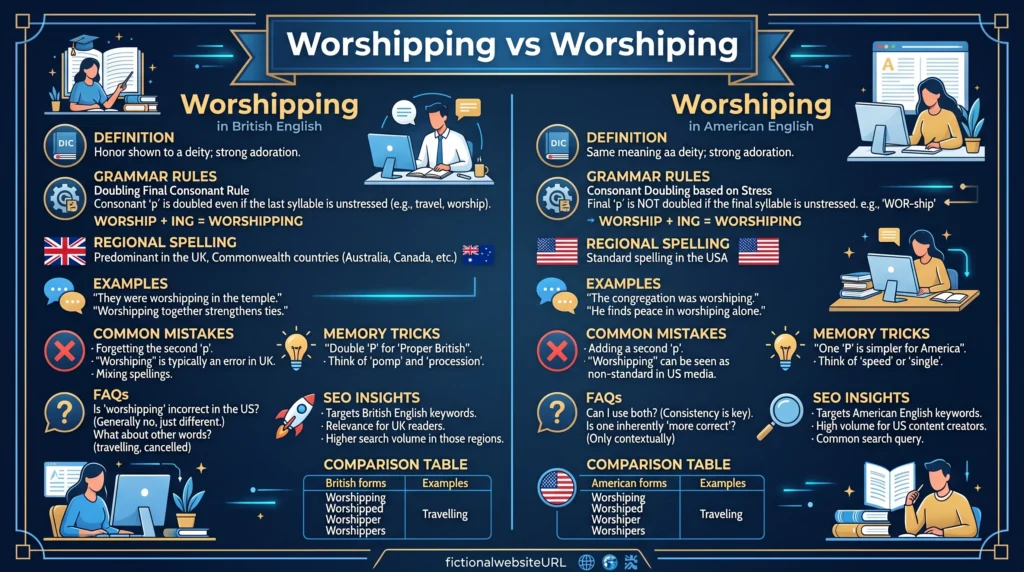
Both worshipping and worshiping are correct spellings, but their usage depends on the type of English being used. Worshipping with a double “p” is the preferred spelling in British English, while worshiping with a single “p” is more common in American English. If you’re writing for a U.S. audience, use worshiping. If you’re writing for a U.K., Australian, or Canadian audience, worshipping is often preferred.
The question of worshipping or worshiping is a common spelling dilemma for writers, students, bloggers, and professionals.
Unlike many spelling disputes where one version is correct and the other is wrong, both forms are accepted in modern English. The difference mainly comes down to regional spelling conventions.
Consider these examples:
- They were worshipping at the temple.
- They were worshiping at the temple.
Both sentences are grammatically correct.
However, depending on your audience, one spelling may look more natural than the other.
This guide explains:
- The difference between worshipping and worshiping
- American vs British English rules
- Grammar usage
- Examples
- Common mistakes
- SEO recommendations
- FAQs
Quick Answer
| Word | Correct? | Common Region |
|---|---|---|
| Worshipping | Yes | British English |
| Worshiping | Yes | American English |
Simple Summary
Both spellings are correct.
- Worshipping = British English
- Worshiping = American English
What Does Worship Mean?
Definition
The verb worship means to show devotion, reverence, honor, or deep respect toward a deity, religious figure, person, or idea.
Religious Meaning
Examples:
- Christians worship God.
- Hindus worship various deities.
- Muslims worship Allah.
Non-Religious Meaning
The word can also describe strong admiration.
Examples:
- She practically worships her favorite singer.
- Many fans worship the athlete.
Verb Forms
| Form | Word |
|---|---|
| Base Verb | Worship |
| Present Participle | Worshiping / Worshipping |
| Past Tense | Worshiped / Worshipped |
| Past Participle | Worshiped / Worshipped |
What Does Worshiping Mean?
Definition
Worshiping is the American English present participle and gerund form of worship.
Examples
- They are worshiping together.
- Millions are worshiping online.
- The community is worshiping peacefully.
American English Usage
Most U.S. dictionaries prefer worshiping.
Professional Writing
American publications commonly use worshiping.
What Does Worshipping Mean?
Definition
Worshipping is the British English present participle form of worship.
Examples
- They are worshipping in the cathedral.
- Pilgrims were worshipping at the shrine.
- Families gather for worshipping services.
British English Usage
Most British style guides favor worshipping.
International Usage
Many Commonwealth countries also prefer worshipping.
Main Difference Between Worshipping or Worshiping
Meaning
There is no difference in meaning.
Spelling Convention
Worshipping
British English preference.
Worshiping
American English preference.
Pronunciation
Both are pronounced exactly the same.
Grammar Function
Both function identically as verbs.
Comparison Table
| Feature | Worshipping | Worshiping |
|---|---|---|
| Correct Spelling | Yes | Yes |
| Meaning | Same | Same |
| British English | Preferred | Less Common |
| American English | Less Common | Preferred |
| Pronunciation | Same | Same |
| Grammar Function | Same | Same |
Why Are There Two Spellings?
American English Simplification
American English often simplifies certain spellings.
Examples:
- Traveling vs Travelling
- Counseling vs Counselling
- Worshiping vs Worshipping
British English Doubling Rule
British English frequently doubles the final consonant when adding suffixes.
Examples:
- Cancelled
- Travelling
- Worshipping
Historical Development
Both spellings evolved from different spelling traditions.
Modern Acceptance
Major dictionaries recognize both versions.
British English Rule
Double Final Consonant
British English commonly doubles the final consonant before adding -ing.
Examples
- Travel → Travelling
- Cancel → Cancelling
- Worship → Worshipping
Publishing Standards
British publishers generally use worshipping.
Academic Writing
U.K. universities often prefer worshipping.
American English Rule
Single Consonant Preference
American English often removes the doubled consonant.
Examples
- Travel → Traveling
- Cancel → Canceling
- Worship → Worshiping
Business Writing
American businesses typically use worshiping.
Media Usage
Most U.S. publications prefer worshiping.
Common Examples of Worshiping
Religious Services
- People are worshiping together.
Online Worship
- Members are worshiping remotely.
Community Gatherings
- Families are worshiping every weekend.
Spiritual Events
- Thousands are worshiping at the festival.
Common Examples of Worshipping
Church Activities
- The congregation is worshipping.
Religious Ceremonies
- Pilgrims are worshipping at sacred sites.
Cultural Events
- Communities are worshipping during celebrations.
Traditional Practices
- People were worshipping according to local customs.
Common Mistakes People Make
Mixing Regional Styles
Avoid switching between worshiping and worshipping within the same document.
Assuming One Is Wrong
Both spellings are correct.
Using Different Variants Together
Incorrect:
- The group was worshipping while others were worshiping.
Use one style consistently.
Ignoring Audience Location
Choose the spelling that matches your target audience.
Worshipping vs Worshiping in SEO
Search Intent
Users searching this phrase usually want spelling clarification.
Search Popularity
Worshiping often receives higher search volume due to American internet traffic.
International Content
Including both spellings improves keyword coverage.
SEO Recommendation
Use worshipping or worshiping as the primary keyword and explain the regional difference.
Worshipping vs Worshiping in Professional Writing
American Businesses
Prefer worshiping.
British Organizations
Prefer worshipping.
International Companies
Choose one style and remain consistent.
Academic Publications
Follow the style guide required by the institution.
How to Remember the Difference
Think Geography
America → Worshiping
Britain → Worshipping
Double P Rule
British English often doubles consonants.
Easy Formula
US = One P
UK = Two Ps
Consistency Matters
Neither spelling is wrong if used consistently.
Related Word Comparisons
Traveling or Travelling
Similar American vs British spelling difference.
Counseling or Counselling
Another regional variation.
Worshiped or Worshipped
Past tense version of the same spelling distinction.
Worshipping or Worshiping
A classic British vs American English comparison.
Exercises With Answers
Exercise 1
Which spelling is preferred in American English?
Answer: Worshiping
Exercise 2
Which spelling is preferred in British English?
Answer: Worshipping
Exercise 3
Do the words have different meanings?
Answer: No
Exercise 4
Which spelling uses a double p?
Answer: Worshipping
Exercise 5
Are both forms accepted by dictionaries?
Answer: Yes
FAQs
Is it worshipping or worshiping?
Both are correct. Worshipping is British English, while worshiping is American English.
Which spelling is more common in the United States?
Worshiping is more common.
Which spelling is more common in the United Kingdom?
Worshipping is more common.
Do worshipping and worshiping mean different things?
No. They have identical meanings.
Is worshipping grammatically correct?
Yes.
Is worshiping grammatically correct?
Yes.
Which spelling should I use in academic writing?
Follow your institution’s preferred style guide.
Can I use both spellings in one article?
It’s best to choose one version and stay consistent.
Which spelling is better for SEO?
Using both forms naturally can help capture broader search traffic.
Will readers understand either spelling?
Yes. Both are widely recognized and accepted.
Conclusion
The answer to worshipping or worshiping is that both spellings are correct.
The difference is primarily regional:
- Worshiping is preferred in American English.
- Worshipping is preferred in British English.
Key takeaways include:
- Both words have the same meaning.
- Both are grammatically correct.
- Neither spelling is superior.
- Choose the version that matches your audience.
- Maintain consistency throughout your writing.
For SEO, educational content, and professional communication in 2026, understanding both spellings ensures clarity and broader audience reach.

Victoria Lane is a grammar-focused writer at GramBrix.com, passionate about helping readers master the rules of language. She provides clear explanations and practical examples that make writing more accurate, polished and confident.