Last Updated on July 8, 2026
Requester and requestor are both accepted English words that refer to a person who makes a request. However, requester is the more common spelling in modern English and appears more frequently in business communication, customer service, academic writing, and general usage. Requestor is often found in legal, technical, government, and procurement documents. For most writing situations in 2026, requester is the preferred choice.
The debate between requestor or requester creates confusion because both words seem correct and often appear in professional documents.
For example:
- The requester submitted a support ticket.
- The requestor completed the application form.
Both sentences are grammatically correct.
Unlike many spelling comparisons where one word is clearly wrong, both requester and requestor are legitimate English terms. They share the same meaning and are often interchangeable.
The difference mainly comes down to usage preferences, industry standards, and writing style.
In business communication, customer support, education, and everyday English, requester is far more common. Meanwhile, requestor often appears in legal, government, procurement, and technical environments.
This guide explains:
- Definitions
- Key differences
- Industry usage
- Grammar rules
- Examples
- Common mistakes
- SEO recommendations
Quick Answer
| Word | Correct? | Common Usage |
|---|---|---|
| Requester | Yes | Very Common |
| Requestor | Yes | Common in Specific Industries |
Simple Summary
Both words are correct, but requester is the preferred choice in modern English. Requestor is more common in legal, technical, and administrative documents.
What Does Requester Mean?
Definition
A requester is a person who asks for something.
Common Uses
Requester is frequently used in:
- Customer support
- Business communication
- Education
- Online forms
- Service requests
Example Sentences
- The requester submitted a complaint.
- Please contact the requester for more details.
- The requester received approval.
What Does Requestor Mean?
Definition
Requestor has the same meaning as requester.
It refers to:
- Someone making a request
- An individual seeking information, services, or approval
Common Uses
Requestor often appears in:
- Government forms
- Procurement systems
- Legal documents
- Technical documentation
Example Sentences
- The requestor must provide identification.
- Approval was granted to the requestor.
Main Difference Between Requestor or Requester
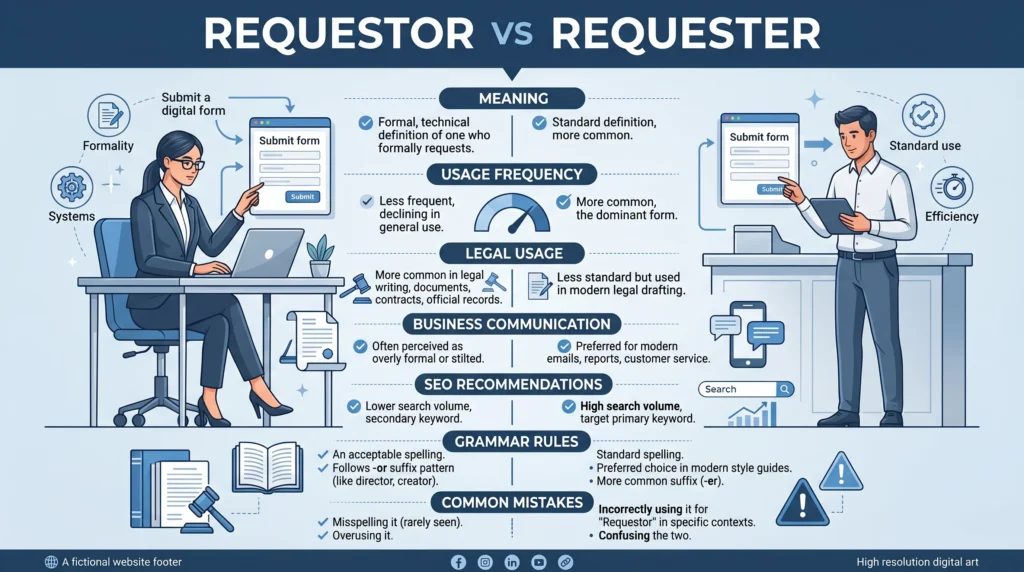
Meaning
Requester
Person making a request.
Requestor
Person making a request.
Usage Frequency
Requester
More common.
Requestor
Less common.
Industry Preference
Requester
General communication.
Requestor
Formal administrative contexts.
Comparison Table
| Feature | Requester | Requestor |
|---|---|---|
| Correct English Word | Yes | Yes |
| General Usage | High | Moderate |
| Business Communication | Preferred | Less Common |
| Legal Documents | Sometimes | Common |
| Government Forms | Sometimes | Common |
| SEO Value | Higher | Lower |
Why Requester Is More Common
Standard English Patterns
Many English nouns end in -er.
Examples:
- Teacher
- Worker
- Builder
- Requester
Reader Familiarity
Most people naturally recognize requester.
Business Preference
Many organizations use requester in documentation and workflows.
Search Trends
Online searches favor requester over requestor.
Why Requestor Still Exists
Historical Usage
The word has existed for many years.
Legal Terminology
Certain legal systems continue using requestor.
Procurement Systems
Government and purchasing departments often use requestor.
Software Platforms
Some enterprise software applications use requestor as a field label.
Requester in Business Communication
Customer Service
Examples:
- The requester opened a support ticket.
- The requester received assistance.
Human Resources
Examples:
- The requester submitted a leave request.
- HR reviewed the requester’s application.
Corporate Workflows
Requester commonly appears in approval systems.
Requestor in Legal and Government Settings
Public Records Requests
Government agencies sometimes use requestor.
Procurement Documents
Purchasing systems often label applicants as requestors.
Regulatory Forms
Certain official forms use requestor terminology.
Grammar and Word Formation
The Suffix “-er”
The suffix often identifies a person performing an action.
Examples:
- Writer
- Reader
- Teacher
- Requester
The Suffix “-or”
The suffix can also indicate a person performing an action.
Examples:
- Creator
- Operator
- Director
- Requestor
Why Both Forms Exist
English allows multiple noun-forming suffixes, creating alternative spellings in some cases.
SEO Recommendation for 2026
Target Requester
Popular searches include:
- Requester meaning
- Requester definition
- Requester vs requestor
- Service requester
Include Requestor Naturally
Helpful for capturing industry-specific searches.
Focus on User Intent
Most searchers want to know which version is preferred.
Common Mistakes People Make
Assuming Requestor Is Wrong
It is a valid English word.
Thinking Meanings Are Different
Both words share the same meaning.
Mixing Terms Within One Document
Consistency improves professionalism.
Ignoring Industry Standards
Some organizations require one version over the other.
How to Choose Between Requester and Requestor
Use Requester For
- Business communication
- Customer support
- Academic writing
- General English
Use Requestor For
- Government forms
- Legal documents
- Procurement systems
- Technical platforms
Follow Existing Standards
Match the terminology already used by your organization.
Real World Examples
Customer Support
- The requester submitted a help ticket.
Procurement Department
- The requestor completed the purchase request.
Educational Setting
- The requester asked for additional information.
Government Agency
- The requestor filed a records request.
Related Word Comparisons
Requester or Applicant
An applicant applies, while a requester asks for something.
Requester or Customer
A customer may also be a requester.
Requestor or Petitioner
Both can appear in legal contexts.
Exercises With Answers
Exercise 1
Which word is more common in everyday English?
Answer: Requester
Exercise 2
Are requester and requestor both correct?
Answer: Yes
Exercise 3
Which spelling appears more often in legal documents?
Answer: Requestor
Exercise 4
Complete the sentence:
The _____ submitted a support request.
Answer: Requester
Exercise 5
Do the words have different meanings?
Answer: No
FAQs
Is it requestor or requester?
Both are correct, but requester is generally more common.
What is the difference between requestor and requester?
The meaning is the same. The difference is mainly usage preference.
Which spelling is more common?
Requester is more common in modern English.
Is requestor a real word?
Yes. It is widely used in legal, government, and procurement contexts.
Should I use requester in business writing?
Yes. It is usually the preferred choice.
Why do government forms use requestor?
Many agencies have adopted requestor as part of their administrative terminology.
Can requester and requestor be used interchangeably?
In most situations, yes.
Which spelling is better for SEO?
Requester generally has higher search volume and broader recognition.
Should I use both terms in the same document?
No. Choose one term and remain consistent.
Which word should students use?
Requester is usually the safest and most widely accepted option.
Conclusion
The choice between requestor or requester is unique because both words are correct and share the same meaning.
However, modern usage clearly favors requester in most situations. It appears more often in business communication, customer support, education, and everyday English.
Meanwhile, requestor remains common in:
- Legal environments
- Government agencies
- Procurement systems
- Technical documentation
Key takeaways include:
- Both words are correct.
- Requester is more common.
- Requestor is often industry-specific.
- Meanings are identical.
- Consistency matters more than the specific spelling.
For most websites, articles, and professional communication in 2026, requester is generally the best choice.

Victoria Lane is a grammar-focused writer at GramBrix.com, passionate about helping readers master the rules of language. She provides clear explanations and practical examples that make writing more accurate, polished and confident.