
Last Updated on July 13, 2026
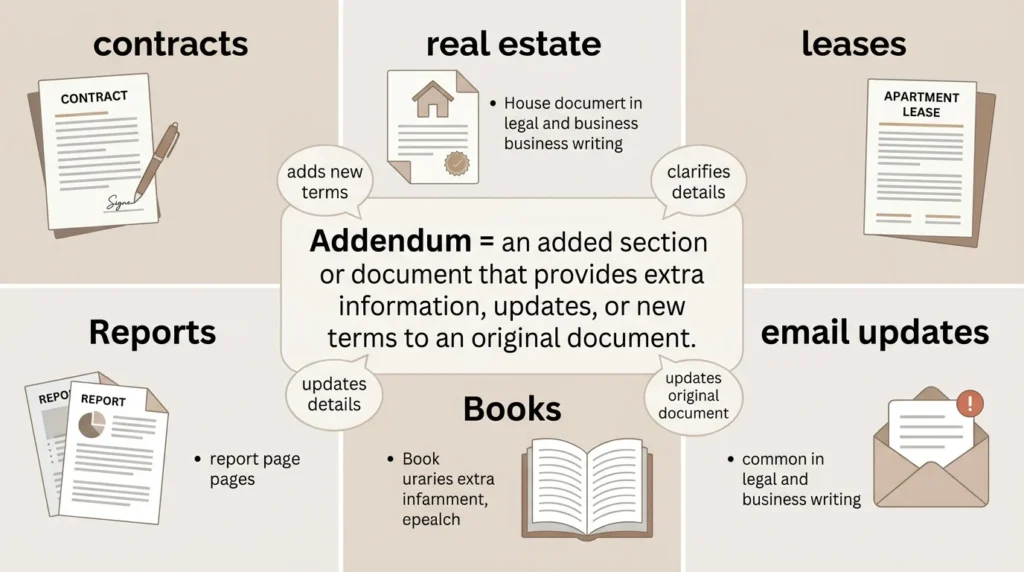
Addendum meaning: An addendum is something added to an existing document, agreement, book, email, or message to provide extra information, make a correction, update details, or include new terms. It is commonly used in contracts, legal documents, business writing, academic work, and real estate paperwork.
If you’ve seen the word addendum in a contract, report, lease, book, or email, you might be wondering what it actually means and when people use it. The short answer is simple: an addendum is an addition made after the original document or agreement already exists. It adds new information, clarifies something, corrects an omission, or updates terms without replacing the whole original text.
But the full addendum meaning depends on context. In legal and business settings, an addendum can change the practical effect of a contract. In books and reports, it can add missing information or updates. In casual communication, people may use it to refer to an extra note, follow-up point, or late addition to a message.
This guide breaks down the meaning of addendum in plain US English, shows how it’s used across real-life situations, explains the difference between an addendum and similar terms like appendix, amendment, attachment, and supplement, and gives realistic examples you can actually understand and use.
Quick Answer Box
| Topic | Quick Answer |
|---|---|
| Meaning | An addendum is an addition to an existing document, agreement, or message. |
| Main purpose | To add new information, clarify details, correct omissions, or update content after the original version was created. |
| Common contexts | Contracts, real estate, business documents, reports, books, academic writing, and emails. |
| Tone | Usually formal or semi-formal, especially in legal or professional settings. |
| Can it change meaning? | Yes. In contracts and official documents, an addendum can affect obligations, timelines, pricing, conditions, or disclosures. |
| Simple example | “We signed the lease, then added an addendum about pet rules.” |
| Everyday explanation | Think of it as an official “extra section added later.” |
What Does Addendum Mean?
The word addendum means an added section or note attached to something that already exists. It usually appears after the original document, agreement, report, or text has been written.
In simple terms, an addendum is used when someone says:
- “We need to add one more detail.”
- “We forgot to include something important.”
- “The original document is fine, but it needs an extra part.”
- “We need to clarify or update this without rewriting the whole thing.”
So if a company creates a contract and later needs to add a clause about delivery dates, that new section may be called an addendum. If a professor submits a report and later includes an extra note with updated data, that could also be an addendum. If an author releases a book and later adds a section with corrections or new references, that added section may be labeled an addendum too.
Simple Definition of Addendum
A clean, easy definition is:
Addendum = an additional section, note, or document added to an original document after it has already been prepared.
That’s the core meaning in almost every setting.
Why People Use an Addendum
People use an addendum when they want to:
- include missing information
- add a new term or condition
- clarify an earlier point
- expand the original content
- update facts or instructions
- make a formal addition without replacing the original document
Full Definition of Addendum
The full addendum meaning becomes clearer when you look at how the word functions in formal writing and practical communication.
An addendum is usually:
- Connected to an existing document or agreement
- Added after the original has been drafted, shared, or signed
- Meant to be read together with the original
- Used to provide additional information, not create a totally unrelated document
In many professional settings, an addendum is not just a random note. It’s a structured addition with a clear purpose. It may be numbered, dated, signed, and referenced alongside the original material.
The Origin of the Word
Addendum comes from Latin and is related to the idea of “something to be added.” That origin still matches modern usage almost perfectly. Even today, the word carries the sense of “an extra piece added onto the main thing.”
Singular and Plural Forms
- Singular: addendum
- Plural: addenda or addendums
Both plural forms are used in modern English, though addenda sounds slightly more formal and is common in legal, academic, or business contexts.
Examples:
- “The contract includes one addendum.”
- “The report was updated with two addenda.”
- “Please review all addendums before signing.”
Context and Usage of Addendum
The meaning of addendum changes slightly depending on where you see it. The core idea stays the same, but the practical use differs across legal, academic, business, publishing, and casual communication.
Addendum in Contracts
In contracts, an addendum is a formal addition to the original agreement. It might add new terms, explain conditions, update timelines, or include details that were left out of the first version.
For example, if a service agreement originally says nothing about overtime fees, the parties might later add an addendum explaining:
- overtime rates
- weekend work charges
- revised deadlines
- additional deliverables
In this setting, an addendum can matter a lot because it may affect payment, responsibilities, deadlines, and legal obligations.
Contract Example
Original contract:
- Designer will deliver a website in 30 days for $2,000.
Addendum:
- If the client requests e-commerce functionality, the delivery timeline extends by 10 days and the project fee increases by $600.
The original contract still exists, but the addendum adds a new rule to it.
Addendum in Real Estate
Real estate is one of the most common places people encounter the word addendum. Buyers, sellers, landlords, tenants, and agents often use addenda to attach important details to purchase agreements, lease agreements, or disclosure documents.
A real estate addendum may cover:
- home repairs
- inspection findings
- financing conditions
- move-in dates
- appliances included in the sale
- HOA details
- pet terms in a rental
- seller concessions
- occupancy timelines
Real Estate Example
A buyer agrees to purchase a house, but after the inspection, both parties sign an addendum saying the seller will repair the roof before closing or provide a credit of $4,000.
That extra document is an addendum because it adds terms to the original purchase agreement.
Addendum in Business Documents
In business, addenda can appear in:
- proposals
- vendor agreements
- employee policies
- project scopes
- partnership documents
- procurement paperwork
- compliance documents
- meeting materials
A business addendum often exists because new information becomes relevant after the original document was created. Instead of recreating the whole file, the company issues an addendum.
Business Example
A vendor contract may get an addendum that adds:
- a new pricing tier
- an updated service region
- cybersecurity requirements
- revised billing contacts
Addendum in Books, Reports, and Academic Writing
In books, research papers, manuals, and reports, an addendum is used to include information that was not part of the original body but needs to be added later.
This could include:
- newly discovered data
- corrected statistics
- updated references
- an extra explanation
- a note about changes after publication
- supplementary findings
Academic Example
A researcher submits a report and later realizes a newly released data source strengthens the findings. Instead of rewriting the full report, they add an addendum with the updated figures and a short explanation.
Addendum in Everyday Communication
In casual speech or informal writing, people sometimes use addendum to mean “one more thing I want to add.” It sounds more formal than saying “extra note,” but it’s still understandable in everyday use.
Example:
- “Quick addendum to my last email: the meeting is at 3:30, not 3:00.”
- “Small addendum to what I said earlier—parking is only free after 6 PM.”
In these cases, the speaker is using addendum as a polished way to say “additional information.”
Real-Life Examples of Addendum Meaning
Below are realistic examples that show how addendum works in different settings.
Example 1: Lease Agreement
Situation: A tenant signs an apartment lease. Later, the landlord agrees to allow a cat in the unit under specific conditions.
Addendum: A pet addendum is added to the lease with:
- monthly pet fee
- refundable pet deposit
- cleaning expectations
- rules about damage
Meaning here: The addendum adds a new lease condition without replacing the lease itself.
Example 2: Job Offer Letter
Situation: A company sends a job offer. After discussions, the company agrees to reimburse relocation costs.
Addendum: The employer issues an addendum stating:
- relocation reimbursement cap
- eligible expenses
- timeline for reimbursement
- repayment conditions if the employee leaves early
Meaning here: It formally adds a benefit and its rules to the original offer terms.
Example 3: Research Report
Situation: A nonprofit publishes a report. Two weeks later, it receives updated census data that affects one chart.
Addendum: The organization publishes an addendum with the revised numbers and a note explaining the update.
Meaning here: The addendum preserves the original report while correcting or expanding it.
Example 4: Construction Project
Situation: A contractor signs an agreement to renovate a kitchen. Mid-project, the client wants custom cabinets and upgraded lighting.
Addendum: The contractor prepares an addendum listing:
- new materials
- added labor costs
- revised timeline
- payment schedule changes
Meaning here: The addendum documents scope changes so everyone is aligned.
Example 5: Book Publishing
Situation: A technical manual is released, but a software update changes one section of the instructions.
Addendum: The publisher releases an addendum explaining the new process.
Meaning here: The addendum adds post-publication updates to the original text.
Real-Life Conversation Examples
Below are five natural examples showing how people might talk about an addendum in real life.
Conversation Example 1: Renting an Apartment
Tenant: I’m ready to sign the lease.
Landlord: Great. Since you’re bringing a dog, there’s also a pet addendum.
Tenant: What does that include?
Landlord: It covers the pet deposit, monthly pet rent, and damage rules.
Meaning in context: The pet addendum adds extra lease terms related to the dog.
Conversation Example 2: Buying a House
Buyer: The inspection found plumbing issues. What happens now?
Agent: We can request an addendum to the purchase agreement.
Buyer: So that would change the deal?
Agent: It can add repair terms, a seller credit, or a revised closing timeline.
Meaning in context: The addendum modifies the practical terms of the home purchase.
Conversation Example 3: Office Email
Manager: Quick addendum to my earlier message: the client call has been moved to Thursday.
Team Member: Got it. I’ll update the calendar invite.
Meaning in context: Here, addendum means an extra update added to a previous message.
Conversation Example 4: Freelance Project
Client: We also want you to create social media graphics.
Designer: That wasn’t included in the original scope. I can add it through an addendum.
Client: Perfect. Send the updated cost too.
Meaning in context: The addendum adds new work and pricing to the original agreement.
Conversation Example 5: Academic Setting
Professor: Please read the addendum to the syllabus.
Student: What changed?
Professor: I added a revised due date and a new reading for Week 6.
Meaning in context: The addendum updates the original course document.
Platform-Specific Meaning of Addendum
The word addendum is not platform slang like “IMO” or “TBH,” but people still use it across digital communication tools and platforms. The meaning stays fairly consistent: an added note, update, or extra detail attached to earlier information.
Addendum in Email
Email is one of the most common modern places to see the word addendum, especially in work, school, legal, or project communication.
People may write:
- “Addendum to my previous email…”
- “Please see the attached addendum.”
- “As an addendum, here are the revised dates.”
- “We’ve added an addendum to the contract for review.”
What it usually means in email
In email, addendum often means one of two things:
- A formal attached document that supplements a contract, proposal, or policy
- A follow-up note that adds missing or updated information to a previous email
Email Example
“Addendum to yesterday’s project memo: the client approved the budget increase, so the new launch date is September 15.”
Here, addendum means “additional update to the previous communication.”
Addendum in Google Docs, Word Files, and Shared Documents
In collaborative documents, an addendum is often inserted as a separate section or a new attached page when teams need to add more information after a draft is complete.
Common use cases include:
- revised policy notes
- extra meeting decisions
- budget changes
- compliance clarifications
- research updates
Shared Document Example
“Please review the addendum at the end of the proposal. It includes the revised implementation timeline and training scope.”
Addendum in Slack, Teams, and Workplace Chat
People don’t always use the word addendum in casual chat, but it does show up in professional teams, especially when someone wants to sound clear and organized.
Examples:
- “Small addendum to my last note: legal wants to review the pricing language.”
- “Posting an addendum here with the final vendor list.”
- “There’s an addendum to the rollout plan in the shared folder.”
In workplace chat, addendum usually means an official follow-up point rather than casual slang.
Addendum in Learning Platforms and Course Portals
In schools, training programs, and online courses, instructors or administrators may post an addendum to:
- a syllabus
- assignment instructions
- grading policy
- reading list
- exam schedule
Example
“An addendum to the syllabus has been posted. Please note that the final presentation is now worth 25% instead of 20%.”
Addendum in Legal and E-Signature Platforms
On platforms used for e-signatures, leasing, procurement, and contract management, an addendum often appears as a formal file that must be reviewed and signed.
Examples include:
- lease addendum
- purchase agreement addendum
- confidentiality addendum
- data privacy addendum
- pricing addendum
In these environments, the addendum is not just informative. It may become part of the enforceable agreement.
Alternative Meanings and Related Terms
A big reason people search addendum meaning is because they want to know whether it’s the same as words like amendment, appendix, attachment, supplement, rider, or annex. These terms overlap, but they are not always identical.
Addendum vs Amendment
This is one of the most important comparisons.
Addendum
An addendum usually adds information to the original document. It supplements or expands what already exists.
Amendment
An amendment usually changes existing content. It modifies a clause, corrects wording, or replaces part of the original agreement.
Simple distinction
- Addendum: adds something new
- Amendment: changes something already written
Example
Original contract:
- Delivery date is June 1.
Amendment: changes the delivery date from June 1 to June 15.
Addendum: adds a new clause about weekend delivery charges.
In real life, though, some organizations use these terms loosely, so context matters.
Addendum vs Appendix
An appendix is usually a supporting section placed at the end of a book, report, or paper. It often contains reference material, charts, tables, raw data, or extra background information.
An addendum is more often something added later or separately to supplement the original content.
Quick difference
- Appendix: supporting material included as part of the document structure
- Addendum: additional material added after or alongside the original document
Addendum vs Attachment
An attachment is any file or extra item sent with an email or document. It’s a broad technical term.
An addendum is a specific type of additional content. It may be attached as a file, but not every attachment is an addendum.
Example
If you email a contract and include:
- a photo → attachment
- an invoice → attachment
- a new page adding legal terms to the contract → addendum
Addendum vs Supplement
A supplement is extra material that adds value or more detail, but it may stand more independently than an addendum. Supplements are common in education, publishing, nutrition labeling, and product information.
An addendum is usually more directly tied to a specific original document.
Addendum vs Rider
A rider is commonly used in contracts, insurance, entertainment, and event agreements. It adds specific terms or conditions to the base agreement. In many cases, a rider functions similarly to an addendum.
Examples:
- insurance rider
- performance rider
- event hospitality rider
Addendum vs Annex or Exhibit
These terms show up in legal, policy, government, and corporate documents.
- Annex: extra material formally attached, often in policy or international documents
- Exhibit: supporting document referenced in a contract or court filing
- Addendum: additional material added to the original agreement or document
The naming convention often depends on the organization, jurisdiction, or document style.
Related Terms and NLP Variations
If you’re researching addendum meaning, you may also see these related words and search variations:
- addendum definition
- what is an addendum
- addendum in contract
- addendum in real estate
- lease addendum meaning
- contract addendum example
- addendum vs amendment
- addendum legal meaning
- document addendum
- pet addendum
- purchase agreement addendum
- policy addendum
- appendix vs addendum
- supplemental note
- added clause
- formal addition to document
Semantically, these all orbit the same core idea: an added section connected to an original document.
How to Respond When Someone Mentions an Addendum
If someone says there’s an addendum, your response depends on context. In many cases, the best next step is to read it carefully, because it may contain new terms, restrictions, deadlines, or responsibilities.
If It’s a Contract or Legal Document
A practical response would be:
- “Can you send me the addendum for review?”
- “What terms does the addendum add or change?”
- “Does the addendum need to be signed by all parties?”
- “Is it part of the original agreement?”
- “Which sections does it affect?”
Example response
“Thanks for sending the addendum. I’ll review the new payment and timeline terms before signing.”
If It’s a Lease or Real Estate Document
Useful questions include:
- Does this addendum affect rent, deposits, repairs, or move-in terms?
- Is it mandatory?
- Is it temporary or permanent?
- Does it override anything in the original lease or purchase agreement?
Example response
“I reviewed the addendum and I’m okay with the updated move-in date, but I have a question about the pet deposit language.”
If It’s an Email or Informal Update
You can reply more casually:
- “Thanks for the addendum.”
- “Got it—thanks for the extra note.”
- “Understood. I’ll use the updated timeline.”
- “Thanks for clarifying.”
If You Need to Write Your Own Addendum
If you’re the one creating the addendum, keep it clear and structured. A good addendum usually includes:
- title of the addendum
- date
- reference to the original document
- names of the parties involved
- exact new information or terms
- signature lines if needed
Simple addendum format example
Addendum to Service Agreement dated March 1, 2026
This addendum is entered into by ABC Studio and Jordan Lee. The parties agree to add social media design services consisting of 12 Instagram graphics for an additional fee of $450. All other terms of the original agreement remain unchanged.
That’s the basic idea: identify the original document, state the new addition clearly, and specify what stays the same.
Misinterpretations of Addendum
Because the word sounds formal, people sometimes misunderstand it. Here are the most common mistakes.
Misinterpretation 1: “Addendum means a correction only”
Not exactly. An addendum can correct or clarify something, but it isn’t limited to corrections. It can also add entirely new terms, conditions, examples, notes, or instructions.
Misinterpretation 2: “An addendum replaces the original document”
Usually no. An addendum is generally read together with the original document. It supplements it rather than replacing it.
Misinterpretation 3: “Addendum and amendment mean the same thing”
They overlap, but they are not always identical. An amendment usually changes existing language, while an addendum usually adds to it.
Misinterpretation 4: “An addendum is just a casual note”
Sometimes in email or conversation it can feel like a simple follow-up note, but in contracts, leases, and legal documents, an addendum may have real consequences and should be reviewed carefully.
Misinterpretation 5: “If it’s added later, it doesn’t matter as much”
That’s a risky assumption. In legal and financial contexts, later-added material can matter just as much as the original agreement if it’s validly incorporated and signed.
When Not to Use the Word Addendum
Even though addendum is useful, it’s not always the best word choice. Sometimes a simpler or more accurate term works better.
Don’t use “addendum” when you just mean a regular attachment
If you’re sending a photo, invoice, or spreadsheet with an email, it’s usually better to say attachment unless the file is specifically adding terms or information to an existing document.
Don’t use it casually if the audience may find it too formal
In a casual text, saying “One more thing” or “Quick update” may sound more natural than “addendum.”
Example:
- More natural in casual chat: “Quick update: I’ll be 10 minutes late.”
- More formal: “Addendum to my earlier message: I’ll be 10 minutes late.”
Don’t assume it has legal force unless it’s properly handled
Calling something an addendum doesn’t automatically make it enforceable. In legal or business settings, validity may depend on signatures, references to the original agreement, consent of the parties, and jurisdiction-specific rules.
Don’t use it if you actually mean amendment
If you’re changing an existing clause rather than adding a new one, amendment may be the more precise word.
Usage Tips for Addendum
If you want to use the word addendum correctly in speech or writing, these tips help.
Use It for Formal Additions
The word fits best when:
- the original document already exists
- new information needs to be added
- the addition should be connected to the original
- the tone is professional, academic, legal, or organized
Identify the Original Document Clearly
When writing an addendum, always say what it belongs to.
Examples:
- “Addendum to Lease Agreement dated August 1, 2026”
- “Addendum to Marketing Proposal”
- “Addendum to Employee Handbook”
- “Addendum to Purchase Agreement”
This avoids confusion and shows what the extra content applies to.
State Whether Anything Else Changes
A common line in formal addenda is:
“All other terms remain unchanged.”
That sentence helps make it clear that the addendum only affects the specific added terms and does not rewrite the whole document.
Be Specific, Not Vague
A weak addendum says:
- “Additional services may be included later.”
A better addendum says:
- “The consultant will provide two additional training sessions on September 8 and September 15 for an added fee of $300.”
Specific wording reduces confusion and disputes.
Keep Dates and Signatures Straight
In legal, HR, real estate, or vendor settings, addenda should be dated and signed when required. An undated extra note can create confusion about whether it was agreed to and when it became effective.
Addendum Meaning in Different Industries
To fully understand the term, it helps to see how different industries use it.
Real Estate
Common real estate addenda include:
- inspection addendum
- financing addendum
- appraisal addendum
- lead-based paint disclosure addendum
- seller disclosure addendum
- HOA addendum
- pet addendum for rentals
These documents can affect closing terms, costs, responsibilities, and occupancy.
Law and Contracts
Legal addenda may cover:
- confidentiality terms
- dispute resolution procedures
- pricing updates
- compliance requirements
- service expansions
- geographic restrictions
- renewal terms
Human Resources and Employment
HR-related addenda can include:
- remote work policies
- relocation reimbursement
- bonus terms
- confidentiality additions
- updated job duties
- equipment use policies
Education
In schools and universities, addenda may appear in:
- syllabi
- thesis submissions
- policy manuals
- grant documents
- curriculum updates
Publishing and Research
In publishing and research, addenda are useful for:
- post-publication corrections
- additional sources
- revised data
- technical updates
- supplemental explanation
Addendum Examples by Sentence Type
Here are more sentence examples to make the usage feel natural.
Formal sentence examples
- “An addendum to the contract was signed to include revised payment terms.”
- “Please review the attached addendum before approving the final proposal.”
- “The lease addendum outlines the tenant’s responsibilities regarding pets.”
- “The report includes an addendum with updated market data.”
- “A closing-date addendum was issued after the buyer requested more time.”
Semi-formal sentence examples
- “Quick addendum: the training will start at 1 PM instead of noon.”
- “I’m sending an addendum with the extra deliverables we discussed.”
- “There’s a small addendum to the original plan, mostly around budget timing.”
Everyday explanation examples
- “It’s basically an extra section added later.”
- “Think of it as an official add-on to the original document.”
- “It doesn’t replace the first document—it adds to it.”
FAQs
Is an addendum legally binding?
It can be, especially if it’s attached to a contract, clearly references the original agreement, and is properly approved or signed by the relevant parties. Whether it is legally binding depends on the document type, the governing law, and how it was executed.
What is the difference between an addendum and an amendment?
An addendum usually adds new information or terms. An amendment usually changes or revises something already written in the original document. In practice, some people use them loosely, but that is the general distinction.
What does addendum mean in real estate?
In real estate, an addendum is an extra document added to a purchase agreement or lease to include new terms, disclosures, conditions, timelines, credits, repairs, or property-related details.
What does addendum mean in a lease?
In a lease, an addendum is an additional set of rules or terms attached to the original lease agreement. Common examples include pet addenda, parking addenda, smoking policies, or maintenance responsibilities.
Is an addendum the same as an appendix?
No. An appendix is usually a supporting section already included at the end of a report, book, or paper. An addendum is more often an additional section added later or separately to supplement the original document.
Can an email have an addendum?
Yes. In professional communication, someone may send an addendum to an earlier email to add missing details, corrections, or updates. It may be a formal attached document or simply a follow-up note.
What is a pet addendum?
A pet addendum is a lease addition that explains the rules, fees, deposits, responsibilities, and restrictions related to keeping a pet in a rental property.
How do you write an addendum?
A basic addendum should include:
- a title
- the date
- reference to the original document
- the names of the parties involved
- the added or revised information
- signature lines if needed
It should also clearly state whether all other original terms remain unchanged.
Does an addendum replace the original contract?
Usually no. An addendum supplements the original contract rather than replacing it. Both documents are generally read together unless the wording specifically states otherwise.
Can there be more than one addendum?
Yes. A document or contract can have multiple addenda if new information is added at different times. In that case, they are often numbered and dated for clarity.
What is the plural of addendum?
Both addenda and addendums are used. Addenda is more traditional and formal, while addendums also appears in modern business and everyday English.
Is an addendum always formal?
Not always. In everyday communication, someone may use “addendum” casually to mean an extra note or follow-up point. But the word is most common in formal, professional, academic, and legal contexts.
Can an addendum add pricing information?
Yes. In contracts, proposals, and service agreements, an addendum can add updated pricing, extra services, fee schedules, payment milestones, or budget adjustments.
What is an addendum in a book?
In a book, an addendum is a section added after the main text to include updates, corrections, extra references, or newly relevant information.
Is an addendum important to read?
Absolutely. If the addendum is attached to a lease, contract, offer letter, purchase agreement, or policy, it may contain obligations, deadlines, restrictions, or costs that affect you directly.
Common Search Phrases Related to Addendum Meaning
People looking up addendum meaning often search with slightly different wording. Here are the most common intent variations:
- What does addendum mean?
- Addendum meaning in contract
- Addendum meaning in real estate
- Addendum meaning in lease
- Addendum legal definition
- What is an addendum to a contract?
- Addendum vs amendment meaning
- Addendum in simple words
- Addendum example in business
- How to write an addendum
- Is an addendum legally binding?
- What is a lease addendum?
- What is a purchase addendum?
- Addendum in a report meaning
These searches all point to one underlying goal: understanding how an additional document or note changes, supplements, or clarifies the original content.
Practical Scenarios Where You Might See an Addendum
To make the concept even more concrete, here are some common situations where an addendum shows up in the real world.
You’re Renting an Apartment
You sign the lease, then later the landlord gives you:
- a pet addendum
- a parking addendum
- a mold disclosure addendum
- a roommate policy addendum
These all add rules or details to the original lease.
You’re Buying a House
After inspection or financing discussions, you may receive:
- a repair addendum
- a financing contingency addendum
- a closing-date extension addendum
- an appliance inclusion addendum
You’re Starting a Job
A company may send:
- a relocation addendum
- a remote-work addendum
- a bonus addendum
- a confidentiality addendum
You’re Working With a Freelancer or Agency
A project that grows beyond the original scope may need an addendum covering:
- extra deliverables
- new deadlines
- pricing changes
- support hours
- additional rounds of revisions
You’re Reading a Report or Manual
If important information appears after publication, the organization may release an addendum rather than reissue the entire document.
Conclusion
The simplest way to understand addendum meaning is this: an addendum is an added section or document attached to an existing document, agreement, report, or message to include extra information, clarify details, or add new terms. It does not usually replace the original material. Instead, it works alongside it.
That’s why the word appears so often in contracts, leases, real estate paperwork, business proposals, reports, books, and formal emails. In each case, the core idea is the same: the original document already exists, but something still needs to be added.
If you remember one thing, make it this:
An addendum is an official add-on to something already written.
Whether you’re reading a lease addendum, reviewing a contract addendum, seeing an addendum in a report, or using the term in a professional email, that definition will help you understand exactly what’s going on.

Kevin Brooks is a grammar specialist at GramBrix.com, dedicated to helping readers understand language rules with clarity and confidence. He simplifies complex grammar concepts through practical examples and easy explanations.