
Last Updated on July 15, 2026
Pessimistic means expecting bad outcomes, focusing on what could go wrong, or assuming a situation will turn out worse rather than better. It can describe a person’s mindset, a comment, a prediction, or an overall outlook. For example, if someone says, “We’ll probably fail anyway,” that’s a pessimistic statement because it assumes a negative result before it happens.
If you’ve ever heard someone described as pessimistic, you may have wondered whether it simply means “negative,” or whether it has a deeper emotional meaning. The short answer is this: pessimistic meaning refers to expecting the worst, seeing the downside first, or believing that bad results are more likely than good ones.
But in everyday English, the word does more than define a personality type. It can describe a mood, a reaction, a communication style, a relationship pattern, a workplace attitude, or even the tone of a text message. Someone can be pessimistic about a job interview, a friendship, an exam, the economy, dating, or life in general. In some cases, pessimism sounds cautious and realistic. In others, it comes across as discouraging, hopeless, or emotionally draining.
In this guide, you’ll learn the full meaning of pessimistic, how it’s used in conversations, what it sounds like on different platforms, how it differs from being realistic, and when the label is fair versus oversimplified. You’ll also get examples, reply ideas, related words, common misunderstandings, and a full FAQ section.
Quick Answer Box
| Topic | Answer |
|---|---|
| Word | Pessimistic |
| Basic meaning | Expecting bad outcomes or focusing on what may go wrong |
| Used for | People, thoughts, comments, predictions, moods, attitudes |
| Tone | Usually negative, doubtful, worried, skeptical, or discouraging |
| Common context | School, work, relationships, money, health, news, daily life |
| Example | “I’m pessimistic about our chances of winning.” |
| Opposite | Optimistic |
| Can it be temporary? | Yes. A person can feel pessimistic about one situation without being a pessimistic person overall |
| Can it sound realistic? | Sometimes, yes. That’s why context matters |
| Common idea behind it | “I don’t think this will go well” |
What Does Pessimistic Mean?
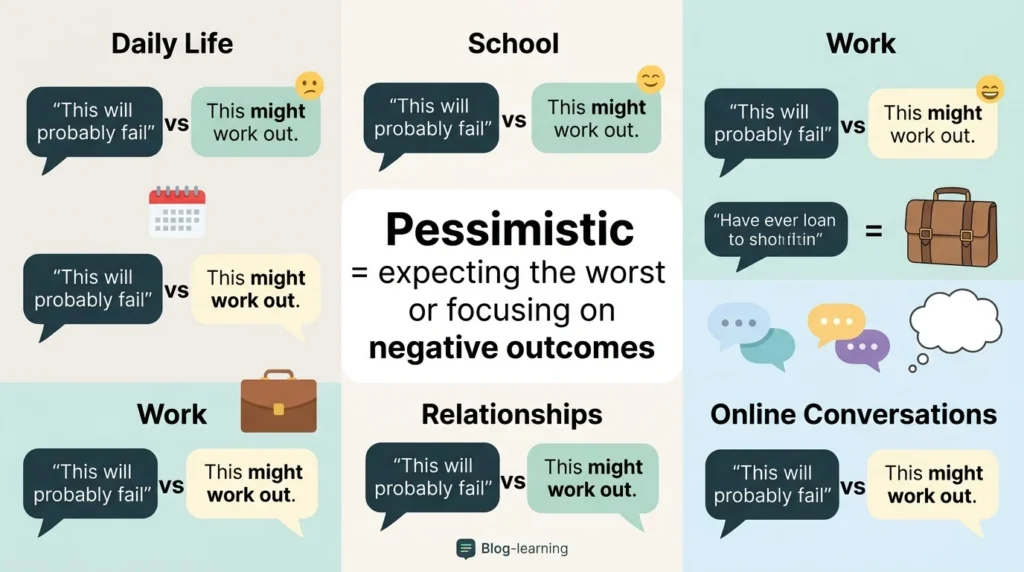
Pessimistic means having a tendency to expect the worst, focus on problems, or assume that outcomes will be unfavorable. A pessimistic person often looks at a situation and notices the risks, failures, disappointments, or negative possibilities before the positive ones.
In simple terms:
- Optimistic thinking says, “This could work out.”
- Pessimistic thinking says, “This probably won’t work out.”
The word can describe:
- A person’s general outlook
Example: “He’s pessimistic about almost everything.” - A reaction to a specific event
Example: “She feels pessimistic about the interview.” - A prediction or statement
Example: “That’s a pessimistic view of the economy.” - A tone in conversation
Example: “Your response sounds really pessimistic.”
At its core, pessimism is about expectation. It’s not just noticing problems; it’s leaning toward the belief that the outcome will likely be bad, disappointing, difficult, or unsuccessful.
Full Definition of Pessimistic
The full meaning of pessimistic includes several layers. It can refer to mindset, emotion, communication style, and worldview. Here’s the clearest way to understand it.
Pessimistic as a mindset
A pessimistic mindset assumes that things may go wrong, fail, or end badly. It often focuses on obstacles more than opportunities. Someone with this mindset may think:
- “There’s no point trying.”
- “It probably won’t work.”
- “Something will go wrong.”
- “I already know this will end badly.”
- “People always disappoint you.”
This doesn’t always mean the person is trying to be negative on purpose. Sometimes pessimism comes from stress, burnout, disappointment, fear, past failures, anxiety, or feeling emotionally exhausted.
Pessimistic as a tone
A statement can be pessimistic even if the speaker is not always pessimistic as a person. For example:
- “Don’t get your hopes up.”
- “We’re probably going to mess this up.”
- “There’s no way they’ll pick me.”
- “This plan is going to fail.”
These comments sound pessimistic because they assume a negative outcome before there’s enough evidence to know for sure.
Pessimistic as a personality tendency
Some people are naturally more cautious, skeptical, or risk-focused. They may regularly prepare for worst-case scenarios and feel more comfortable expecting less. In that sense, pessimistic can describe a long-term pattern:
- always assuming bad news is coming
- struggling to trust good outcomes
- noticing danger before opportunity
- mentally preparing for disappointment
Pessimistic as emotional protection
Sometimes people use pessimism as a defense mechanism. The thinking goes like this:
- “If I expect the worst, I won’t be disappointed.”
- “If I don’t get my hopes up, it won’t hurt as much.”
- “If I assume failure, success will be a surprise.”
This is one reason pessimism can be emotionally complicated. It may look like negativity from the outside, but for the person using it, it can feel like self-protection.
Pessimistic Meaning in Simple Everyday English
If you want the plain-English version, pessimistic means negative about the future.
A pessimistic person often:
- expects bad results
- assumes plans will fail
- worries more than hopes
- sees the downside first
- doubts improvement
- predicts disappointment
Here are simple sentence examples:
- “She’s pessimistic about getting the job.”
- “I’m feeling pessimistic about this exam.”
- “That was a very pessimistic response.”
- “He always thinks the worst will happen.”
- “Why are you so pessimistic about everything?”
Context and Usage of Pessimistic
The meaning of pessimistic changes slightly depending on context. The core idea stays the same, but the emotional tone can shift from mild doubt to deep negativity.
Pessimistic in personal life
In personal life, pessimistic often describes how someone thinks about relationships, family issues, plans, health, or future goals.
Examples:
- “I’m pessimistic about this relationship lasting.”
- “She’s pessimistic about moving to a new city.”
- “He’s pessimistic about fixing things with his parents.”
Here, the word usually implies emotional doubt, fear, or low expectations.
Pessimistic in school or academics
Students may sound pessimistic when they assume they’ll fail, do badly, or not get accepted.
Examples:
- “I’m pessimistic about my exam results.”
- “She’s pessimistic about getting into that college.”
- “He thinks his presentation will go terribly.”
In academic settings, pessimism often overlaps with stress, self-doubt, and pressure.
Pessimistic at work
At work, the word can describe a negative view of a project, deadline, promotion, meeting, or business result.
Examples:
- “The manager is pessimistic about this quarter’s sales.”
- “I’m pessimistic about the client approving the proposal.”
- “Her pessimistic attitude affected the team’s morale.”
In workplace communication, pessimistic can sound professional, analytical, cynical, or demotivating depending on tone.
Pessimistic in news, politics, or economics
The word is also common in broader public conversations.
Examples:
- “Experts are pessimistic about the housing market.”
- “The report gives a pessimistic forecast.”
- “Voters feel pessimistic about the economy.”
In these contexts, pessimistic often means expecting decline, instability, or poor results based on current conditions.
Pessimistic in emotional conversations
Sometimes the word is used as feedback on how someone sounds rather than what they believe.
Examples:
- “You’re being really pessimistic right now.”
- “That message sounded kind of pessimistic.”
- “I get your concerns, but this feels overly pessimistic.”
Here, the speaker is reacting to the tone of the message, not necessarily diagnosing the person’s entire personality.
Real-Life Examples of Pessimistic Meaning
The easiest way to understand the word is to see it in natural situations.
Example 1: Job interview
Person A: “I have an interview tomorrow.”
Person B: “Nice. How do you feel?”
Person A: “Honestly, I’m pessimistic. They probably already have someone else in mind.”
Meaning: Person A expects a bad outcome before the interview even happens.
Example 2: Group project
Student 1: “I think we can finish this by Friday.”
Student 2: “I doubt it. Someone will probably miss their part and we’ll all lose marks.”
Meaning: Student 2 is taking a pessimistic view by assuming failure.
Example 3: Relationship talk
Friend 1: “Do you think he’ll text back?”
Friend 2: “I’m pessimistic about it. If he wanted to, he would’ve replied already.”
Meaning: Friend 2 expects the disappointing outcome.
Example 4: Sports
Fan 1: “We still have a chance to win.”
Fan 2: “No way. We always choke in the second half.”
Meaning: Fan 2 is pessimistic because they assume the team will fail.
Example 5: Daily life
Coworker 1: “Maybe traffic won’t be too bad.”
Coworker 2: “I’m pessimistic. It’s Friday. We’ll probably be stuck for hours.”
Meaning: The second coworker assumes the negative possibility is more likely.
5 Conversation Examples in Natural Chat Style
Below are realistic dialogue examples that show how pessimistic appears in actual conversations.
Conversation Example 1: Exam stress
A: “Do you think you passed?”
B: “I’m pretty pessimistic about it.”
A: “Why?”
B: “Because the last section completely destroyed me.”
What it means: B expects a bad result and is mentally leaning toward failure.
Conversation Example 2: Dating
A: “You should ask her out.”
B: “I’m pessimistic tbh. I don’t think she sees me that way.”
A: “You don’t know that unless you ask.”
What it means: B assumes rejection before getting a real answer.
Conversation Example 3: Work deadline
Manager: “Can we deliver by Monday?”
Employee: “I want to say yes, but I’m pessimistic. The design team is behind and the client keeps changing the scope.”
What it means: The employee is expressing doubt based on obstacles and likely delays.
Conversation Example 4: Family plans
A: “Do you think everyone will get along at dinner?”
B: “I’m pessimistic after what happened last time.”
What it means: Past experience is making B expect conflict again.
Conversation Example 5: Online order
A: “Your package should arrive today.”
B: “I’m pessimistic. It’s been ‘out for delivery’ for like 10 hours.”
What it means: B expects disappointment because the situation already feels unreliable.
Platform-Specific Meaning of Pessimistic
Unlike internet slang, pessimistic is a standard English adjective, so its meaning stays fairly stable across platforms. What changes is tone, brevity, and how directly people use it.
Pessimistic on WhatsApp
On WhatsApp, people often use pessimistic when talking casually about personal problems, exams, work stress, family issues, or plans.
Common WhatsApp-style examples
- “I’m pessimistic about tomorrow’s meeting.”
- “Don’t be so pessimistic, it might go fine.”
- “She’s being pessimistic again about the trip.”
- “I know I sound pessimistic but I really think they’ll cancel.”
Tone on WhatsApp
On WhatsApp, pessimistic can sound:
- worried
- tired
- emotionally honest
- slightly dramatic
- realistic, depending on the context
Because chats are personal, the word often carries emotional weight rather than sounding purely academic.
Pessimistic on Snapchat
On Snapchat, people are less likely to use the word in a formal sentence unless they’re venting or joking. The idea might show up more through the tone of a message than the exact word itself.
Snapchat-style examples
- “I’m pessimistic af about this test 😭”
- “Bro why are you so pessimistic”
- “Not to be pessimistic but this is definitely gonna flop”
- “My mood is just permanently pessimistic during finals week”
Tone on Snapchat
The tone can be:
- exaggerated
- humorous
- dramatic
- self-aware
- emotionally messy in a relatable way
Pessimistic on TikTok
On TikTok, the word appears in captions, comment sections, self-reflection videos, mental health discussions, study content, relationship content, and “day in my life” posts.
TikTok-style uses
- “Trying to stop being so pessimistic about my future.”
- “I’m not negative, just pessimistic and tired.”
- “Pessimistic people after one minor inconvenience: it’s over.”
- “Growing up in chaos made me so pessimistic fr.”
Tone on TikTok
TikTok often blends serious emotional language with humor. So pessimistic might be used in:
- sincere self-analysis
- therapy-adjacent conversations
- dark humor
- burnout content
- relationship commentary
Pessimistic on Instagram
On Instagram, the word might appear in story captions, quote posts, personal reflections, or comments.
Instagram-style examples
- “Trying not to be pessimistic, just realistic.”
- “My pessimistic brain always assumes the worst.”
- “This year made me way more pessimistic than I used to be.”
Tone on Instagram
It can feel:
- introspective
- aesthetic
- emotionally polished
- self-aware
- motivational if paired with growth language
Pessimistic on X or text-style short posts
On fast-moving text platforms, the word is often used to label someone’s take or reaction.
Examples:
- “That’s such a pessimistic read of the situation.”
- “I’m pessimistic about this rollout.”
- “Market is looking pessimistic rn.”
The tone here can be analytical, blunt, sarcastic, or emotionally detached.
Alternative Meanings and Closely Related Uses
The word pessimistic usually has one core meaning, but it can point to slightly different shades of thought depending on how it’s used.
Pessimistic as “expecting failure”
This is the most common meaning.
- “I’m pessimistic about our chances.”
- “He’s pessimistic about passing.”
This means: I expect the outcome to go badly.
Pessimistic as “negative in outlook”
This is broader and can describe a person’s personality or worldview.
- “She has a pessimistic outlook on life.”
- “He tends to be pessimistic about people.”
This means: the person generally leans toward negative expectations.
Pessimistic as “discouraging or doubtful”
Sometimes the word doesn’t mean someone expects total disaster. It can simply mean they’re talking in a discouraging, low-hope way.
- “Your response sounds pessimistic.”
- “That’s a very pessimistic take.”
This means: your tone is heavily focused on problems or bad outcomes.
Pessimistic as “cautious to the point of negativity”
Some people are not trying to be hopeless; they’re trying to protect themselves by preparing for the worst. In those cases, pessimistic overlaps with caution.
- “I’m pessimistic because I’d rather not get my hopes up.”
This means: I’m using low expectations as emotional protection.
Related Terms and NLP Variations
If you’re learning the pessimistic meaning, it helps to understand the words around it. These related terms show the semantic family of pessimistic and help you interpret tone more accurately.
Common synonyms of pessimistic
These words can overlap with pessimistic, though they are not always exact replacements.
Negative
A broad word for unfavorable thinking, language, or attitude.
- “She’s very negative about the whole thing.”
Doubtful
Suggests uncertainty and low confidence rather than full negativity.
- “I’m doubtful this plan will work.”
Cynical
More specific than pessimistic. It often implies distrust of people’s motives.
- “He’s cynical about politics.”
Defeatist
Means acting as if failure is already certain, often giving up too early.
- “That’s a defeatist attitude.”
Gloomy
Suggests sadness, darkness, or emotional heaviness.
- “She sounded gloomy about the future.”
Hopeless
Stronger than pessimistic. It implies almost no belief in improvement.
- “He felt hopeless after the rejection.”
Skeptical
Means unconvinced or doubtful, but not always negative.
- “I’m skeptical of those numbers.”
Fatalistic
A more extreme word that suggests believing outcomes are fixed and bad things can’t be changed.
- “He has a fatalistic view of life.”
Opposites of pessimistic
Optimistic
Expecting good outcomes or at least believing things may improve.
Hopeful
Feeling some confidence or positive possibility.
Encouraging
Expressing support and confidence rather than doubt.
Positive
Broadly favorable in attitude or expectation.
Pessimistic vs Optimistic
This is the most important contrast.
| Pessimistic | Optimistic |
|---|---|
| Expects bad outcomes | Expects good outcomes |
| Focuses on what may go wrong | Focuses on what may go right |
| Lowers expectations | Raises hope or confidence |
| May sound protective or discouraging | May sound motivating or unrealistic |
| Often linked to fear, stress, or doubt | Often linked to hope, confidence, or resilience |
Example contrast
Optimistic: “I think the interview could go well.”
Pessimistic: “They probably won’t hire me.”
Both are guesses about the future, but one leans positive and the other leans negative.
Pessimistic vs Realistic
This is where people get stuck, because many people say, “I’m not pessimistic. I’m realistic.”
Sometimes that’s true. Sometimes it isn’t.
When pessimistic may actually be realistic
If there’s strong evidence that something is unlikely to work, a negative prediction may simply be realistic.
Examples:
- The project is already two months late
- The company publicly announced layoffs
- You didn’t meet the application requirements
- The weather forecast clearly shows a storm
In those cases, saying “This probably won’t happen” may not be irrational or overly negative.
When “realistic” is actually pessimistic
Sometimes people use “realistic” to justify automatic worst-case thinking.
Examples:
- assuming someone hates you because they replied late
- deciding you’ll fail before studying
- believing one bad experience means every future attempt will fail
- dismissing good possibilities without evidence
That’s less about realism and more about negative expectation.
Simple test
Ask: Is this belief based on evidence, or is it based on fear, habit, or disappointment?
- If it’s evidence-based, it may be realistic.
- If it jumps straight to the worst conclusion, it’s probably pessimistic.
Emotional Meaning of Pessimistic
The dictionary meaning is useful, but the emotional meaning matters just as much in real life.
When someone is called pessimistic, it can imply more than “they expect bad outcomes.” It may also suggest:
- they struggle to trust good things
- they’re emotionally guarded
- they’ve been disappointed before
- they’re anxious or overwhelmed
- they are draining the mood of the group
- they don’t leave much room for hope
That’s why tone matters. Saying “I’m pessimistic about this test” sounds different from saying “You’re such a pessimistic person.” The first describes a feeling about one situation. The second can sound like a judgment about someone’s personality.
How to Respond When Someone Is Being Pessimistic
If someone says something pessimistic, your response depends on the situation. Sometimes they need encouragement. Sometimes they need realism. Sometimes they just need to feel heard.
If they’re stressed and discouraged
You can respond with calm support:
- “I get why you feel that way, but it’s not over yet.”
- “Maybe. But there’s still a chance it works out.”
- “You don’t have to assume the worst right now.”
- “Let’s wait until we actually know.”
If they’re catastrophizing without evidence
You can gently challenge the assumption:
- “What makes you think that’s definitely going to happen?”
- “Is that the most likely outcome, or just the worst one?”
- “Could there be another explanation?”
- “You might be jumping to the negative version first.”
If they’re being pessimistic in a team setting
Try reframing without dismissing concerns:
- “The risks are real, but let’s talk about solutions too.”
- “I hear the concern. What would improve the odds?”
- “Let’s separate what’s possible from what’s probable.”
If they’re using pessimism as self-protection
A softer response works better:
- “You don’t have to expect the worst to protect yourself.”
- “I know you’re trying not to get hurt.”
- “Keeping expectations low might feel safer, but it can also make everything feel heavier.”
Misinterpretations of Pessimistic
The word is common, but it’s often used too loosely. Here are the biggest misunderstandings.
Misinterpretation 1: Pessimistic always means dramatic
Not necessarily. A pessimistic comment can be quiet, calm, and logical. It doesn’t have to be emotional or exaggerated.
Example:
- “I don’t think this plan is financially viable.”
That could be pessimistic, but not dramatic.
Misinterpretation 2: Pessimistic people are always wrong
Also false. A pessimistic person can be right. The label is about expectation style, not whether the prediction turns out true.
Misinterpretation 3: Pessimistic and depressed mean the same thing
They do not mean the same thing. Pessimism is a style of expectation or outlook. Depression is a mental health condition. They can overlap, but they are not interchangeable.
Misinterpretation 4: One pessimistic comment means someone is a pessimistic person
Not always. Anyone can sound pessimistic during a bad week, a stressful situation, or after a disappointment. Context matters.
Misinterpretation 5: Pessimistic just means honest
Sometimes honesty sounds negative because the facts are negative. But honesty and pessimism are not the same thing. Pessimism involves expecting bad outcomes, often ahead of certainty.
When Not to Use the Word Pessimistic
Even if the word fits broadly, it isn’t always the best label.
Don’t use it to dismiss valid concerns
If someone points out real problems, calling them pessimistic can shut down useful discussion.
Example:
- “We don’t have enough budget for this.”
- “Stop being pessimistic.”
That response may be unfair if the concern is fact-based.
Don’t use it as a shortcut for “I don’t like your tone”
Sometimes the real issue is that the person sounds blunt, cold, cynical, anxious, or unmotivated. Pessimistic may be part of that, but it may not be the whole story.
Don’t assume it’s their entire personality
A person may be pessimistic about one area of life but not others.
Examples:
- optimistic in relationships but pessimistic about money
- hopeful socially but pessimistic academically
- positive outwardly but privately pessimistic about their future
Usage Tips: How to Use Pessimistic Correctly
Here are practical ways to use the word naturally.
Use it for outlook, not just mood
Good:
- “She’s pessimistic about the outcome.”
Less precise:
- “She looks pessimistic.”
The first one clearly refers to expectation. The second sounds vague unless the context is obvious.
Clarify whether you mean temporary or general
Compare:
- “I’m feeling pessimistic about this week.”
This is temporary. - “He has a pessimistic outlook on life.”
This is broader and more serious.
Use it carefully in personal conversations
Calling someone pessimistic can sound like criticism. If you want a softer version, try:
- “You sound really discouraged.”
- “You seem worried about the worst-case outcome.”
- “It sounds like you’re expecting this to go badly.”
These phrases describe the moment without making it sound like a personality attack.
Example Sentences Using Pessimistic
Here are more examples across different contexts.
Daily life
- “I’m pessimistic about finding parking this late.”
- “She gave me a pessimistic look when I mentioned road-tripping in winter.”
School
- “He’s pessimistic about his math grade.”
- “Don’t be so pessimistic before the results are even out.”
Work
- “The team is pessimistic about meeting the deadline.”
- “Her pessimistic forecast made the investors nervous.”
Relationships
- “After a few bad experiences, he became pessimistic about dating.”
- “I’m trying not to be pessimistic, but this situation feels off.”
Money and future planning
- “Consumers are feeling pessimistic about inflation.”
- “They remain pessimistic about the housing market.”
Common Phrases With Pessimistic
You’ll often see the word in these patterns:
- pessimistic about something
“I’m pessimistic about the launch.” - a pessimistic outlook
“He has a pessimistic outlook on life.” - a pessimistic view
“That’s a pessimistic view of the situation.” - sound pessimistic
“You sound pessimistic today.” - overly pessimistic
“I think that prediction is overly pessimistic.” - cautiously pessimistic
This means negative, but not dramatic—more restrained and measured.
Is Pessimistic Always a Bad Thing?
Not always. In some situations, pessimistic thinking can serve a purpose.
Potential benefits of pessimistic thinking
It can encourage preparation
If you assume something might go wrong, you may prepare better.
Example:
- bringing backup files
- saving extra money
- leaving earlier for traffic
- checking details twice
It can reduce overconfidence
Optimism without realism can lead to careless decisions. Pessimism can sometimes add caution.
It can protect emotional expectations
Some people cope by not getting their hopes too high. That doesn’t solve everything, but it can explain why pessimism feels safer.
Downsides of pessimistic thinking
It can become self-fulfilling
If you always assume failure, you may stop trying hard enough to change the outcome.
It can damage motivation
Low expectations can kill momentum before a plan even begins.
It can affect relationships
Constantly expecting disappointment can make you harder to reassure, trust, or encourage.
It can distort reality
When pessimism becomes automatic, neutral situations can start looking negative by default.
FAQs
What does pessimistic mean in simple words?
In simple words, pessimistic means expecting bad things to happen or assuming a situation will turn out badly instead of well.
Is pessimistic the same as negative?
Not exactly, but they overlap. Negative is broader and can describe attitude, feedback, mood, or language. Pessimistic specifically focuses on expecting unfavorable outcomes.
What is an example of pessimistic?
A good example is: “I probably won’t get the job, so there’s no point getting excited.”
That’s pessimistic because it assumes failure before the result is known.
What is the opposite of pessimistic?
The opposite is optimistic. An optimistic person expects better outcomes, sees possibilities, and tends to believe things may work out.
Can a person be pessimistic about one thing but not everything?
Yes. Someone might be pessimistic about school, dating, or money, but optimistic in other areas of life. The word doesn’t always describe their entire personality.
Is pessimistic a personality trait or just a mood?
It can be either. Some people have a generally pessimistic outlook, while others only feel pessimistic during specific situations like stress, failure, conflict, or uncertainty.
Does pessimistic mean depressed?
No. They are not the same. Pessimistic refers to expecting bad outcomes or focusing on the negative side of situations. Depression is a mental health condition and should not be used interchangeably with pessimism.
Is being pessimistic always unhealthy?
Not always. Mild pessimism can make people more cautious, prepared, and realistic about risks. It becomes more harmful when it turns into constant hopelessness, avoidance, or automatic worst-case thinking.
What does “don’t be pessimistic” mean?
It means: don’t assume the worst so quickly. The speaker is usually asking the other person to be more hopeful, open-minded, or balanced about the outcome.
What does pessimistic mean in a relationship?
In relationships, pessimistic usually means expecting rejection, conflict, disappointment, or emotional failure. For example, someone may assume the relationship won’t last or that the other person will leave, even without clear evidence.
Conclusion
The pessimistic meaning is simple at its core but nuanced in real life. It refers to expecting bad outcomes, focusing on what might go wrong, or assuming a situation will end poorly rather than well. You can use it to describe a person, a prediction, a message, a mindset, or a temporary emotional state.
What makes the word important is context. Sometimes pessimistic thinking is just negativity. Sometimes it’s caution. Sometimes it’s emotional self-protection after disappointment. And sometimes it’s a fair description of someone who habitually expects the worst. That’s why it helps to ask not just what someone is saying, but why they’re saying it. Are they looking at evidence? Are they anxious? Are they protecting themselves? Or are they stuck in a pattern of assuming the worst before life even has a chance to play out?
In everyday English, if someone is pessimistic, they’re leaning toward the negative outcome. Whether that sounds realistic, discouraging, guarded, or simply honest depends on the situation, the evidence, and the tone. But now when you see or hear the word, you’ll know exactly what it means, how it’s used, and how to interpret it in conversation.

Victoria Lane is a grammar-focused writer at GramBrix.com, passionate about helping readers master the rules of language. She provides clear explanations and practical examples that make writing more accurate, polished and confident.