Last Updated on July 7, 2026
| Term | Meaning |
|---|---|
| ASL | Age, Sex, Location |
| Type | Internet slang acronym |
| Common Use | Getting basic information about someone online |
| Platforms | Texting, chat rooms, Snapchat, Discord, social media |
| Example | “ASL?” = “How old are you, what is your gender, and where are you from?” |
| Tone | Casual, conversational, sometimes outdated |
If you’ve ever received a message saying “ASL?” and wondered what it means, you’re not alone. The acronym has been part of internet culture for decades and still appears in chats, social media conversations, gaming communities, and messaging apps.
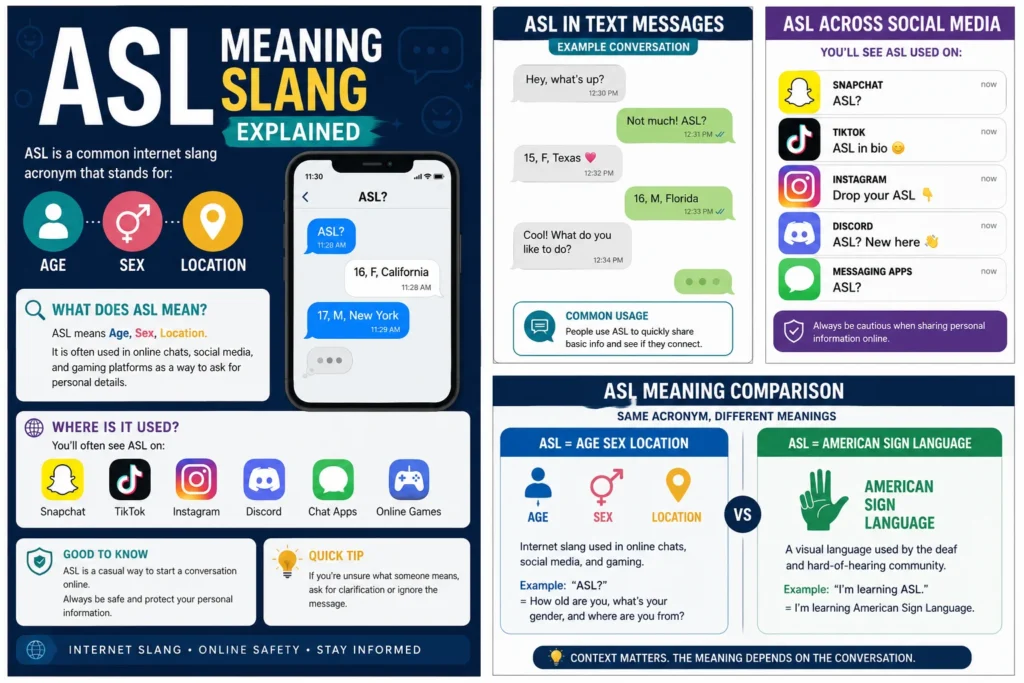
The ASL meaning slang most commonly stands for Age, Sex, Location. It is a quick way for someone online to ask for basic personal information. While the phrase originated in early internet chat rooms, it continues to appear across modern platforms, although its usage has evolved.
Today, ASL can have multiple meanings depending on context. Sometimes it refers to Age, Sex, Location, while in other situations it may stand for American Sign Language. Because of these multiple meanings, understanding context is essential.
In this complete guide, you’ll learn what ASL means, where it came from, how it’s used on different platforms, examples of real conversations, alternative meanings, reply strategies, common misunderstandings, and much more.
Quick Answer Box
| Category | Explanation |
|---|---|
| Meaning | Age, Sex, Location |
| Type | Internet slang acronym |
| Purpose | Asking for basic personal details |
| Common Platforms | Texting, Snapchat, Discord, Reddit, gaming chats |
| Example | “ASL?” |
| Typical Reply | “21/F/California” |
| Tone | Casual, informal |
| Popularity | Most common in online chat culture |
What Does ASL Mean?
The most common slang meaning of ASL is:
Age, Sex, Location
People use it to quickly ask someone:
- How old are you?
- What gender do you identify as?
- Where are you located?
For many years, ASL was one of the most frequently used acronyms on the internet.
Example:
Person 1: ASL?
Person 2: 19/F/Texas
This means:
- Age: 19
- Sex/Gender: Female
- Location: Texas
The phrase became popular because it allowed people to exchange basic information quickly without typing full questions.
Full Definition
ASL is an internet shorthand acronym that traditionally means:
Age + Sex + Location
It serves as a conversation starter and is often used when meeting someone online for the first time.
Breakdown of ASL
| Letter | Meaning |
|---|---|
| A | Age |
| S | Sex or Gender |
| L | Location |
The acronym became a standard greeting in many online communities during the early days of internet chat.
Why People Use ASL
People use ASL to:
- Learn basic information quickly
- Start conversations
- Find people with similar demographics
- Build online friendships
- Connect with gamers or community members
While common historically, some users today view it as outdated or overly personal depending on the situation.
Context and Usage
Understanding context is important because ASL can feel normal in some settings and unusual in others.
Casual Online Conversations
ASL is most commonly used when strangers first meet online.
Example:
“Hey, ASL?”
The sender wants basic information before continuing the conversation.
Gaming Communities
Gamers occasionally use ASL while chatting in multiplayer games.
Example:
“Anyone here from the US? ASL?”
Social Media
On social platforms, ASL appears less frequently than it did in old chat rooms but is still recognized.
Group Chats
Sometimes people use ASL to get to know new members.
Example:
“Welcome to the group. ASL?”
Internet Culture
The phrase has become part of internet history and is often referenced humorously.
Many older internet users instantly recognize it.
Real-Life Examples
Here are practical examples showing how ASL works in everyday online communication.
Example 1: New Chat
A stranger sends:
“Hi, ASL?”
They are asking for your age, gender, and location.
Example 2: Gaming Server
A player asks:
“ASL? Looking for people around my age.”
They want demographic information before forming a gaming group.
Example 3: Community Forum
Someone writes:
“ASL everyone?”
They’re asking participants to introduce themselves.
Example 4: Old-School Chat Room
Users often exchanged:
“16/M/New York”
or
“21/F/Florida”
as standard introductions.
Example 5: Social Media Comment
A user jokes:
“This feels like the old internet. ASL?”
This references classic internet culture.
Real-Life Conversation Examples
Conversation Example 1
Alex: Hey.
Jordan: Hi.
Alex: ASL?
Jordan: 22/F/California.
Alex: Nice to meet you.
Conversation Example 2
Player 1: Anyone want to squad up?
Player 2: Sure.
Player 1: ASL?
Player 2: 20/M/Texas.
Conversation Example 3
User A: New here.
User B: Welcome! ASL?
User A: 18/F/Ohio.
Conversation Example 4
Friend: Why did they ask ASL?
You: They wanted my age, gender, and location.
Conversation Example 5
User: ASL?
Reply: 25/M/Chicago. You?
Platform-Specific Meaning
The meaning of ASL can vary slightly depending on where it appears.
Snapchat
On Snapchat, ASL usually means Age, Sex, Location.
Users often ask it early in conversations.
Example:
“Hey, ASL?”
Sometimes users may be cautious about answering due to privacy concerns.
TikTok
On TikTok, ASL often appears in comments as a nostalgic reference to early internet culture.
Example:
“This comment section feels like old chat rooms. ASL?”
It may also refer to American Sign Language depending on the video topic.
Instagram users occasionally use ASL in direct messages when meeting new people.
Example:
“ASL before we chat?”
Discord
Discord communities frequently use ASL when introducing members.
Example:
“Drop your ASL in introductions.”
Reddit users often recognize ASL as a classic internet acronym.
Depending on the subreddit, it may be used seriously or humorously.
Gaming Platforms
In gaming chats, ASL is often used to identify players of similar ages or locations.
Example:
“ASL? Looking for teammates.”
ASL occasionally appears in community groups and Messenger chats.
However, it is less common than in earlier internet eras.
Alternative Meanings
ASL does not always mean Age, Sex, Location.
Context matters.
American Sign Language
This is the most common alternative meaning.
American Sign Language is a complete language used by many deaf and hard-of-hearing individuals in the United States.
Example:
“I’m learning ASL.”
In this case, the person is referring to American Sign Language.
Assessment for Learning
In education, ASL may refer to Assessment for Learning.
Average Sentence Length
In writing and publishing discussions, ASL can mean Average Sentence Length.
Other Industry Meanings
Certain industries use ASL as an abbreviation for technical terms, organizations, or processes.
However, in internet slang conversations, Age, Sex, Location remains the most recognized meaning.
Emotional and Social Meaning
Beyond the literal definition, ASL carries social implications.
Curiosity
Most users ask ASL because they want to know more about someone.
Connection
The phrase can help people find others with similar backgrounds.
Community Building
ASL often serves as an icebreaker.
Nostalgia
For many internet users, ASL represents classic online culture from the 1990s and early 2000s.
Ngl, seeing “ASL?” can instantly remind people of old chat rooms.
Privacy Considerations
Some users may feel uncomfortable sharing personal information.
As a result, ASL questions are sometimes viewed differently today than they were years ago.
Related Terms and NLP Variations
People searching for ASL meaning slang often search for similar terms.
Related Acronyms
- BRB (Be Right Back)
- LOL (Laugh Out Loud)
- IDK (I Don’t Know)
- IMO (In My Opinion)
- TBH (To Be Honest)
- SMH (Shaking My Head)
- DM (Direct Message)
- IRL (In Real Life)
- FWIW (For What It’s Worth)
- ICYMI (In Case You Missed It)
Similar Questions
People may ask:
- How old are you?
- Where are you from?
- What’s your age?
- What state do you live in?
- What’s your gender?
ASL combines all these questions into one short acronym.
Related Slang Phrases
- Introduce yourself
- Tell me about yourself
- Where are you from?
- What’s your demographic?
- New here?
How to Respond or Reply to ASL
There is no single correct response.
Your answer depends on comfort level and privacy preferences.
Traditional Reply
Example:
22/F/California
This follows the classic ASL format.
Casual Reply
Example:
I’m 21 and from Texas.
Friendly Reply
Example:
24/M/New York. How about you?
Privacy-Focused Reply
Example:
I’d rather not share personal details yet.
Humorous Reply
Example:
Nice try, FBI.
This is a common internet joke.
Modern Reply
Some users share only partial information.
Example:
Mid-20s, USA.
Misinterpretations
ASL is often misunderstood.
Mistake 1: Assuming It Always Means American Sign Language
Not necessarily.
Example:
“Learning ASL”
Likely means American Sign Language.
Example:
“ASL?”
Likely means Age, Sex, Location.
Mistake 2: Assuming Everyone Knows It
Many younger users have never encountered classic chat-room slang.
Mistake 3: Thinking It Is New Slang
ASL is actually one of the oldest internet acronyms.
Mistake 4: Assuming It Is Always Appropriate
Some people consider requests for personal information intrusive.
When NOT to Use It
There are situations where ASL may not be appropriate.
Professional Settings
Avoid ASL in:
- Job interviews
- Workplace emails
- Business communications
Formal Communication
The acronym is too informal for professional contexts.
Sensitive Conversations
Avoid requesting personal details if someone seems uncomfortable.
Public Spaces
Some users prefer not to share demographic information publicly.
Educational Contexts
If discussing American Sign Language, using ASL without context can create confusion.
Usage Tips
Understand the Audience
Younger users may not recognize classic internet slang.
Respect Privacy
Not everyone wants to share age or location.
Read Context Carefully
Determine whether ASL means:
- Age, Sex, Location
- American Sign Language
- Something else
Use It Casually
ASL works best in informal conversations.
Avoid Assumptions
If unsure, ask for clarification.
Example:
“Do you mean Age, Sex, Location or American Sign Language?”
ASL in Internet History
One reason ASL remains popular in search results is its importance in internet culture.
Early Chat Rooms
In the 1990s and early 2000s, users commonly entered chat rooms and immediately exchanged ASL information.
A typical conversation looked like:
ASL?
17/F/Florida
18/M/Texas
This became one of the most recognizable internet greetings ever.
AOL and Instant Messaging
ASL gained widespread popularity through online messaging platforms.
Meme Culture
Today, many people use ASL jokingly to reference old-school internet experiences.
Modern Relevance
Although less common than before, ASL remains widely understood.
Fr, it is one of the internet’s most iconic acronyms.
Comparison With Similar Slang Terms
ASL vs IRL
ASL
- Requests personal information
IRL
ASL vs DM
ASL
- Conversation starter
DM
- Direct Message
ASL vs TBH
ASL
- Seeks information
TBH
- Expresses honesty
ASL vs AMA
ASL
- Asks demographic information
AMA
- Means Ask Me Anything
FAQs
What does ASL mean in slang?
ASL most commonly means Age, Sex, Location in online conversations.
What does ASL mean in texting?
In texting, ASL usually asks for someone’s age, gender, and location.
Is ASL still used today?
Yes, although it is less common than during the early internet era.
What does ASL mean on Snapchat?
Most often, it means Age, Sex, Location.
What does ASL mean on TikTok?
It can mean Age, Sex, Location or American Sign Language depending on context.
What is the proper response to ASL?
A traditional response is something like “21/F/Texas.”
Is ASL considered old internet slang?
Yes. It is one of the oldest and most recognizable internet acronyms.
Does ASL always mean Age, Sex, Location?
No. It can also mean American Sign Language and other terms depending on context.
Why do people ask ASL?
Usually to learn basic information about someone online.
Is it okay not to answer ASL?
Absolutely. Sharing personal information is always optional.
Conclusion
The ASL meaning slang most commonly stands for Age, Sex, Location, a classic internet acronym used to ask basic personal information when meeting someone online. It became famous in chat rooms, instant messaging platforms, gaming communities, and early social networking spaces.
Today, ASL remains widely recognized, although its usage has evolved. Depending on context, it may also refer to American Sign Language, making context especially important when interpreting the acronym.
Whether you encounter ASL in a text message, Discord server, Snapchat conversation, TikTok comment, gaming chat, or social media discussion, understanding its meaning helps you navigate online communication more confidently. No cap, ASL remains one of the most iconic and enduring pieces of internet slang culture.

Kevin Brooks is a grammar specialist at GramBrix.com, dedicated to helping readers understand language rules with clarity and confidence. He simplifies complex grammar concepts through practical examples and easy explanations.