Last Updated on July 10, 2026
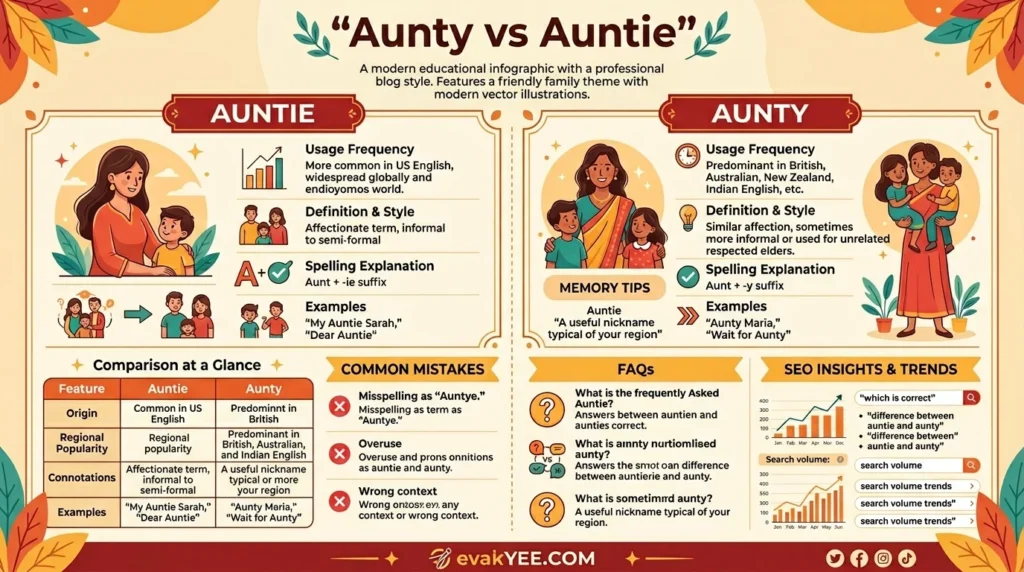
Both aunty and auntie are correct spellings of the informal word used for an aunt. However, auntie is generally more common in British English and many Commonwealth countries, while aunty is often used in informal writing, family communication, and certain regional dialects. Both words refer to a person’s aunt or a close older female family friend and have the same meaning.
You’ve probably seen both spellings before—Auntie on a birthday card and Aunty in a text message. So which one is actually correct? Surprisingly, the answer is: both.
Many English speakers grow up affectionately calling a favorite family member “Auntie Sarah” or “Aunty Jane” without ever questioning the spelling. It’s a common source of confusion because both versions appear in books, conversations, social media, and everyday writing.
The reassuring news is that both “auntie” and “aunty” are accepted English spellings. Neither is grammatically wrong. The choice usually depends on regional English, personal preference, publishing style, and family tradition rather than any official grammar rule.
For example:
- Auntie Mary is visiting this weekend. ✅
- Aunty Mary is visiting this weekend. ✅
Both sentences are perfectly correct. The only real difference is where and how the spelling is commonly used.
Understanding aunty or auntie is helpful whether you’re writing a greeting card, creating online content, learning English, or simply trying to choose the most appropriate spelling for your audience. Knowing the regional preferences can also make your writing feel more natural and culturally appropriate.
In this complete guide, you’ll learn the meaning of aunty and auntie, explore their regional differences, see real-life usage examples, understand which spelling works best for SEO, avoid common mistakes, and find answers to the most frequently asked questions about these two equally correct spellings.
Quick Answer
| Word | Correct? | Common Usage |
|---|---|---|
| Auntie | Yes | More common globally |
| Aunty | Yes | Informal and regional use |
| Both | Yes | Accepted English |
Simple Summary
- Auntie and aunty mean the same thing.
- Both are correct spellings.
- Auntie is slightly more common in published writing.
- Aunty is often used in personal and family contexts.
What Does Auntie Mean?
Definition
Auntie is an affectionate or informal way of referring to an aunt.
Family Meaning
An aunt is:
- The sister of a parent
- The wife of an uncle
- A close female family friend in some cultures
Examples
- Auntie Lisa baked cookies for us.
- My auntie lives in London.
- The children love visiting Auntie Emma.
Tone
Auntie sounds warm, friendly, and affectionate.
What Does Aunty Mean?
Definition
Aunty has exactly the same meaning as auntie.
Examples
- Aunty Jane sent me a birthday gift.
- We visited Aunty Susan yesterday.
- The children ran to greet Aunty Carol.
Informal Usage
Aunty is especially common in:
- Family conversations
- Text messages
- Social media posts
- Regional English varieties
Meaning
There is no difference in meaning between aunty and auntie.
Main Difference Between Aunty and Auntie
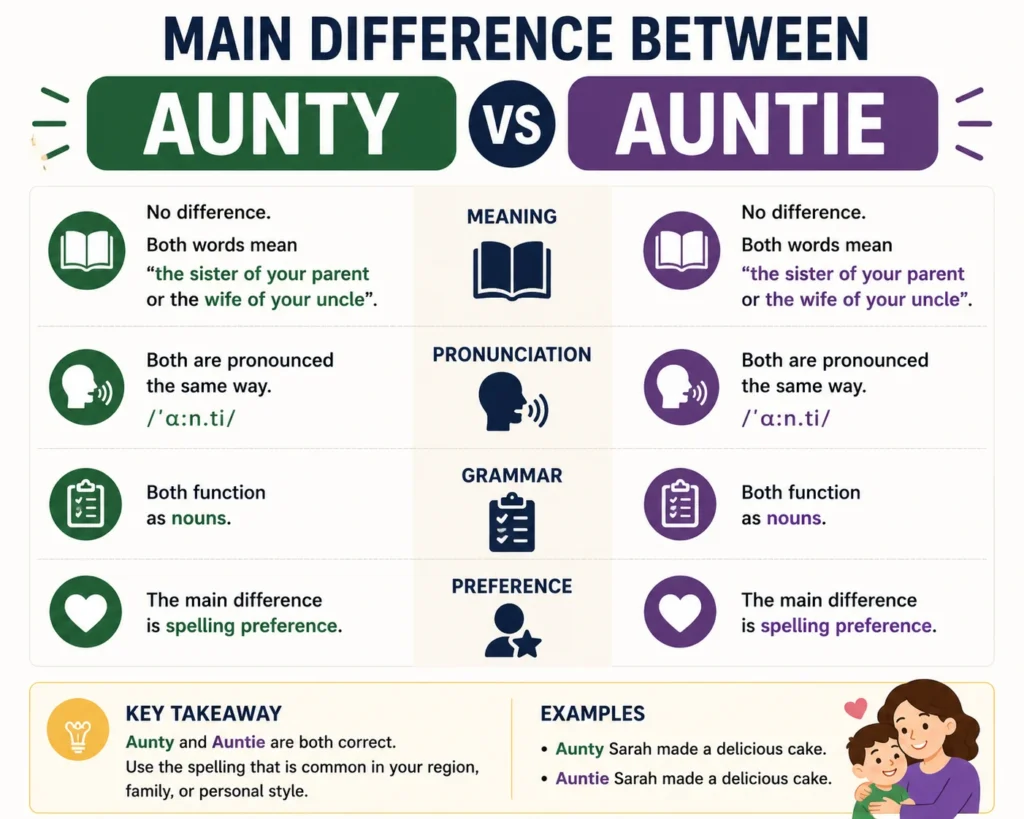
Meaning
No difference.
Pronunciation
Both are pronounced the same way.
Grammar
Both function as nouns.
Preference
The main difference is spelling preference.
Comparison Table
| Feature | Auntie | Aunty |
|---|---|---|
| Meaning | Same | Same |
| Pronunciation | Same | Same |
| Informal Usage | Yes | Yes |
| Family Use | Yes | Yes |
| Common in Publishing | More Common | Less Common |
| Correct English | Yes | Yes |
Why Are There Two Spellings?
Language Evolution
English often develops multiple spellings for informal family terms.
Regional Preferences
Different countries and communities adopted different spellings over time.
Family Traditions
Many families simply continue using the version they grew up with.
Personal Choice
Both spellings remain acceptable today.
Auntie in Everyday English
Family Conversations
Examples:
- Auntie Rachel is coming over.
- Ask Auntie if she wants tea.
Children’s Speech
Many children naturally use auntie.
Greeting Cards
Examples:
- Happy Birthday, Auntie!
Family Events
Auntie is common in invitations and family messages.
Aunty in Everyday English
Informal Communication
Examples:
- Aunty Emma called today.
- Thanks, Aunty, for the gift.
Social Media
Aunty frequently appears in captions and posts.
Cultural Usage
Many cultures use aunty for respected older women who are not biological relatives.
Community Settings
Aunty often functions as a term of affection and respect.
Is One More Correct Than the Other?
Short Answer
No.
Dictionary Recognition
Both spellings appear in major dictionaries.
Modern English
Both are accepted.
Context Matters
Audience and personal preference determine which version you use.
Which Spelling Is More Common?
Published Writing
Auntie generally appears more often in books and media.
Family Communication
Both spellings are common.
Online Searches
Auntie tends to have slightly higher search volume.
Regional Variations
Popularity depends on location.
Auntie vs Aunt
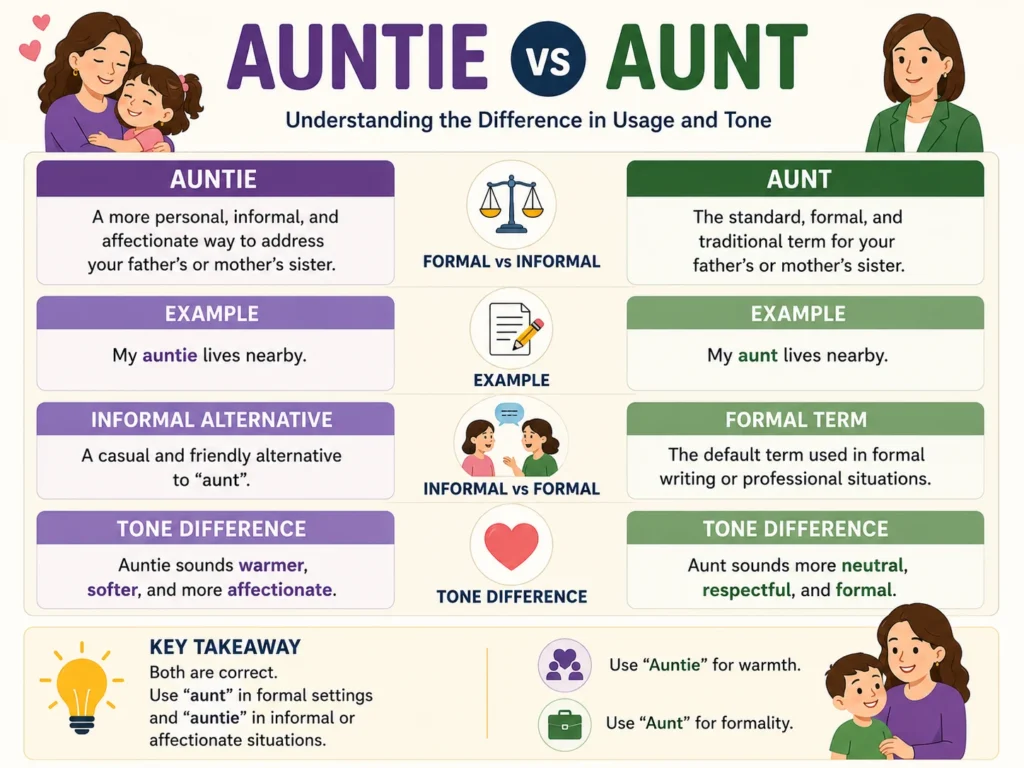
Formal vs Informal
Aunt is the standard formal term.
Example
- My aunt lives nearby.
Informal Alternative
- My auntie lives nearby.
Tone Difference
Auntie sounds warmer and more affectionate.
Aunty vs Aunt
Formal Context
Use aunt.
Informal Context
Use aunty.
Family Nickname
Many people prefer aunty as a nickname.
Personal Style
Both remain acceptable.
Cultural Uses of Auntie and Aunty
Respectful Address
In many cultures, older women are called auntie or aunty even without family connections.
Community Relationships
The terms often show respect and affection.
Social Traditions
Children frequently use these words for trusted adults.
Global Usage
Both spellings are recognized internationally.
Common Mistakes People Make
Assuming One Is Wrong
Both spellings are correct.
Confusing With Aunt
Aunt is the formal version.
Mixing Spellings
Choose one spelling and remain consistent.
Overthinking Regional Rules
Most readers understand both versions.
Which Version Is Better for SEO?
Search Trends
Auntie generally attracts slightly higher search volume.
Keyword Coverage
Including both spellings improves relevance.
Search Intent
Users often search to confirm which spelling is correct.
SEO Recommendation
Target aunty or auntie while explaining that both are correct.
How to Remember the Difference
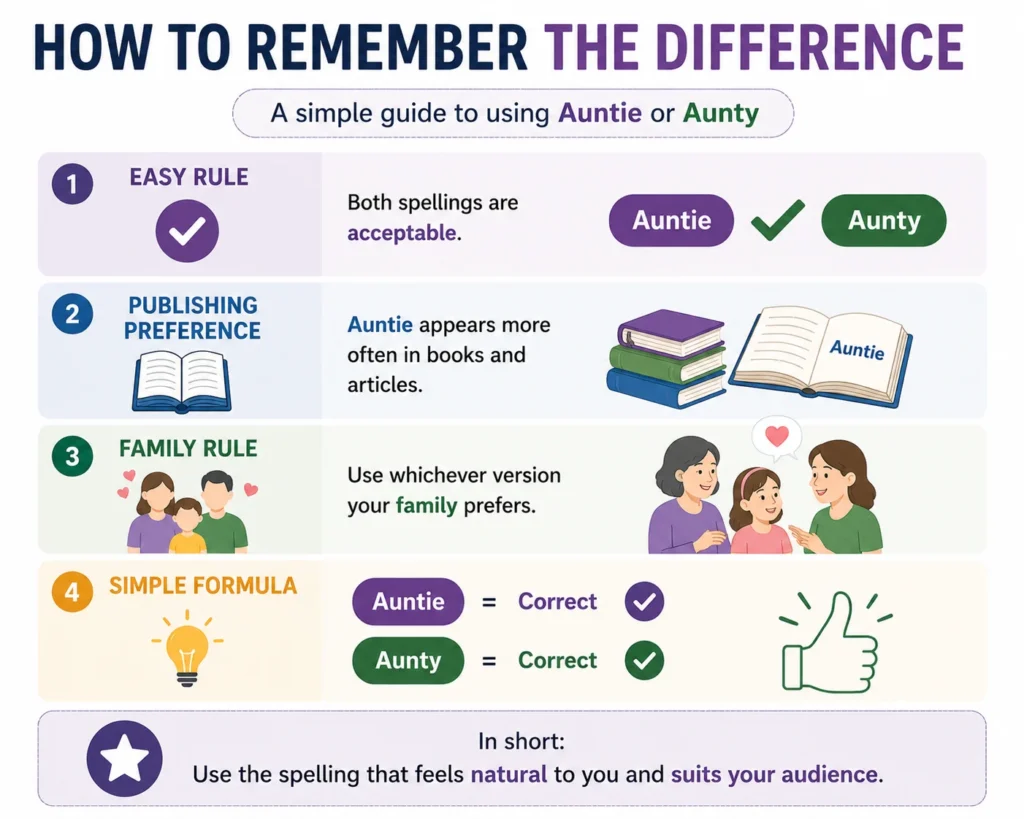
Easy Rule
Both spellings are acceptable.
Publishing Preference
Auntie appears more often in books and articles.
Family Rule
Use whichever version your family prefers.
Simple Formula
Auntie = Correct
Aunty = Correct
Related Spelling Comparisons
Theater or Theatre
Regional spelling variation.
Realize or Realise
American vs British English.
Color or Colour
Different regional spellings.
Aunty or Auntie
Personal and regional preference.
Exercises With Answers
Exercise 1
Which spelling is correct?
Answer: Both auntie and aunty.
Exercise 2
Do the words have different meanings?
Answer: No.
Exercise 3
Which spelling is more common in published writing?
Answer: Auntie.
Exercise 4
Can both refer to a close family friend?
Answer: Yes.
Exercise 5
Should you stay consistent with one spelling?
Answer: Yes.
FAQs
Is it aunty or auntie?
Both spellings are correct.
Which spelling is more common?
Auntie is generally more common in published English.
Do auntie and aunty mean the same thing?
Yes. Their meanings are identical.
Is aunty wrong?
No. It is a valid English spelling.
Is auntie more formal?
Not really. Both are informal forms of aunt.
Can I use either spelling in writing?
Yes.
Which spelling is better for SEO?
Auntie tends to have slightly higher search volume, but both should be included.
Is aunt the formal version?
Yes.
Are both spellings accepted in dictionaries?
Yes.
Which spelling should I use?
Choose the one preferred by your audience or family tradition.
Conclusion
The answer to aunty or auntie is simple:
Both spellings are correct.
Key takeaways include:
- Auntie and aunty have the same meaning.
- Both refer to an aunt or a respected older woman.
- Auntie is slightly more common in published English.
- Aunty is common in family communication and regional usage.
- Neither spelling is grammatically incorrect.
Remember this simple rule:
Auntie = Correct
Aunty = Correct
The best choice depends on personal preference, audience expectations, and consistency throughout your writing.

Victoria Lane is a grammar-focused writer at GramBrix.com, passionate about helping readers master the rules of language. She provides clear explanations and practical examples that make writing more accurate, polished and confident.