
Last Updated on July 8, 2026
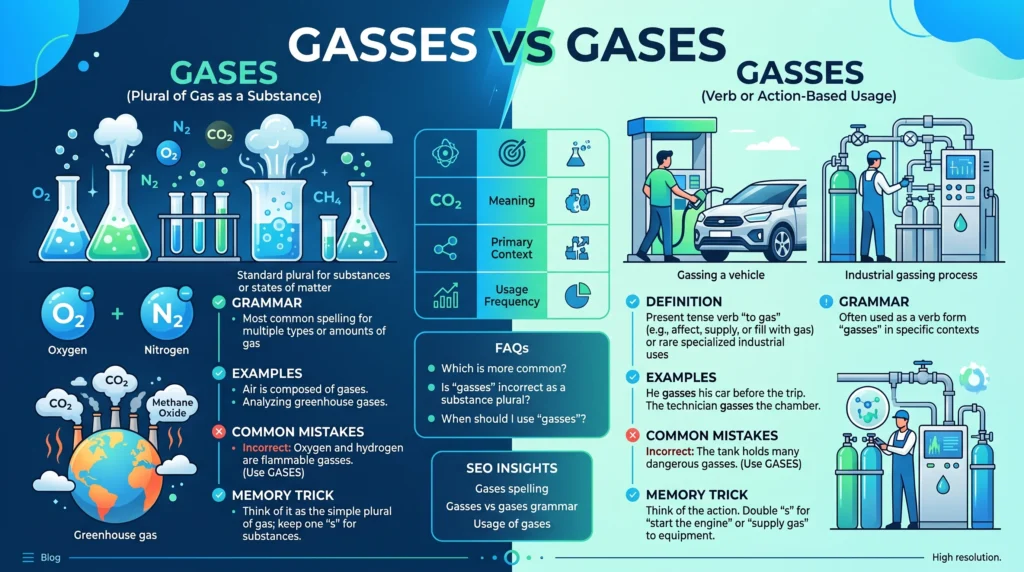
Gases is the standard and preferred plural form of gas in modern English. Gasses is also a real word, but it is typically used as a verb meaning “to expose someone to gas” or “to talk excessively.” In most scientific, academic, and everyday contexts, gases is the correct spelling when referring to multiple types of gas.
The confusion between gasses and gases is common because both words exist in English and are spelled correctly. However, they serve different grammatical purposes.
Consider these examples:
- The atmosphere contains several gases. ✅
- The atmosphere contains several gasses. ❌
In the first sentence, gases is correct because it refers to multiple gas substances.
Now consider:
- The factory gasses harmful insects. ✅
Here, gasses is correct because it functions as a verb.
Understanding the difference can improve:
- Grammar accuracy
- Scientific writing
- Academic work
- Professional communication
- SEO content quality
This guide explains:
- The meaning of gases
- The meaning of gasses
- Grammar rules
- Examples
- Common mistakes
- Memory tricks
- FAQs
Quick Answer
| Word | Part of Speech | Meaning |
|---|---|---|
| Gases | Noun (plural) | More than one gas |
| Gasses | Verb | To expose to gas or talk excessively |
Simple Summary
- Gases = Plural of gas.
- Gasses = Verb form.
- Most people searching “gasses or gases” need gases.
What Does Gases Mean?
Definition
Gases is the plural form of the noun gas.
Scientific Meaning
A gas is one of the primary states of matter.
Examples include:
- Oxygen
- Nitrogen
- Hydrogen
- Helium
- Carbon dioxide
Examples
- The laboratory studied various gases.
- Greenhouse gases affect climate change.
- Industrial gases are used in manufacturing.
Common Usage
Gases is widely used in:
- Science
- Education
- Engineering
- Medicine
- Environmental studies
What Does Gasses Mean?
Definition
Gasses is the third-person singular form of the verb to gas.
Verb Meaning
The verb can mean:
- To expose someone or something to gas
- To poison with gas
- To fuel with gas
- To talk excessively (informal)
Examples
- The machine gasses the chamber.
- He gasses up the car every week.
- She often gasses about her vacation. (informal)
Modern Usage
Gasses is far less common than gases.
Main Difference Between Gasses and Gases
Gases
Plural noun.
Example:
- Scientists analyzed several gases.
Gasses
Verb form.
Example:
- The technician gasses the equipment.
Quick Comparison
| Feature | Gases | Gasses |
|---|---|---|
| Part of Speech | Noun | Verb |
| Refers to Multiple Gases | Yes | No |
| Scientific Usage | Very Common | Rare |
| Everyday Usage | Common | Limited |
| Preferred Search Term | Yes | No |
Why Is Gases the Standard Plural?
English Plural Rules
Most nouns ending in S add -es to form the plural.
Examples:
- Bus → Buses
- Class → Classes
- Gas → Gases
Dictionary Preference
Modern dictionaries list gases as the standard plural.
Scientific Consistency
Scientists universally use gases.
Examples:
- Noble gases
- Greenhouse gases
- Industrial gases
Academic Writing
Gases is the accepted form in educational institutions worldwide.
How to Use Gases Correctly
Science
Examples:
- Different gases react differently under pressure.
- The experiment involved several gases.
Environmental Studies
Examples:
- Greenhouse gases contribute to global warming.
- Carbon dioxide is one of the most studied gases.
Engineering
Examples:
- Compressed gases require careful handling.
Medicine
Examples:
- Medical gases support patient treatment.
How to Use Gasses Correctly
Industrial Processes
Examples:
- The equipment gasses the storage container.
Vehicle Usage
Examples:
- He gasses up the truck every Friday.
Informal Speech
Examples:
- She gasses endlessly about celebrities.
Technical Context
Examples:
- The system automatically gasses the chamber.
Common Examples of Gases
Chemistry
- Oxygen and hydrogen are gases.
Physics
- Gases expand when heated.
Environment
- Greenhouse gases trap heat.
Industry
- Industrial gases are essential for manufacturing.
Common Examples of Gasses
Fueling Vehicles
- He gasses up before every road trip.
Industrial Equipment
- The machine gasses the enclosure.
Pest Control
- The technician gasses the area.
Informal Conversation
- She constantly gasses about her achievements.
Why People Confuse Gasses and Gases
Similar Spelling
The words differ by only one letter.
Same Pronunciation
In many accents, they sound nearly identical.
Both Are Correct Words
Unlike many spelling mistakes, both forms exist.
Limited Exposure
Many people rarely encounter the verb gasses.
Common Mistakes People Make
Using Gasses as a Plural Noun
Incorrect:
- The atmosphere contains many gasses.
Correct:
- The atmosphere contains many gases.
Using Gases as a Verb
Incorrect:
- The operator gases the chamber.
Correct:
- The operator gasses the chamber.
Confusing Scientific and Everyday Usage
Scientific writing almost always requires gases.
Ignoring Context
The correct choice depends on grammar, not pronunciation.
Gases in Scientific Writing
Chemistry
Examples:
- Noble gases are chemically stable.
Physics
Examples:
- Ideal gases follow predictable laws.
Environmental Science
Examples:
- Greenhouse gases affect Earth’s climate.
Academic Research
Gases is the universally accepted plural form.
Gases in Business and Industry
Manufacturing
Industrial gases support production processes.
Healthcare
Medical gases are essential in hospitals.
Energy Sector
Natural gases play a significant role in energy production.
Engineering
Compressed gases require specialized storage systems.
Which Word Is More Common?
Search Volume
Gases is significantly more common.
Scientific Literature
Gases dominates academic publications.
Education
Students encounter gases regularly.
Everyday English
Gasses appears far less frequently.
Which Word Is Better for SEO?
Search Intent
Most users searching this keyword want to know the correct plural form.
User Expectations
The majority expect the answer to be gases.
Content Optimization
Include both words while clearly explaining their differences.
SEO Recommendation
Target gasses or gases and explain that gases is usually the correct choice.
How to Remember the Difference
The Plural Trick
Think:
One gas → Two gases
Just like:
One bus → Two buses
The Verb Trick
If the action involves exposing something to gas, use gasses.
Easy Formula
Gases = Noun
Gasses = Verb
Memory Shortcut
If you’re talking about substances like oxygen or nitrogen, use gases.
Related Word Comparisons
Cactuses or Cacti
Common plural debate.
Indexes or Indices
Another plural variation.
Buses or Busses
Frequently confused forms.
Gasses or Gases
One of the most searched scientific spelling questions.
Exercises With Answers
Exercise 1
What is the plural of gas?
Answer: Gases
Exercise 2
Which word functions as a verb?
Answer: Gasses
Exercise 3
Complete the sentence:
Greenhouse _____ affect climate.
Answer: Gases
Exercise 4
Which word is common in chemistry?
Answer: Gases
Exercise 5
Which word means to expose something to gas?
Answer: Gasses
FAQs
Is it gasses or gases?
For the plural of gas, the correct word is gases.
What does gases mean?
Gases is the plural form of gas.
What does gasses mean?
Gasses is a verb meaning to expose something to gas or fuel with gas.
Which spelling is used in science?
Gases.
Is gasses a real word?
Yes, but it is generally used as a verb.
What are examples of gases?
Oxygen, nitrogen, helium, hydrogen, and carbon dioxide.
Why do people confuse the words?
Because both are correctly spelled English words.
Which word is more common?
Gases is far more common.
Can I use gasses as a plural noun?
Modern style guides recommend using gases.
Which word should I use in academic writing?
Use gases when referring to multiple gas substances.
Conclusion
The difference between gasses and gases comes down to grammar.
Key takeaways include:
- Gases is the standard plural form of gas.
- Gasses is primarily a verb.
- Scientific, educational, and professional writing almost always uses gases.
- Both words are technically correct but serve different purposes.
- Most people searching this topic are looking for the plural noun gases.
Remember this simple rule:
Gases = More than one gas
Gasses = An action involving gas
Using the correct form will improve clarity, professionalism, and grammatical accuracy in both everyday and technical writing.

Victoria Lane is a grammar-focused writer at GramBrix.com, passionate about helping readers master the rules of language. She provides clear explanations and practical examples that make writing more accurate, polished and confident.