
Last Updated on August 12, 2026
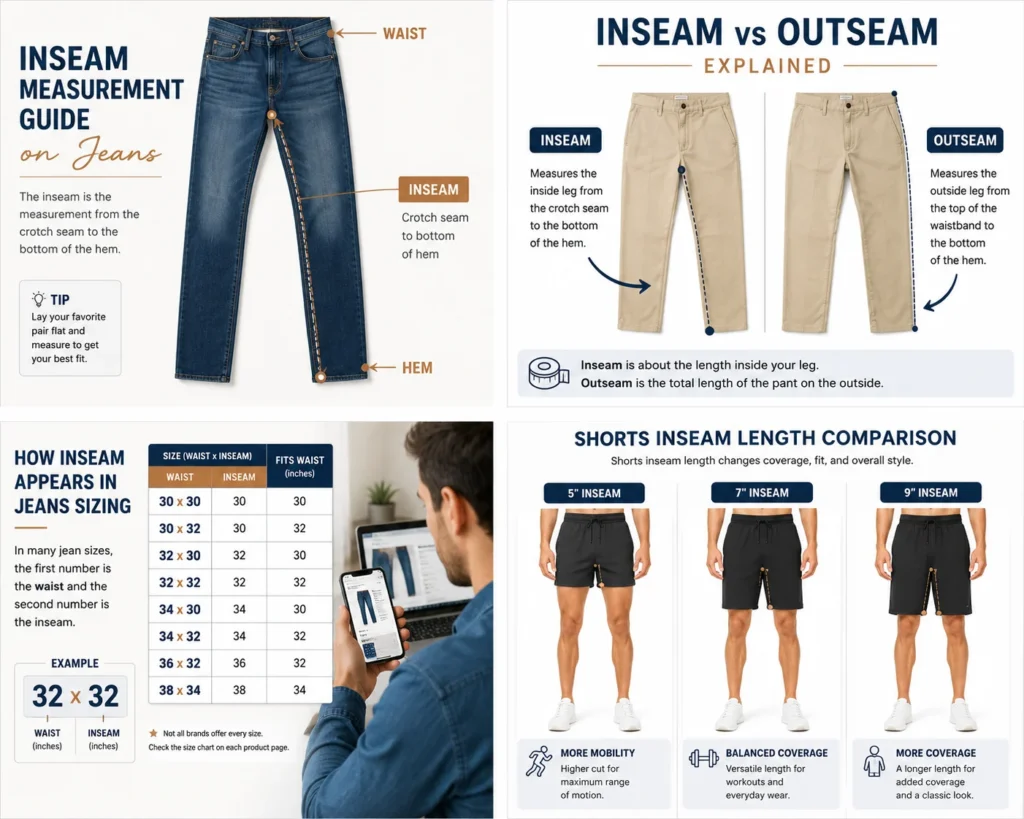
Inseam means the length of the inner leg seam on pants, measured from the crotch to the bottom of the leg opening. It’s one of the most important clothing measurements because it helps determine how long pants, jeans, leggings, or trousers will fit on your body.
Ever wondered why two pairs of pants with the same waist size can fit completely differently? The answer may be the inseam.
The inseam is one of the most important measurements when buying jeans, trousers, chinos, or other pants. In simple terms, inseam meaning refers to the length of the inside leg, measured from the crotch area down to the bottom of the pant leg. Knowing your inseam can help you choose pants that sit at the right length without looking too short or overly long.
Whether you are shopping online or checking a clothing size chart, understanding what is an inseam makes sizing much easier. In this guide, we’ll explain the inseam definition, how to measure inseam, where to find it on pants, and how inseam measurements affect the way your clothes fit.
Quick Answer Box
| Item | Explanation |
| Meaning | Inseam is the length from the crotch seam to the bottom hem on the inside of the leg. |
| Used for | Jeans, trousers, leggings, joggers, shorts, uniforms, and tailored pants. |
| Why it matters | It helps determine whether pants are too short, too long, or the right length. |
| Where you see it | Clothing size charts, product pages, tailoring instructions, and online shopping filters. |
| Common format | Sizes like 32×30 or 34×32 usually mean waist x inseam. |
| Example | If your jeans are labeled 30×32, the inseam is 32 inches. |
| Tone / usage | Neutral clothing and sizing term, not slang. |
What Does Inseam Mean?
The inseam meaning in clothing is simple: it refers to the inside leg measurement of a pair of pants, taken from the crotch seam down to the bottom of the pant leg. It’s called “inseam” because it follows the inner seam that runs along the inside of the leg.
When a brand lists a pair of jeans as Waist 32 / Inseam 30, that means the waistband is meant for a 32inch waist and the inner leg length is 30 inches.
In everyday shopping, inseam tells you how long the pants are. It’s the measurement that helps answer questions like:
- Will these jeans hit at my ankle?
- Will these trousers drag on the floor?
- Are these joggers cropped or full length?
- Will these work pants fit over boots?
- Are these petite, regular, or tall enough for me?
So if you want the most direct definition possible, here it is:
Inseam = the length of the inside leg of pants, measured from the crotch to the hem.
That’s the core meaning whether you’re shopping for denim, athletic wear, formal trousers, cargo pants, or school uniforms.
Full Definition of Inseam
To really understand inseam, it helps to place it in the context of how clothing measurements work.
In apparel sizing, pants and bottoms are often described using several measurements, including:
- Waist – around the waistband area
- Inseam – inside leg length
- Rise – distance from crotch seam to top of waistband
- Hip – circumference around the fullest part of the hips
- Outseam – outside leg length from waistband to hem
- Leg opening – width at the bottom of the pant leg
Among these, inseam is specifically about leg length on the inside of the garment.
Why the inseam measurement matters
Inseam matters because two people can have the same waist size but very different leg lengths. For example:
- Person A might wear 32×30
- Person B might wear 32×34
Both have a 32inch waist, but their inseams are different. If Person B buys pants with a 30inch inseam, they’ll likely feel too short. If Person A buys a 34inch inseam, the pants may bunch heavily at the ankle or need hemming.
That’s why inseam exists as a separate number rather than assuming everyone with the same waist needs the same pant length.
Inseam is not the same as total pant length
A common misunderstanding is thinking inseam means the full length of the pants. It doesn’t. It measures only the inside leg, not the entire pant from top to bottom.
The total outer length of pants is usually called the outseam. More on that in a later section.
Context and Usage: Where You’ll See “Inseam”
The term “inseam” shows up most often in fashion, tailoring, online shopping, and clothing size guides. It’s not slang, and it’s not usually used outside the context of apparel.
Common places where inseam appears
You’ll see the word inseam in places like:
- Jeans size labels
- Pants product pages
- Brand size charts
- Tailor or alteration notes
- Uniform sizing forms
- Sportswear descriptions
- Workwear and bootcut measurements
- Marketplace listings like eBay, Poshmark, and resale apps
Typical sentences using inseam
Here are some natural examples of how people use the word:
- “What’s the inseam on these jeans?”
- “I need a 30inch inseam.”
- “These pants fit my waist, but the inseam is too long.”
- “The listing says the inseam is 28 inches.”
- “Can you hem the inseam by an inch?”
- “I wear a 32 waist with a 34 inseam.”
These are standard, practical clothingrelated uses. No hidden meaning, no slang angle, no social media trend. It’s a sizing term.
Inseam vs Other Clothing Measurements
One reason people search inseam meaning is because they see it alongside other measurements and aren’t sure how they differ. The biggest points of confusion are usually inseam vs outseam, inseam vs rise, and inseam vs pant length.
Inseam vs Outseam
Inseam is the length from the crotch to the hem on the inside of the leg.
Outseam is the length from the top of the waistband to the hem on the outside of the leg.
Simple comparison
| Measurement | Starts at | Ends at | Used for |
| Inseam | Crotch seam | Bottom hem | Inner leg length |
| Outseam | Top of waistband | Bottom hem | Full outer pant length |
Why this matters
Two pants can have a similar inseam but feel different if the rise is different. For example, highrise pants sit higher on your body, which can affect the overall fit even if the inseam is the same.
Inseam vs Rise
Rise is the distance from the crotch seam up to the waistband.
- Lowrise pants sit lower on the hips
- Midrise pants sit around the natural waist area or slightly below
- Highrise pants sit higher on the waist
A person might wear:
- 30inch inseam with a high rise
- 30inch inseam with a low rise
Even though the inseam is the same, the pants can feel and look very different because the waistband sits in a different place.
Inseam vs Pant Length
People often use “pant length” casually to mean inseam, but they aren’t always identical.
In everyday shopping language, someone might say:
- “What length are these pants?”
- “I need a shorter pant length.”
Sometimes they mean inseam. Sometimes they mean the overall look of the pants. Retailers may list “length” categories such as:
- Short
- Regular
- Long
- Petite
- Tall
- Ankle
- Cropped
Those categories often correspond to inseam ranges, but not always in a standardized way. One brand’s “ankle length” might be 27 inches, while another’s could be 29 inches depending on the fit model.
How Inseam Is Measured
If you want the most useful part of this guide, it’s this section. Understanding the inseam meaning is one thing; knowing how to measure inseam correctly is what actually helps you buy clothes that fit.
The standard inseam measurement
Inseam is measured from:
the crotch seam → down the inside of the leg → to the bottom hem
That’s it in theory. But in practice, there are a few ways to measure it depending on whether you’re measuring your body or a pair of pants.
How to Measure Inseam on a Pair of Pants
This is usually the easiest and most accurate method if you already own pants that fit you well.
Stepbystep
- Lay the pants flat on a smooth surface.
- Smooth out wrinkles without stretching the fabric.
- Locate the crotch seam where the two legs meet.
- Place a measuring tape at the crotch seam.
- Measure straight down along the inner seam to the bottom hem.
- Record the measurement in inches.
That number is the inseam.
Example
If the measurement from crotch seam to hem is 31 inches, then the inseam is 31 inches.
This is one of the best ways to figure out your preferred inseam before shopping online.
How to Measure Inseam on Your Body
You can also measure your inseam directly on your body, though it’s a little trickier and often easier with help.
Body measurement method
- Stand straight with your shoes off.
- Place the top of a measuring tape at the highest point of your inner thigh, close to the crotch.
- Measure down the inside of your leg to where you want the pants to end.
- Keep the tape straight and close to the leg.
- Record the number.
Why this can be less reliable
Body inseam measurements can vary if:
- the tape shifts
- you don’t start at the right point
- you measure to the ankle bone instead of the desired hem point
- you’re measuring for different types of pants, like cropped jeans vs dress trousers
That’s why many people prefer measuring a pair of pants that already fits well.
How Tailors Use Inseam
Tailors often use inseam as a base reference, but they may also consider:
- shoe height
- break of the pant leg
- heel height
- boot shaft height
- whether the wearer wants a cropped, stacked, or fullbreak look
- whether the pants are for workwear, suiting, or casual use
So while inseam is crucial, it’s not the only measurement a tailor uses when adjusting pant length.
Why Inseam Matters So Much
You can think of inseam as the measurement that decides whether pants land correctly on your body. It directly affects comfort, style, and function.
Fit and comfort
If the inseam is too short:
- the pants may look awkwardly cropped
- socks may show when you don’t want them to
- the hem may sit too high over boots or shoes
- movement can feel restricted in some cuts
If the inseam is too long:
- the fabric may bunch at the ankle
- the hem may drag on the floor
- the pants can look sloppy or oversized
- you may need hemming
Style and silhouette
Inseam affects the visual shape of an outfit. A oneinch difference can change whether pants look:
- tailored
- relaxed
- cropped
- stacked
- modern
- dated
- formal
- casual
For example:
- A slightly shorter inseam can create a clean anklelength look with loafers or sneakers.
- A longer inseam can create stacking over boots or a relaxed denim vibe.
- A precise inseam in dress pants helps create a polished break over formal shoes.
Online shopping accuracy
If you know your inseam, online shopping becomes much easier. Instead of guessing based on model photos, you can compare the listed inseam with what you already know fits you.
This matters because model styling can be misleading:
- models may be taller than average
- hems may be pinned for photography
- wideleg and skinnyleg styles fall differently
- brands use different fit blocks
Knowing your inseam cuts through that noise.
RealLife Examples of Inseam in Everyday Shopping
Here’s how inseam shows up in normal shopping situations.
Buying jeans
You see a listing for jeans in size 32×30.
That means:
- 32 = waist
- 30 = inseam
If you usually wear 32×32, the jeans may be shorter than you prefer.
Buying women’s trousers online
A product page says:
- Regular inseam: 30″
- Petite inseam: 27″
- Tall inseam: 33″
That tells you the same pant style comes in different leg lengths for different heights and proportions.
Tailoring dress pants
You buy dress pants that fit well at the waist but are too long. The tailor says:
- “We can shorten the inseam by one inch.”
That means they’ll adjust the leg length so the pants sit better over your shoes.
Selling clothes online
If you’re listing pants on a resale platform, buyers often ask:
- “What’s the inseam?”
- “Can you measure the inseam?”
- “Are these full length or cropped?”
That’s because tagged size alone doesn’t tell them whether the pants will be the right length.
RealLife Conversation Examples
Below are realistic examples showing how people naturally talk about inseam in shopping, tailoring, and resale situations.
Conversation Example 1: Shopping for jeans
Person A: I found these jeans on sale, but I’m not sure if they’ll fit.
Person B: What size are they?
Person A: 30×32.
Person B: Then the waist is 30 and the inseam is 32. If you usually wear a 30 inseam, they might be a bit long.
Conversation Example 2: Asking a seller for measurements
Buyer: Hi! Can you tell me the inseam on these pants?
Seller: Sure, I just measured them. The inseam is 29 inches.
Buyer: Perfect, thanks. That helps a lot.
Conversation Example 3: Tailor visit
Customer: These pants fit well at the waist, but they’re dragging on the floor.
Tailor: No problem. We can hem them. What inseam do you usually wear?
Customer: Around 30 inches.
Conversation Example 4: Comparing lengths online
Shopper 1: Why do these “regular” pants look short on me?
Shopper 2: Check the inseam. Some brands call 29 inches regular, which can feel cropped if you’re used to 31 or 32.
Conversation Example 5: Dressing for boots
Friend 1: I need jeans that work with boots.
Friend 2: Go for a slightly longer inseam if you want them to sit well over the boot without looking too short.
These examples show the practical role inseam plays in real buying decisions. It’s not just a technical term on a tag; it affects whether the item actually works for your body and style.
PlatformSpecific Meaning of Inseam
Unlike slang terms that change meaning across apps, inseam meaning stays basically the same everywhere. Still, the way it’s presented can vary by platform.
Inseam on eCommerce websites
On brand websites and online stores, inseam is usually listed in one of these formats:
- 32×30
- Inseam: 30″
- Regular inseam
- Tall inseam
- Petite inseam
- Ankle inseam
- Cropped inseam
What it usually means on retail sites
- The measurement of the inner leg
- The intended finished pant length
- A way to compare short, regular, and tall versions of the same item
Common retail categories using inseam
- jeans
- chinos
- suit pants
- leggings
- joggers
- cargo pants
- ski pants
- work pants
- scrub pants
Inseam on Amazon and marketplace listings
On marketplaces, inseam can be more inconsistent because some listings are brandgenerated while others are sellergenerated.
What to watch for
Sometimes the listing may show:
- inseam in the size dropdown
- inseam in a chart
- inseam hidden in the product description
- no inseam listed at all
If it’s not clear, shoppers often ask in reviews or Q&A:
- “What’s the inseam on the medium?”
- “Is the tall version actually longer?”
- “Does the 32inch inseam shrink after washing?”
So on marketplaces, inseam still means the same thing, but you may have to dig more to find it.
Inseam on resale platforms
On apps like Poshmark, Depop, Mercari, eBay, and Facebook Marketplace, inseam is one of the most requested measurements for pants.
Why buyers ask for inseam on resale apps
- older garments may have been hemmed
- tags may be inaccurate after alterations
- vintage sizing can differ from modern sizing
- “cropped” or “ankle” labels are inconsistent across brands
A seller might write:
- “Tagged size 8, inseam 27.5 inches”
- “Men’s Levi’s 34×32, actual inseam measures 31”
- “Hemmed once, see inseam measurement in photos”
This is especially useful because secondhand clothing often doesn’t match the original factory measurements anymore.
Inseam in tailoring and alterations
In tailoring, inseam is often part of a bigger fit conversation. A tailor may ask:
- Where do you want the pants to hit?
- Are you wearing flats, heels, sneakers, or boots?
- Do you want a full break, half break, no break, or cropped look?
The inseam still means the same insideleg measurement, but the desired final length depends on the outfit and occasion.
Inseam in sportswear and performance clothing
Athletic brands often use inseam to describe not just pants, but shorts too.
For example:
- 5inch inseam shorts
- 7inch inseam training shorts
- 9inch inseam biker shorts
In shorts, inseam tells you how long the shorts are along the inside thigh. This can affect:
- coverage
- mobility
- comfort while running or lifting
- whether the shorts ride up
- whether they feel more fitted or relaxed
So if you’re shopping for shorts, inseam is still the same concept—just shorter.
Alternative Meanings of Inseam
For the keyword inseam meaning, the good news is there’s not much ambiguity. Inseam is overwhelmingly used as a clothing measurement term.
Is inseam slang?
No. Inseam is not internet slang, not a texting acronym, and not a hidden social media phrase. It’s a standard apparel term.
Does inseam have a meaning outside clothing?
In most everyday searches, not really. If someone asks about inseam, they almost always mean pants or shorts measurement. It’s primarily a fashion, garment, and tailoring term.
So unlike words that have multiple meanings across texting, TikTok, or memes, inseam is very stable. That’s actually helpful for SEO and for users because the search intent is usually straightforward.
Related Terms and Semantic Variations
People don’t always search for “inseam meaning” in exactly those words. They might use different phrasing depending on whether they’re shopping, measuring, or trying to understand a size chart.
Here are the most common related searches and semantic variations.
Common search variations
- what is inseam
- inseam definition
- what does inseam mean in pants
- what is inseam in jeans
- how to measure inseam
- inseam vs outseam
- what does 32 inseam mean
- what is a 30 inch inseam
- what does 32×30 mean in jeans
- inseam measurement meaning
- what is inseam on shorts
- what is regular inseam
Related apparel terms
These are terms often searched alongside inseam:
- waist size
- rise
- outseam
- hem
- leg opening
- pant length
- cropped pants
- petite sizing
- tall sizing
- ankle pants
- bootcut
- straight leg
- taper
- full break / no break
Understanding these related terms helps users decode size charts and product descriptions more accurately.
What Does a Number Like 32Inch Inseam Mean?
A phrase like “32inch inseam” means the inside leg measurement of the pants is 32 inches from the crotch seam to the hem.
Example with jeans sizing
If a pair of jeans is labeled 34×32, that usually means:
- 34 = waist measurement
- 32 = inseam measurement
So the pants are designed for someone with approximately a 34inch waist and a 32inch inner leg length.
What if you don’t know your inseam?
If you don’t know your inseam yet, the easiest route is:
- Take a pair of pants that fits you well.
- Measure the inside seam from crotch to hem.
- Use that number as your reference when shopping.
That single step can save a lot of returns.
Inseam by Clothing Type
Inseam doesn’t look the same across every category of clothing. A “good” inseam depends on what you’re buying.
Jeans
Jeans are one of the most common places inseam appears. Men’s jeans especially often use the waist x inseam format.
Examples:
- 30×30
- 32×32
- 36×34
Women’s jeans may use numeric sizing plus a separate inseam listing, or categories like petite, regular, and tall.
Dress pants
Dress pants are often hemmed more precisely because the length affects how the pant breaks over dress shoes. A difference of even half an inch can change the look from polished to messy.
Leggings and athletic pants
These may list:
- full length inseam
- 7/8 inseam
- cropped inseam
- petite/tall inseam
For activewear, inseam often influences where the leggings hit on the ankle or calf.
Shorts
Short inseams change the entire look and feel of shorts.
Examples:
- 5inch inseam shorts = shorter, more above the knee
- 7inch inseam shorts = common athletic/casual middle length
- 9inch inseam shorts = longer, more coverage
Workwear and uniforms
In work pants, inseam matters for safety and function too. Pants that are too long can drag; pants that are too short may not work well with required footwear.
How to Respond if Someone Asks for the Inseam
If you’re selling clothes, helping someone shop, or listing items online, people may ask for the inseam directly. Here’s how to answer clearly.
Best response format
Use a simple, direct reply like:
- “The inseam is 30 inches.”
- “Measured from crotch seam to hem, the inseam is 28.5 inches.”
- “Tagged 32×32, but actual measured inseam is closer to 31 inches.”
If you’re not sure
Say:
- “I can measure it for you from the crotch seam to the hem.”
- “I’ll doublecheck the inseam and send the exact number.”
This helps avoid confusion with outseam or total length.
Misinterpretations and Common Mistakes
Even though inseam is a straightforward term, there are still a few common misunderstandings.
Mistake 1: Confusing inseam with waist size
A label like 32×30 doesn’t mean:
- 32inch inseam and 30inch waist
It usually means:
- 32 waist
- 30 inseam
In the US, jeans are commonly listed waist first, inseam second.
Mistake 2: Measuring the outside of the leg
If you measure from the waistband down the outer side of the pants, that’s not inseam. That’s closer to outseam.
Mistake 3: Assuming all brands use the same inseam for “regular”
They don’t. One brand’s regular inseam might be 30 inches, another’s 31, another’s 32. Always check the product details if length matters.
Mistake 4: Ignoring shoe type
A great inseam for sneakers might feel too short with boots or too long with flats. Pant length is partly a styling decision, not just a body measurement.
Mistake 5: Forgetting alterations
On resale platforms, tagged size doesn’t guarantee original inseam. The pants may have been hemmed. That’s why actual measurement matters.
When Not to Use Inseam as Your Only Fit Guide
Inseam is important, but it doesn’t tell you everything about fit.
You should not rely on inseam alone when choosing pants because other factors matter too:
- waist measurement
- rise
- hip room
- thigh width
- leg shape
- fabric stretch
- shrinkage after washing
- intended style of the garment
For example, two pants can both have a 30inch inseam and still fit completely differently if one is highrise and wideleg while the other is lowrise and skinny.
So the best shopping approach is:
- know your inseam
- check the size chart
- review rise and cut
- read reviews if available
Usage Tips for Getting the Right Inseam
If your goal is to actually use inseam information well while shopping, these tips make a big difference.
Tip 1: Measure pants you already love
This is the easiest and most useful inseam strategy. Find pants that fit exactly how you like and measure the inseam on those.
Tip 2: Keep separate inseam references for different styles
You might prefer:
- one inseam for dress pants
- a slightly shorter inseam for ankle jeans
- a longer inseam for bootcut jeans
- a shorter inseam for summer trousers worn with loafers
So don’t assume one inseam number covers every category.
Tip 3: Check whether the item is intended to be cropped
If the product page says:
- ankle
- cropped
- 7/8 length
- capri
then the inseam may be intentionally shorter than your usual fulllength pants.
Tip 4: Look at the model’s height
If the model is 5’10” and the pants hit at the ankle, they may fit very differently on someone who is 5’4″ or 6’1″. The listed inseam matters more than the photo.
Tip 5: Ask for actual measurements on resale sites
Don’t rely only on the tagged size, especially for secondhand jeans or vintage trousers.
FAQs
What does inseam mean in pants?
Inseam means the length of the inner leg seam of the pants, measured from the crotch to the bottom hem. It tells you how long the pants are on the inside leg.
What does inseam mean in jeans size?
In jeans, inseam is the second number in sizes like 32×30. In that example, 30 is the inseam measurement in inches.
What is a 30inch inseam?
A 30inch inseam means the inside leg of the pants measures 30 inches from the crotch seam to the hem.
Is inseam the same as length?
Not exactly. In casual conversation, people sometimes use “length” to mean inseam, but inseam specifically refers to the inside leg measurement, not the total outer length of the pants.
How do I know my inseam?
The easiest way is to measure a pair of pants that already fits you well. Lay them flat and measure from the crotch seam down the inside leg to the hem.
What’s the difference between inseam and outseam?
Inseam is measured on the inside leg from crotch to hem. Outseam is measured on the outside of the pants from the waistband to the hem.
Is inseam important for women’s pants too?
Yes. Even when women’s pants aren’t labeled in the same waist x inseam format as men’s jeans, inseam still matters for fit, especially in petite, regular, tall, ankle, and cropped styles.
What inseam should I get if I’m tall?
There’s no single answer because height alone doesn’t determine inseam. Two people with the same height can have different leg proportions. Measure pants that fit you well and use that inseam as your guide.
Does inseam matter for shorts?
Yes. Shorts often use inseam to show how long they are on the inner thigh. For example, 5inch, 7inch, and 9inch inseam shorts all fit and look different.
Can a tailor change the inseam?
A tailor can usually shorten pant length by hemming. Technically, they’re adjusting the leg length rather than changing your body inseam, but in practical terms they can alter the finished inseam of the garment.
Conclusion
The full inseam meaning is straightforward once you know what to look for: it’s the measurement from the crotch seam to the bottom hem along the inside of the leg. In practical terms, inseam tells you how long a pair of pants, jeans, leggings, or shorts will fit on your body.
That might sound like a small detail, but it has a big effect on how clothing looks and feels. The right inseam can mean clean hems, better proportions, less bunching, and fewer returns when shopping online. The wrong inseam can make great pants feel off, even if the waist fits perfectly.
If you remember just a few key takeaways, make them these:
- Inseam = inside leg length from crotch to hem
- In US jean sizing, the format is usually waist x inseam
- Measuring a pair of pants you already love is the easiest way to find your ideal inseam
- Inseam is important for jeans, trousers, leggings, and shorts
- It should be used together with waist, rise, and overall fit details—not by itself
So the next time you see 32×30, petite inseam, 7inch inseam shorts, or a product listing asking for leg measurements, you’ll know exactly what it means and how to use it.
Discover More Article
- Obsequious Meaning | Definition, Examples, Usage, and Context
- ASL Meaning Slang | What It Means in Text, Chat, and Social Media

Kevin Brooks is a grammar specialist at GramBrix.com, dedicated to helping readers understand language rules with clarity and confidence. He simplifies complex grammar concepts through practical examples and easy explanations.