Last Updated on June 24, 2026
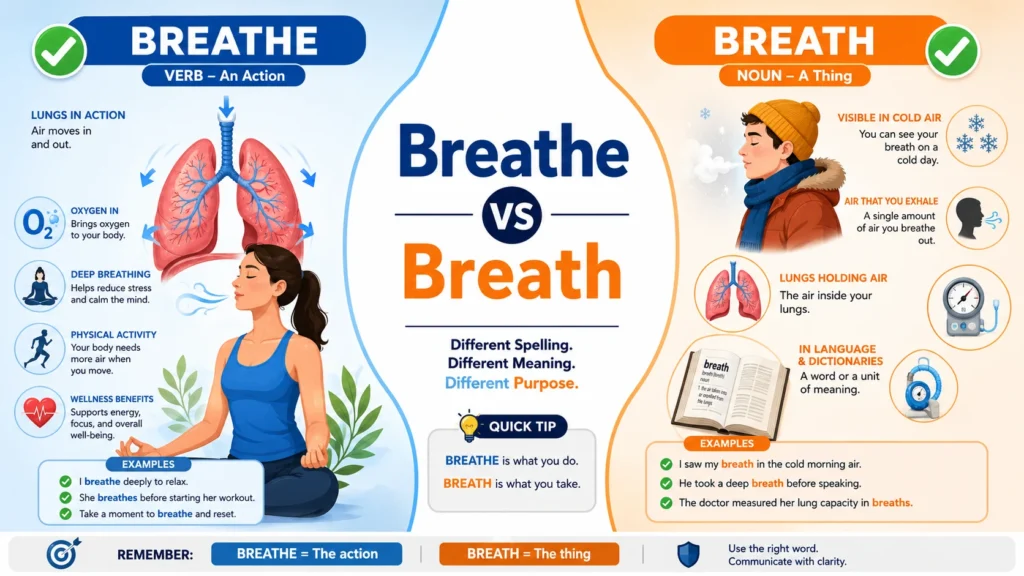
Breathe and breath are often confused because they look similar, but they serve different roles in English. Breathe is a verb that means to inhale and exhale air, while breath is a noun that refers to the air taken in or released from the lungs.
The English language contains many words that look almost the same but have different meanings. One common example is breathe or breath. Many writers, students, professionals, and English learners mix these two words because they are closely related and differ by only one letter.
The confusion is understandable. Both words are connected to the act of breathing. They sound similar when spoken quickly. However, using the wrong word can make a sentence grammatically incorrect and confusing.
Imagine writing, “I need to breath deeply before the presentation.” Most readers will understand what you mean, but the sentence contains an error. The correct word should be breathe because the sentence describes an action.
Learning the difference between breathe or breath is important for clear communication. Whether you are writing emails, academic papers, blog posts, social media updates, or professional documents, knowing when to use each word will improve your writing and speaking skills.
This guide explains everything you need to know about breathe or breath, including definitions, examples, common mistakes, exercises, regional usage, and practical tips.
Quick Answer
The difference between breathe and breath is simple:
| Word | Part of Speech | Meaning | Example |
|---|---|---|---|
| Breathe | Verb | To inhale and exhale air | I breathe deeply during meditation. |
| Breath | Noun | The air taken into or released from the lungs | Take a deep breath before speaking. |
Simple Rule
If the word describes an action, use breathe.
If the word names a thing, use breath.
Action = Breathe
Thing = Breath
What Does Breathe Mean?
Breathe is a verb.
It refers to the action of taking air into the lungs and releasing it.
Definition
To inhale and exhale air.
Examples
- Humans need to breathe to stay alive.
- Remember to breathe slowly during exercise.
- She could barely breathe after running.
- Take a moment to breathe and relax.
- The patient struggled to breathe.
In every example above, the word describes an action.
Pronunciation
Breathe is pronounced:
/briːð/
It ends with a soft “th” sound similar to the word “this.”
What Does Breath Mean?
Breath is a noun.
It refers to the air that moves in and out of the lungs.
Definition
The air inhaled or exhaled during breathing.
Examples
- Take a deep breath.
- His breath smelled like mint.
- She held her breath underwater.
- I was out of breath after climbing the stairs.
- You could see your breath in the cold air.
In these examples, breath is a thing rather than an action.
Pronunciation
Breath is pronounced:
/breθ/
It ends with the same sound found in the word “think.”
Breathe or Breath: Side-by-Side Comparison
| Feature | Breathe | Breath |
|---|---|---|
| Part of speech | Verb | Noun |
| Function | Action | Thing |
| Meaning | To inhale and exhale | Air inhaled or exhaled |
| Pronunciation | Bree-th | Breth |
| Example | I breathe slowly. | Take a deep breath. |
| Grammar role | Predicate action | Subject or object |
Why People Confuse Breathe and Breath
Several factors contribute to the confusion.
Similar Spelling
The words differ by only one letter.
- Breath
- Breathe
Because they look almost identical, writers often choose the wrong one.
Related Meanings
Both words relate to respiration and oxygen.
Similar Pronunciation
Many people do not notice the slight pronunciation difference.
Fast Typing
Writers sometimes type quickly and accidentally use the noun instead of the verb.
How to Remember the Difference
A simple memory trick can help.
The Extra E Means Action
The word breathe has an extra “e.”
Think of that extra letter as representing energy or effort, which are actions.
Breathe = Action
Breath = Object
Another Memory Trick
Ask yourself:
“Can I replace this word with ‘do’?”
If yes, use breathe.
Example:
- I need to breathe.
- I need to do something.
This works because breathe is a verb.
Grammar Rules for Breathe and Breath
Understanding grammar makes the distinction easier.
Breathe as a Verb
Verbs show actions.
Examples:
- We breathe oxygen.
- Birds breathe through their respiratory systems.
- He breathes heavily after running.
Notice how the verb changes:
| Tense | Example |
|---|---|
| Present | I breathe |
| Past | I breathed |
| Future | I will breathe |
| Present Continuous | I am breathing |
Breath as a Noun
Nouns identify people, places, things, or ideas.
Examples:
- Her breath was visible.
- One breath is enough.
- His breath smelled fresh.
Breath can function as:
Subject
- Your breath smells like coffee.
Object
- Take a deep breath.
Common Expressions Using Breath
English contains many popular phrases with breath.
Take a Breath
Meaning: Relax and pause.
Example:
- Take a breath before answering.
Deep Breath
Meaning: A long inhalation.
Example:
- She took a deep breath before the interview.
Hold Your Breath
Meaning: Stop breathing temporarily.
Example:
- Hold your breath while swimming underwater.
Catch Your Breath
Meaning: Recover after physical activity.
Example:
- He stopped to catch his breath.
Out of Breath
Meaning: Breathing heavily after exertion.
Example:
- I was out of breath after the race.
Breath of Fresh Air
Meaning: Something refreshing or new.
Example:
- Her ideas were a breath of fresh air.
Common Expressions Using Breathe
Many expressions use the verb form.
Breathe Deeply
Example:
- Doctors often recommend breathing deeply during stress.
Breathe Easy
Meaning: Feel relieved.
Example:
- We could finally breathe easy after hearing the good news.
Breathe Life Into
Meaning: Revitalize something.
Example:
- The new manager breathed life into the company.
Breathe In
Example:
- Breathe in slowly through your nose.
Breathe Out
Example:
- Breathe out gently through your mouth.
Real World Examples of Breathe and Breath
In Healthcare
Breathe
- The patient struggled to breathe.
Breath
- The nurse checked the patient’s breath.
In Sports
Breathe
- Athletes learn to breathe efficiently.
Breath
- He took a breath before lifting the weight.
In Public Speaking
Breathe
- Remember to breathe calmly.
Breath
- Take a deep breath before walking on stage.
In Meditation
Breathe
- Breathe slowly and focus on the moment.
Breath
- Pay attention to your breath.
Advantages and Disadvantages of Learning the Difference
Advantages
Better Writing
Correct word choice improves clarity.
Improved Professionalism
Proper grammar creates a stronger impression.
Greater Confidence
You can write and speak without hesitation.
Better Academic Performance
Students avoid unnecessary grammar mistakes.
Enhanced Communication
Readers immediately understand your message.
Disadvantages of Mixing Them Up
Grammar Errors
Incorrect usage weakens writing quality.
Reduced Credibility
Professional documents may appear careless.
Reader Confusion
Some readers may question the intended meaning.
Lower Test Scores
Grammar mistakes can affect academic results.
Regional and Global Usage
One interesting fact about breathe or breath is that both forms are used consistently throughout the English-speaking world.
Whether you are in:
- United States
- United Kingdom
- Canada
- Australia
- New Zealand
- Pakistan
- India
The distinction remains the same:
- Breathe = verb
- Breath = noun
Unlike words such as “color” and “colour,” there are no major spelling differences between American and British English.
Common Mistakes and Corrections
Below are some of the most frequent errors.
| Incorrect | Correct |
|---|---|
| I need to breath. | I need to breathe. |
| Take a deep breathe. | Take a deep breath. |
| She couldn’t breath. | She couldn’t breathe. |
| Hold your breathe. | Hold your breath. |
| He took a breathe. | He took a breath. |
Breathe vs Breath in Sentences
Correct Use of Breathe
- I breathe deeply every morning.
- We need to breathe fresh air.
- Can you breathe normally now?
- She struggled to breathe.
- They breathe through their noses.
Correct Use of Breath
- Take a deep breath.
- His breath was warm.
- Hold your breath.
- I lost my breath after running.
- Your breath smells fresh.
Breathe or Breath in Everyday Communication
At Work
Incorrect:
- Take a deep breathe before your presentation.
Correct:
- Take a deep breath before your presentation.
At School
Incorrect:
- Plants breath through tiny openings.
Correct:
- Plants breathe through tiny openings.
During Exercise
Incorrect:
- Remember your breathe pattern.
Correct:
- Remember your breath pattern.
Related Concepts and Comparisons
Breath vs Breathing
Breath
A noun.
Example:
- His breath was visible.
Breathing
A noun or gerund describing the process.
Example:
- Breathing exercises reduce stress.
Breathe vs Exhale
Breathe
Includes inhaling and exhaling.
Exhale
Only releasing air.
Example:
- Breathe naturally.
- Exhale slowly.
Breathe vs Inhale
Breathe
Entire process.
Inhale
Taking air in only.
Example:
- Breathe calmly.
- Inhale through your nose.
When to Use Breathe
Use breathe when discussing:
- Respiration
- Relaxation
- Meditation
- Exercise
- Health
- Physical actions
Examples:
- Breathe slowly.
- Breathe through your nose.
- Learn to breathe properly.
When to Use Breath
Use breath when referring to:
- Air in the lungs
- Breathing capacity
- Smells
- Respiratory observations
- Expressions
Examples:
- Take a breath.
- His breath smelled sweet.
- She held her breath.
Practice Exercises
Exercise 1
Choose the correct word.
- Please _____ slowly.
- Take a deep _____.
- I cannot _____ through my nose.
- Hold your _____.
- She stopped to catch her _____.
Answers
- Breathe
- Breath
- Breathe
- Breath
- Breath
Exercise 2
Identify whether the word should be a noun or verb.
- We need to ______.
- Take a deep ______.
- The runner lost his ______.
- Children must ______ normally.
- She held her ______ underwater.
Answers
- Breathe
- Breath
- Breath
- Breathe
- Breath
Exercise 3
- I need to breath deeply.
- Take a deep breathe.
- She couldn’t breath after running.
- Hold your breathe.
- We breath oxygen every day.
Answers
- I need to breathe deeply.
- Take a deep breath.
- She couldn’t breathe after running.
- Hold your breath.
- We breathe oxygen every day.
Advanced Understanding of Breathe and Breath
For advanced English learners, it helps to understand word formation.
The noun breath came first historically.
The verb breathe was later developed from the noun.
This pattern appears in other English words:
| Noun | Verb |
|---|---|
| Bath | Bathe |
| Wreath | Wreathe |
| Breath | Breathe |
Notice how adding an “e” often creates a related verb.
This pattern can help you remember the correct spelling.
Professional Writing Tips
When proofreading your work:
Look for Action
If someone is doing something, use breathe.
Look for a Thing
If the word names air or a breathing event, use breath.
Read Aloud
Hearing the sentence often reveals the correct word.
Use Grammar Tools
Modern grammar checkers can catch many mistakes.
Review Common Phrases
Memorize:
- Take a breath
- Hold your breath
- Catch your breath
- Breathe deeply
- Breathe slowly
FAQs
What is the difference between breathe and breath?
Breathe is a verb meaning to inhale and exhale air. Breath is a noun referring to the air itself.
Is it take a breath or take a breathe?
The correct phrase is take a breath because breath is the noun.
How do you remember breathe or breath?
Remember that breathe has an extra “e,” which can remind you of energy and action.
Is breathe a noun or a verb?
Breathe is always a verb.
Is breath a noun or a verb?
Breath is a noun and refers to air inhaled or exhaled.
Why do people confuse breathe and breath?
They look similar, have related meanings, and sound alike in casual speech.
Can breath ever be used as a verb?
In modern standard English, breath is generally used as a noun, not a verb.
How is breathe pronounced differently from breath?
Breathe ends with a voiced sound, while breath ends with an unvoiced sound.
Which word is correct: I can’t breath or I can’t breathe?
The correct sentence is: I can’t breathe.
Which word is correct: take a deep breath or take a deep breathe?
The correct phrase is: take a deep breath.
Are breathe and breath used differently in American and British English?
No. The distinction between breathe and breath is the same in both varieties of English.
Conclusion
Understanding the difference between breathe or breath is easier than many people think. The key is remembering that breathe is a verb and describes the action of inhaling and exhaling, while breath is a noun that refers to the air moving through the lungs. Although the two words look similar and share related meanings, they play very different grammatical roles.
A simple way to avoid mistakes is to ask whether the word represents an action or a thing. If it is an action, choose breathe. If it refers to air or a breathing event, choose breath. Practicing common phrases such as “take a breath,” “hold your breath,” and “breathe deeply” can reinforce correct usage.
Whether you are writing academic papers, business emails, website content, or everyday messages, using the correct word improves clarity, professionalism, and confidence. With regular practice and careful proofreading, you can eliminate confusion and use breathe and breath correctly every time.

Justin Powell is a writer at GramBrix.com who focuses on grammar, clarity and effective communication, helping readers strengthen their language skills.