Last Updated on July 7, 2026
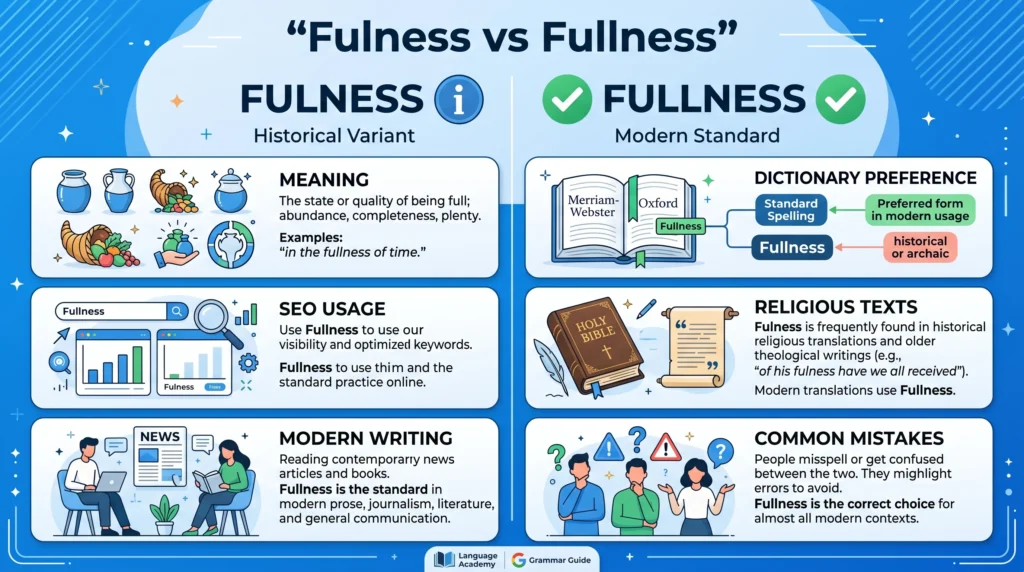
Both fulness and fullness are accepted English spellings, but fullness is the modern standard and overwhelmingly preferred in dictionaries, academic writing, business communication, and online searches. Fulness is an older variant that still appears in religious texts, historical literature, and some traditional publications. For SEO and modern writing in 2026, fullness is usually the best choice.
The debate over fulness or fullness is a common spelling question in English. At first glance, the two words look almost identical. They also share the same meaning, which makes the confusion even greater.
You may encounter examples such as:
- The fullness of time.
- The fulness of time.
Both can be correct depending on the context. However, modern English has largely adopted one spelling over the other.
Today, most dictionaries, style guides, educational institutions, and publishers prefer fullness. Meanwhile, fulness is primarily found in older books, historical writings, and certain religious translations.
Understanding which version to use can improve your writing, strengthen SEO performance, and help maintain consistency in professional communication.
This guide explains:
- The difference between fulness and fullness
- Historical usage
- Modern spelling standards
- SEO recommendations
- Common mistakes
- Real-world examples
- Frequently asked questions
Quick Answer
| Spelling | Correct? | Modern Usage |
|---|---|---|
| Fullness | Yes | Very Common |
| Fulness | Yes | Less Common |
Simple Summary
Both spellings are correct, but fullness is the preferred spelling in modern English.
What Does Fullness Mean?
Definition
Fullness refers to:
- A state of being full
- Completeness
- Abundance
- Totality
- Maximum capacity
Common Examples
Examples include:
- The fullness of life
- Fullness of flavor
- Emotional fullness
- Spiritual fullness
Modern Usage
Today, fullness appears in:
- Books
- Websites
- Academic writing
- Business content
- Journalism
What Does Fulness Mean?
Definition
Fulness carries the same meaning as fullness.
There is no difference in definition.
Historical Usage
Fulness was more common in earlier forms of English.
Religious Context
Many religious texts continue to use:
Fulness
because they preserve historical spelling traditions.
Main Difference Between Fulness or Fullness
Meaning
Fullness
Means completeness or abundance.
Fulness
Means the same thing.
Modern Acceptance
Fullness
Widely used today.
Fulness
Less frequently used.
SEO Performance
Fullness
Receives significantly more modern search traffic.
Fulness
Often searched only when quoting older texts.
Why Fullness Became More Popular
English Spelling Patterns
Many English words keep the double “l” when adding suffixes.
Examples:
- Full → Fullness
- Skill → Skillful
- Will → Willing
Publishing Standards
Publishers gradually adopted:
Fullness
as the preferred spelling.
Dictionary Preference
Most modern dictionaries list fullness as the primary spelling.
Comparison Table
| Feature | Fullness | Fulness |
|---|---|---|
| Meaning | Same | Same |
| Modern English | Preferred | Alternative |
| Dictionary Usage | Higher | Lower |
| SEO Value | Higher | Lower |
| Religious Texts | Common | Common |
Examples of Fullness in Sentences
Everyday Writing
- She enjoyed the fullness of summer.
- The soup had a fullness of flavor.
- He lived life with fullness and purpose.
Academic Writing
- The fullness of the data was analyzed.
- Researchers examined the fullness of the results.
Business Writing
- Customer satisfaction reached its fullest expression through service excellence.
Examples of Fulness in Sentences
Historical Literature
- The fulness of time had come.
Religious Writing
- Many older translations use the word fulness.
Traditional Publications
Certain publishers retain historical spelling for consistency.
Fullness in Religion and Spirituality
Biblical References
Some Bible translations use:
- Fulness of God
- Fulness of time
Modern Editions
Many contemporary editions prefer:
Fullness
for readability.
Why Both Appear
Translation choices often influence spelling preferences.
Fullness in Everyday Language
Emotional Fullness
A sense of satisfaction and completeness.
Physical Fullness
Feeling completely satisfied after eating.
Creative Fullness
A rich expression of ideas or talent.
Professional Fullness
Achieving complete development in a career or project.
SEO Recommendation for 2026
Use Fullness as the Primary Keyword
Most users search for:
- Fullness meaning
- Feeling of fullness
- Fullness definition
Mention Fulness as a Variant
Helpful for search intent and spelling questions.
Maintain Consistency
Choose one spelling and use it consistently throughout your content.
Common Mistakes People Make
Assuming Fulness Is Incorrect
Fulness is still a valid spelling.
Mixing Spellings
Avoid switching between both forms in the same article.
Ignoring Audience Expectations
Most readers expect the spelling fullness.
Overusing Historical Spellings
Modern audiences generally prefer contemporary English.
Related Word Comparisons
Color or Colour
Different regional spellings.
Judgment or Judgement
Both accepted depending on context.
Toward or Towards
Regional variation in English.
How Dictionaries Treat the Words
Fullness
Usually listed as the primary spelling.
Fulness
Often listed as a variant spelling.
Style Guide Preference
Most modern style guides recommend fullness.
Exercises With Answers
Exercise 1
Which spelling is more common today?
Answer: Fullness
Exercise 2
Do fulness and fullness have different meanings?
Answer: No
Exercise 3
Which spelling is generally better for SEO?
Answer: Fullness
Exercise 4
Can fulness appear in religious texts?
Answer: Yes
Exercise 5
Which spelling do modern publishers usually prefer?
Answer: Fullness
FAQs
Is it fulness or fullness?
Both are correct, but fullness is more common in modern English.
Which spelling should I use in professional writing?
Fullness is generally the preferred choice.
Is fulness a misspelling?
No. It is an accepted alternative spelling.
Why do some religious books use fulness?
Many older translations preserve traditional spelling conventions.
Which spelling is better for SEO?
Fullness usually performs better because it matches modern search habits.
Do the words have different meanings?
No. They mean the same thing.
Which spelling appears in dictionaries?
Most dictionaries include both, but fullness is usually listed first.
Can I use fulness in academic writing?
You can, but fullness is generally preferred unless quoting a source.
Why is fullness more popular today?
Modern English spelling standards favor the double “l” version.
Should websites use fulness or fullness?
Most websites should use fullness for clarity and SEO benefits.
Conclusion
The question of fulness or fullness comes down to modern usage rather than meaning.
Both spellings are correct and refer to the same idea of completeness, abundance, or a state of being full. However, their popularity differs significantly.
Today:
- Fullness is the standard spelling.
- Fulness remains a valid historical variant.
- Both words share the same meaning.
- Most dictionaries prioritize fullness.
- SEO and professional writing strongly favor fullness.
For blogs, websites, academic content, business communication, and digital marketing in 2026, fullness is the recommended choice. It aligns with modern language standards, reader expectations, and search engine trends while still acknowledging that fulness remains an accepted alternative in specific contexts.

Victoria Lane is a grammar-focused writer at GramBrix.com, passionate about helping readers master the rules of language. She provides clear explanations and practical examples that make writing more accurate, polished and confident.