Last Updated on July 15, 2026
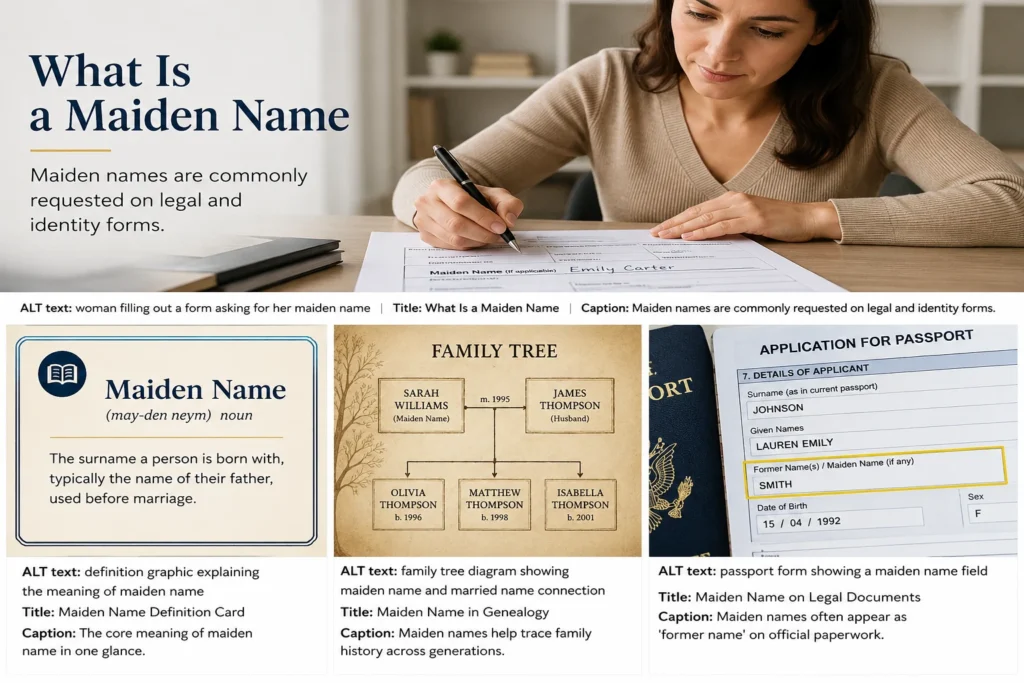
A maiden name is the surname (last name) a woman had before marriage, typically inherited from her father or family of origin. It’s commonly requested on legal forms, security questions, and genealogy records to verify identity, even if the woman never legally changed her name after marriage.
If you’ve ever filled out a bank form, passport application, or security verification question, you’ve probably seen the phrase “maiden name” and paused for a second. What does maiden name actually mean, who does it apply to, and why do so many official forms still ask for it? This guide breaks down the full meaning of maiden name, where the term comes from, how it’s used today, and how to answer it correctly in different situations including cases where it doesn’t quite apply anymore.
Quick Answer Box
- Meaning: A woman’s surname before marriage
- Context: Legal forms, identity verification, genealogy, casual conversation
- Usage: Noun phrase “What is your maiden name?”
- Platforms: Bank forms, government documents, ancestry sites, security questions
- Example: “Her maiden name was Bennett before she married and became Mrs. Carter.”
- Tone: Neutral, formal, informational
What Does Maiden Name Mean?
A maiden name refers to the last name a woman used before she got married, most often the surname passed down from her father or the one she was born with. Historically, this term exists because it was once traditional and legally standard for a woman to adopt her husband’s surname upon marriage, replacing her birth surname entirely.
The term “maiden” itself is an old English word referring to an unmarried woman or girl. So “maiden name” literally translates to “the name of the unmarried woman” the surname that existed before marriage changed it.
The Core Idea Behind Maiden Name
The concept isn’t just about tradition it’s practical. Maiden names are used to trace identity across a name change, which is especially important in legal, financial, and genealogical contexts. If a woman changes her surname when she marries, her maiden name becomes the historical link between her old records (birth certificate, school documents, early employment history) and her new legal identity.
Full Definition
In formal usage, maiden name refers specifically to:
- The surname on a woman’s birth certificate, before any marriage
- The family name inherited from her father (in traditional Western naming customs)
- A name used for identity verification even decades after marriage
It’s worth noting that maiden name specifically applies to women in traditional usage, since historically men did not change their surnames upon marriage. In modern contexts, a similar concept called a “birth name” is sometimes used instead, since it applies to anyone regardless of gender who changes their last name for any reason, including marriage.
Context & Usage
Maiden name shows up in several everyday and official contexts, and the way it’s used can shift slightly depending on the setting.
- On legal documents: “Please list your maiden name if applicable.”
- On security questions: “What is your mother’s maiden name?”
- In casual conversation: “I didn’t know your maiden name was Reyes.”
- In genealogy research: “Her maiden name helped us trace three more generations.”
- In wedding or family contexts: “She kept her maiden name after getting married.”
Each of these examples reflects the same underlying idea: a maiden name is a reference point to a woman’s identity before marriage, used for verification, tradition, or historical tracing.
RealLife Examples
Seeing “maiden name” used in real situations makes the meaning much clearer than a dictionary definition alone. Here are five realistic examples across different everyday contexts.
Bank Verification Call
Bank Representative: “For security purposes, can you confirm your mother’s maiden name?” Customer: “Sure, it’s Whitfield.”
Casual Text Message
Friend: “Wait, is Sarah’s last name Coleman or Price now?” You: “Price is her married name, Coleman was her maiden name lol”
Genealogy Research Chat
Person A: “I found my greatgrandmother’s records but her last name doesn’t match ours.” Person B: “That’s probably her maiden name check the marriage certificate for the name change.”
Wedding Planning Conversation
Bridetobe: “I think I’m going to keep my maiden name professionally, but use his name personally.” Friend: “That’s really common now, a lot of people do a hyphenated version too.”
Passport Renewal Office
Clerk: “Since your name changed after marriage, we’ll need your maiden name listed as a former name on file.” Applicant: “Got it, it’s Delgado.”
PlatformSpecific Meaning
While “maiden name” isn’t internet slang, the term appears differently depending on the platform or system requesting it.
Government and Legal Forms
On passport applications, driver’s license renewals, and court documents, “maiden name” is typically requested under a “former name” or “other names used” field. It’s treated as an official identity marker, not just a casual detail.
Banking and Security Systems
Financial institutions frequently use “mother’s maiden name” as a security question because it’s historically hard for outsiders to guess, though this practice has declined recently due to genealogy websites making the information easier to find.
Genealogy and Ancestry Platforms
On sites like Ancestry or FamilySearch, “maiden name” is a critical data point used to trace family lines accurately, since marriage records often show a woman’s maiden name alongside her married name.
Social Media Profiles
On platforms like Facebook, some users still display their maiden name in parentheses next to their married name (e.g., “Emily Carter (Bennett)”) to help old friends or classmates recognize them.
Alternative Meanings
While the primary meaning of maiden name centers on marriagerelated surname changes, a few related concepts are worth understanding.
- Birth name: A genderneutral term referring to the surname (or full name) a person had at birth, regardless of marital status.
- Née: A Frenchderived term meaning “born as,” often used formally in writing (e.g., “Jane Carter, née Bennett”) to indicate a maiden name.
- Former name: A broader legal term covering any past name, including maiden names, but also names changed for other reasons.
- Family name of origin: Sometimes used in cultural or genealogical contexts to describe the same idea as maiden name, without gendered assumptions.
Related Terms / NLP Variations
Words and phrases closely related to maiden name include:
- Birth name
- Née
- Former surname
- Family name before marriage
- Premarital name
- Original surname
Understanding these variations helps clarify how maiden name fits into a broader set of naming terms used across legal, cultural, and casual contexts.
How to Respond / Reply
If you’re asked for your maiden name, there are a few natural and appropriate ways to respond depending on the setting:
- Formal/legal setting: “My maiden name is [Surname].”
- Casual conversation: “Oh, my maiden name was Bennett before I got married.”
- If you never changed your name: “I actually kept my name, so I don’t have a different maiden name.”
- If the question doesn’t apply to you: “I’ve never been married, so I don’t have a maiden name to list.”
Misinterpretations
Maiden name is sometimes misunderstood in a few common ways:
- Assumed to apply to everyone: Not every woman changes her surname after marriage, so “maiden name” doesn’t always apply.
- Confused with “married name”: These are opposites maiden name is the surname before marriage, while married name is the surname adopted after.
- Assumed to be outdated or irrelevant: While the tradition of changing names is less universal today, the term maiden name is still widely used on legal and security forms.
- Assumed to only apply to mothers: While “mother’s maiden name” is a common security question, the term itself applies to any woman, not just mothers.
When NOT to Use It
There are situations where using “maiden name” isn’t accurate or appropriate:
- Don’t assume someone has a maiden name just because they’re married many people keep their original surname.
- Avoid using it for someone who has never been married, since the term specifically relates to a name held before marriage.
- In genderneutral or inclusive contexts, “birth name” or “former name” may be a more accurate and respectful alternative, especially for nonbinary individuals or samesex marriages where traditional gendered naming assumptions don’t apply.
Usage Tips
- Use “maiden name” specifically when referring to a woman’s surname before marriage, especially in traditional or historical contexts.
- On modern forms, look for “former name” or “birth name” if “maiden name” doesn’t apply to your situation.
- In writing, “née” is a more formal alternative often used in obituaries, wedding announcements, or biographical writeups.
- When asking someone for this information, consider the context legal and security settings expect a direct name, while casual conversations are more flexible.
FAQs
1. What does “maiden name” mean? It refers to a woman’s surname before she got married, usually inherited from her father or family of origin.
2. Why do banks ask for your mother’s maiden name? It’s traditionally used as a security question because it was historically difficult for outsiders to find, though this has become less secure due to public genealogy records.
3. What if I never changed my last name after marriage? If you kept your original surname, you may not have a separate “maiden name” to provide, and can note that on forms if needed.
4. Is maiden name the same as birth name? They’re closely related, but “birth name” is a broader, genderneutral term, while “maiden name” specifically refers to a woman’s premarital surname.
5. What does “née” mean? “Née” is a French term meaning “born as,” used to introduce someone’s maiden name in formal writing (e.g., “Anna Smith, née Johnson”).
6. Do men have a maiden name? Traditionally, no the term applies specifically to women, since men historically did not change their surnames upon marriage. Men who do change their names typically use the term “former name” instead.
7. Can you use your maiden name professionally after marriage? Yes, many people legally change their name for personal use but continue using their maiden name professionally or publicly.
8. What’s the difference between maiden name and married name? A maiden name is the surname before marriage, while a married name is the surname adopted after marriage, often the spouse’s last name.
9. Where do I find my maiden name on official documents? Your maiden name is typically listed on your birth certificate, and may also appear on marriage certificates as the “former name” or “name at birth.”
10. Is “maiden name” still commonly used today? Yes, especially on legal forms, security questions, and genealogy platforms, even though many modern couples choose alternative naming arrangements.
Conclusion
At its core, the meaning of maiden name is simple: it’s the surname a woman held before marriage, most often used today for identity verification, legal documentation, and genealogical research. While naming customs have evolved with many people keeping their original name, hyphenating, or choosing entirely new arrangements the term maiden name remains a widely recognized and practically useful concept across forms, security systems, and family history research.

Kevin Brooks is a grammar specialist at GramBrix.com, dedicated to helping readers understand language rules with clarity and confidence. He simplifies complex grammar concepts through practical examples and easy explanations.