Last Updated on July 15, 2026
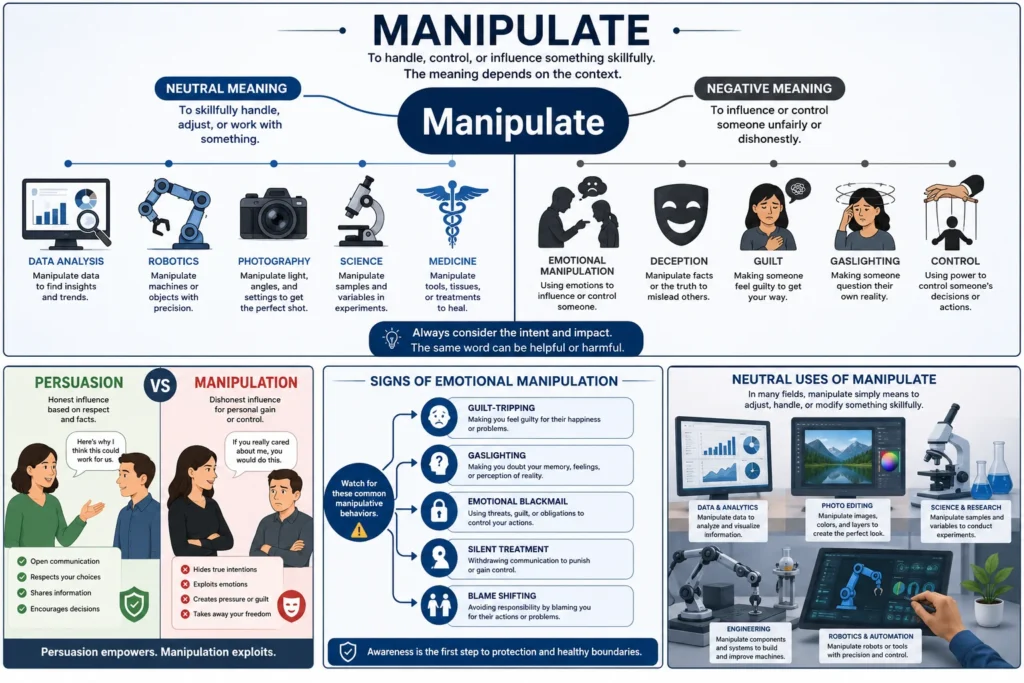
Manipulate means to control, influence, or handle someone, something, or a situation to achieve a desired result. The word can have both positive and negative meanings. It may refer to skillfully handling objects or information, but it often describes influencing people in unfair, deceptive, or emotionally controlling ways.
The word manipulate is commonly used in conversations about relationships, psychology, business, politics, media, and everyday communication. While many people associate it with deception or emotional control, the term actually has multiple meanings depending on the context.
For example, a doctor may manipulate a joint during treatment, an artist may manipulate digital images, and a person may manipulate someone emotionally to get what they want. Understanding the manipulate meaning requires looking beyond a single definition and examining how it is used across different situations.
In this guide, you’ll learn the full definition of manipulate, its origins, common uses, examples, positive and negative meanings, platformspecific usage, related words, common misconceptions, response strategies, and practical tips for recognizing manipulation in real life.
Quick Answer Box
| Topic | Explanation |
| Meaning | To control, influence, handle, or change something to achieve a particular result. |
| Common Context | Relationships, psychology, communication, media, business, technology. |
| Positive Usage | Skillfully handling objects, data, or equipment. |
| Negative Usage | Controlling or influencing people unfairly or deceptively. |
| Example | “He manipulated the conversation so everyone agreed with him.” |
| Tone | Neutral by definition but often negative when referring to people. |
What Does Manipulate Mean?
The word manipulate generally means to handle, control, influence, or change something carefully to achieve a desired outcome.
The exact meaning depends on the context.
Sometimes it simply means handling physical objects with skill.
Other times, it refers to influencing someone’s thoughts, emotions, or decisions, often in dishonest or unfair ways.
DictionaryStyle Definition
Manipulate (verb):
- To handle or control something with skill.
- To influence or control a person or situation cleverly, unfairly, or dishonestly.
- To alter or modify information, images, or data.
Full Definition
The manipulate meaning changes based on the subject being discussed.
Physical Manipulation
This involves moving, adjusting, or handling physical objects.
Examples:
- Manipulating laboratory equipment
- Manipulating a robotic arm
- Manipulating clay into a sculpture
- Manipulating puzzle pieces
This usage is completely neutral.
Digital Manipulation
In technology, manipulate often means editing or modifying digital content.
Examples include:
- Manipulating photographs
- Manipulating videos
- Manipulating spreadsheets
- Manipulating computer data
Again, this meaning is usually neutral unless used to deceive others.
Emotional Manipulation
This is the meaning most people recognize.
Emotional manipulation happens when someone intentionally influences another person’s emotions, beliefs, or actions for personal benefit.
Examples include:
- Using guilt
- Lying
- Gaslighting
- Playing the victim
- Giving silent treatment
- Love bombing
- Threatening to leave
- Creating unnecessary fear
This meaning has a negative connotation.
Context and Usage
The meaning of manipulate depends entirely on context.
In Everyday Conversation
People usually mean emotional influence.
Example:
“I think she’s trying to manipulate him.”
Meaning:
She may be influencing him unfairly.
In Medicine
Doctors sometimes manipulate joints or muscles during treatment.
Example:
“The therapist manipulated the patient’s shoulder.”
This is a professional medical procedure.
In Science
Scientists manipulate variables during experiments.
Example:
“Researchers manipulated the temperature.”
Meaning:
They intentionally changed one condition.
In Technology
Programmers manipulate data.
Example:
“The software manipulates customer information.”
Meaning:
It processes or changes data.
In Art and Photography
Artists manipulate images.
Example:
“The photographer manipulated the lighting.”
Meaning:
They edited or adjusted the image.
RealLife Examples
Here are practical examples showing different meanings.
Example 1: Relationship
Sarah:
“I feel guilty every time I say no.”
Friend:
“He may be manipulating your emotions.”
Meaning:
Someone is using guilt as control.
Example 2: Workplace
Manager:
“The sales figures were manipulated.”
Meaning:
The numbers were altered.
Example 3: Technology
Developer:
“We manipulated the database.”
Meaning:
They modified stored data.
Example 4: Photography
Designer:
“I manipulated the colors.”
Meaning:
The image was edited.
Example 5: Science
Teacher:
“The experiment manipulated one variable.”
Meaning:
One factor was intentionally changed.
PlatformSpecific Meaning
Social Media
People often discuss manipulation in relationships.
Example:
“He’s emotionally manipulating her.”
Usually refers to toxic behavior.
TikTok
Videos often discuss:
- Narcissistic manipulation
- Gaslighting
- Emotional abuse
- Love bombing
- Toxic relationships
The term is commonly used in selfhelp and psychology content.
Manipulate often appears in motivational or mental health posts.
Example:
“Don’t let people manipulate your kindness.”
People may use the word when discussing:
- Politics
- News
- Family conflicts
- Relationships
Example:
“The media manipulates public opinion.”
Professional usage is more neutral.
Examples:
- Manipulating datasets
- Manipulating market data
- Manipulating financial models
YouTube
Common topics include:
- Psychology
- Body language
- Negotiation
- Emotional intelligence
- Manipulation tactics
Alternative Meanings
Although manipulate usually refers to influence or control, it has several legitimate meanings.
Skillfully Handle
Example:
“The surgeon manipulated the instrument.”
Adjust
Example:
“She manipulated the camera settings.”
Edit
Example:
“He manipulated the video.”
Influence
Example:
“The advertisement manipulates consumer behavior.”
Control
Example:
“The leader manipulated public opinion.”
The Psychology Behind Manipulation
Psychologists describe manipulation as behavior intended to influence another person’s thoughts, emotions, or actions without open or honest communication.
Manipulation often relies on indirect tactics instead of straightforward requests. Rather than saying, “I need your help,” a manipulative person may use guilt, fear, shame, or excessive praise to encourage a desired response.
Common psychological tactics include:
- Guilttripping
- Gaslighting
- Emotional blackmail
- Playing the victim
- Withholding affection
- Passiveaggressive behavior
- Creating confusion
- Selective honesty
- Flattery with hidden motives
- Pressure disguised as concern
Recognizing these patterns can help people establish healthier boundaries.
Common Signs Someone May Be Manipulating You
Not every disagreement is manipulation, but recurring patterns can be warning signs.
They Make You Feel Guilty Constantly
They repeatedly make you feel responsible for their emotions or problems.
They Twist Your Words
Your statements are repeatedly misrepresented to make you appear wrong.
They Avoid Accountability
Instead of accepting responsibility, they blame others.
They Use Fear
They threaten consequences to influence your decisions.
They Alternate Between Praise and Criticism
This creates emotional dependence and uncertainty.
They Ignore Your Boundaries
They continue pushing after you’ve clearly said no.
Five Conversation Examples
Conversation Example 1: Friendship
Alex: “Can you help me move this weekend?”
Ben: “I can’t. I already have plans.”
Alex: “Wow, I guess our friendship doesn’t matter.”
Ben: “Please don’t try to manipulate me with guilt.”
Conversation Example 2: Family
Mother: “If you loved me, you’d visit every weekend.”
Child: “I love you, but I also need personal time.”
Conversation Example 3: Workplace
Employee: “These numbers don’t look correct.”
Manager: “Someone manipulated the report before sending it.”
Conversation Example 4: Online Discussion
User A:
“The image looks fake.”
User B:
“It was manipulated using editing software.”
Conversation Example 5: Relationship
Partner A:
“I’m upset because you ignored my message.”
Partner B:
“You’re overreacting.”
Partner A:
“I want us to discuss the issue instead of dismissing my feelings.”
Positive vs. Negative Meanings
| Positive Meaning | Negative Meaning |
| Manipulating equipment | Manipulating emotions |
| Manipulating software | Manipulating relationships |
| Manipulating data for analysis | Manipulating facts |
| Manipulating machinery | Manipulating public opinion |
| Manipulating images for design | Manipulating someone into guilt |
The surrounding context determines whether the word has a positive, neutral, or negative meaning.
Related Terms and NLP Variations
People searching for manipulate meaning may also look for:
- Manipulation meaning
- Emotional manipulation
- Manipulative behavior
- Manipulative person
- Psychological manipulation
- Gaslighting
- Influence meaning
- Persuasion vs manipulation
- Control meaning
- Coercion
- Emotional control
- Brainwashing
- Mind games
- Deception
- Social influence
- Persuasion
- Exploitation
- Behavioral influence
- Hidden motives
- Emotional pressure
These related terms help explain the broader topic while highlighting important distinctions. For example, persuasion involves openly presenting reasons for a decision, while manipulation often conceals intent or uses emotional pressure.
Manipulation vs. Persuasion
These words are often confused but are not the same.
| Persuasion | Manipulation |
| Honest communication | Hidden motives |
| Respects free choice | Limits free choice |
| Transparent intentions | Deceptive intentions |
| Uses facts and reasoning | Uses emotional pressure |
| Builds trust | Often damages trust |
For example:
Persuasion: “I think this option is better because it costs less.”
Manipulation: “If you don’t choose this, you’ll disappoint everyone.”
Misinterpretations
The word manipulate is frequently misunderstood.
Every Influence Is Not Manipulation
Parents, teachers, coaches, and mentors naturally influence others. Influence becomes manipulation when it relies on deception, coercion, or unfair emotional pressure.
Editing Is Not Always Deception
Manipulating an image for better lighting or color correction is common in photography and design. Problems arise when edits intentionally mislead viewers.
Strong Communication Isn’t Necessarily Manipulative
Being persuasive, confident, or emotionally expressive does not automatically mean someone is manipulating others.
When NOT to Use the Word
Avoid using manipulate when:
Someone Simply Disagrees
Disagreement alone is not manipulation.
Someone Gives Honest Advice
Constructive guidance is different from emotional control.
Normal Negotiation Is Happening
Negotiation involves both sides making informed choices.
There Is No Evidence of Deception
Avoid accusing others of manipulation without clear reasons.
How to Respond to Manipulation
If you believe someone is trying to manipulate you, responding calmly is usually more effective than reacting emotionally.
Stay Calm
Avoid making impulsive decisions under pressure.
Ask Questions
Clarify intentions.
Example:
“What are you asking me to do?”
Set Boundaries
Say no respectfully when necessary.
Example:
“I understand how you feel, but my decision remains the same.”
Focus on Facts
Separate emotions from the actual issue.
Take Time Before Deciding
Avoid feeling pressured into immediate answers.
Usage Tips
To use the word manipulate correctly:
- Consider the context before assuming a negative meaning.
- Distinguish between handling objects and influencing people.
- Avoid labeling someone as manipulative without evidence.
- Remember that the word has both neutral and negative definitions.
- Use specific examples when discussing manipulation to avoid misunderstandings.
FAQs
What does manipulate mean in simple words?
It means to control, influence, handle, or change someone or something to achieve a desired result.
Is manipulate always negative?
No. It can be neutral when referring to handling equipment, data, or objects. It is usually negative when describing unfair influence over people.
What is emotional manipulation?
Emotional manipulation involves influencing another person’s feelings or decisions through guilt, fear, deception, or other indirect tactics.
What is the difference between manipulation and persuasion?
Persuasion is open and honest, while manipulation often relies on hidden motives, emotional pressure, or deception.
Can manipulation be positive?
Yes. In fields like medicine, engineering, science, robotics, photography, and computing, manipulation simply means skillfully handling or adjusting something.
What does manipulative person mean?
A manipulative person repeatedly tries to control or influence others unfairly for personal benefit.
What does manipulate mean in psychology?
In psychology, manipulation refers to behaviors intended to influence another person’s emotions, thoughts, or actions through indirect, deceptive, or controlling methods.
Is editing a photo considered manipulation?
Yes. Photo manipulation means altering an image. This is not necessarily unethical unless the edits intentionally mislead people.
What are common examples of manipulation?
Examples include guilttripping, gaslighting, emotional blackmail, selective honesty, and twisting facts to influence another person’s decisions.
How can I recognize manipulation?
Look for recurring patterns such as guilt, pressure, dishonesty, inconsistent behavior, refusal to respect boundaries, or attempts to control your decisions through emotions rather than honest communication.
Conclusion
The manipulate meaning extends far beyond its common association with emotional control. At its core, the word simply means to handle, influence, adjust, or control something to achieve a specific outcome. Whether the meaning is positive, neutral, or negative depends entirely on the context.
In science, medicine, technology, and art, manipulation often refers to skillful handling or modification. In psychology and relationships, however, the term usually describes attempts to influence another person’s emotions, decisions, or behavior through deceptive or unfair means.
Understanding these distinctions helps you interpret conversations more accurately, recognize unhealthy communication patterns, and use the word appropriately in both professional and personal settings. By paying attention to context, intent, and behavior, you can better distinguish between healthy influence, honest persuasion, and harmful manipulation.

Victoria Lane is a grammar-focused writer at GramBrix.com, passionate about helping readers master the rules of language. She provides clear explanations and practical examples that make writing more accurate, polished and confident.