Last Updated on July 10, 2026
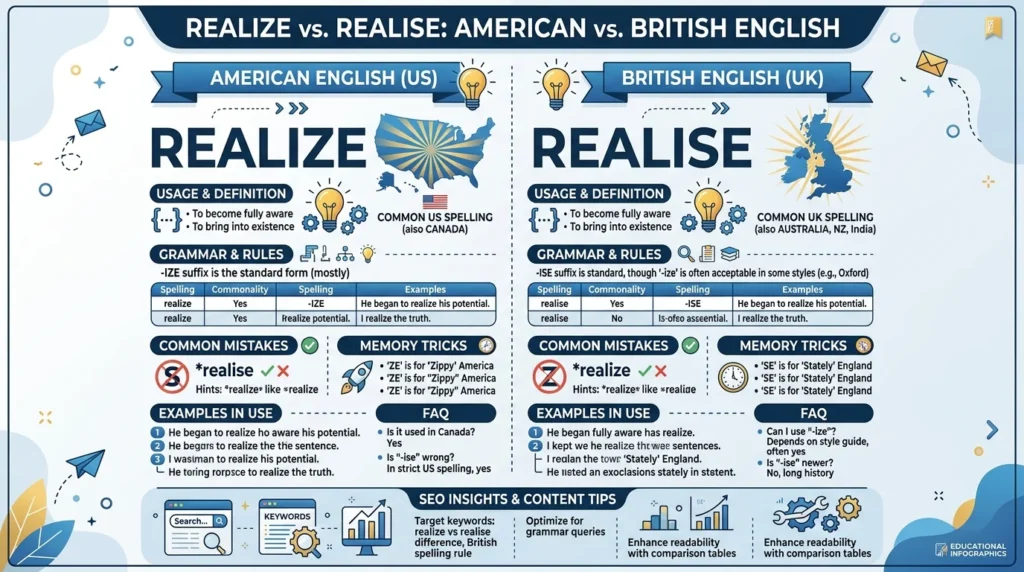
Both realize and realise are correct spellings of the same verb. The difference depends on the variety of English being used. Realize is the preferred spelling in American English and is also accepted by many British publishers, while realise is commonly used in British English, Australian English, and other Commonwealth countries. Both words have identical meanings, pronunciation, and grammatical functions.
The question of realize or realise is one of the most common spelling comparisons in English.
Many writers notice that American publications use realize, while British websites often use realise. This creates uncertainty about which version is correct.
Fortunately, the answer is simple:
Both spellings are correct.
The difference is based on regional spelling conventions rather than grammar or meaning.
Consider these examples:
- I didn’t realize the meeting had started. ✅
- I didn’t realise the meeting had started. ✅
Both sentences are correct English.
This guide explains:
- The meaning of realize and realise
- American vs British spelling rules
- Examples
- Common mistakes
- SEO considerations
- FAQs
Quick Answer
| Word | Correct? | Common Region |
|---|---|---|
| Realize | Yes | United States |
| Realise | Yes | United Kingdom, Australia |
| Both | Yes | Standard English |
Simple Summary
- Realize = American English
- Realise = British English
- Both mean exactly the same thing
What Does Realize Mean?
Definition
Realize means:
- To become aware of something
- To understand a fact or situation
- To achieve or fulfill something
Examples
- I realized I had forgotten my keys.
- She realized the answer immediately.
- They realized their dream of owning a business.
Common Usage
Realize is frequently used in:
- Business writing
- Academic papers
- News articles
- Everyday communication
American Preference
American English strongly favors realize.
What Does Realise Mean?
Definition
Realise has the exact same meaning as realize.
Examples
- I realised my mistake too late.
- She realised what had happened.
- They realised their goal after years of work.
British Preference
Realise is widely used in British English.
International Usage
Realise commonly appears in:
- United Kingdom
- Australia
- New Zealand
- South Africa
Main Difference Between Realize and Realise
Meaning
There is no difference in meaning.
Pronunciation
Both words are pronounced exactly the same way.
Grammar
Both function as verbs.
Regional Preference
Realize
Preferred in American English.
Realise
Preferred in British English.
Comparison Table
| Feature | Realize | Realise |
|---|---|---|
| Meaning | Same | Same |
| Pronunciation | Same | Same |
| Part of Speech | Verb | Verb |
| American English | Preferred | Less Common |
| British English | Accepted | Preferred |
Why Are There Two Spellings?
Historical Development
The words developed from older French and Latin influences.
American English Reform
American English adopted many simplified spellings.
Examples include:
- Realize
- Organize
- Recognize
British English Tradition
British English often prefers:
- Realise
- Organise
- Recognise
Modern English
Today, both forms remain correct.
Realize in American English
Standard Usage
Realize is the dominant spelling in the United States.
Examples
- I realized my phone was missing.
- She realized the importance of education.
- We realized the project ahead of schedule.
Academic Writing
American universities typically prefer realize.
Business Communication
Most U.S. businesses use realize.
Realise in British English
Standard British Usage
Realise is commonly used throughout the UK.
Examples
- I realised the problem quickly.
- They realised their mistake.
- She realised her potential.
Publishing Standards
Many British publishers favor realise.
Educational Usage
British schools commonly teach realise.
Is Realize Wrong in British English?
Short Answer
No.
Oxford Style
Some British publishers actually prefer realize.
Academic Acceptance
Many UK universities accept both spellings.
Reader Understanding
British readers easily recognize realize.
Is Realise Wrong in American English?
Technically No
Realise is still correct English.
Practical Usage
However, it appears less common in American publications.
Reader Expectations
American readers generally expect realize.
Professional Writing
Realize is usually preferred in U.S.-focused content.
Common Examples of Realize
Awareness
- I realized the truth.
Understanding
- She realized her mistake.
Achievement
- They realized their ambition.
Business
- The company realized significant profits.
Common Examples of Realise
Awareness
- I realised the answer later.
Understanding
- He realised his error.
Achievement
- They realised their vision.
Education
- Students realised the importance of studying.
Common Mistakes People Make
Assuming One Is Wrong
Both spellings are correct.
Mixing Styles
Avoid switching between realize and realise in the same article.
Ignoring Audience
Choose the version preferred by your readers.
Confusing Meaning
There is no difference in definition.
Realize vs Realise in Academic Writing
American Institutions
Typically prefer realize.
British Institutions
Often prefer realise.
International Journals
Either spelling may be accepted.
Student Assignments
Follow your instructor’s style requirements.
Realize vs Realise in SEO
Search Volume
Realize generally receives higher global search volume.
International Reach
Realise remains highly searched in Commonwealth countries.
Content Strategy
Including both spellings can improve keyword coverage.
SEO Recommendation
Target realize or realise while explaining regional differences.
Which Spelling Is More Common?
Online Usage
Realize appears more frequently worldwide.
American Influence
The large volume of U.S. content increases the popularity of realize.
International Publishing
Realise remains common outside the United States.
Overall Trend
Realize tends to dominate global search results.
Related American vs British Spellings
Realize or Realise
Regional spelling variation.
Organize or Organise
Another common distinction.
Recognize or Recognise
Frequently compared pair.
Analyze or Analyse
Popular spelling difference.
How to Remember the Difference
Geography Rule
United States → Realize
United Kingdom → Realise
The Z Rule
American English often prefers Z.
Examples:
- Realize
- Organize
- Recognize
The S Rule
British English often prefers S.
Examples:
- Realise
- Organise
- Recognise
Easy Formula
US = Realize
UK = Realise
Exercises With Answers
Exercise 1
Which spelling is preferred in American English?
Answer: Realize
Exercise 2
Which spelling is preferred in British English?
Answer: Realise
Exercise 3
Do realize and realise have different meanings?
Answer: No
Exercise 4
Which spelling uses the letter Z?
Answer: Realize
Exercise 5
Are both spellings grammatically correct?
Answer: Yes
FAQs
Is it realize or realise?
Both are correct. Realize is American English, while realise is commonly used in British English.
Which spelling is used in the United States?
Realize.
Which spelling is used in the United Kingdom?
Realise is common, though realize is also accepted by some publishers.
Do realize and realise mean the same thing?
Yes. Their meanings are identical.
Is realise wrong in American English?
No, but it is uncommon.
Is realize wrong in British English?
No. Many British style guides accept it.
Which spelling is better for SEO?
Realize generally has higher global search volume.
Can I use both spellings in one article?
It is best to remain consistent.
Which spelling is more common globally?
Realize.
Will readers understand both versions?
Yes. Both are widely recognized.
Conclusion
The answer to realize or realise is straightforward:
Both spellings are correct.
Key takeaways include:
- Realize is preferred in American English.
- Realise is commonly used in British English.
- Both words have identical meanings and pronunciation.
- Neither spelling is grammatically incorrect.
- Audience location should determine which version you choose.
Remember this simple rule:
US English = Realize
UK English = Realise
Using the appropriate spelling for your audience improves consistency, professionalism, readability, and SEO performance in 2026 and beyond.

Kevin Brooks is a grammar specialist at GramBrix.com, dedicated to helping readers understand language rules with clarity and confidence. He simplifies complex grammar concepts through practical examples and easy explanations.