
Last Updated on July 15, 2026
| Term | Meaning |
|---|---|
| Tiff | A small argument, minor disagreement, or brief quarrel |
| Tone | Usually mild and temporary |
| Common Context | Friends, family, coworkers, couples |
| Example | “They had a tiff but quickly made up.” |
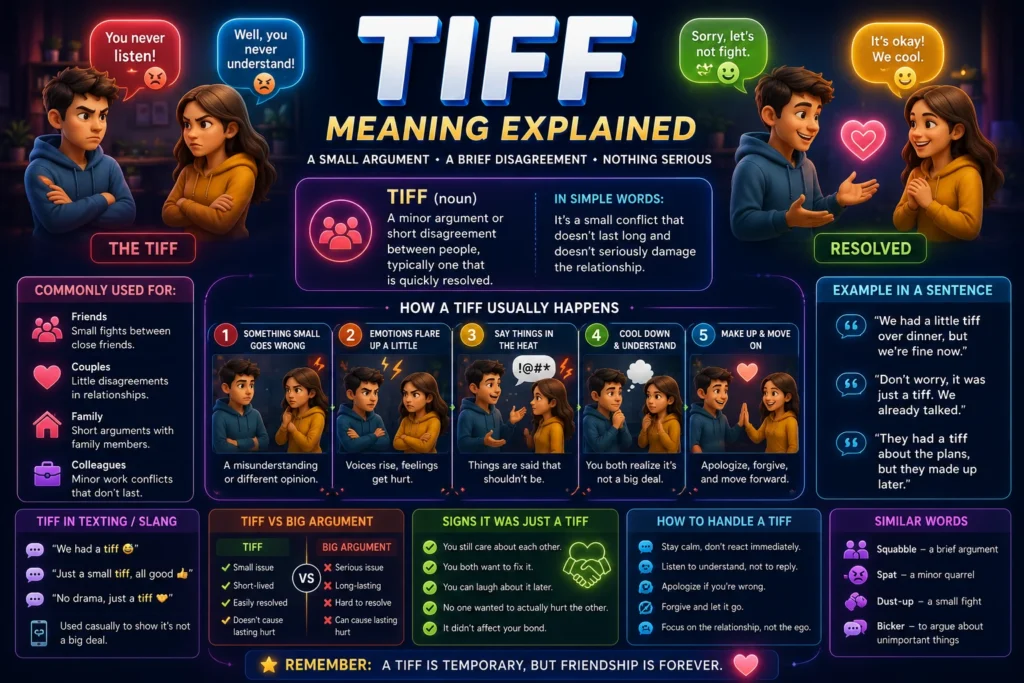
A tiff is a small, usually short-lived argument or disagreement between people. Unlike a serious conflict, a tiff often involves minor issues and typically resolves quickl
Have you ever heard someone say, “We had a little tiff,” and wondered what they meant?
The word tiff is a common English term used to describe a minor argument, disagreement, or quarrel. People often use it when discussing brief conflicts between friends, family members, coworkers, romantic partners, or acquaintances.
Unlike a major dispute or heated confrontation, a tiff usually involves a relatively small issue. Moreover, it often ends quickly without causing lasting damage to a relationship.
Understanding the tiff meaning can help you improve your English vocabulary and better understand conversations, books, movies, television shows, workplace discussions, and social media content.
In this comprehensive guide, you’ll learn what tiff means, where it comes from, how people use it, real-life examples, platform-specific meanings, conversation scenarios, common mistakes, related words, and much more.
Quick Answer Box
| Category | Explanation |
|---|---|
| Meaning | A small argument or minor disagreement |
| Context | Relationships, friendships, family, workplace |
| Usage | Describing brief conflicts |
| Tone | Mild, informal, usually non-serious |
| Common Platforms | Social media, messaging apps, entertainment |
| Example | “The siblings had a tiff over the remote control.” |
| Synonyms | Quarrel, spat, disagreement, dispute |
| Opposites | Harmony, agreement, peace, understanding |
What Does It Mean?
A tiff is a minor argument or brief disagreement between two or more people.
People generally use the word when the conflict is:
- Small
- Temporary
- Non-serious
- Easily resolved
- Emotionally limited
Simple Definition
Tiff = small argument + brief disagreement
Examples:
- Friends arguing over dinner plans
- Siblings fighting about a television show
- Coworkers disagreeing about a meeting schedule
- A couple arguing over a minor misunderstanding
In most situations, a tiff does not result in a major conflict.
Full Definition
The word tiff refers to a petty quarrel, minor disagreement, or brief argument.
Unlike words such as conflict, feud, or dispute, tiff suggests a disagreement that remains relatively harmless and temporary.
Key Characteristics of a Tiff
A tiff is often:
- Short-lived
- Mild
- Emotional but manageable
- Easily resolved
- Limited in scope
- Non-threatening
For example, two friends may argue about where to eat lunch. If the disagreement lasts only a few minutes and neither person remains upset, most people would describe it as a tiff.
Origin and History
The exact origin of the word remains uncertain. However, English speakers have used tiff since the 18th century.
Historically, the word described:
- Petty disputes
- Small quarrels
- Temporary disagreements
Over time, the meaning remained largely unchanged.
Today, English speakers still use tiff to describe minor interpersonal conflicts.
Context and Usage
The word appears in many social situations.
In Friendships
Friends occasionally disagree.
Example:
“They had a tiff about vacation plans.”
In Romantic Relationships
Couples often experience small disagreements.
Example:
“The couple had a minor tiff but resolved it before dinner.”
In Families
Family members frequently have brief arguments.
Example:
“The brothers had a tiff over who would drive.”
In Workplaces
Coworkers sometimes disagree about responsibilities or decisions.
Example:
“A small tiff developed during the meeting.”
In Schools
Students may experience minor disagreements.
Example:
“The classmates had a tiff over the group project.”
Emotional Meaning of Tiff
The emotional impact of a tiff differs significantly from a major conflict.
Mild Frustration
Most tiffs involve temporary annoyance.
Example:
“She felt irritated after the tiff.”
Limited Anger
The emotions usually remain controlled.
Consequently, people often recover quickly.
Temporary Tension
A tiff may create brief awkwardness.
However, the tension rarely lasts long.
Quick Reconciliation
Unlike serious disputes, many tiffs end with apologies or simple conversations.
Real-Life Examples
Understanding everyday examples makes the meaning clearer.
Example 1: Restaurant Choice
Two friends disagree about where to eat.
“The tiff lasted ten minutes before they chose a restaurant.”
Example 2: Remote Control Argument
Siblings argue about television programming.
“The tiff ended when they agreed to alternate shows.”
Example 3: Workplace Scheduling
Coworkers disagree about meeting times.
“The team quickly resolved the tiff.”
Example 4: Vacation Planning
A couple debates travel destinations.
“Their tiff disappeared once they reviewed options together.”
Example 5: Social Event
Friends argue about transportation arrangements.
“A brief tiff occurred before everyone reached an agreement.”
Conversation Examples
Conversation Example 1
Person A: Are you upset with Sarah?
Person B: Not really. We had a small tiff yesterday.
Conversation Example 2
Person A: Why wasn’t Mark talking to Emily?
Person B: They had a tiff about weekend plans.
Conversation Example 3
Person A: Is everything okay at work?
Person B: Yes. There was a minor tiff during the meeting, but it’s settled now.
Conversation Example 4
Person A: You seemed annoyed earlier.
Person B: My brother and I had a tiff over borrowing the car.
Conversation Example 5
Person A: Did the group finish the project?
Person B: Yes, although we had a brief tiff about responsibilities.
Platform-Specific Meaning
The meaning remains consistent across platforms. However, usage varies slightly.
Tiff on Social Media
People often use the term when discussing celebrity disagreements or personal experiences.
Example:
“The influencers had a public tiff online.”
Tiff on Instagram
Users may describe relationship disagreements.
Example:
“Just a tiny tiff. Everything is fine now.”
Tiff on TikTok
Creators sometimes use the word while discussing friendships, relationships, or family situations.
Example:
“We had a little tiff, but we’re good now.”
Tiff on X
Journalists and users frequently describe minor public disagreements as tiffs.
Example:
“The politicians had a brief tiff during the debate.”
Tiff in Messaging Apps
People often use the term casually.
Example:
“Sorry about our tiff earlier.”
Alternative Meanings
Although the primary meaning refers to a minor disagreement, context can create subtle variations.
Friendly Tiff
A disagreement that remains playful.
Example:
“Their friendly tiff entertained everyone.”
Romantic Tiff
A brief disagreement between partners.
Example:
“The couple experienced a small tiff over vacation plans.”
Workplace Tiff
A professional disagreement.
Example:
“The managers had a tiff about project priorities.”
Family Tiff
A disagreement among relatives.
Example:
“The family tiff ended before the holiday dinner.”
Related Terms and NLP Variations
Search engines and AI systems associate tiff with numerous related concepts.
Common Synonyms
- Quarrel
- Spat
- Disagreement
- Argument
- Dispute
- Clash
- Friction
- Conflict
- Difference
- Altercation
Near Synonyms
- Debate
- Misunderstanding
- Tension
- Frustration
- Verbal disagreement
Opposites
- Harmony
- Peace
- Agreement
- Cooperation
- Unity
- Understanding
- Friendship
- Reconciliation
Related Concepts
- Relationship conflict
- Minor dispute
- Temporary disagreement
- Personal misunderstanding
- Emotional tension
Tiff vs Similar Words
Many English learners confuse tiff with related terms.
Tiff vs Argument
An argument can be serious or minor.
A tiff is usually small and temporary.
Tiff vs Dispute
A dispute often involves more significant issues.
A tiff typically concerns minor matters.
Tiff vs Feud
A feud can last months or years.
A tiff usually ends quickly.
Tiff vs Spat
These words are very similar.
However, spat often sounds even more informal.
Tiff vs Conflict
Conflict may involve major disagreements.
A tiff suggests limited tension.
How to Respond When Someone Mentions a Tiff
Your response depends on the context.
When Friends Have a Tiff
Possible responses:
- “I hope you work things out.”
- “I’m sure you’ll resolve it.”
When Couples Have a Tiff
Possible responses:
- “Every relationship has occasional disagreements.”
- “It sounds like a minor issue.”
When Coworkers Have a Tiff
Possible responses:
- “Communication usually helps.”
- “Hopefully everyone can move forward.”
When Family Members Have a Tiff
Possible responses:
- “Families often disagree sometimes.”
- “I’m sure things will improve.”
Why People Use the Word Tiff
The word serves an important purpose because it softens the description of conflict.
Instead of saying:
“We had a serious argument.”
Someone might say:
“We had a little tiff.”
This wording suggests:
- Lower intensity
- Temporary tension
- Limited emotional impact
- Easy resolution
Therefore, many people prefer the term when describing small disagreements.
Common Misinterpretations
Several misconceptions surround this word.
Mistake 1: Assuming It Means a Major Fight
A tiff usually refers to a minor disagreement.
Mistake 2: Assuming It Means Physical Conflict
The word generally describes verbal disagreements.
Mistake 3: Thinking It Always Involves Anger
Some tiffs involve frustration rather than anger.
Mistake 4: Assuming It Lasts a Long Time
Most tiffs resolve relatively quickly.
When NOT to Use It
Avoid using tiff when describing serious conflicts.
Incorrect Usage Examples
- Major legal disputes
- Violent confrontations
- Long-term family feuds
- International conflicts
- Workplace harassment cases
These situations exceed the typical scope of a tiff.
Better Alternatives
Consider using:
- Conflict
- Dispute
- Feud
- Confrontation
- Crisis
- Litigation
Usage Tips
These practical tips will help you use the word naturally.
Tip 1: Use It for Small Disagreements
Example:
“The friends had a brief tiff.”
Tip 2: Consider Tone
The word usually sounds informal and conversational.
Tip 3: Use It in Relationship Contexts
Many native speakers associate tiff with personal relationships.
Tip 4: Avoid Using It for Serious Situations
Reserve the word for relatively minor disagreements.
Tip 5: Pair It with Resolution
Many tiffs end quickly.
Example:
“They had a tiff but soon reconciled.”
Why Understanding Tiff Matters
Learning nuanced vocabulary improves communication.
Moreover, understanding tiff helps you:
- Interpret conversations accurately
- Read books more effectively
- Understand television dialogue
- Follow social media discussions
- Describe disagreements precisely
Because the word appears frequently in both casual and professional contexts, it remains useful for English learners and native speakers alike.
Tiff in Literature and Popular Culture
The word frequently appears in entertainment and media.
In Novels
Authors often use tiffs to create relationship tension without escalating conflict.
In Television Shows
Characters regularly experience minor tiffs.
These disagreements help develop relationships and storylines.
In Romantic Comedies
Tiffs often create humorous situations.
Consequently, they play an important role in character development.
In Celebrity News
Entertainment media frequently describe minor disagreements as tiffs.
This wording sounds less dramatic than conflict or feud.
FAQs
What does tiff mean?
A tiff is a small argument, brief disagreement, or minor quarrel.
Is a tiff serious?
Usually not. Most tiffs involve minor issues and resolve quickly.
What is an example of a tiff?
Two friends arguing about where to eat dinner is a common example.
Is a tiff the same as a fight?
No. A fight is often more serious than a tiff.
Can couples have a tiff?
Yes. The word frequently describes minor disagreements between romantic partners.
Is tiff a formal word?
It is generally informal and conversational.
What is the difference between a tiff and a feud?
A tiff is short and minor. A feud is usually long-term and serious.
Can coworkers have a tiff?
Yes. Minor workplace disagreements often qualify as tiffs.
What are synonyms for tiff?
Common synonyms include spat, quarrel, disagreement, and argument.
How do you use tiff in a sentence?
Example: “The sisters had a tiff but made up before bedtime.”
Conclusion
The tiff meaning refers to a minor argument, brief disagreement, or small quarrel between people. Unlike serious disputes or long-lasting conflicts, a tiff usually involves a relatively minor issue and often resolves quickly.
Moreover, the word commonly appears in discussions about friendships, romantic relationships, families, workplaces, schools, and social situations. Because it suggests a lower level of conflict, many people use it to describe disagreements without making them sound overly dramatic.
By understanding the meaning, examples, usage patterns, synonyms, comparisons, and common misconceptions associated with tiff, you can use this useful English word naturally and confidently in everyday conversation and writing.

Justin Powell is a writer at GramBrix.com who focuses on grammar, clarity and effective communication, helping readers strengthen their language skills.