
Last Updated on July 8, 2026
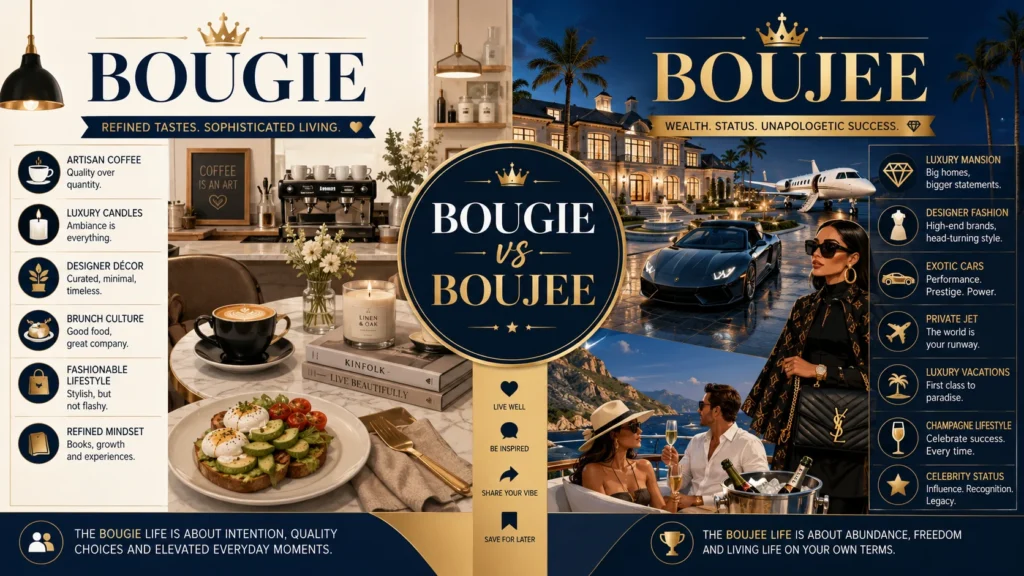
Bougie and boujee are two popular slang terms that describe a luxurious, upscale, or high class lifestyle. While they are often used interchangeably, bougie traditionally refers to someone perceived as middle class but aspiring to wealth, whereas boujee is a modern cultural variation that celebrates luxury, success, and expensive tastes. Understanding the difference helps you use each term correctly in conversation, social media, and writing.
Have you ever heard someone say, “That’s so bougie,” while another person says, “She’s boujee”? If so, you’re not alone. Many people wonder whether these words mean the same thing or if there is an important difference between them.
The confusion comes from the fact that both words sound similar and are often used in the same situations. They both relate to luxury, wealth, fashion, expensive habits, and high end lifestyles. However, their history and meaning are not exactly identical.
In today’s world, social media, music, celebrity culture, and internet trends have made both terms extremely popular. You can find them in captions, songs, memes, and everyday conversations. Because they appear so often, understanding their meanings can help you communicate more clearly and avoid using the wrong term.
This guide explains everything you need to know about bougie or boujee, including definitions, origins, examples, comparisons, common mistakes, regional usage, and practical exercises.
Quick Answer
If you are looking for a simple answer:
| Term | Meaning |
|---|---|
| Bougie | Originally refers to someone with middle class values who acts wealthy or sophisticated |
| Boujee | Modern slang describing a luxurious, wealthy, stylish, or glamorous lifestyle |
In casual conversation, many people use the two words interchangeably.
However:
- Bougie has roots in the word “bourgeois.”
- Boujee gained popularity through modern slang and music culture.
- Bougie can sometimes be slightly critical.
- Boujee is often positive or celebratory.
What Does Bougie Mean?
The word bougie comes from the French term bourgeoisie.
Historically, the bourgeoisie referred to the middle class, especially people who owned businesses or property. Over time, English speakers shortened the term to “bougie.”
Today, bougie often describes someone who:
- Likes expensive things
- Acts sophisticated
- Prefers luxury products
- Has refined tastes
- Sometimes appears pretentious
Example Sentences
- My friend only drinks imported coffee because she’s bougie.
- That restaurant is too bougie for my budget.
- He bought designer furniture for his apartment because he likes a bougie lifestyle.
In many cases, bougie carries a playful tone rather than a serious insult.
What Does Boujee Mean?
The word boujee is a modern spelling variation inspired by African American Vernacular English (AAVE) and popular culture.
It became especially famous through the hit song Bad and Boujee by the musical group Migos.
Today, boujee usually means:
- Wealthy
- Stylish
- Luxurious
- Successful
- High class
Unlike bougie, boujee often has a more positive tone.
Example Sentences
- She lives a boujee lifestyle.
- We stayed at a boujee resort during vacation.
- His boujee taste in cars is impressive.
People frequently use boujee to celebrate success and luxury.
Bougie vs Boujee Comparison Table
| Feature | Bougie | Boujee |
|---|---|---|
| Origin | Bourgeoisie | Modern slang variation |
| Historical roots | French social class term | Popular culture and music |
| Tone | Sometimes critical | Usually positive |
| Meaning | Acting wealthy or sophisticated | Living luxuriously |
| Common usage | Everyday slang | Social media and entertainment |
| Focus | Aspirational wealth | Celebrated luxury |
The History Behind Bougie
Understanding the history helps explain why the word exists.
French Origins
The term bourgeoisie emerged in France centuries ago.
It described people who were:
- Neither poor nor aristocratic
- Business owners
- Merchants
- Professionals
Eventually, the word gained political and social meanings.
Evolution into Slang
As language evolved, English speakers shortened bourgeoisie into bougie.
The meaning shifted from a social class to describing people who:
- Want to appear refined
- Enjoy luxury
- Follow upper class trends
Today, many people use the term humorously.
The Rise of Boujee in Popular Culture
Boujee became especially popular during the 2010s.
Several factors contributed:
Music
Hip hop artists frequently used the term to describe success and luxury.
Social Media
Platforms such as:
- TikTok
- X
helped spread the word globally.
Celebrity Influence
Celebrities often showcase:
- Designer clothing
- Luxury vacations
- Expensive cars
- Exclusive experiences
These lifestyles are frequently described as boujee.
Why People Confuse Bougie and Boujee
The confusion happens for several reasons.
Similar Pronunciation
Many people pronounce both words nearly the same way.
Similar Meanings
Both terms involve:
- Luxury
- Wealth
- Fashion
- Sophistication
Shared Contexts
Examples:
- Bougie brunch
- Boujee brunch
- Bougie apartment
- Boujee apartment
In many situations, either term works.
When to Use Bougie
Use bougie when discussing:
Refined Preferences
Example:
- He buys artisan bread instead of regular bread because he’s bougie.
Pretentious Behavior
Example:
- She refuses to drink coffee from chain stores because she’s bougie.
Aspirational Luxury
Example:
- Their small apartment feels surprisingly bougie.
Bougie often highlights someone’s attempt to create a luxury experience.
When to Use Boujee
Use boujee when discussing:
Glamorous Lifestyles
Example:
- Their wedding was incredibly boujee.
Wealth and Success
Example:
- The celebrity’s mansion looks very boujee.
High End Experiences
Example:
- We enjoyed a boujee spa weekend.
Boujee tends to emphasize actual luxury rather than simply appearing luxurious.
Advantages and Disadvantages of Using Bougie
Advantages
- Widely understood
- Flexible meaning
- Useful in casual conversation
- Can be humorous
Disadvantages
- May sound judgmental
- Some people interpret it negatively
- Meaning varies by audience
Advantages and Disadvantages of Using Boujee
Advantages
- Modern and trendy
- Positive tone
- Popular online
- Associated with success
Disadvantages
- Informal
- Not suitable for professional writing
- Some people may misunderstand it
Real World Examples of Bougie and Boujee
Food
Bougie:
- Organic imported cheese
- Gourmet coffee beans
- Artisanal desserts
Boujee:
- Private chef dinners
- Luxury tasting menus
- Exclusive restaurants
Fashion
Bougie:
- Following luxury fashion trends
Boujee:
- Owning luxury designer collections
Travel
Bougie:
- Upgrading to premium economy
Boujee:
- Flying on a private jet
Home Decor
Bougie:
- Decorative candles and luxury bedding
Boujee:
- Waterfront mansions and designer interiors
Regional and Global Usage
United States
Both words are extremely common.
Boujee is particularly popular among younger generations.
Canada
Both terms appear frequently in social media and casual speech.
United Kingdom
Bougie is generally more common.
The connection to class and sophistication is often stronger.
Australia
Bougie appears more often than boujee.
Global Internet Culture
Social media has spread both terms worldwide.
Today, people use them regardless of location.
Related Concepts and Similar Words
If you’re learning about bougie or boujee, you may encounter related terms.
| Word | Meaning |
|---|---|
| Fancy | Elegant or expensive |
| Classy | Stylish and refined |
| Luxury | High quality and expensive |
| Affluent | Wealthy |
| Elite | Exclusive and prestigious |
| Sophisticated | Cultured and refined |
| High end | Premium quality |
| Upscale | Designed for wealthy consumers |
These words share some overlap with bougie and boujee.
Common Mistakes When Using Bougie or Boujee
Assuming They Are Completely Different
Reality:
The meanings overlap significantly.
Using Them in Formal Writing
Incorrect:
- The company’s annual report describes a boujee strategy.
Better:
- The company follows a luxury branding strategy.
Confusing Wealth with Style
Someone can be bougie without being rich.
For example:
- A college student buying expensive coffee every day.
Thinking Bougie Is Always Negative
Not true.
Many people use it affectionately.
Bougie or Boujee in Social Media
Social media has helped both words become mainstream.
Common captions include:
- Living my boujee life.
- Bougie brunch with friends.
- Boujee vacation vibes.
- Feeling a little bougie today.
- Boujee and loving it.
These captions often highlight luxury experiences.
How Language Changes Over Time
The story of bougie and boujee shows how language evolves.
Words often:
- Change meaning
- Gain new spellings
- Spread through music
- Become popular online
Many modern slang words follow the same pattern.
Examples include:
- Lit
- Flex
- Glow up
- Vibe
- Extra
Boujee developed in a similar way.
Bougie or Boujee in Different Generations
Older Generations
May be more familiar with:
- Bourgeois
- Bourgeoisie
- Bougie
Younger Generations
Often use:
- Boujee
- Luxury aesthetic
- Rich vibes
Generation Z
Frequently uses both words interchangeably.
Examples in Everyday Situations
At a Restaurant
Person A:
- Why is the menu so expensive?
Person B:
- This place is really bougie.
Shopping
Person A:
- You bought another designer handbag?
Person B:
- I like boujee things.
Travel
Person A:
- How was your hotel?
Person B:
- It was super boujee. The pool overlooked the ocean.
Exercises With Answers
Exercise 1
Choose the best word.
- The luxury yacht looked very _____.
- My friend insists on drinking imported sparkling water because she’s _____.
- Their five star resort vacation was incredibly _____.
Answers
- Boujee
- Bougie
- Boujee
Exercise 2
Identify whether the sentence sounds more bougie or boujee.
- Buying handcrafted coffee daily.
- Owning a private island.
- Decorating a small apartment with luxury candles.
Answers
- Bougie
- Boujee
- Bougie
Exercise 3
Rewrite the sentence.
Original:
- The restaurant is expensive.
Possible Rewrite:
- The restaurant is really bougie.
Or:
- The restaurant feels incredibly boujee.
Advanced Understanding of Bougie and Boujee
At a deeper level, the difference involves perception.
Bougie Often Suggests
- Aspiration
- Presentation
- Sophisticated tastes
- Lifestyle choices
Boujee Often Suggests
- Achievement
- Luxury
- Wealth
- Glamour
Think of it this way:
A person who buys premium coffee every day may be bougie.
A celebrity arriving by helicopter may be boujee.
The line between them is not strict, but the distinction helps explain usage.
FAQs
What is the difference between bougie or boujee?
Bougie traditionally refers to someone acting sophisticated or aspiring to luxury, while boujee often celebrates luxury, wealth, and success.
Is bougie a negative word?
Not always. Bougie can be playful, humorous, positive, or mildly critical depending on context.
Is boujee a real word?
Yes. Boujee is widely recognized slang and appears frequently in music, social media, and modern culture.
Can I use bougie and boujee interchangeably?
In many casual conversations, yes. However, subtle differences in tone still exist.
Which spelling is more common, bougie or boujee?
Bougie generally appears more often in writing, while boujee is very common in social media and entertainment.
Does bougie mean rich?
Not necessarily. A person can be bougie without being wealthy. The term often refers to tastes and behavior.
Does boujee mean wealthy?
Usually, yes. Boujee often suggests luxury, success, and access to expensive experiences.
Why do people say boujee instead of bougie?
The spelling became popular through modern slang, music culture, and internet trends.
Can businesses use bougie or boujee in marketing?
Yes, especially brands targeting younger audiences or luxury focused consumers.
Is bougie or boujee appropriate in professional writing?
Generally no. Formal writing usually uses terms like luxury, upscale, premium, affluent, or sophisticated instead.
Conclusion
The debate over bougie or boujee is less about right versus wrong and more about understanding nuance. Both words relate to luxury, style, and high end tastes, but they come from different cultural backgrounds and carry slightly different meanings.
Bougie originated from the French concept of the bourgeoisie and often describes someone who enjoys refined tastes or tries to create an upscale lifestyle. It may sometimes carry a playful or mildly critical tone. Boujee, on the other hand, emerged from modern slang and popular culture and is usually associated with celebrating wealth, success, glamour, and luxury.
In everyday conversation, the two words overlap heavily, and many people use them interchangeably. However, understanding the subtle distinction can help you communicate more accurately and understand cultural references in music, social media, and entertainment.
When in doubt, remember this simple rule: bougie often describes aspirational sophistication, while boujee often celebrates luxurious success. Knowing that difference will help you choose the right word with confidence.

Justin Powell is a writer at GramBrix.com who focuses on grammar, clarity and effective communication, helping readers strengthen their language skills.