
Last Updated on August 16, 2026
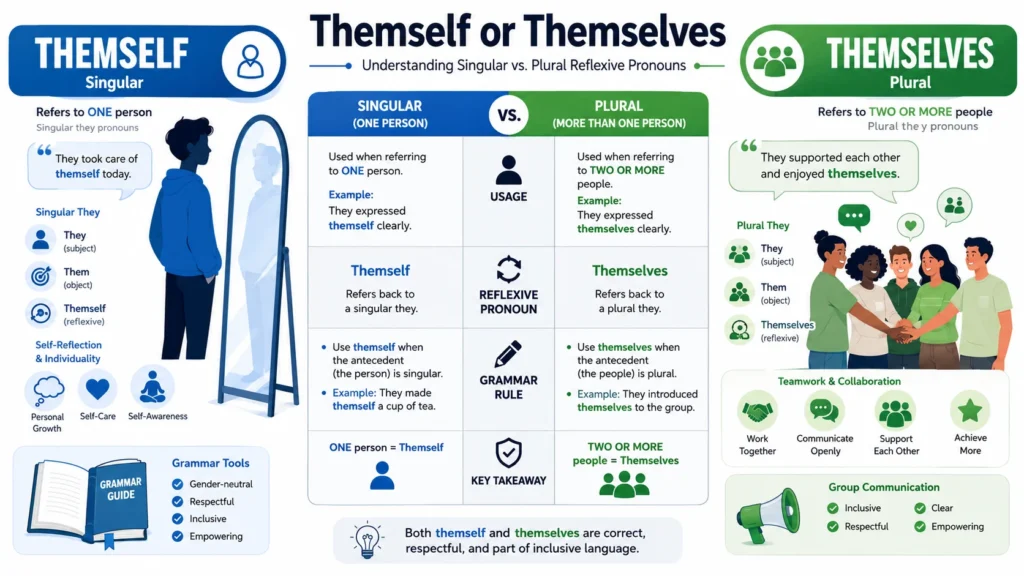
Themself or themselves are both reflexive pronouns, but they are used in different situations. Themselves is the standard and most common form for plural subjects, while themself is increasingly accepted when referring to a singular person who uses singular they or when the gender of a person is unknown.
Many English learners and even native speakers wonder whether they should write themself or themselves. At first glance, both words seem correct. After all, they are closely related and both refer back to the pronoun they.
The confusion comes from the fact that English has changed over time. Traditionally, they was used only for more than one person. In that case, themselves was the correct reflexive form. Today, however, they is also commonly used to refer to one person when the person’s gender is unknown or when someone uses they/them pronouns.
Because of this shift, many writers now use themself in certain situations. Yet themselves remains much more common in everyday writing.
Understanding when to use each form helps you write clearly and confidently. Whether you are a student, teacher, editor, or professional writer, knowing the difference between themself or themselves can improve your grammar and communication skills.
This guide explains everything you need to know, from basic definitions to advanced usage, examples, common mistakes, exercises, and frequently asked questions.
Quick Answer
If you need a quick answer to the question themself or themselves, here it is:
| Situation | Correct Form |
|---|---|
| Referring to multiple people | Themselves |
| Referring to a singular person using singular they | Themself or themselves |
| Formal traditional writing | Themselves |
| Modern inclusive writing | Themself often preferred |
| Unknown gender of one person | Themself or themselves |
Examples
Plural:
- The students prepared themselves for the exam.
- The players introduced themselves.
Singular:
- Each participant should introduce themself.
- A customer may find themself waiting during busy hours.
In modern English, both forms may appear in singular contexts, but themself often emphasizes that only one person is being discussed.
Understanding Reflexive Pronouns
Before comparing themself or themselves, it helps to understand reflexive pronouns.
A reflexive pronoun refers back to the subject of a sentence.
Common reflexive pronouns include:
| Subject Pronoun | Reflexive Pronoun |
|---|---|
| I | Myself |
| You | Yourself |
| He | Himself |
| She | Herself |
| It | Itself |
| We | Ourselves |
| You (plural) | Yourselves |
| They | Themselves |
Examples:
- I taught myself guitar.
- She prepared herself.
- We enjoyed ourselves.
- They introduced themselves.
Reflexive pronouns are used when the subject and object are the same person or group.
What Does Themself Mean?
Themself is a reflexive pronoun used with singular they.
It refers back to a single individual.
Examples
- Someone may find themself in a difficult situation.
- Each applicant should ask themself this question.
- A person should trust themself.
In these sentences, only one person is being discussed.
The word themself helps maintain consistency when singular they is used.
What Does Themselves Mean?
Themselves is the traditional reflexive form of they.
It usually refers to multiple people.
Examples
- The children entertained themselves.
- The employees introduced themselves.
- The athletes prepared themselves for competition.
Each sentence refers to more than one person.
Because English speakers have used themselves for centuries, it remains the most familiar form.
Themself or Themselves: Side by Side Comparison
| Feature | Themself | Themselves |
|---|---|---|
| Grammatical Type | Reflexive pronoun | Reflexive pronoun |
| Refers to One Person | Yes | Sometimes |
| Refers to Multiple People | No | Yes |
| Traditional Usage | Rare | Standard |
| Modern Inclusive Usage | Common | Common |
| Associated with Singular They | Yes | Sometimes |
| Associated with Plural They | No | Yes |
Why Does the Confusion Exist?
The confusion comes from the changing role of they.
Historically:
- They = plural
- Themselves = plural reflexive form
Modern English:
- They = plural or singular
- Themself = singular reflexive form
- Themselves = plural reflexive form
As singular they became more common, writers needed a reflexive form that matched a singular meaning.
This led to increased use of themself.
The History of Themself
Many people assume themself is a new invention.
It is actually quite old.
Language historians have found examples of themself dating back several centuries.
Writers used it when referring to a singular person whose gender was unknown.
Over time, themselves became dominant because people associated they with plural subjects.
Today, the rise of singular they has brought themself back into wider use.
This demonstrates how language evolves to meet communication needs.
When to Use Themself
Use themself when referring to a single person represented by singular they.
Unknown Person
- If anyone calls, they can help themself to the information packet.
Generic Person
- A customer should ask themself whether the product meets their needs.
Nonbinary Individual
- Alex describes themself as a creative thinker.
Formal Policies
- Each employee should familiarize themself with company guidelines.
These examples all refer to one person.
When to Use Themselves
Use themselves when discussing multiple people.
Groups
- The students organized themselves into teams.
Families
- The family members introduced themselves.
Employees
- The workers protected themselves from the weather.
Teams
- The athletes challenged themselves to improve.
In all cases, more than one person is involved.
Advantages and Disadvantages of Using Themself
Advantages
Clear Singular Meaning
It clearly shows that only one person is being discussed.
Inclusive Language
It works naturally with singular they.
Increasing Acceptance
Many style guides now recognize it.
Avoids Gender Assumptions
It allows writers to remain gender neutral.
Disadvantages
Less Familiar
Some readers may find it unusual.
Not Universal
Some editors still prefer themselves.
Can Look Informal
Certain traditional publications avoid it.
Advantages and Disadvantages of Using Themselves
Advantages
Widely Recognized
Most readers instantly understand it.
Traditional Grammar
It has long been considered standard.
Accepted Everywhere
It rarely attracts criticism.
Disadvantages
Can Create Number Mismatch
Singular they paired with themselves may feel inconsistent to some readers.
Less Precise
It may not clearly indicate one person.
Real World Examples
Here are examples from everyday situations.
Education
- Each student should ask themself whether they understand the lesson.
Business
- Every employee must prepare themself for annual reviews.
Customer Service
- A customer may find themself waiting during peak hours.
Healthcare
- A patient should educate themself about treatment options.
Sports
- The athletes pushed themselves beyond their limits.
Notice how singular contexts often use themself, while group contexts use themselves.
Regional and Global Usage
Different English-speaking regions show different preferences.
| Region | Preferred Form |
|---|---|
| United States | Themself increasingly accepted |
| Canada | Themself increasingly common |
| United Kingdom | Both forms used |
| Australia | Mixed usage |
| Academic Writing | Depends on style guide |
| Everyday Speech | Usually unnoticed |
The growth of inclusive language has increased acceptance of themself around the world.
Style Guide Perspectives
Many writers rely on style guides.
Traditional Approach
Older guides often recommend:
- they
- them
- themselves
even when referring to one person.
Modern Approach
Newer guides increasingly accept:
- they
- them
- themself
for singular references.
The choice often depends on audience and publication standards.
Common Mistakes
Using Themself for Multiple People
Incorrect:
- The students taught themself.
Correct:
- The students taught themselves.
Using Themselves for Clearly Singular Meaning
Less Clear:
- Every applicant should prepare themselves.
Clearer:
- Every applicant should prepare themself.
Switching Between Forms
Incorrect:
- A person should prepare themself and then introduce themselves.
Correct:
- A person should prepare themself and then introduce themself.
Consistency matters.
Using Reflexive Pronouns Incorrectly
Incorrect:
- Themself completed the project.
Correct:
- They completed the project themselves.
Reflexive pronouns should usually refer back to a subject.
Related Concepts and Comparisons
Singular They
Singular they refers to one person.
Examples:
- Someone left their phone.
- A student should bring their notebook.
Because singular they is common, themself naturally follows.
Himself or Herself
Traditional grammar often required choosing between:
- himself
- herself
Example:
- Each student should prepare himself or herself.
Many writers now prefer:
- Each student should prepare themself.
This sounds smoother and more inclusive.
Themself vs Himself
| Aspect | Themself | Himself |
|---|---|---|
| Gender Neutral | Yes | No |
| Singular | Yes | Yes |
| Inclusive | Yes | No |
| Modern Usage | Growing | Traditional |
Themself vs Herself
| Aspect | Themself | Herself |
|---|---|---|
| Gender Neutral | Yes | No |
| Singular | Yes | Yes |
| Inclusive | Yes | No |
| Modern Usage | Growing | Traditional |
Practice Exercises
Choose the correct answer.
Exercise 1
Each participant should introduce _____.
A. themself
B. themselves
Answer: A. themself
Exercise 2
The players congratulated _____ after the victory.
A. themself
B. themselves
Answer: B. themselves
Exercise 3
Someone may find _____ confused by the instructions.
A. themself
B. themselves
Answer: A. themself
Exercise 4
The students organized _____ into study groups.
A. themself
B. themselves
Answer: B. themselves
Exercise 5
Every employee should ask _____ whether the training is complete.
A. themself
B. themselves
Answer: A. themself
Advanced Usage Notes
Language continues to evolve.
Modern English increasingly values:
- clarity
- inclusiveness
- natural speech
As a result, singular they and themself have become more visible.
Writers should consider:
- Audience expectations
- Publication standards
- Consistency
- Readability
In formal academic environments, check the required style guide.
In everyday communication, either form may be accepted when referring to a singular person.
FAQs
Is themself a real word?
Yes. Themself has existed for centuries and is widely recognized in modern English.
Which is correct: themself or themselves?
Both can be correct. Themself is usually singular, while themselves is typically plural.
Can I use themself in formal writing?
Yes. Many modern publications and style guides accept themself when using singular they.
Why do people use themself instead of themselves?
People use themself to make it clear that only one person is being discussed.
Is themselves wrong for singular they?
Not necessarily. Many writers still use themselves with singular they.
Do dictionaries recognize themself?
Yes. Most major dictionaries include themself as a valid word.
Should students write themself or themselves in essays?
Follow the style guide required by the teacher, school, or publication.
Is themself more inclusive?
Many people consider themself more inclusive because it works naturally with singular they.
Can nonbinary people use themself?
Yes. Many individuals who use singular they prefer themself as a reflexive pronoun.
Will themself become more common in the future?
Language trends suggest that themself may continue to grow in acceptance and usage.
Conclusiothemself or themselvesn
The debate over themself or themselves reflects the ongoing evolution of English grammar. Traditionally, themselves served as the reflexive form of they because they was viewed as a plural pronoun. Today, however, singular they is widely accepted, creating a natural place for themself in modern English.
The simplest rule is this: use themselves for groups and multiple people, and consider themself when referring to a single person represented by singular they. Both forms are understood by modern readers, but themself often provides greater clarity when discussing one individual.
When writing, think about your audience, style guide, and purpose. Academic or traditional publications may still favor themselves, while modern and inclusive writing often welcomes themself. Consistency is also important. Choose one form that fits the context and use it throughout your document.
By understanding these differences, you can communicate more clearly, write with confidence, and avoid one of the most common grammar questions in modern English.

Kevin Brooks is a grammar specialist at GramBrix.com, dedicated to helping readers understand language rules with clarity and confidence. He simplifies complex grammar concepts through practical examples and easy explanations.