
Last Updated on July 8, 2026
Abide means to accept, follow, remain faithful to, or stay with something over time, depending on the context. It is commonly used in phrases like abide by the rules, abide in peace, or can’t abide something, which means strongly dislike or cannot tolerate it.
If you have searched for abide meaning, you are probably trying to understand what this word really means in everyday English, formal writing, legal language, or even in phrases people use in conversation. At first glance, abide looks like a simple word, but it actually has multiple meanings depending on the context.
In one sentence, it can mean to obey a rule. In another, it can mean to tolerate something. In older or literary English, it can even mean to remain, stay, continue, or live in a certain state. That is why many English learners, students, writers, and even native speakers sometimes pause when they see the word abide in a sentence.
This guide gives you a complete, clear, and practical explanation of the word abide in natural US English. You will learn:
- the exact abide meaning
- how it is used in daily conversation
- how it appears in formal, legal, and biblical language
- the meaning of common phrases like abide by and cannot abide
- sentence examples and realistic dialogues
- related words, synonyms, and common mistakes
- when to use it and when not to use it
If you want a full answer that works for Google search, voice search, AI summaries, homework, writing, and reallife conversation, this article covers the entire topic in one place.
Quick Answer Box
| Topic | Simple Answer |
| Word | Abide |
| Main meaning | To accept, follow, tolerate, remain, or stay depending on context |
| Most common use | Abide by = follow or obey rules, laws, decisions, or agreements |
| Tone | Usually formal, neutral, literary, or slightly oldfashioned in some uses |
| Common phrase | I can’t abide that = I can’t tolerate or stand that |
| Where used | Daily English, legal writing, workplace language, literature, religion, and older expressions |
| Example | “All employees must abide by company policy.” |
| Another example | “She cannot abide dishonesty.” |
| Core idea behind the word | Staying with something, accepting it, or following it |
What Does Abide Mean?
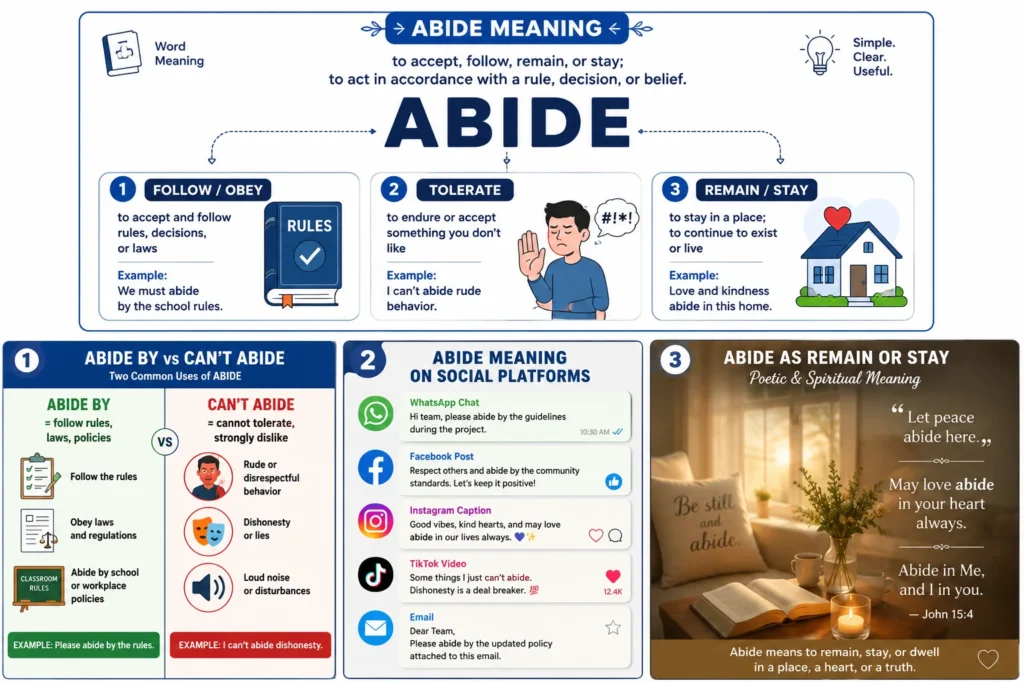
The word abide has a few closely related meanings. The exact meaning changes based on the sentence.
The most common meanings of abide
Abide can mean:
- To obey or follow
- especially rules, laws, agreements, or decisions
- example: You must abide by the contract.
- To tolerate or accept something
- often used in negative sentences like can’t abide
- example: I can’t abide rude behavior.
- To remain, stay, or continue
- more literary, poetic, or religious
- example: May peace abide in this home.
So if someone asks for the abide meaning, the short answer is:
Abide means to follow, accept, tolerate, or remain, depending on the context.
Full Definition of Abide
To really understand this word, it helps to separate it into its main meanings.
Abide meaning 1: To follow or obey
This is the most common modern use of the word. It usually appears in the phrase abide by.
Structure
- abide by + rule / law / agreement / decision / policy / terms
Meaning
To accept and act according to something official or expected.
Examples
- We must abide by the law.
- Students are expected to abide by school rules.
- All users must abide by the website’s terms of service.
- If you sign the contract, you must abide by its conditions.
In these examples, abide means follow, obey, or comply with.
Abide meaning 2: To tolerate or endure
This use is common in the expression can’t abide or cannot abide.
Meaning
To accept something unpleasant without rejecting it, or more commonly, to be unable to tolerate it.
Examples
- I can’t abide people who lie.
- She cannot abide loud chewing noises.
- He couldn’t abide the constant disrespect.
- My grandfather couldn’t abide laziness.
In this use, abide is close to:
- tolerate
- stand
- put up with
- endure
Abide meaning 3: To remain, stay, or continue
This is a more formal, literary, poetic, or biblical use of the word.
Meaning
To remain in a place, state, condition, or relationship.
Examples
- Love should abide in every family.
- May hope abide in your heart.
- The memory of that day will abide with me forever.
- Truth abides even when opinions change.
This sense is less common in everyday speech, but you will still see it in:
- literature
- religious writing
- speeches
- inspirational quotes
- formal essays
Context and Usage of Abide
The best way to understand abide meaning is to look at where and how people use it. The word behaves differently in different settings.
Abide By: The Most Common Modern Use
When most people use abide today, they usually say abide by.
What does “abide by” mean?
Abide by means:
- to obey
- to follow
- to act according to
- to accept and respect rules, decisions, laws, or agreements
Common things people abide by
People often abide by:
- laws
- rules
- court decisions
- contracts
- company policies
- school regulations
- safety instructions
- religious teachings
- social expectations
- deadlines or official terms
Examples of abide by in sentences
- Drivers must abide by traffic laws.
- Please abide by the deadline if you want your application considered.
- Visitors are required to abide by the dress code.
- The team agreed to abide by the final decision.
- Tenants must abide by the terms of the lease.
Why “abide by” matters in English
This phrase is extremely common because it appears in:
- contracts
- workplace documents
- school policies
- government instructions
- legal language
- website terms and conditions
- formal emails
If you see the word abide in modern practical English, there is a good chance it is part of abide by.
“Can’t Abide” Meaning
Another common expression is can’t abide or cannot abide.
What does “can’t abide” mean?
It means:
- I cannot tolerate it
- I strongly dislike it
- I can’t stand it
Tone of “can’t abide”
This expression sounds:
- a bit strong
- sometimes slightly oldfashioned
- sometimes British or literary in tone
- still understandable in American English
Examples
- I can’t abide dishonesty.
- She can’t abide people who interrupt.
- He cannot abide bad customer service.
- My aunt can’t abide clutter in the house.
This phrase is useful when you want to express strong dislike or zero tolerance.
Abide as “Remain” or “Stay”
This meaning is less common in everyday spoken American English, but it still matters because it appears in writing, songs, religion, and inspirational language.
Meaning
To remain, stay, continue, or dwell.
Examples
- Let peace abide here.
- Faith abides in difficult times.
- His influence still abides in the company.
- Those values abide across generations.
This use gives the word a more poetic or elevated feel.
RealLife Examples of Abide in Sentences
Below are practical examples that show how the word works in different situations.
Workplace examples
- Employees must abide by all workplace safety rules.
- If you want to work remotely, you still need to abide by company policy.
- Our department will abide by the final HR decision.
- The manager cannot abide repeated lateness.
School examples
- Students must abide by the code of conduct.
- If you join the club, you agree to abide by its rules.
- The teacher could not abide cheating on exams.
Family and social examples
- My parents always taught us to abide by our promises.
- I can’t abide people who are rude to waiters.
- Even after the argument, love still abided in the family.
- Good values should abide in every home.
Legal and formal examples
- Both parties agree to abide by the court’s ruling.
- The organization must abide by federal regulations.
- Failure to abide by these conditions may result in termination of service.
- Members are expected to abide by the constitution of the association.
Emotional or literary examples
- Hope continued to abide in her heart.
- His words abided with me for years.
- Let patience abide with wisdom.
- Their friendship abided despite distance.
RealLife Conversation Examples
Here are five realistic dialogue examples showing how abide works in natural conversation and writing.
Conversation Example 1: School Rules
Situation
A student asks about school policy.
Student: Do I really have to wear the full uniform every day?
Teacher: Yes. All students are expected to abide by the school dress code.
Student: Even on Fridays?
Teacher: Yes, unless the school announces a casual day.
Meaning here
Abide by = follow or obey the rules.
Conversation Example 2: Workplace Policy
Situation
An employee is discussing office procedures.
Employee: Can I submit the report next week instead?
Manager: The deadline is Friday, and everyone has to abide by it.
Employee: Got it. I’ll finish it before then.
Manager: Thanks. Consistency matters.
Meaning here
Abide by = respect and follow an official requirement.
Conversation Example 3: Strong Dislike
Situation
Friends are talking about habits that annoy them.
Friend 1: What’s one thing you really can’t stand?
Friend 2: I can’t abide people who talk loudly in movie theaters.
Friend 1: Same. It ruins the whole experience.
Meaning here
Can’t abide = cannot tolerate.
Conversation Example 4: Relationship Advice
Situation
Someone is giving advice after a disagreement.
Sister: Marriage isn’t about agreeing on everything.
Brother: True.
Sister: It’s about respect, patience, and learning to abide by boundaries.
Brother: That makes sense.
Meaning here
Abide by = respect and follow agreed limits.
Conversation Example 5: Literary or Emotional Use
Situation
A graduation speech.
Speaker: Trends change, jobs change, and life changes. But integrity should abide in everything you do.
Meaning here
Abide = remain or stay present.
PlatformSpecific Meaning
The word abide is not a trendy slang word on social media in the way that words like “ate,” “rizz,” or “mid” are. However, people still use it across digital platforms, especially in captions, comments, bios, quotes, discussions, and formal online spaces.
Abide Meaning on WhatsApp
On WhatsApp, abide usually appears in one of three ways:
In serious or formal messages
- “Please abide by the group rules.”
- “All members should abide by the schedule.”
In personal chats
- “I can’t abide fake people.”
- “I can’t abide drama anymore.”
In religious or inspirational messages
- “May peace abide with you.”
- “Let love abide in your heart.”
WhatsApp tone
On WhatsApp, abide often sounds:
- thoughtful
- mature
- formal
- slightly poetic
It is not typical Gen Z slang on WhatsApp, but it is common in family groups, workplace groups, school groups, and inspirational messages.
Abide Meaning on Facebook
On Facebook, you may see abide in:
Group rules and moderation posts
- “Members must abide by community standards.”
- “Please abide by posting guidelines.”
Personal opinion posts
- “I cannot abide dishonesty in friendships.”
Religious or motivational posts
- “Let kindness abide among us.”
- “Faith, hope, and love abide.”
Facebook context
Facebook uses often lean toward:
- community rules
- moral values
- inspirational writing
- longer, more reflective posts
Abide Meaning on Instagram
Instagram is less likely to use abide in casual captions, but it still appears in:
Aesthetic or poetic captions
- “Let peace abide where chaos once lived.”
- “May soft things abide.”
Selfgrowth content
- “Protect your peace and don’t abide disrespect.”
Spiritual content
- “Abide in grace.”
- “Abide in truth.”
Brand or creator bios
Some creators use abide to sound calm, reflective, or faithbased.
Abide Meaning on TikTok
On TikTok, abide is less common in slangheavy comments, but it still shows up in specific communities.
Where you might see it
- book content
- religious content
- relationship advice
- motivational videos
- commentary about boundaries or values
Example uses
- “You don’t have to abide toxic behavior.”
- “Abide by your standards.”
- “I can’t abide men who play games.”
- “Abide in your peace era.”
TikTok tone
On TikTok, the word can sound:
- dramatic
- poetic
- thoughtful
- emotionally expressive
Abide Meaning on X or Threads
On textbased platforms like X or Threads, abide may appear in short opinions or reactions:
- “I can’t abide hypocrisy.”
- “Leaders should abide by the same rules as everyone else.”
- “Let truth abide.”
- “If you agreed to the terms, abide by them.”
Because these platforms favor sharp phrasing, can’t abide works especially well when someone wants to sound firm or expressive.
Abide in Email, Business, and Professional Communication
This is one of the most common modern contexts for the word.
Examples in professional communication
- “Please abide by the updated submission guidelines.”
- “All contractors must abide by the confidentiality agreement.”
- “Employees are expected to abide by the company’s code of conduct.”
- “We appreciate your willingness to abide by the revised timeline.”
Tone in business English
In professional writing, abide by sounds:
- formal
- clear
- respectful
- policyoriented
It is often used when there is a rule, expectation, or official requirement involved.
Alternative Meanings of Abide
Even though the main meanings are clear, the word can still shift slightly depending on tone and context.
Abide as Obey
In many contexts, abide simply means obey.
Example
- “You must abide by the law.”
This is basically the same as saying:
- “You must obey the law.”
- “You must follow the law.”
Abide as Accept
Sometimes abide means accept something and live with it, even if it is not ideal.
Example
- “We have to abide by the result.”
This can imply:
- we may not like it
- but we accept it
- and we will act according to it
Abide as Endure
In older or expressive use, abide can overlap with endure or bear.
Example
- “He could not abide the pain of betrayal.”
This is not the most common modern use, but it still appears in novels, essays, and dramatic writing.
Abide as Remain
This is the poetic sense of the word.
Example
- “Truth abides.”
- “May love abide here.”
Here it means:
- remain
- continue
- stay present
Related Terms and NLP Variations
If you searched for abide meaning, you may also be looking for related phrases, synonyms, or close alternatives. Here is the wider semantic picture.
Synonyms of Abide
The right synonym depends on the sentence.
When abide means “follow”
Use words like:
- obey
- follow
- comply with
- observe
- respect
- honor
- stick to
When abide means “tolerate”
Use words like:
- tolerate
- stand
- bear
- endure
- put up with
- accept
When abide means “remain”
Use words like:
- remain
- stay
- continue
- endure
- persist
- dwell
Related phrases
Abide by
To follow or obey.
Cannot abide / can’t abide
Cannot tolerate or strongly dislike.
Abide with
A more literary phrase meaning remain with someone or stay present.
Example:
- “May wisdom abide with you.”
Abide in
Usually literary or religious. Means remain in a condition, place, or spiritual state.
Example:
- “Abide in peace.”
- “Abide in faith.”
Common search variations people use
People often search for:
- abide meaning
- abide by meaning
- cannot abide meaning
- what does abide mean
- abide meaning in a sentence
- abide definition
- abide meaning in law
- abide meaning in the Bible
- abide synonym
- abide in simple words
All of these connect back to the same core idea: staying with, following, tolerating, or remaining in something.
Abide Meaning in the Bible and Religious Language
One reason this word feels deeper than many other English verbs is that it appears often in religious language, especially in Christian writing and Bible translations.
What does abide mean in the Bible?
In biblical or spiritual language, abide usually means:
- remain in
- stay connected to
- live in
- continue faithfully in
- dwell with spiritual closeness
Examples of biblicalstyle meaning
- Abide in God
- Abide in love
- Abide in truth
- Let the word abide in you
In this context, abide is not just about staying physically somewhere. It often means remaining spiritually, emotionally, morally, or faithfully connected.
Simple explanation
If a religious text says “abide in love”, it usually means:
- stay rooted in love
- continue living in love
- remain guided by love
This spiritual use is one reason the word can sound calm, deep, and reflective.
Abide Meaning in Legal and Formal Contexts
In legal and official English, abide by is extremely important.
What does abide mean in legal language?
In legal or formal writing, abide usually means:
- comply with
- obey
- follow exactly
- accept and act according to a decision or condition
Common legal examples
- abide by the contract
- abide by the ruling
- abide by the terms
- abide by the settlement
- abide by regulations
- abide by the agreement
Example sentence
- Both parties agree to abide by the arbitrator’s final decision.
In this sentence, abide by means the parties must accept and follow the decision, whether they personally like it or not.
How to Respond When Someone Uses “Abide”
Sometimes people don’t just search for meaning. They also want to know how to respond when they hear or read the word.
If someone says “Please abide by the rules”
A natural response could be:
- “Sure, I will.”
- “Understood.”
- “I’ll follow them.”
- “No problem.”
- “Absolutely.”
If someone says “I can’t abide that”
They mean they strongly dislike or cannot tolerate it. You could reply:
- “Yeah, I get that.”
- “Same here.”
- “That would bother me too.”
- “I understand why that annoys you.”
If someone says “Let peace abide”
This is more poetic or spiritual. You might respond with:
- “That’s beautiful.”
- “I hope so too.”
- “Amen to that.”
- “May it be so.”
If someone says “You need to abide by the agreement”
A practical response would be:
- “Understood.”
- “I’ll follow the agreement.”
- “I recognize the terms.”
- “Yes, I’ll comply.”
Misinterpretations of Abide
Because abide has multiple meanings, people sometimes misunderstand it. Here are the most common mistakes.
Mistake 1: Thinking abide only means obey
That is the most common use, but not the only use.
Wrong assumption
“Abide always means obey.”
Better understanding
Abide can mean:
- obey
- tolerate
- remain
- continue
- stay connected
Mistake 2: Using abide without the right structure
People often forget that abide by is a set phrase.
Correct
- abide by the rules
- abide by the law
- abide by the agreement
Less natural or incorrect in modern English
- abide the rules
- abide the law
In everyday modern English, abide by is the standard form when you mean follow.
Mistake 3: Assuming “can’t abide” means “can’t stay”
It usually does not mean physically staying somewhere. It usually means cannot tolerate.
Example
- “I can’t abide dishonesty.”
This means:
- I can’t tolerate dishonesty
not - I can’t remain near dishonesty physically
Mistake 4: Using abide in casual slang contexts where it sounds unnatural
If you are texting a friend about pizza, “abide” may sound overly formal unless you are using it intentionally for style.
Natural
- “I can’t stand that.”
- “I hate that.”
- “I’m not okay with that.”
More formal or dramatic
- “I can’t abide that.”
Both can work, but the tone is different.
When Not to Use Abide
Even though abide is a useful word, it is not always the best choice.
Don’t use abide if you want very casual speech
In relaxed everyday conversation, words like these may sound more natural:
- follow
- stick to
- obey
- stand
- tolerate
- stay
Example
Instead of:
- “Can you abide by my instructions?”
A more natural everyday sentence may be:
- “Can you follow my instructions?”
Don’t use poetic abide in highly practical situations unless the tone fits
Example:
- “May calm abide in our scheduling process” sounds strange in a normal office email.
Better:
- “I hope the process stays smooth.”
- “Let’s keep the process calm and organized.”
Don’t overuse “can’t abide” if you want modern casual American tone
It is understandable, but it can sound dramatic, literary, or slightly oldfashioned depending on who is speaking.
For casual speech, people more often say:
- I can’t stand it
- I hate that
- I’m not dealing with that
- I’m not okay with that
Usage Tips for Using Abide Naturally
If you want to use abide correctly and naturally, these tips will help.
Tip 1: Use “abide by” for rules, laws, and policies
This is the safest and most common use.
Good examples
- abide by the law
- abide by the rules
- abide by the contract
- abide by the deadline
- abide by the terms
Tip 2: Use “can’t abide” for strong dislike in expressive speech
This works well in:
- essays
- storytelling
- dialogue
- opinion writing
- character voice
- dramatic social posts
Example
- “She couldn’t abide cruelty of any kind.”
Tip 3: Use poetic abide for emotional, spiritual, or literary writing
This use is great in:
- speeches
- captions
- devotionals
- wedding writing
- memorial writing
- motivational content
Example
- “May gratitude abide in your life.”
Tip 4: Match the tone to the setting
Formal setting
“Please abide by the policy.”
Casual setting
“Please follow the policy.”
Dramatic opinion
“I can’t abide hypocrisy.”
Poetic or spiritual
“Let kindness abide.”
Tone matters just as much as dictionary meaning.
Tip 5: Learn the phrase, not just the word
Many English learners try to memorize abide by itself. A better method is to learn the most common patterns:
- abide by + rules/law/decision
- can’t abide + behavior/person/thing
- abide in + love/faith/peace
- abide with + someone
That makes the word much easier to use naturally.
Abide vs Similar Words
To fully understand abide meaning, it helps to compare it with nearby words.
Abide vs Obey
Obey
Usually direct and clear. Often used for rules, orders, and authority.
- obey the law
- obey your parents
- obey the command
Abide by
Slightly more formal and often used with systems, agreements, and policies.
- abide by the law
- abide by the contract
- abide by the guidelines
Difference
Obey is more direct. Abide by often sounds more formal and institutional.
Abide vs Tolerate
Tolerate
Means put up with something.
Abide
Can mean tolerate, but usually in expressions like can’t abide.
Example
- I can’t tolerate that.
- I can’t abide that.
Both work, but abide sounds more expressive or literary.
Abide vs Remain
Remain
A common everyday word for staying in a state or place.
Abide
Can also mean remain, but usually sounds more formal, poetic, or spiritual.
Example
- Hope remains.
- Hope abides.
The second one feels more elevated and literary.
Abide in Pop Culture and Memorable Usage
Some people recognize the word abide from famous lines, religious phrases, literature, or classic movie dialogue. One reason it stays memorable is that it carries a sense of endurance, acceptance, and continuity all at once.
You may see it in:
- spiritual books
- devotionals
- poetry
- legal statements
- movie quotes
- formal speeches
- motivational captions
This broad range of usage is why the word remains relevant even though it is not trendy slang.
FAQs
What is the simple meaning of abide?
The simple meaning of abide is to follow, accept, tolerate, or remain, depending on the sentence. The most common modern use is abide by, which means to obey or follow rules, laws, or agreements.
What does “abide by” mean?
Abide by means to follow, obey, or act according to something, especially a rule, law, policy, agreement, or decision.
Example:
“All members must abide by the group rules.”
What does “I can’t abide it” mean?
It means I can’t tolerate it or I can’t stand it.
Example:
“I can’t abide dishonesty” = “I strongly dislike dishonesty and won’t tolerate it.”
Is abide a formal word?
Yes, abide often sounds more formal than words like follow, stay, or put up with. However, it can still appear in everyday speech, especially in phrases like abide by and can’t abide.
Is abide used in American English?
Yes. It is absolutely used in American English, especially in:
- legal writing
- work policies
- official communication
- religious language
- expressive speech
It may sound more formal or literary than some simpler alternatives, but it is still common and correct.
What is the difference between abide and obey?
Obey is more direct and often used for commands or authority.
Abide by is often used for laws, rules, agreements, and policies.
Example
- obey the order
- abide by the agreement
Both can involve following something, but the tone and context are slightly different.
What does abide mean in the Bible?
In the Bible, abide often means remain in, stay connected to, live in, or continue faithfully in something spiritual, such as love, truth, faith, or God.
Can abide mean stay?
Yes. In literary, poetic, or religious English, abide can mean remain, stay, or continue.
Example
- “May peace abide here.”
What part of speech is abide?
Abide is a verb. It describes an action or state such as following, tolerating, remaining, or staying.
What is the past tense of abide?
The past tense can be:
- abided in many modern uses
- abode in older or literary use, though it is much less common today in this sense
Examples
- He abided by the rules.
- Peace abided in the home.
- In older writing, you may also see abode.
Is “abide by” the same as “agree with”?
Not exactly.
Abide by
Means follow or comply with.
Agree with
Means share the same opinion or approval.
You can abide by a decision even if you do not agree with it.
Example
- “I don’t agree with the rule, but I will abide by it.”
That sentence shows the difference clearly.
Can I use abide in an essay?
Yes. It works especially well in essays about:
- rules and laws
- ethics
- values
- religion
- literature
- social behavior
- personal standards
Just make sure the tone fits your writing.
Is “can’t abide” rude?
Not necessarily. It usually sounds strong, but not automatically rude. It simply shows strong dislike or refusal to tolerate something.
Example
- “I can’t abide cruelty.”
That sounds firm, not rude.
What are the best synonyms for abide?
It depends on the meaning.
If you mean follow:
- obey
- comply with
- follow
- observe
- respect
If you mean tolerate:
- tolerate
- stand
- endure
- bear
- put up with
If you mean remain:
- stay
- remain
- continue
- persist
Conclusion
The full abide meaning is broader than many people expect. It can mean to follow, to accept, to tolerate, or to remain, and the right meaning depends entirely on context.
If you want the simplest possible summary, remember these three core uses:
- Abide by = follow or obey
- Please abide by the rules.
- Can’t abide = cannot tolerate
- I can’t abide dishonesty.
- Abide = remain or stay
- May peace abide here.
In modern American English, the most common use is definitely abide by, especially in school, workplace, legal, and policyrelated language. The expression can’t abide is also useful when you want to show strong dislike, while the poetic sense of abide still appears in literature, speeches, religion, and emotional writing.
So if someone asks, “What does abide mean?”, the best answer is:
Abide means to follow, accept, tolerate, or remain, depending on the sentence. Most often, “abide by” means to obey or follow rules, laws, agreements, or decisions.
Once you know those three major patterns—abide by, can’t abide, and abide as remain—you can understand almost every common use of the word with confidence.

Kevin Brooks is a grammar specialist at GramBrix.com, dedicated to helping readers understand language rules with clarity and confidence. He simplifies complex grammar concepts through practical examples and easy explanations.